When it comes to measuring PC noise, having the right tool can make all the difference. Whether you’re a professional looking for precision or a DIY enthusiast seeking simplicity, the options available in 2026 are impressive. With features tailored to various environments and needs, the top models stand ready to deliver. Curious about which meters will best suit your sound measurement challenges? Let’s explore the top contenders that could enhance your sound monitoring experience.
TopTes TS-501B Sound Level Meter

The TopTes TS-501B Sound Level Meter stands out as the ideal choice for DIY enthusiasts and professionals alike, thanks to its precise measurement capabilities and user-friendly design. With a 2.25-inch backlit LCD screen, you can easily read noise levels from 30 to 130 dB, boasting an accuracy of 1.5 dB. Its condenser microphone guarantees reliable results, while A-weighting and C-weighting options cater to different monitoring needs. The Max/Min functions let you track peak values, and the data hold feature freezes readings for convenience. Plus, its non-slip design, battery operation, and included accessories make it a practical tool for any setting.
Best For: The TopTes TS-501B Sound Level Meter is best for DIY enthusiasts and professionals who require accurate sound measurement in various environments.
Pros:
- Accurate noise level measurements with an accuracy of 1.5 dB.
- User-friendly design featuring a backlit LCD screen and non-slip grip.
- Includes Max/Min functions and data hold feature for tracking and convenience.
Cons:
- Limited frequency range of 30 to 8000 Hz may not suit all specialized applications.
- Battery-operated, which may require frequent battery changes for extended use.
- Some users may find the device’s weight less portable compared to lighter alternatives.
Decibel Meter Digital Sound Level Meter

For professionals and enthusiasts who demand precise sound measurements, the Decibel Meter Digital Sound Level Meter by DANOPLUS stands out with its impressive ability to record up to 43,000 data points. You’ll appreciate its measuring range of 30–130 dB, with an accuracy of +/-1.5 dB. The vibrant colored screen displays line charts and analog bars for easy interpretation. Plus, the three-color light alarm system indicates noise levels effectively. You can switch between A and C frequency weighting and adjust the measuring response. USB rechargeable and compatible with Windows 7, 10, and 11, it makes data exporting a breeze.
Best For: Professionals and enthusiasts seeking accurate sound measurements for various applications.
Pros:
- High measurement range of 30–130 dB with an accuracy of +/-1.5 dB, suitable for diverse environments.
- Features a user-friendly colored screen displaying real-time data, including line charts and analog bars.
- USB rechargeable with a quick charging time and compatibility with multiple Windows versions for easy data management.
Cons:
- The accuracy may not meet the needs of highly specialized acoustic professionals.
- Limited documentation may leave some users needing clarification on advanced features.
- The device’s dependence on a PC for data exporting might be inconvenient for users who prefer standalone functionality.
SM-130DB Digital Decibel Meter Reader and Sound Level Meter
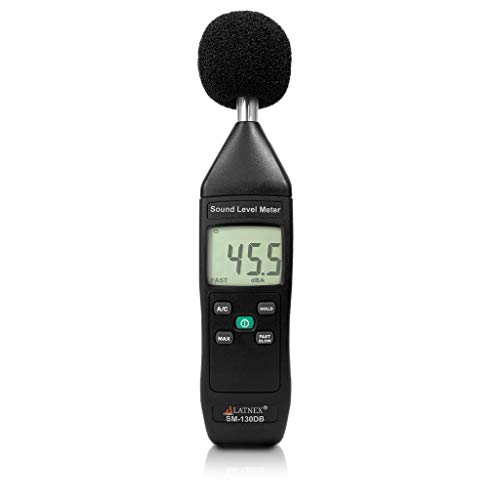
Designed for professionals and enthusiasts alike, the SM-130DB Digital Decibel Meter Reader offers precise sound level measurements that cater to a variety of environments. With an operating range of 35dB to 130dB, it guarantees you can monitor noise accurately, whether in warehouses, schools, or art galleries. Its ±1.8dB accuracy at 94dB@1KHz assures reliability, while the 0.1dB resolution provides detailed insights. Equipped with a 1/2 inch electret condenser microphone, this meter delivers dependable results. Plus, you’ll enjoy peace of mind with a 2-year warranty and dedicated customer support via phone or email, ensuring you’re never left in silence.
Best For: Professionals and enthusiasts seeking accurate sound level measurements in diverse environments such as warehouses, schools, and art galleries.
Pros:
- High accuracy of ±1.8dB ensures reliable sound measurements.
- Wide operating range from 35dB to 130dB makes it versatile for various applications.
- 2-year warranty and dedicated customer support provide peace of mind for users.
Cons:
- May be considered overly sensitive for casual users who need basic sound monitoring.
- The price point may be higher compared to simpler sound level meters.
- Requires calibration for optimal performance, which may be inconvenient for some users.
Decibel Meter Digital Sound Level Reader

Looking for a reliable tool to monitor noise levels in your environment? The Decibel Meter Digital Sound Level Reader is perfect for you. With a measurement range of 30-130 dB and a precision of ±1.5 dB, it offers accurate readings. Its three-color alarm system alerts you to low, medium, and high noise levels, which you can customize. Plus, it features a large backlit color LCD for easy visibility and records up to 43,000 data points, compatible with Windows 7, 10, and 11 for data export and analysis. This portable noise meter is suitable for both home and factory use.
Best For: Individuals and businesses looking to accurately monitor and manage noise levels in both home and industrial environments.
Pros:
- Records up to 43,000 data points for extensive data analysis and tracking.
- Features a three-color alarm system for easy identification of noise levels.
- Large backlit color LCD display for clear visibility in various lighting conditions.
Cons:
- Limited measurement range of 30-130 dB may not cover extremely loud environments.
- Requires compatibility with specific Windows versions for data export and analysis.
- May be considered bulky for users seeking a more compact noise monitoring solution.
RISEPRO Digital Sound Level Meter (HT-80A)

The RISEPRO Digital Sound Level Meter (HT-80A) stands out as an excellent choice for anyone needing a reliable and user-friendly tool to monitor sound levels in diverse environments. With a measurement range of 30 to 130 dB and an accuracy of +/- 1.5 dB, it guarantees precise readings. You’ll appreciate features like the backlit display for low-light use, data hold function, and max/min recording to track fluctuations. Its lightweight design, water resistance, and compact dimensions make it portable. Plus, with a customer rating of 4.4 stars from over 2,000 reviews, it’s proven to be a trusted device for sound measurement.
Best For: The RISEPRO Digital Sound Level Meter (HT-80A) is best for individuals and professionals seeking an accurate and portable tool to monitor sound levels in various settings.
Pros:
- Accurate measurements with a range of 30 to 130 dB and an accuracy of +/- 1.5 dB.
- User-friendly features such as a backlit display, data hold, and max/min recording.
- Compact and lightweight design, making it easy to carry and use in different environments.
Cons:
- Limited frequency range of 31.5 Hz to 4 kHz may not meet all professional needs.
- Plastic material may not be as durable as metal alternatives.
- Auto power-off feature could be inconvenient if frequent use is required.
Decibel Meter Data Logger, Digital Sound Level Meter

If you need a reliable tool for precise sound level measurements, the Decibel Meter Data Logger stands out as an excellent choice for both professionals and enthusiasts alike. With a measurement range of 30~130 dB(A) and 35~130 dB(C), it boasts an accuracy of ±1.5dB. You can store up to 31,000 data records and easily export them via USB connectivity. Its advanced display provides clear readings, while the three-color alarm system alerts you to sound levels. Plus, the 8-hour battery life guarantees you can use it for extended periods, making it perfect for various applications, from industrial settings to personal use.
Best For: Professionals and enthusiasts seeking accurate sound level measurements for various applications.
Pros:
- High accuracy with ±1.5dB ensures reliable sound level readings.
- Large storage capacity of up to 31,000 data records allows for extensive data collection.
- User-friendly design with an advanced display and three-color alarm system for easy monitoring.
Cons:
- Limited battery life of 8 hours may require frequent recharging during extended use.
- Requires PC connectivity for data export, which may not be convenient for all users.
- Automatic shut down feature may interrupt usage if the device is inactive for 10 minutes.
Decibel Meter with Data Logging and PC Connection

For professionals and enthusiasts who need precise noise measurement, the Decibel Meter with Data Logging and PC Connection stands out as an essential tool. It measures a range of 30 to 130 dB and features an audible visual alarm for safety. You can record up to 1999 data groups, and when connected to your PC, there’s virtually unlimited storage. Its accuracy of +/-1.5 dB and adjustable limits guarantee reliable readings. Plus, you’ve got options for frequency weighting and measurement modes. Powered by batteries or USB, this meter is user-friendly and includes all necessary accessories for your convenience.
Best For: Professionals and enthusiasts who require accurate noise measurement for safety and environmental monitoring.
Pros:
- Accurate measurements with a precision of +/-1.5 dB, ensuring reliable data collection.
- Data logging capability that allows recording up to 1999 data groups, with unlimited storage when connected to a PC.
- Versatile measurement options including A, C, Z frequency weighting and FAST/SLOW modes for various applications.
Cons:
- Requires batteries or USB power, which may limit portability if batteries are low and no USB power source is available.
- Limited range of 30 to 130 dB may not be suitable for extremely loud environments.
- Potential learning curve for users unfamiliar with advanced features and data logging software.
DURFICST Sound Level Meter (30-130dB)

Designed for both casual users and professionals, the DURFICST Sound Level Meter (30-130dB) delivers precise measurements with an impressive accuracy of ±1.5dB. You’ll appreciate its wide measurement range and resolution of 0.1dB, perfect for various environments. With A-weighting for low-intensity sounds and C-weighting for industrial noise, it meets diverse needs. The FAST and SLOW response modes allow you to capture both fluctuating and steady-state noise effectively. Plus, its user-friendly design features an LCD color screen, maximum/minimum recording, and a handy carrying case, making it ideal for outdoor use. Measure sound confidently wherever you are!
Best For: The DURFICST Sound Level Meter is best for both casual users looking for accurate sound measurements and professionals needing reliable data for noise assessment in various environments.
Pros:
- Wide Measurement Range: Covers a broad range of 30-130dB, suitable for different noise levels.
- User-Friendly Design: Features an LCD color screen, maximum/minimum recording, and comes with a convenient carrying case.
- Versatile Weighting Modes: Offers A-weighting and C-weighting for accurate sound analysis in various settings.
Cons:
- Accuracy Limitations: The accuracy of ±1.5dB may not meet the needs of some highly specialized professional applications.
- Limited Frequency Range: The frequency range of 31.5Hz to 8kHz may not capture very low or very high-frequency sounds.
- Handheld Only: The design is handheld, which may limit stability during prolonged measurements compared to fixed devices.
Decibel Meter Wall Hanging Sound Level Meter with Large LED Display

The Decibel Meter Wall Hanging Sound Level Meter with its large 11-inch LED display is an ideal choice for anyone needing precise sound level monitoring in various environments. You’ll appreciate the adjustable brightness, ensuring clear visibility of real-time decibel levels, temperature, and humidity. The automatic alarm system uses color-coded icons to indicate sound levels: green for under 60dB, red for over 85dB, and more. With a measuring range of 30-130dB and a calibration function, you can trust its accuracy. Plus, its 2000mAh battery and included USB cable make charging easy, whether you wall-mount it or use it on a desktop.
Best For: This decibel meter is best for educators, professionals in construction, and anyone who needs to monitor sound levels in various environments.
Pros:
- Large 11-inch LED display ensures clear visibility of readings.
- Automatic alarm system with color-coded icons makes it easy to understand sound levels at a glance.
- Versatile design allows for wall mounting or desktop placement.
Cons:
- The accuracy may vary if not calibrated regularly.
- Limited battery life may require frequent charging in high-use environments.
- Initial setup could be complex for users unfamiliar with sound level meters.
Tadeto Digital Sound Level Meter
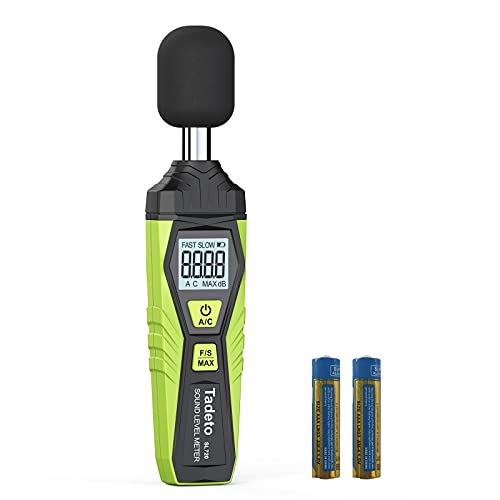
When you need precise sound measurements, the Tadeto Digital Sound Level Meter stands out with its impressive accuracy of ± 2.0 dB across a wide range of 30dB to 130dB. It features A and C weighting methods, allowing you to adapt to different sound environments, from quiet baby rooms to loud construction sites. With fast and slow response rates, you can capture both general and fluctuating noise levels effectively. The 4-digit LCD display, complete with backlighting and low voltage indicators, guarantees you’ll always have clear visibility. Lightweight and portable, it’s perfect for various applications, making your sound measurement tasks easier.
Best For: The Tadeto Digital Sound Level Meter is best for professionals and enthusiasts in various fields, including construction, audio engineering, and environmental monitoring, who require accurate sound measurements.
Pros:
- High accuracy with a measurement range of 30dB to 130dB and an accuracy of ± 2.0 dB.
- Dual weighting methods (A and C) cater to different noise environments for versatile usage.
- Portable design makes it easy to use in various settings, from factories to homes.
Cons:
- Limited battery life may require frequent replacements, indicated by a low voltage icon.
- Basic functionality may not satisfy advanced users looking for additional features or connectivity options.
- LCD display may be harder to read in bright lighting conditions despite backlighting.
Factors to Consider When Choosing a PC Noise Measurement Meter
When you’re choosing a PC noise measurement meter, consider several key factors to guarantee it meets your needs. Think about measurement accuracy, data logging capabilities, and frequency weighting options that might be important for your specific use case. Additionally, pay attention to display features and size, as well as whether the meter includes an alarm system for added functionality.
Measurement Accuracy Requirements
Accurate measurements are vital for effectively evaluating noise levels, so considering accuracy requirements is key when choosing a PC noise measurement meter. Most sound level meters offer an accuracy of ±1.5 dB, suitable for general assessments. However, for specific applications like environmental monitoring or industrial noise assessment, you’ll need to guarantee the meter’s accuracy rating aligns with your needs. Some models may have accuracy levels of ±1.8 dB or ±2.0 dB, which could be adequate for less critical tasks. Remember, the standard reference sound pressure level is 94 dB at 1 kHz, helping you gauge performance. Finally, prioritize meters that come with calibration certificates or features for easy adjustments, as calibration is vital for maintaining accuracy over time.
Data Logging Capabilities
Data logging capabilities are essential features to evaluate in a PC noise measurement meter, especially if you need to track noise levels over time. Look for models that can store a significant number of records—some can handle up to 43,000 entries, providing extensive data for analysis. Many sound level meters also offer PC connectivity, allowing you to export logged data to software like Excel. This makes it easier to visualize trends and patterns in noise levels. Additionally, consider devices with graphical displays that combine numerical data with visual representations to enhance interpretation. Some models even let you set customizable alarm thresholds based on logged data, helping you monitor specific noise conditions that require your attention.
Frequency Weighting Options
How do you choose the right frequency weighting option for your PC noise measurement meter? It’s essential to evaluate how different weightings simulate the human ear’s response in various environments. A-weighting emphasizes frequencies that are more noticeable at lower sound levels, making it ideal for environmental noise assessments. If you’re measuring loud, mechanical sounds in industrial settings, C-weighting is the better choice, as it accounts for higher frequencies. Some meters even let you switch between A and C weighting, offering flexibility for diverse applications. Understanding your specific measurement context will help you select the most suitable option, ensuring that you get accurate and meaningful noise level readings tailored to your needs.
Display Features and Size
When selecting a PC noise measurement meter, the display features and size can greatly influence your experience and the effectiveness of your measurements. A large display, like an 11-inch LED screen, enhances visibility, allowing you to easily read real-time decibel levels from a distance. Look for backlit displays to improve usability in low-light conditions, ensuring you can see measurements clearly anytime. Color-coded indicators provide instant visual feedback on noise levels, helping you quickly identify low, medium, and high decibel ranges. High resolution, such as 0.1 dB, enables precise measurements, essential for accurate monitoring. Additionally, having extra information like temperature and humidity can give you a thorough overview of the environmental conditions affecting noise levels.
Alarm System Functionality
An effective alarm system is vital for any PC noise measurement meter, as it enhances your ability to monitor sound levels efficiently. Look for meters with visual indicators, like colored lights, to quickly recognize noise intensity. Adjustable alarm thresholds let you set specific dB levels for low, medium, and high alerts, tailored to your environment. An audible alarm provides immediate notifications when sound levels exceed pre-set limits, keeping you aware in high-noise settings. Advanced models often include a three-color light system—green for acceptable levels, yellow for caution, and red for excessive noise. These alarm systems are essential for alerting you to potentially harmful noise, promoting a healthier acoustic environment. Choose wisely to guarantee effective sound monitoring.
Power Source and Duration
Choosing the right power source for your PC noise measurement meter can considerably impact its usability and convenience. You’ll want to decide between battery-powered options or those with USB charging capabilities, as this choice affects portability. Many meters come with rechargeable batteries, usually around 1000 mAh, providing several hours of continuous use. Look for models featuring an automatic power-off function to save battery life when idle, enhancing overall usability. Additionally, low battery indicators are handy, letting you know when it’s time to recharge or replace batteries. Charging times can vary between 1.5 hours and longer, so consider how quickly you need your device ready for action. Choosing wisely here makes a big difference in your experience.
Compatibility With PC Software
Ensuring compatibility with PC software is essential for maximizing the functionality of your noise measurement meter. When you select a meter, make sure it works seamlessly with operating systems like Windows 7, 10, and 11. Look for USB connectivity options to easily transfer recorded data for further analysis and reporting. It’s also vital that the device supports data logging capabilities with enough storage for multiple data points. Opt for a sound level meter that includes software for data analysis, offering features like graphical representations and detailed noise level reports. Finally, check if the meter allows real-time monitoring and display of data on your PC to enhance usability across various applications.