If you’re starting your journey as a musician, selecting the right USB audio interface can greatly impact your recording quality. With so many options available, it can be overwhelming to know where to begin. From budget-friendly choices to more advanced models, each interface offers unique features that cater to beginners. Let’s explore the top contenders that can elevate your sound and simplify your recording process.
Focusrite Scarlett Solo 3rd Gen USB Audio Interface

The Focusrite Scarlett Solo 3rd Gen USB Audio Interface is the perfect choice for beginner musicians, podcasters, and producers looking to achieve studio-quality recordings without breaking the bank. With high-performance mic preamps and a switchable Air mode, you’ll capture crystal-clear audio. You’ll love the 24-bit/192kHz converters ensuring professional quality, while the Gain Halo metering helps you set levels with ease. Its USB connectivity means no external power is needed, making it ideal for on-the-go recording. Plus, the included software bundle gives you essential tools to enhance creativity. With a three-year warranty, you’ve got peace of mind while you create.
Best For: Beginner musicians, podcasters, and producers seeking affordable studio-quality recordings.
Pros:
- High-performance mic preamps and switchable Air mode for clear audio capture.
- 24-bit/192kHz converters ensure professional recording quality.
- Includes a comprehensive software bundle with essential tools for music creation.
Cons:
- Limited to two inputs, which may not suffice for larger setups.
- No built-in effects processing, requiring reliance on software for effects.
- USB-powered, which may limit options for mobile recording in certain environments.
Focusrite Scarlett Solo 4th Gen USB Audio Interface

For budding musicians and producers seeking an entry-level audio interface, the Focusrite Scarlett Solo 4th Gen stands out as an excellent choice. With its studio-quality sound and a dynamic range of 120dB, you’ll capture every nuance of your recordings. The improved Air mode enhances vocals and guitars, while the ultra-low-noise mic preamp guarantees clarity. You’ll enjoy a robust headphone output with independent volume control as well. Plus, it includes essential software like Pro Tools Intro+ and Auto-Tune Access, giving you all the tools needed for mixing and mastering. With a three-year warranty and 24/7 support, you’re well-covered.
Best For: Budding musicians and producers looking for an entry-level audio interface that delivers studio-quality sound and essential recording tools.
Pros:
- Studio-quality sound with a dynamic range of 120dB, capturing every nuance of recordings.
- Improved Air mode enhances the clarity of vocals and guitars.
- Includes essential software for recording, mixing, and mastering, such as Pro Tools Intro+ and Auto-Tune Access.
Cons:
- Limited connectivity options compared to higher-end models.
- Does not include MIDI inputs for connecting external instruments.
- Maximum sample rate of 192 kHz may not meet the needs of professional users requiring higher specifications.
MAONO USB Audio Interface for PC (PS22 Lite Black)

Looking for a straightforward solution to enhance your audio quality? The MAONO USB Audio Interface (PS22 Lite Black) is perfect for you. With 24-bit/192kHz recording and a dynamic range of 106dB, it delivers clear sound. It supports both condenser and dynamic microphones, offering 48V phantom power for your setups. Musicians will appreciate the dedicated guitar input for rich tones. Plus, its intuitive design features plug-and-play functionality and direct monitoring. Compact and lightweight, it’s compatible with Mac, Windows, and even smartphones. With ProStudio Routing Software included, you’ll enjoy seamless live streaming and recording. A solid choice for beginners!
Best For: The MAONO USB Audio Interface (PS22 Lite Black) is best for podcasters, voice actors, and musicians seeking an easy-to-use, high-quality audio solution.
Pros:
- High-Resolution Recording: Offers 24-bit/192kHz recording for superior sound quality.
- Microphone Versatility: Supports both condenser and dynamic microphones with 48V phantom power.
- User-Friendly Design: Intuitive plug-and-play setup and direct monitoring for hassle-free operation.
Cons:
- Limited Advanced Features: May not have as many advanced features as higher-end interfaces.
- Dependence on Software: Requires compatibility with specific DAW software for full functionality.
- Compact Size: Small size may limit the number of inputs and outputs compared to larger interfaces.
Focusrite Scarlett 2i2 4th Gen USB Audio Interface for Recording
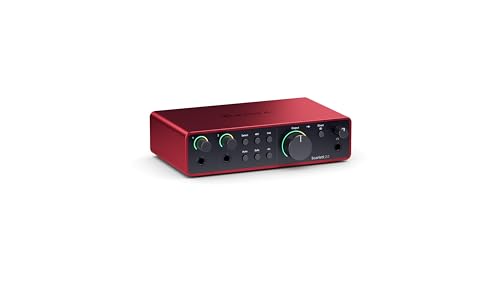
Designed with beginners in mind, the Focusrite Scarlett 2i2 4th Gen USB Audio Interface stands out for its user-friendly features that simplify the recording process. With studio-grade converters and a 120dB dynamic range, you’ll achieve high-fidelity recordings that rival professional studios. The Auto Gain feature optimizes levels for your mic or guitar, while Clip Safe prevents any clipping issues. Plus, the Air mode enhances your vocals and guitars, adding a polished touch. It includes essential software like Pro Tools Intro+ and Hitmaker Expansion, ensuring you have everything you need to start creating right away. Enjoy the journey!
Best For: Beginners and aspiring musicians looking for an easy-to-use audio interface for high-quality recording and streaming.
Pros:
- Studio-quality recordings with a 120dB dynamic range.
- User-friendly features like Auto Gain and Clip Safe for optimal sound levels.
- Includes a comprehensive software bundle to kickstart your music production.
Cons:
- Limited inputs may not suit advanced users with multiple instruments.
- Some users may find the bundled software less comprehensive compared to higher-tier options.
- USB connection may require additional adapters for compatibility with certain devices.
Synido USB C Audio Interface for Music Recording and Streaming

The Synido USB C Audio Interface stands out as an excellent choice for aspiring musicians and podcasters who need a reliable tool for recording and streaming. With its compact size and lightweight design, it’s easy to transport. The interface features high-fidelity sound quality, supporting 24-bit depth at 48kHz, ensuring your recordings come out clear and natural. You’ll appreciate the three monitoring modes, allowing for accurate recording and real-time mixing. Its intuitive controls make switching between inputs seamless, and it’s compatible with various devices and software. Plus, the 30-day return policy gives you peace of mind while exploring your creative potential.
Best For: Aspiring musicians and podcasters seeking a compact and high-quality audio interface for recording and streaming.
Pros:
- High-fidelity sound quality with 24-bit depth and 48kHz sampling rate for clear recordings.
- Three versatile monitoring modes for accurate recording and real-time mixing.
- User-friendly design with intuitive controls and compatibility with various devices and software.
Cons:
- Limited to 2-channel input, which may not suffice for larger recording sessions.
- Requires a third-party ASIO driver for optimal performance on certain systems.
- The compact size may result in fewer physical controls compared to larger interfaces.
XTUGA USB Audio Interface for PC

For students and beginners enthusiastic to create their first home studio, the XTUGA USB Audio Interface stands out with its professional 16-Bit/48kHz audio resolution. This interface delivers crystal-clear sound thanks to its upgraded chip, eliminating unwanted noise. You can easily connect condenser mics using the switchable 48V phantom power, perfect for vocal tracking without delays. The USB connection powers the device directly from your PC, making it ideal for mobile karaoke or music creation. Its sturdy build guarantees durability for regular use, while the simple setup lets you focus on your creativity and imagination without frustration.
Best For: Students and beginners looking to establish their first home studio with budget-friendly audio equipment.
Pros:
- Professional audio quality with 16-Bit/48kHz resolution for clear sound.
- Durable build designed for regular use in home karaoke and streaming.
- User-friendly setup allows beginners to focus on creativity without frustration.
Cons:
- Limited to 2-channel setup, which may not satisfy advanced users.
- Lacks advanced features that professional audio interfaces offer.
- Dependent on PC power, which may restrict mobility compared to battery-powered options.
M-AUDIO M-Track Duo USB Audio Interface for Recording and Streaming
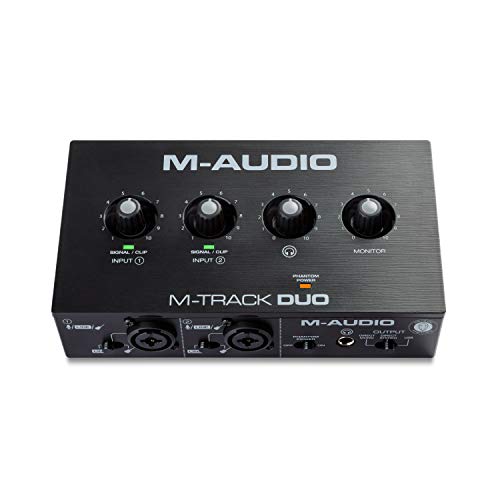
If you’re just starting out in recording, streaming, or podcasting, the M-Audio M-Track Duo USB Audio Interface is an excellent choice thanks to its user-friendly features. With two combo XLR/line/instrument inputs and phantom power, you can easily connect your gear. It supports high-quality 48kHz audio resolution, ensuring clear recordings. Plus, the USB/Direct switch lets you monitor with zero latency. Compatible with various devices and software like MPC Beats and popular DAWs, it’s versatile for any setup. Compact and portable, it’s perfect for musicians on the go. Enjoy a year of warranty and reliable customer support for peace of mind.
Best For: Beginners in recording, streaming, or podcasting who need a user-friendly and portable audio interface.
Pros:
- Compact and portable design, making it easy to transport for on-the-go use.
- High-quality 48kHz audio resolution ensures clear and professional recordings.
- Compatible with a wide range of devices and software, enhancing versatility for various setups.
Cons:
- Limited to two channels, which may not be sufficient for larger recording setups.
- Some users may require additional adapters for iOS compatibility, increasing setup complexity.
- Basic monitoring options may not satisfy advanced users looking for more features.
M-AUDIO M-Track Solo USB Audio Interface for Recording and Streaming
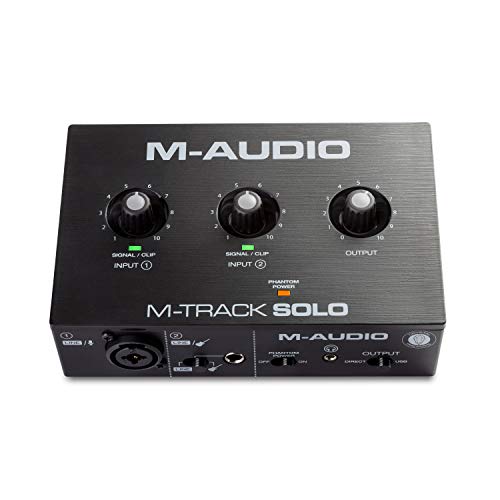
Looking for a user-friendly audio interface that won’t overwhelm you? The M-AUDIO M-Track Solo is perfect for recording, streaming, and podcasting. It delivers 48kHz audio resolution for high-quality sound and features a compact, portable design powered by USB. With one combo XLR/Line input and a Line/Instrument input, you can easily connect your gear. Enjoy zero latency monitoring and a transparent Crystal Preamp for excellent sound. Compatible with various DAWs, it includes software like MPC Beats and ProTools First. Weighing just 10.6 ounces, it’s ideal for on-the-go musicians. Plus, it comes with a 1-year warranty for peace of mind.
Best For: The M-AUDIO M-Track Solo is best for beginners and on-the-go musicians looking for an affordable and user-friendly audio interface for recording, streaming, and podcasting.
Pros:
- Compact and portable design makes it easy to transport.
- Zero latency monitoring allows for real-time audio playback without delays.
- Includes bundled software compatible with popular DAWs, enhancing versatility.
Cons:
- Limited to two-channel recording, which may not suffice for larger projects.
- The single combo XLR/Line input may be restrictive for multi-microphone setups.
- May require additional adapters for iOS devices, impacting convenience.
2×2 USB-C Audio Interface for PC/Mac Recording

The 2×2 USB-C Audio Interface stands out as an excellent choice for aspiring musicians and podcasters seeking professional-quality recording without the hassle of complicated setups. With 24-bit/192kHz audio quality and dual TS/XLR inputs, you’ll capture crisp, clear sound whether recording vocals or instruments. The plug-and-play design guarantees you can start recording instantly, while the independent gain knobs and low-cut filter give you complete control over your sound. Its compact, durable build and silent zero-latency monitoring make it perfect for both studio work and mobile recording. Plus, the loopback feature is a game-changer for streaming!
Best For: Aspiring musicians, podcasters, and streamers looking for a user-friendly and professional-quality audio interface for PC or Mac.
Pros:
- Professional 24-bit/192kHz audio quality ensures crisp and detailed recordings.
- Plug-and-play design allows for quick setup with no complicated installation required.
- Compact and durable build makes it ideal for mobile recording and travel.
Cons:
- Limited to two inputs, which may not be sufficient for larger recording sessions.
- Some users may prefer more advanced software features that are not included.
- USB 2.0 data transfer may not provide as fast performance as newer USB standards.
PreSonus AudioBox 96 USB Audio Interface with Studio One Artist DAW
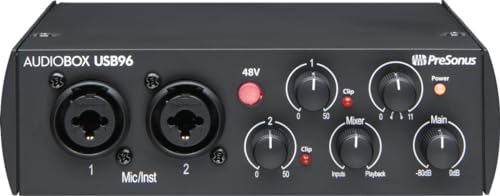
For aspiring musicians and podcasters, the PreSonus AudioBox 96 USB Audio Interface stands out as an ideal choice, thanks to its two high-quality Class-A mic preamps that deliver excellent sound quality. This compact, lightweight interface features two instrument inputs, MIDI I/O, and studio-grade converters for up to 24-bit/96 kHz recording. USB bus-powered for mobility, it requires no extra power supply. Plus, it comes bundled with Studio One Artist DAW and other software valued over $1000. With a solid build and compatibility with major DAWs, the AudioBox 96 offers everything you need to kickstart your recording journey effectively.
Best For: Aspiring musicians and podcasters seeking a portable and high-quality audio recording solution.
Pros:
- Compact and lightweight design makes it ideal for mobile recording.
- Includes Studio One Artist DAW and a software bundle valued over $1000.
- High-quality Class-A mic preamps and studio-grade converters for excellent sound quality.
Cons:
- Limited to 2 channels, which may not be sufficient for larger recording setups.
- Requires a USB connection, which may limit mobility if not using a laptop.
- MIDI I/O may not be necessary for users who do not work with MIDI devices.
Factors to Consider When Choosing Usb Audio Interfaces for Beginners
When you’re choosing a USB audio interface, consider your audio quality requirements and the types of input and output options you need. Also, think about software compatibility, portability, and your budget. Each of these factors can greatly impact your recording experience.
Audio Quality Requirements
Selecting the right USB audio interface is essential for achieving professional audio quality. Look for interfaces that support at least 24-bit depth and a sampling rate of 192 kHz; this guarantees high-resolution recordings. A dynamic range of 106 dB or higher is critical for capturing subtle nuances, especially for vocalists and musicians aiming for superior results. Low-noise mic preamps are important to eliminate unwanted background noise and distortion during your recordings. Features like zero-latency monitoring enable you to hear your performance in real-time, making the recording process smoother. Finally, confirm the interface can provide phantom power (+48V) to power condenser microphones, which can greatly enhance the quality and clarity of your vocal recordings.
Input and Output Options
Achieving high audio quality is just the first step; understanding the input and output options of a USB audio interface can greatly impact your recording experience. When choosing an interface, consider how many inputs and outputs you need—most come with 1 to 4 channels for recording multiple instruments or mics at once. Look for combo XLR/line inputs for added versatility. A dedicated instrument input with adjustable impedance is vital for optimizing sound quality from electric guitars and basses. Don’t forget about phantom power (+48V) for condenser mics, essential for capturing great vocals and acoustic sounds. Finally, check for headphone outputs and direct monitoring options to enjoy latency-free playback during your recording sessions.
Software Compatibility Needs
As you immerse yourself in the world of music production, software compatibility is essential for ensuring your USB audio interface integrates smoothly with your setup. Start by confirming that your interface works well with the digital audio workstation (DAW) you plan to use; some interfaces even come bundled with specific DAWs to enhance your experience. Look for interfaces that support popular software like Pro Tools, Ableton Live, and Cubase, as these are industry standards. Also, consider operating system compatibility, since some interfaces may perform better on Windows than Mac OS, or vice versa. Finally, check for ASIO driver support to reduce latency and boost performance, and review the included software bundle for tools that can help you grow as a musician.
Portability and Design
When you’re starting out in music production, portability and design play an essential role in your choice of a USB audio interface. You’ll want something lightweight and compact, making it easy to record on the go. Look for interfaces powered directly from your computer, so you won’t need bulky power supplies. A plug-and-play design simplifies setup, allowing you to dive right into your music without hassle. Opt for models with a durable build, as they’ll withstand frequent handling and travel. Finally, smaller interfaces usually have intuitive layouts with easily accessible controls, making your learning curve smoother. Overall, prioritizing portability and design will help you create music wherever inspiration strikes!
Budget Considerations
Establishing a clear budget is essential for anyone diving into the world of USB audio interfaces. Prices can range from around $50 for entry-level models to several hundred dollars for professional-grade options. If you’re just starting out, look for beginner-friendly interfaces between $100 and $200 that offer essential features. Don’t forget to evaluate the cost of additional software and plugins; some interfaces include these, saving you money in the long run. Also, factor in expenses for accessories like cables, microphones, and headphones, as they add up quickly. Aim for a balance between features and affordability, focusing on audio resolution and the number of inputs and outputs that suit your needs. This way, you’ll make a smart investment in your music production journey.
Ease of Use
Choosing a USB audio interface that’s easy to use can make all the difference in your recording experience. Look for models with plug-and-play functionality, so you can connect and start recording without complicated setups. Intuitive controls, like clearly labeled gain knobs and monitoring switches, simplify the process, making it less intimidating for beginners. Opt for devices that include user-friendly software and routing options for live streaming and recording, which helps you navigate your audio projects effortlessly. Direct monitoring capabilities are essential, allowing you to hear input signals in real-time without latency. Finally, compact and lightweight designs are a bonus, making it easier to transport your equipment and set up wherever you go.
Warranty and Support
While you might be excited to plunge into recording, considering warranty and support options can greatly enhance your experience with a USB audio interface. Many interfaces come with a manufacturer’s warranty, typically lasting one to three years, covering defects. This guarantees you’re making a reliable purchase. Check the customer support options too; some brands offer 24/7 assistance, while others are only available during business hours. A solid return policy, usually around 30 days, lets you test the product and return it if it doesn’t meet your needs. Additionally, personalized setup guides and online resources, like help centers and user forums, can provide valuable support, helping you quickly configure your interface and troubleshoot any issues.