Hearvo USB 3.0 HDMI KVM Switch review is for buyers who want a straightforward way to run two computers through one monitor and one shared set of peripherals.
If your desk is cluttered and you want a cleaner 2-PC setup, this model is aimed squarely at that job.
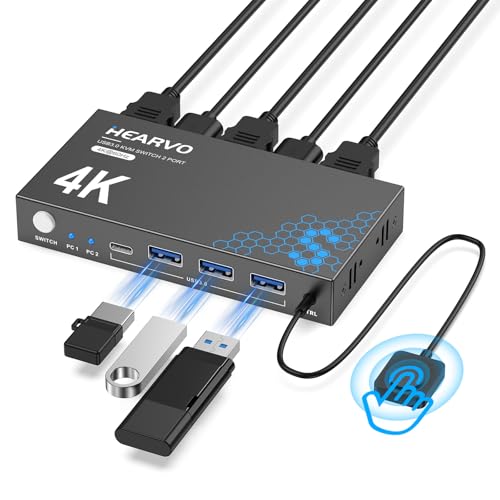
Hearvo USB 3.0 HDMI KVM Switch Review Summary
The Hearvo USB 3.0 HDMI KVM Switch makes sense for people who need to switch between two computers without juggling monitor inputs, keyboard cables, and separate USB hubs.
Its strongest appeal is that it combines HDMI switching and USB device sharing in one box, while keeping the feature set simple enough for everyday desktop use.
It should suit home offices, dual-PC workstations, and mixed setups where one machine handles work and another handles media, testing, or a personal workflow.
The listing also points to broad compatibility across Windows, Linux, and Mac, so it is not narrowly tied to a single ecosystem.
Review Scorecard
| Category | Score | Why it scores this way |
|---|---|---|
| Desk simplicity | 9/10 | One monitor, two computers, and shared USB gear are consolidated into one switch. |
| Video support | 8/10 | 4K at 60Hz is the headline spec, with 4K30, 2K, 3D, and 1080p also listed. |
| Peripheral sharing | 9/10 | Four USB 3.0 ports, including USB-C, give it real utility beyond basic keyboard and mouse use. |
| Switching convenience | 8/10 | Both a top-button switch and a wired remote are included, which helps placement flexibility. |
| Setup simplicity | 8/10 | The listing emphasizes plug-and-play use with no driver software required. |
| Compatibility breadth | 8/10 | Support is stated for Windows, Linux, Mac, and other devices such as laptops and PS4. |
| Value for focused buyers | 8/10 | The feature mix is practical and purpose-built rather than overloaded with extras. |
Key Features and Specifications of Hearvo USB 3.0 HDMI KVM Switch
This is a KVM switch designed for 1 monitor and 2 computers.
That alone makes the product easy to understand: if you are trying to reduce desk clutter and keep a single display shared between two systems, the Hearvo unit is built for that exact workflow.
The video side centers on 4K at 60Hz and HDCP 2.2 support.
The listing also says it handles 4K at 30Hz, 2K, 3D, and 1080p, so it is not locked to one display mode.
For buyers who already know their desk setup will stay in the 4K class, that matters more than a long list of vague compatibility claims.
On the USB side, the switch includes four USB 3.0 ports: three USB-A and one USB-C.
That is a meaningful distinction because the device is not only for keyboard and mouse sharing.
The listing specifically calls out support for printers, scanners, webcams, flash drives, headsets, and other peripherals, with transfer speeds up to 5Gbps.
Switching can be done in two ways: a button on the KVM unit itself or a wired remote switch.
The remote is useful if you plan to hide the switch behind the desk or mount it out of the way.
The package also includes two high-speed USB 3.0 cables, the wired remote, a manual, rubber pads, and a protection plan card.
In setup terms, the listing emphasizes plug and play and says no power supply or driver is required.
It also mentions Adaptive EDID, which is a useful signal for display stability when a KVM is inserted between two machines and one monitor.
- 2 computers, 1 monitor
- HDMI KVM and USB sharing in one device
- 4K at 60Hz support
- HDCP 2.2 listed
- 4 USB 3.0 ports: 3 USB-A, 1 USB-C
- Two switching methods: button and wired remote
- Plug-and-play installation
- Works with Windows, Linux, Mac, and more
Pros and Cons of Hearvo USB 3.0 HDMI KVM Switch
Pros
- Clean two-PC workflow without separate monitor switching and USB hub juggling.
- Useful USB expansion with four ports instead of a bare-minimum keyboard-mouse-only layout.
- 4K60 support makes it a better fit for modern displays than older 4K30-only switches.
- Wired remote included, which improves placement options on a crowded desk.
- Broad compatibility claims make it more flexible for mixed operating systems.
Cons
- It is built for exactly two computers and one monitor, so it will not suit larger multi-machine setups.
- The listing is strong on specs but light on detail about advanced edge cases, so buyers with unusual AV or USB requirements may want to verify their exact peripherals.
- If you need multiple monitors, this is the wrong category entirely.
Who Should Buy Hearvo USB 3.0 HDMI KVM Switch?
This product is best for people who know they want a simple 2-computer, 1-monitor KVM and value convenience over complexity.
It fits a desk where one monitor serves a work computer and a second machine for personal use, testing, remote access, or media tasks.
It is also a sensible pick for users who have several USB peripherals they want to share, because the extra ports make the switch more than a basic pass-through device.
The USB-C port adds a bit of future-proofing for newer accessories.
You should skip it if you need dual monitors, if your workspace uses DisplayPort instead of HDMI, or if your switching needs are more elaborate than a standard two-system desk.
It is also not the right choice if you want a device that doubles as a general-purpose docking station.
4K KVM Switching Performance of Hearvo USB 3.0 HDMI KVM Switch
4K60 Matters More Than Marketing
The most important spec here is 4K at 60Hz.
For a KVM switch, that is the difference between a modern-feeling desktop and one that feels compromised.
If your monitor and computers already support 4K60, this listing suggests the Hearvo unit is aimed at preserving that experience rather than forcing a lower refresh workflow.
USB Sharing Is the Real Practical Advantage
The four USB 3.0 ports make this more versatile than a simple keyboard-and-mouse switch.
Sharing a printer, webcam, flash drive, or headset through the same switch can remove a lot of cable swapping.
That matters for people whose secondary computer is used often enough that convenience becomes part of the buying decision.
The Wired Remote Helps Real Desks
The wired remote is not a gimmick.
If the switch itself is hidden behind a monitor, under a desk, or in a cable tray, the remote makes day-to-day use less annoying.
For a device intended to simplify a workstation, that detail is important because it affects whether you keep using the product or stop bothering with the advanced features.
EDID and Plug-and-Play Reduce Friction
Adaptive EDID and the plug-and-play setup claim point to a product that is trying to avoid common KVM pain points.
Buyers usually care less about the theory and more about whether the display comes back reliably when switching machines.
On that front, the listing’s emphasis is encouraging, even if real-world behavior still depends on the connected computers, cables, and monitor.
Alternatives to Hearvo USB 3.0 HDMI KVM Switch
If you want a known KVM brand with a wider footprint, consider UGREEN HDMI KVM switch.
UGREEN is often a practical comparison point for buyers who want a similar desktop-sharing layout.
If your setup leans toward a more established peripheral brand, look at IOGEAR HDMI KVM switch.
It is a recognizable alternative when you want to compare mainstream KVM options side by side.
If you want a more budget-oriented comparison, check TESmart HDMI KVM switch.
TESmart is frequently searched by buyers comparing KVM feature sets and multi-device desk setups.
If you need more advanced display or peripheral routing options, search for ATEN HDMI KVM switch.
ATEN is a common alternative for buyers who prioritize a more established pro-style product line.
Is Hearvo USB 3.0 HDMI KVM Switch Worth It?
Yes, if your goal is to share one HDMI monitor and one USB peripheral set between two computers with minimal friction. The Hearvo USB 3.0 HDMI KVM Switch is appealing because it keeps the use case narrow, the setup simple, and the feature mix genuinely useful for a real desk.
It is especially worthwhile when you want 4K60 support, a wired remote, and enough USB ports to make the switch feel like a practical workstation tool rather than a bare-bones adapter.
If you need more than two computers, multiple monitors, or a different video standard, look elsewhere.
For the right buyer, though, this is a focused and sensible KVM choice.