When you’re looking to enhance your network’s speed and efficiency, choosing the right QSFP28 100G modules is essential. These modules not only offer impressive performance but also guarantee compatibility with your existing systems. With options like the QSFPTEK 100GBASE-ZR4 and the 100G SR QSFP28, there’s a solution for every need. But what should you keep in mind before making a decision? Let’s explore the top picks and key factors that can impact your choice.
QSFPTEK 100GBASE-ZR4 QSFP28 Module

If you’re looking for a reliable and high-performance solution for your 100G telecom connections, the QSFPTEK 100GBASE-ZR4 QSFP28 Module stands out as an excellent choice. This 100G Ethernet transceiver offers a remarkable data rate, reaching distances up to 80 km with a low power consumption of just 6W. Its compatibility with over 200 vendors, including almost all Cisco devices, guarantees seamless integration. With a plug-and-play design, it simplifies setup, making it perfect for data center interconnects, metro networks, and long-haul communications. Plus, you’ll benefit from enhanced link quality thanks to its advanced error correction features.
Best For: Organizations seeking a high-performance, reliable solution for 100G telecom connections and data center interconnects.
Pros:
- Fully compatible with over 200 vendors and nearly all Cisco devices, ensuring easy integration.
- Low power consumption (≤6W) and plug-and-play design for straightforward setup and deployment.
- Supports long-distance connections up to 80 km without the need for additional light amplification.
Cons:
- Limited to a maximum distance of 80 km, which may not be sufficient for certain long-haul applications.
- Requires compatible optical fiber infrastructure, which may involve additional costs for setup.
- Potentially higher upfront investment compared to lower-speed transceiver options.
100G QSFP28 CWDM4 Optical Transceiver Module
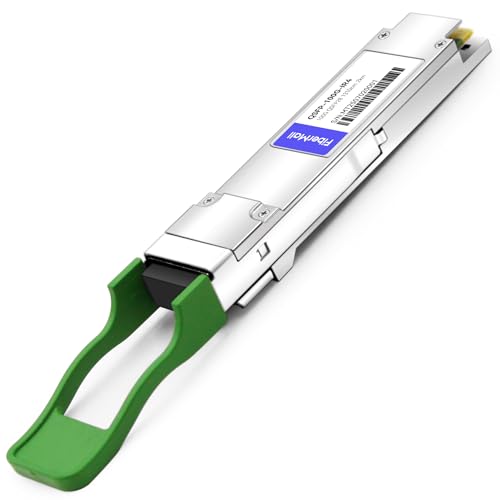
The G QSFP28 CWDM4 Optical Transceiver Module stands out as an ideal choice for data center operators and network engineers seeking high-performance connectivity. This module supports 100GBASE-CWDM4 with wavelengths of 1271nm to 1331nm, covering distances up to 2km. You’ll appreciate its compatibility with Cisco models, and its full-duplex mode guarantees efficient data transmission. With a power consumption of just 3.5W, it’s energy-efficient too. Plus, the hot-pluggable design simplifies upgrades. The module’s DOM support aids in monitoring, while a robust warranty offers peace of mind. If reliability and performance are key, this transceiver module won’t disappoint.
Best For: Data center operators and network engineers seeking high-performance and energy-efficient 100G connectivity solutions.
Pros:
- Supports long-distance data transmission up to 2km with full-duplex capability.
- Energy-efficient design with a low power consumption of just 3.5W.
- Hot-pluggable feature simplifies upgrades and maintenance.
Cons:
- Limited to single mode fiber, which may not suit all network environments.
- Requires compatible equipment, such as specific Cisco models, for optimal performance.
- The operational temperature range may not be suitable for all installation conditions.
QSFPTEK 100G QSFP28 Transceiver Module for Cisco

For those seeking a reliable and high-performance transceiver for their Cisco networking equipment, the QSFPTEK 100G QSFP28 Transceiver Module stands out as an excellent option. This module supports 100G Ethernet with a maximum distance of 10km, utilizing LC duplex connectors. Its plug-and-play design makes installation effortless, and the Digital Diagnostic Monitoring (DDM) feature allows you to track critical information. With a 3-year warranty and lifetime technical support, you can trust its quality and reliability. Plus, it’s compatible with various Cisco devices, ensuring you get the performance you need for your networking setup.
Best For: Network administrators and businesses seeking a high-performance transceiver module for Cisco equipment to enhance their 100G Ethernet connectivity.
Pros:
- Plug-and-play design makes installation quick and easy.
- Compatible with various Cisco devices ensuring broad usability in existing setups.
- Lifetime technical support and a 3-year warranty provide peace of mind.
Cons:
- Limited to a maximum distance of 10km, which may not suit all networking needs.
- Single-mode only, potentially restricting options for users with multi-mode fiber requirements.
- Higher price point compared to non-branded alternatives may deter budget-conscious buyers.
100G SR QSFP28 Multimode Optical Transceiver Module

Designed for high-performance networking, the 100G SR QSFP28 Multimode Optical Transceiver Module stands out as an ideal choice for data centers and enterprise networks. With a maximum data rate of 103.125Gbps and a wavelength of 850nm, it guarantees fast and reliable connections over distances up to 100m using OM4 multimode fiber. Its MTP/MPO-12 connector simplifies installation, while hot-pluggable functionality offers convenience. This module works seamlessly with devices from brands like Juniper, Arista, and Dell. Plus, it’s 100% tested, comes with a 36-month warranty, and includes lifetime tech support, making it a dependable option for your networking needs.
Best For: Data centers and enterprise networks seeking high-speed, reliable optical connectivity for short distances.
Pros:
- Supports a maximum data rate of 103.125Gbps for fast data transmission.
- Compatible with a variety of devices from leading brands like Juniper and Dell.
- Comes with a 36-month warranty and lifetime technical support for peace of mind.
Cons:
- Maximum distance of 100m may not be sufficient for larger installations.
- Requires OM4 multimode fiber for optimal performance, which may increase infrastructure costs.
- Hot-pluggable functionality may not be compatible with all existing network setups.
ipolex QSA Adapter – 100G QSFP28 to 25G SFP28/SFP+ Converter Module

Looking to enhance your network’s efficiency without overspending? The ipolex QSA Adapter is your go-to solution, converting 100G QSFP28 connections to 25G SFP28/SFP+ with ease. It’s compatible with various brands like Dell and Juniper and supports data rates up to 25Gbps per channel. With an operating temperature range of -20°C to +85°C, it’s built for reliability. The secure latching mechanism guarantees a stable connection, while low insertion loss and crosstalk enhance performance. Weighing just 1.09 ounces, it’s a compact, cost-effective option that facilitates a smooth shift to 40 Gigabit Ethernet networking without breaking the bank.
Best For: Businesses and network administrators looking for a reliable and cost-effective solution to convert 100G QSFP28 connections to 25G SFP28/SFP+ for enhanced networking performance.
Pros:
- Versatile compatibility with major brands like Dell, Juniper, and Arista.
- Low insertion loss and crosstalk, ensuring high performance and stability.
- Compact design and weight, making it easy to integrate into existing networking setups.
Cons:
- Limited to data rates of up to 25Gbps per channel, which may not suffice for all high-demand applications.
- Operating temperature range may not be suitable for extreme environments.
- May require additional adapters or cables for complete compatibility with certain systems.
H!Fiber.com QSFP28 to SFP28 QSA Adapter Module

The H!Fiber.com QSFP28 to SFP28 QSA Adapter Module stands out as an ideal choice for network administrators seeking to upgrade their infrastructure without overhauling existing systems. This adapter allows you to utilize 25G SFP28 modules in empty QSFP28 ports, facilitating a smooth migration to 100 Gigabit Ethernet. It supports various optics and cables, ensuring compatibility with numerous brands of switches and routers. With its all-metal housing, you’ll benefit from superior EMI performance and low insertion loss. Installation is a breeze with its plug-and-play design, and you’ll enjoy peace of mind with 24/7 customer support and a three-year warranty.
Best For: Network administrators looking to upgrade to 100 Gigabit Ethernet while utilizing existing 25G SFP28 modules.
Pros:
- Supports a wide variety of 25G SFP28 optics and cable types, ensuring compatibility with multiple brands.
- Features an all-metal housing for enhanced EMI performance and reduced signal loss.
- Easy plug-and-play installation with hot-pluggable capability for seamless integration.
Cons:
- Limited to use with 25G SFP28 modules, which may not meet the needs of all users.
- Operating temperature range may not be suitable for extreme environments.
- While it offers a warranty, users may still prefer more extended support options.
10Gtek QSFP28 100GBASE-SR4 Transceiver

For those seeking high-speed connectivity in data centers, the 10Gtek QSFP28 100GBASE-SR4 Transceiver stands out as an excellent choice. With a data rate of 100 Gb/s, it’s designed for peak performance over OM3 and OM4 multimode fiber, reaching up to 70m and 100m, respectively. This plug-and-play module features DDM for real-time monitoring and is compatible with Cisco devices. Weighing only 0.07 kg, its compact design fits easily into your setup. Ideal for rack-to-rack connections and high-speed Ethernet, this transceiver guarantees reliable data transfer and is perfect for fiber switches and servers alike.
Best For: Data centers and businesses looking for high-speed, reliable connectivity with compatible Cisco devices.
Pros:
- Plug and play installation allows for easy setup and full hot-pluggable functionality.
- DDM (Digital Diagnostic Monitoring) provides real-time monitoring of signal transmission, enhancing reliability.
- Compact design at only 0.07 kg makes it easy to integrate into various setups without adding significant weight.
Cons:
- Maximum reach of 70m on OM3 and 100m on OM4 may not meet the needs of all high-distance applications.
- Compatibility is limited primarily to Cisco devices, potentially restricting use with other brands.
- Customer rating of 4.1 out of 5 indicates mixed feedback, suggesting some users may experience issues.
10Gtek 100G QSFP28 DAC Cable (0.5-Meter)

Designed for data centers seeking efficient connectivity, the 10Gtek 100G QSFP28 DAC Cable (0.5-Meter) stands out with its passive Twinax construction. This cable supports data rates of up to 100Gb/s and features ultra-low crosstalk and low insertion loss for peak performance. With a temperature range of 0–70°C, it’s perfect for short, cost-effective connections between QSFP-100 ports in your racks. Each cable is individually tested to guarantee reliability and complies with industry standards like SFF-8436 and IEEE 802.3bj. Plus, it’s RoHS compliant and halogen-free, making it a smart choice for environmentally conscious setups.
Best For: Data centers requiring reliable, short-distance connectivity solutions between QSFP-100 ports.
Pros:
- Ultra-low crosstalk and low insertion loss for enhanced performance.
- Individually tested for reliability and compliance with industry standards.
- RoHS compliant and halogen-free, making it an environmentally friendly option.
Cons:
- Limited to very short distances (0.5 meters), which may not suit all setups.
- Passive cable design may not be suitable for all environments requiring longer runs.
- Compatibility might be restricted to specific brands or models of equipment.
10GTEK QSA Adapter – 100G to 25G Converter Module

Offering a seamless solution for those needing to connect 100G QSFP28 ports to lower-speed 25G SFP28 devices, the 10Gtek QSA Adapter excels in versatility and compatibility. It’s designed to work with a variety of brands like Dell, Juniper, and Arista, supporting all SFP28 optics and cables. With plug-and-play functionality, you won’t need any setup, making it incredibly user-friendly. This adapter not only facilitates cost-effective migration to 100 Gigabit Ethernet but also guarantees low insertion loss and crosstalk. Just remember, it achieves 10G rates only on Mellanox equipment, so keep that in mind when integrating into your network.
Best For: Network administrators looking for a cost-effective solution to connect 100G QSFP28 ports to 25G SFP28 devices in a variety of networking environments.
Pros:
- Supports a wide range of brands and SFP28 optics, ensuring compatibility with various networking equipment.
- Plug-and-play design eliminates the need for complex setup, simplifying installation and use.
- Facilitates migration to 100 Gigabit Ethernet without the need for complete hardware overhauls, providing cost savings.
Cons:
- Achieves 10G rates only on Mellanox equipment, limiting performance on other brands.
- Not all 100G cards and switches support the QSA adapter, potentially restricting usability.
- Excludes compatibility with Cisco and Mellanox optics, which may limit options for some users.
4 Pack 100G SR QSFP28 Multimode Module Optical Transceiver

The 4 Pack 100G SR QSFP28 Multimode Module Optical Transceiver stands out for its impressive compatibility with a range of networking devices, making it an ideal choice for data centers and high-performance computing environments. With a data rate of 103.125Gbps and a maximum distance of 100m on OM4 fiber, it guarantees rapid data transmission. This hot-pluggable transceiver operates efficiently at temperatures between 0 to 70°C and consumes less than 2.5W of power. Plus, its DDM functionality allows you to monitor real-time parameters, promoting peak performance for enterprise core and distribution layer applications.
Best For: The 4 Pack 100G SR QSFP28 Multimode Module Optical Transceiver is best for data centers and high-performance computing networks looking for reliable and high-speed data transmission.
Pros:
- Hot-pluggable design allows for easy installation and maintenance without downtime.
- Supports DDM functionality for real-time monitoring of fiber link parameters.
- Compatible with a wide range of networking devices, enhancing its versatility.
Cons:
- Limited maximum distance of 100m on OM4 fiber may not meet the needs for larger installations.
- Requires specific MTP/MPO-12 connectors, which may necessitate additional infrastructure.
- Power consumption, while low, may still be a consideration for energy-sensitive environments.
Factors to Consider When Choosing Qsfp28 100G Modules for Pc
When choosing QSFP28 100G modules for your PC, you’ll want to take into account several key factors. Compatibility with your devices is essential, along with the distance and range you need for effective performance. Don’t forget to evaluate power consumption, data rate requirements, and available connector types to guarantee you’re making the right choice.
Compatibility With Devices
Choosing the right QSFP28 100G modules for your PC hinges on compatibility with your existing devices. First, confirm the modules work with your specific networking equipment, as many are tailored for certain brands or models of switches, routers, and servers. It’s crucial to verify that the module meets industry standards like QSFP28 MSA and IEEE 802.3, confirming seamless integration. Pay attention to the connector type, such as LC or MPO, to match your devices. Additionally, while distance capabilities are important, focus on whether the module supports key features like Digital Diagnostic Monitoring (DDM) and a hot-pluggable design for easier maintenance. This compatibility guarantees peak performance and longevity for your high-speed networking setup.
Distance and Range
Compatibility with your devices sets the stage for understanding distance and range requirements in QSFP28 100G modules. The maximum transmission distance varies greatly; for instance, multimode fiber (OM4) supports up to 100 meters, while long-range (ZR4) options can reach 80 kilometers. Wavelength also plays an essential role—multimode modules typically operate at 850nm, whereas long-range ones use wavelengths between 1295nm and 1310nm. If you’re working in a data center or need short-range applications, QSFP28 SR4 modules are ideal for distances up to 100 meters over multimode fiber. Remember, the type of fiber you choose directly influences achievable distance. Assess your network’s specific distance needs to select the right QSFP28 module for best performance and reliability.
Power Consumption Levels
Power consumption levels are a critical factor in selecting QSFP28 100G modules for your PC. Typically, these modules consume between 2.5W and 6W, depending on their type and functionality. If energy efficiency is your priority, consider lower power consumption options like the 100G SR QSFP28, which uses around 2.5W. On the other hand, modules designed for longer distances, such as the QSFPTEK 100GBASE-ZR4, may draw up to 6W due to the extra power needed for signal amplification and error correction. Balancing power consumption with performance is essential, as higher power usage can increase cooling needs and operational costs. Choose a module that meets both your bandwidth requirements and energy efficiency goals.
Data Rate Requirements
When evaluating QSFP28 100G modules for your PC, it’s essential to match the data rate with your network’s needs, as this guarantees smooth and efficient operation. Most typical modules support a data rate of 100Gb/s, but you’ll want to take into account specific standards like 100GBASE-LR4, 100GBASE-ZR4, and 100GBASE-CWDM4, which influence their suitability for different applications. Confirm compatibility with your existing infrastructure, as many QSFP28 modules work seamlessly with devices supporting 100G Ethernet. Additionally, think about the desired reach; some modules can extend up to 80 km, while others are limited to shorter distances. Finally, keep an eye on power consumption, as these modules typically operate between 2.5W to 6W, impacting system efficiency.
Connector Types Available
Choosing the right connector type for your QSFP28 100G modules is essential for optimizing performance and ensuring seamless integration with your existing network. Typically, QSFP28 modules use LC connectors, ideal for high-density applications in data centers. If you’re considering multimode connections, look for MTP/MPO connectors, which excel in higher data rates over shorter distances. It’s vital to match the connector type with your module; multimode often requires MTP/MPO, while single-mode generally uses LC connectors. Additionally, remember that single-mode connectors support longer distances compared to multimode options. Thanks to the hot-pluggable design, you can easily install or replace these modules without disrupting your network, provided you use standardized connectors for compatibility.
Operating Temperature Range
To guarantee ideal performance of your QSFP28 100G modules, it’s vital to take into account the operating temperature range that suits your specific environment. Typically, these modules operate effectively between 0°C to 70°C (32°F to 158°F), perfect for standard data centers. If you’re in a more extreme environment, some QSFP28 modules can function between -20°C to 85°C (-4°F to 185°F). Choosing a module that aligns with your installation site’s temperature conditions is important to prevent overheating and maintain signal integrity. Operating outside the specified range can lead to increased failure rates and degraded performance. Always check the manufacturer’s specifications to confirm compatibility with your equipment and operational environment.
Hot-Pluggable Features
Understanding hot-pluggable features in QSFP28 100G modules is essential for maintaining a reliable network. These modules allow you to insert and remove them without powering down your device, which means uninterrupted network operations. This capability is particularly useful for seamless upgrades and maintenance, minimizing downtime while boosting overall system reliability. You’ll appreciate how hot-pluggable modules automatically recognize when inserted, simplifying installation and configuration. Many QSFP28 modules come with standard compliant connectors, ensuring they’re compatible with a wide range of networking equipment. This feature is especially advantageous in data center environments, where uptime is critical. By choosing hot-pluggable modules, you can easily replace or add components in a live system without service interruption.
Warranty and Support Options
When evaluating QSFP28 100G modules, warranty and support options play an essential role in ensuring your investment is protected. Look for warranties ranging from 30 days to 5 years, providing vital coverage against defects and failures. A longer warranty can give you peace of mind as you integrate these modules into your network. Additionally, consider support options that include lifetime technical assistance for troubleshooting and maintenance. Some manufacturers offer a 30-day free return policy, allowing you to test compatibility without commitment. Check if free replacement options are available for defective products, and evaluate customer service availability, including 24/7 support and detailed documentation to assist with installation and ongoing maintenance.