The best audio rack cabinets do more than hold amplifiers and media components. They help organize cables, protect equipment, improve airflow, and make a studio, theater, or home entertainment system easier to maintain.
This roundup compares 10 options ranging from compact wooden media consoles to rolling 12U and 16U equipment racks. Use the guide below to match cabinet size, mounting style, ventilation, mobility, and capacity to your setup.
Best 10 Audio Rack Cabinets Picks for 2026
Best Heavy-Duty Pick

- 500-pound stated capacity
- Open design for easy wiring
- Lockable casters and top shelf
Best For: Mobile studio, AV, and network equipment storage
Best Corner Design
Space-Saving 4-Tier Audio Cabinet

- Compact corner-friendly footprint
- 17 adjustable shelf positions
- Walnut finish with metal frame
Best For: Home media setups with limited floor space
Best Network Rack Value

- 550-pound stated capacity
- 19-inch rack-mount compatibility
- Lockable 3-inch caster wheels
Best For: Pro audio, IT, server, and network equipment
Best Tall Storage Tower

- Six adjustable storage tiers
- 66-pound rating per shelf
- Lockable 360-degree swivel wheels
Best For: Tall, movable home and office AV storage
Best Open-Frame Pick

- Wall or floor mounting
- Up to 260-pound floor capacity
- Two ventilated shelves included
Best For: Flexible home AV and IT setups
Best Mobile Rack

- Four casters, two locking
- Ventilated mesh panels
- Removable side panels
Best For: Studios and movable AV setups
Best Furniture-Style Stand

- Five adjustable storage tiers
- 110-pound capacity per tier
- 360-degree swivel wheels
Best For: Home stereo and media equipment
Best Heavy-Duty Open Frame Rack
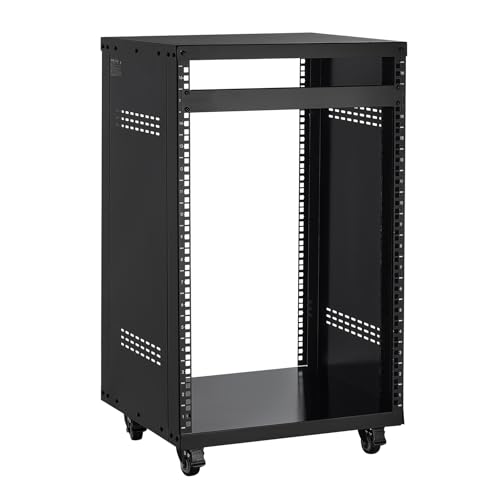
- 200-pound Q235 steel capacity
- Open front and back for easy access
- Locking casters and top storage shelf
Best For: Studios, venues, and equipment rooms needing a mobile, service-friendly rack
Best Furniture-Style Media Cabinet
LEVNARY 5-Tier AV Media Cabinet

- Five tiers with adjustable shelving
- Grille door and cable-routing holes
- Walnut finish with mobile wheels
Best For: Home entertainment setups seeking organized, enclosed AV storage
Best High-Capacity Rolling Studio Rack

- 220-pound stated load capacity
- Open frame with side securing tracks
- Handles and four wheels for mobility
Best For: Studios and offices needing a strong, movable 16U equipment rack
Best Heavy-Duty Pick – VEVOR 12U Mobile AV Rack
The VEVOR 12U is a practical choice among audio rack cabinets when you need mobile, rack-mount storage for larger AV or network setups. Its open frame, 18-inch depth, top shelf, and lockable casters make equipment access and repositioning straightforward.
Best For: Studios, offices, classrooms, clubs, and other spaces needing a sturdy mobile rack for 19-inch equipment.
Pros:
- Q235 carbon-steel construction with a stated 500-pound maximum capacity.
- Open-front and open-back design simplifies wiring and maintenance.
- Lockable casters, removable side panels, top shelf, and included mounting hardware add convenience.
Cons:
- Open-frame construction provides less enclosure than a fully closed cabinet.
- At 33.1 pounds, it may be cumbersome to move frequently despite the casters.
Choose this model when durability, airflow, and mobility matter more than a concealed cabinet design. The 12U capacity and broad accessory kit make it a flexible foundation for expanding equipment collections.
Best Corner Design – Space-Saving 4-Tier Audio Cabinet
This compact corner unit stands out among audio rack cabinets for home entertainment spaces where floor area is limited. Four open shelves, a walnut finish, and 17 height positions provide flexible storage for receivers, consoles, speakers, and related components.
Best For: Living rooms, bedrooms, offices, and home theaters that need adaptable media storage with a furniture-style appearance.
Pros:
- Corner-friendly footprint helps use otherwise wasted space.
- Seventeen shelf-height positions accommodate equipment of varying sizes.
- 15mm MDF shelves and a reinforced metal frame support up to 200 pounds.
Cons:
- It is a floor-standing media cabinet, not a standard 19-inch rack-mount enclosure.
- The compact shelves may not suit especially deep or oversized components.
This is a good fit when appearance and configuration flexibility are as important as equipment storage. Its open layout also supports heat dissipation while keeping components visible and accessible.
Best Network Rack Value – AxcessAbles 12U Rolling Rack
The AxcessAbles RK12U is a strong contender among audio rack cabinets for users who need standard 19-inch compatibility and substantial load support. Its 18-inch depth, steel frame, and preinstalled lockable wheels suit pro audio, video, IT, and network equipment.
Best For: Studios, DJ systems, server equipment, patch panels, routers, power amplifiers, and other rack-mount gear.
Pros:
- Supports up to 550 pounds according to the supplied specifications.
- 1.5mm steel construction is designed for durability and reduced vibration.
- Includes lockable 3-inch casters, rack screws, spacer, and assembly tool.
Cons:
- The open-frame design does not provide the protection or concealment of a closed cabinet.
- Its 27.5-inch height and 20-inch width require more floor space than compact furniture-style racks.
For buyers prioritizing rack compatibility and high load capacity, this model offers a practical rolling platform. The included hardware and one-year manufacturer warranty add useful setup and ownership support.
Best Tall Storage Tower – 6-Tier AV Media Stand
This six-tier tower offers a furniture-style alternative among audio rack cabinets, with adjustable wood shelves and a tall vertical profile. Its steel frame, lockable swivel wheels, and 66-pound-per-shelf rating make it useful for organizing multiple home or office components.
Best For: Home theaters, offices, bedrooms, stores, and other spaces needing tall, movable storage for AV accessories and equipment.
Pros:
- Six adjustable tiers provide substantial vertical storage.
- Each shelf is rated for 66 pounds, with a stated total capacity of 400 pounds.
- Lockable 360-degree swivel wheels make repositioning convenient.
Cons:
- At 47 inches tall, the tower may not suit low-profile setups.
- Its 15.7-inch depth may limit compatibility with deeper components.
- It is a freestanding shelf system rather than a standard 19-inch rack cabinet.
Select this stand when you want flexible, vertically arranged storage instead of enclosed rack mounting. The combination of adjustable shelves and mobility works well for mixed equipment, accessories, books, and display items.
Best Open-Frame Pick – Tecmojo 12U Network Rack
For buyers comparing audio rack cabinets for mixed networking and AV equipment, the Tecmojo 12U rack offers an open, space-efficient design with included shelves and mounting hardware. Its cold-rolled steel frame can be wall mounted or used on the floor, depending on your setup.
Best For: Home offices, classrooms, warehouses, and AV or IT setups that need flexible placement and straightforward expansion.
Pros:
- Supports up to 130 pounds wall mounted or 260 pounds when floor mounted.
- Includes two ventilated 1U shelves, shelf stops, Velcro straps, and mounting screws.
- Open-frame construction improves access to installed equipment.
- Includes a drilling template, manual, and online assembly video.
Cons:
- Open construction provides less enclosure and security than a cabinet-style rack.
- Its 12U capacity may not suit larger equipment collections.
The Tecmojo is a practical choice when load capacity, accessibility, and flexible wall-or-floor installation matter more than a fully enclosed cabinet.
Best Mobile Rack – Ktaxon 12U AV Equipment Rack
The Ktaxon 12U is a mobile option among audio rack cabinets, with removable side panels, ventilated panels, and four casters. The two locking wheels help keep the floor-mounted rack in place while still allowing it to be repositioned when needed.
Best For: Studios, clubs, restaurants, places of worship, and audio technicians who need movable equipment storage.
Pros:
- Cold-rolled steel construction with a powder-coated finish.
- Four removable casters include two lockable wheels.
- Mesh ventilation panels support airflow around equipment.
- Suitable for amplifiers, AV or HiFi equipment, computers, and other rack-mounted gear.
Cons:
- The supplied warranty is limited to 30 days.
- The product details do not state a specific maximum load capacity.
Choose the Ktaxon when mobility and ventilation are priorities. Its caster-based design is especially useful for equipment that must be moved between rooms or event areas.
Best Furniture-Style Stand – 5-Tier AV Media Rack
For home users who want audio rack cabinets with open shelving rather than standard rack-unit mounting, this 43-inch, five-tier media stand provides adjustable storage for stereo and entertainment equipment. Its wheels also make the setup easy to move around the room.
Best For: Living rooms, bedrooms, offices, and flexible home entertainment setups with components of varying heights.
Pros:
- Five shelves provide vertical storage with a relatively small footprint.
- Three middle partitions adjust through 15 pre-drilled positions.
- 360-degree swivel wheels support mobility across common floor surfaces.
- Each tier is rated to support up to 110 pounds.
Cons:
- This is a freestanding media stand, not a conventional 19-inch rack cabinet.
- Open shelving offers less protection and cable management than an enclosed cabinet.
The five-tier stand is a strong fit for residential audio systems, especially when adjustable shelf spacing and easy relocation are more useful than standardized rack mounting.
Best Heavy-Duty Open Frame Rack – VEVOR 16U AV Rack
For buyers comparing audio rack cabinets for studios, venues, or equipment rooms, the VEVOR 16U AV Rack emphasizes accessible wiring, mobility, and substantial load capacity. Its open-front and open-back layout suits installations that need regular maintenance.
Best For: Clubs, bars, places of worship, recording studios, and other spaces needing a movable rack for audio, video, IT, or network equipment.
Pros:
- Supports up to 200 pounds with a durable Q235 carbon-steel enclosure.
- Open design makes equipment access, wiring, and maintenance straightforward.
- Lockable caster wheels and a top shelf add flexibility and storage.
- Includes cage nuts, screws, a wrench, a blank panel, and an instruction manual.
Cons:
- Open-front and open-back construction provides less enclosure than a closed cabinet.
- At 18 inches deep, it may not fit especially deep equipment.
- No warranty is listed in the supplied details.
With a 16U capacity, 200-pound rating, and rolling base, this VEVOR rack is a practical choice when service access and repositioning matter more than a fully enclosed design.
Best Furniture-Style Media Cabinet – LEVNARY 5-Tier AV Media Cabinet
If you want audio rack cabinets that blend into a living space, the LEVNARY 5-Tier AV Media Cabinet combines a walnut-finish engineered-wood body with enclosed storage, cable routing, and adjustable shelving. The grille door also provides ventilation for stored components.
Best For: Living rooms, home theaters, gaming rooms, home offices, and recording studios that need organized media storage with a furniture-style appearance.
Pros:
- Five tiers and three height-adjustable shelves accommodate varied AV components.
- Grille door design promotes airflow while concealing equipment.
- Built-in cable-management holes help keep connections organized.
- Wheels support repositioning, while hidden compartments reduce visible clutter.
Cons:
- Engineered-wood construction is less suited to heavy rack-mounted equipment than a steel rack.
- The cabinet-style layout may provide less immediate access than an open-frame design.
- Its 23.62-inch width and 19.68-inch depth require adequate floor space.
This cabinet is a strong fit when appearance, concealed storage, and flexible shelf placement are priorities. It is better suited to component storage than to a traditional rack-unit installation.
Best High-Capacity Rolling Studio Rack – 16U Studio Rack with Wheels
For audio rack cabinets that need to move between work areas, this 16U open-frame studio rack offers a 220-pound load capacity, side tracks for securing devices, and four wheels. Its compact profile is designed for recording, theater, office, and network equipment.
Best For: Recording studios, home theaters, offices, and users organizing amplifiers, mixers, servers, routers, recorders, or other electronic equipment.
Pros:
- Handles up to 220 pounds, the highest stated capacity in this group.
- Open frame supports equipment access and straightforward installation.
- Side-panel tracks help hold devices securely in place.
- Four wheels and handles make the rack easier to move.
Cons:
- Open construction does not provide the protection or concealment of a closed cabinet.
- The supplied dimensions should be checked against available floor space and equipment depth.
- The product is reported as requiring assembly.
Its combination of 16U storage, a 220-pound rating, handles, and rolling mobility makes this rack compelling for active setups. Confirm your equipment dimensions before assembly, especially for deeper components.
How We Picked These Audio Rack Cabinets
We focused on practical differences that matter when housing audio, video, networking, and recording equipment. The selection includes open-frame racks for accessible installations, enclosed media cabinets for living spaces, and rolling models for studios or flexible equipment layouts.
We compared rack-unit capacity, stated weight limits, depth, shelf adjustability, caster design, cable-management features, ventilation, mounting flexibility, and included hardware. Because equipment dimensions vary, buyers should verify the usable depth and internal clearance before ordering.
Quick Comparison
| Best For | Recommended Style | What to Prioritize |
|---|---|---|
| Recording studios | Rolling open-frame rack | Rack-unit capacity, sturdy casters, accessible wiring |
| Home theaters | Enclosed media cabinet | Ventilation, shelf adjustment, appearance, cable routing |
| Networking and AV integration | 19-inch open-frame rack | Mounting compatibility, depth, weight capacity |
| Small rooms | Corner or compact shelf unit | Footprint, adjustable shelves, component clearance |
Key Buying Factors for Audio Rack Cabinets
Rack Size and Usable Depth
Rack-mounted components are commonly measured in rack units, or U. A 12U cabinet may suit a modest amplifier, receiver, patch panel, and accessories, while a 16U model provides more room for expansion. Check both the cabinet’s rack width and usable front-to-back depth; unusually deep amplifiers, power conditioners, and network hardware may not fit shallow designs.
Weight Capacity and Stability
Calculate the combined weight of every component, then leave a safety margin. Heavy amplifiers should sit low to reduce the risk of tipping. Locking casters can make a rolling rack easier to reposition while keeping it stable during use.
Ventilation and Cable Access
Amplifiers and other high-power components need airflow. Open sides, vented panels, grille doors, and spacing between devices can help dissipate heat. Look for rear access and cable-management openings if the rack will hold multiple power, signal, and network cables.
Open Frame Versus Enclosed Cabinet
Open-frame Audio Rack Cabinets are convenient for maintenance and usually provide excellent airflow. Enclosed wooden or metal cabinets offer a cleaner appearance and can help conceal equipment in a living room, but they require careful attention to ventilation and shelf clearance.
Who Should Buy Which Audio Rack Cabinets?
Choose a rolling 12U or 16U open-frame rack if you are building a recording studio, editing suite, or expandable equipment station. These models are best when easy rear access, mobility, and standard 19-inch mounting are more important than furniture-style presentation.
A corner or tiered media stand is a better fit for a compact stereo or home-theater setup with mostly shelf-based components. Prioritize adjustable shelves and adequate width for receivers, game consoles, and streaming devices.
For a visible living-room installation, choose an enclosed cabinet with cable management and a grille or ventilated door. Before buying, measure the equipment, confirm clearance around hot-running components, and plan where power strips and excess cables will go.