A check-engine light does not always require an expensive shop visit. The best budget car diagnostic scanners can reveal trouble codes, explain basic faults, and help you decide whether a problem needs immediate professional attention.
We compared 10 affordable OBD2 readers with attention to compatibility, code access, live data, battery testing, readiness checks, and ease of use. Use the guide below to choose the right scanner for your vehicle and diagnostic needs.
Best 10 Budget Car Diagnostic Scanners Picks for 2026
Best Basic Coverage

- Reads and clears engine fault codes
- Supports nine OBD II protocols
- Large backlit display with six languages
Best For: DIY engine diagnostics and routine check-engine troubleshooting
Best for Easy DIY Use
- Plug-and-play operation for beginners
- One-click I/M readiness testing
- Includes lifetime free updates
Best For: First-time users checking and clearing engine codes
Best Feature Set

- Adds battery-health testing
- Includes O2 and EVAP tests
- Supports cloud diagnostic reports
Best For: DIYers wanting broader engine and battery diagnostics
Best for Used-Car Checks
- Retrieves VIN and calibration information
- Reads generic and manufacturer-specific codes
- Checks live data and I/M readiness
Best For: DIY troubleshooting and used-car inspections
Best Value Diagnostic Pick
OBD2 Scanner and Battery Tester

- Battery health check without an app
- EVAP, O2, live data, and freeze-frame tests
- Supports 4,000+ code explanations
Best For: DIY drivers needing engine diagnostics and battery monitoring
Most Feature-Rich Budget Pick

- 50,000+ built-in code database
- Graph live data plus EVAP and O2 tests
- Lifetime software updates
Best For: DIY owners wanting detailed engine diagnostics
Simple Entry-Level Pick

- Built-in definitions for 1,000+ codes
- Checks codes, freeze frames, and readiness
- No registration required
Best For: Basic engine and emissions troubleshooting
Best Beginner-Friendly Scanner

- 42,000+ built-in DTC lookups
- Color display with live-data functions
- Includes readiness, O2, and EVAP tests
Best For: Beginners checking engine and emissions issues
Best Compact Live-Data Tool

- Monitors 20+ real-time data streams
- Includes voltage and readiness testing
- Compact wired design with English and Spanish
Best For: DIY users needing portable live-data monitoring
Best Basic Coverage – MOTOPOWER MP69033
The MOTOPOWER MP69033 is a practical option for shoppers comparing budget car diagnostic scanners for basic check-engine troubleshooting. It reads and clears engine codes, displays live data and freeze-frame information, and includes a built-in code lookup library.
Best For: DIY users who want broad OBD II compatibility, a simple screen, and essential engine diagnostics without batteries or a charger.
Pros:
- Supports nine OBD II protocols and many 1996-and-newer US vehicles, plus newer EU and Asian vehicles.
- Provides code reading and clearing, freeze frame, I/M readiness, vehicle information, and live data functions.
- Uses a 2.8-inch backlit display, six-language support, and vehicle-powered operation.
Cons:
- Does not support ABS, airbag, oil-service, or other non-OBD II systems.
- Compatibility is limited to OBD II-equipped vehicles.
This scanner offers a useful mix of coverage and core features for routine check-engine diagnosis. Choose it when engine-related OBD II functions are enough and dedicated ABS or airbag scanning is not required.
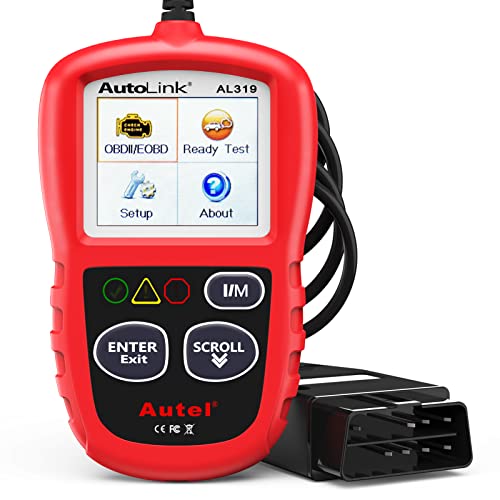
Best for Easy DIY Use – Autel AL319
The Autel AL319 is a straightforward choice among budget car diagnostic scanners, especially for drivers who want quick access to check-engine information. Its plug-and-play design supports code reading, clearing, live data, freeze frame, and I/M readiness checks.
Best For: First-time users and DIYers who value a simple interface, one-click I/M readiness testing, and a compact color display.
Pros:
- Reads and clears diagnostic trouble codes and includes a built-in DTC lookup function.
- One-click I/M readiness, live-data, freeze-frame, and vehicle-information features support basic diagnosis.
- Requires no batteries, supports seven languages, and includes a 12-month warranty with lifetime free updates.
Cons:
- Designed for OBD II vehicles and check-engine diagnostics rather than broader vehicle-module coverage.
- The 2.4-inch screen is smaller than some competing scanners.
The AL319 focuses on accessible operation rather than an extensive feature set. It is a sensible low-cost pick for checking emissions readiness and investigating ordinary check-engine warnings.
Best Feature Set – BluSon YM319
The BluSon YM319 stands out in the budget car diagnostic scanners category by combining engine-code scanning with battery testing and additional test functions. It can read and clear codes, display live data, check I/M readiness, test oxygen sensors and EVAP systems, and create cloud-based diagnostic reports.
Best For: DIYers who want more diagnostic features, battery-health checks, live-data graphs, and shareable maintenance records in one tool.
Pros:
- Includes a one-click battery diagnostic feature alongside OBD II engine scanning.
- Offers oxygen-sensor and EVAP testing, freeze-frame data, live-data curves, and a database of more than 63,000 fault codes.
- Features a 2.4-inch color display, customizable shortcut keys, 13-language support, and cloud printing.
Cons:
- Not compatible with new-energy or hybrid vehicles.
- Its larger feature set may be more than needed for simple code reading.
The YM319 is a strong option when a basic code reader is not enough. Its battery testing, graphing, and report-sharing features add practical value for owners who perform more involved maintenance.
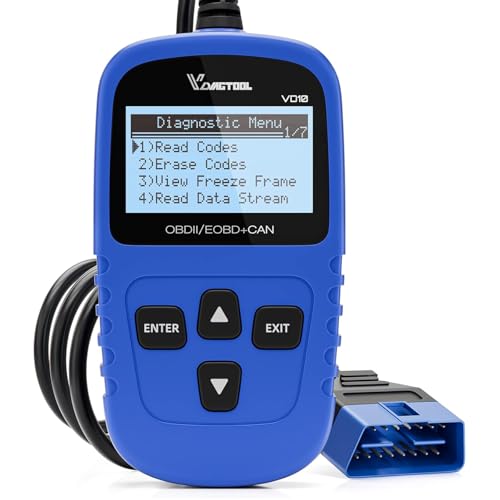
Best for Used-Car Checks – VDIAGTOOL VD10
The VDIAGTOOL VD10 is one of the more practical budget car diagnostic scanners for everyday code checks and used-car evaluation. It reads and clears codes, shows live sensor data and freeze frames, checks I/M readiness, and retrieves vehicle identifiers such as the VIN.
Best For: DIY owners and used-car shoppers who need accessible engine diagnostics plus emissions-readiness and vehicle-information checks.
Pros:
- Supports all listed OBD II protocols and 12V cars, SUVs, and light trucks across specified US, EU, and Asian model years.
- Displays generic, manufacturer-specific, and pending codes with a built-in database of more than 3,000 definitions.
- Provides live data, freeze-frame information, I/M readiness, VIN, calibration ID, and verification-number retrieval.
Cons:
- Its compatibility guidance varies by vehicle region and model year, so buyers should verify fitment.
- It is focused on OBD II diagnostics rather than dedicated ABS or airbag coverage.
The VD10 balances simple plug-and-play operation with useful information for troubleshooting and pre-purchase checks. Its VIN and calibration details make it particularly helpful when inspecting a used vehicle.
Best Value Diagnostic Pick – OBD2 Scanner and Battery Tester
For shoppers comparing budget car diagnostic scanners, this model adds useful testing features without requiring an app or complicated setup. It reads and clears engine codes, checks battery health, and provides EVAP, O2 sensor, live-data, and emissions-readiness functions through a 2.8-inch color screen.
Best For: DIY drivers who want engine diagnostics plus a convenient battery check and smog-readiness monitor.
Pros:
- One-click battery health check with voltage monitoring.
- Supports EVAP and O2 sensor tests, live data, and freeze-frame information.
- Displays explanations for more than 4,000 diagnostic trouble codes.
- Works with OBDII vehicles across multiple regions and supports eight languages.
Cons:
- Does not support ABS, SRS, or transmission systems.
- Designed for 12V OBDII vehicles rather than broader professional diagnostics.
Its combination of battery testing and enhanced engine checks makes it a strong value for routine home troubleshooting. The included two-year warranty and plug-and-play operation add practical appeal for occasional DIY use.
Most Feature-Rich Budget Pick – ZMOON ZM201 OBD2 Scanner
The ZMOON ZM201 is a practical choice among budget car diagnostic scanners for drivers who want more than basic code retrieval. It combines engine-code reading and clearing with graph-view live data, freeze-frame records, EVAP and O2 tests, I/M readiness, and lifetime software updates.
Best For: DIY owners seeking a broad set of engine-focused functions and a clear color display.
Pros:
- Includes live-data graphing, freeze-frame, EVAP, O2, and onboard-monitor testing.
- Built-in database lists more than 50,000 diagnostic trouble codes.
- Plug-and-play design needs no battery, charging, app, or registration.
- Offers lifetime software updates and optional Windows-based review and printing.
Cons:
- Does not diagnose ABS, SRS, transmission, or other advanced systems.
- Optional PC features support Windows XP/7/8/10, not Mac.
- Permanent codes require the underlying repair before they can be reset.
This scanner stands out when engine diagnostics are the priority and you want more detailed data than a basic reader provides. Its three-year warranty and lifetime updates support longer-term ownership.
Simple Entry-Level Pick – Autel MS309 OBD2 Scanner
For buyers who mainly need straightforward check-engine-light diagnosis, the Autel MS309 keeps the process simple. This plug-and-play OBDII reader retrieves and clears supported codes, displays code definitions, checks emissions readiness, and reports freeze-frame and vehicle-identification data.
Best For: DIY owners who want a basic, no-registration scanner for standard OBDII engine and emissions checks.
Pros:
- Built-in definitions cover more than 1,000 diagnostic trouble codes.
- Reads generic, manufacturer-specific, and pending codes, where supported.
- Provides freeze-frame data, VIN, calibration IDs, and I/M readiness status.
- Plug-and-play operation requires no registration.
Cons:
- Does not support TPMS or other service functions.
- Does not provide full engine-system coverage or advanced parameter display.
- Cannot access or clear OBDII modules on certain FCA vehicles made after 2017 with SGW/AutoAuth security.
The MS309 is best viewed as a focused basic code reader rather than a full-service scan tool. It is a sensible budget option for identifying common engine and emissions faults, provided your vehicle is compatible.
Best Budget Code Lookup – V519 OBD2 Scanner
For shoppers comparing budget car diagnostic scanners, the V519 stands out for its large built-in trouble-code reference and straightforward plug-and-play design. It reads and clears engine codes, displays live data, checks I/M readiness, tests battery voltage, and requires no app, battery, or Bluetooth connection.
Best For: DIY owners who want quick code explanations and basic engine diagnostics in a compact wired scanner.
Pros:
- Includes a 35,901-code built-in DTC lookup library.
- Supports live data, freeze-frame data, I/M readiness, VIN retrieval, battery voltage, and component tests.
- Works with many OBD2 vehicles and supports 10 languages.
- Powered directly through the vehicle and covered by a one-year warranty.
Cons:
- Its listed functions focus on OBD2 engine and related diagnostics rather than advanced module coverage.
- Vehicle compatibility depends on having a supported OBD2 system and 16-pin port.
The V519 is a practical pick when an extensive code library and simple operation matter more than wireless features or specialized diagnostics. Its compact body also makes it convenient to keep in a vehicle for routine checks and emergencies.
Best Beginner-Friendly Scanner – ANCEL AD410 OBD2 Scanner
The ANCEL AD410 is one of the more approachable budget car diagnostic scanners for check-engine troubleshooting. Its color display, built-in code definitions, live-data views, and broad OBD2 protocol support help drivers investigate engine and emissions issues without a phone app.
Best For: Beginners and home mechanics who want clear engine-code information and smog-readiness checks.
Pros:
- Provides more than 42,000 built-in DTC lookups.
- Supports code reading and clearing, freeze frame, live data, I/M readiness, O2 sensor, EVAP, and vehicle-information functions.
- Uses a 2.4-inch color display with multilingual support and no battery or app required.
- Free software updates and ANCEL support add practical long-term value.
Cons:
- Reads engine and emissions-related codes only.
- Does not support ABS, SRS, transmission, bidirectional control, or service-reset functions.
- Compatibility should be checked for the specific vehicle before purchase.
The AD410 offers a strong balance of usability and diagnostic coverage for routine check-engine work. It is less suitable for users seeking full-system or advanced service functions, but its code library and inspection-readiness tools are useful for everyday maintenance.
Best Compact Live-Data Tool – V119 OBD2 Scanner
The V119 is a compact option among budget car diagnostic scanners, combining standard code-reader functions with battery-voltage testing and real-time data tracking. It can read and clear codes, review freeze frames, check I/M readiness, and monitor more than 20 available data streams on supported vehicles.
Best For: DIY users and mechanics who want a small wired scanner for basic car and truck troubleshooting.
Pros:
- Offers code reading and clearing, freeze-frame review, live data, voltage testing, and component tests.
- Tracks more than 20 real-time data streams, including fuel pressure and coolant temperature.
- Supports I/M readiness checks for eight vehicle systems.
- Uses a 16-pin connection and includes English and Spanish language options.
Cons:
- Does not support hybrids, electric vehicles, or non-OBD2 models.
- The 1.8-inch screen is smaller than the display on some competing scanners.
- Listed compatibility varies by region and model year, so confirmation is important.
The V119 makes sense for buyers who prioritize live-data monitoring and a compact form factor. Its coverage is centered on OBD2 diagnostics, so it should be viewed as a practical engine and emissions tool rather than a full-vehicle professional scanner.
How We Picked the Best Budget Car Diagnostic Scanners
We focused on affordable wired OBD2 scanners designed for everyday vehicle owners, DIY maintenance, and basic troubleshooting. The selected models support common OBDII or EOBD functions, including reading and clearing diagnostic trouble codes, displaying check-engine information, and checking emissions readiness where supported.
We also considered practical differences that matter in daily use: vehicle compatibility, screen readability, menu simplicity, built-in code references, freeze-frame data, live data, battery-voltage testing, and the likelihood that a beginner can use the tool without additional equipment. Advanced capabilities vary substantially, so confirm the scanner’s supported protocols and functions before purchase.
Quick Comparison
- Best for straightforward code reading: Basic Autel, MOTOPOWER, and similar plug-in readers.
- Best for emissions preparation: Models with I/M readiness and freeze-frame displays.
- Best for battery checks: Scanners that include a voltage or battery tester.
- Best for more diagnostic detail: Models offering live data, built-in DTC lookup, or enhanced OBD2 features.
- Best for frequent DIY use: A clearly labeled unit with a durable cable, responsive buttons, and a readable display.
Key Buying Factors for Budget Car Diagnostic Scanners
Vehicle Compatibility
Most OBD2 vehicles sold in the United States from 1996 onward are supported, but coverage is not universal across every market, diesel application, truck, or manufacturer-specific system. Check the listing and manufacturer documentation for your vehicle’s year, engine, and region.
What the Scanner Can Read
Entry-level readers generally access engine and emissions-related codes. Some can show pending codes, freeze-frame data, live sensor readings, and I/M readiness. Do not assume an inexpensive scanner can diagnose ABS, airbag, transmission, or body-control modules unless those systems are explicitly listed.
Code Clearing and Safety
Clearing a code turns off the warning temporarily but does not repair the underlying fault. It can also reset emissions monitors, making the vehicle temporarily unready for inspection. Read the code, record the details, and investigate the cause before erasing it.
Display and Usability
A simple standalone screen avoids phone pairing and subscription costs. Look for plain-language menus, readable characters, useful buttons, and a cable long enough to reach comfortably from the driver’s seat.
Who Should Buy Which Budget Car Diagnostic Scanners?
Choose a basic code reader if you only need to identify a check-engine fault before visiting a mechanic. Select a model with I/M readiness if you are preparing for an emissions test. A scanner with battery testing is useful for owners troubleshooting starting problems or monitoring charging voltage. For more involved DIY work, prioritize live data, freeze-frame information, and built-in code definitions.
These tools are best for diagnosis, not guaranteed repairs. If the warning light is flashing, the vehicle runs poorly, or a code involves safety-critical systems, stop driving when appropriate and seek qualified service.