Tracking electricity use does not have to require a costly professional energy audit. Today’s budget home energy monitors can show real-time consumption, identify power-hungry circuits, and help households spot opportunities to reduce waste.
We compare 10 options with different clamp capacities, circuit coverage, connectivity, automation support, and local-control features so you can choose a monitor that fits your electrical panel and energy goals.
Best 10 Budget Home Energy Monitors Picks for 2026
Best Whole-Home Value

- UL Listed whole-home monitoring
- Solar and net-metering support
- Expandable to 16 branch sensors
Best For: Whole-home energy tracking with optional appliance monitoring
Best Low-Cost Circuit Monitor
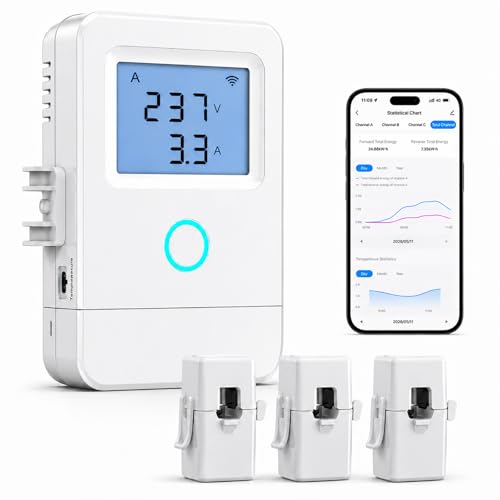
- Three included 80A CT clamps
- Smart Life and Tuya app support
- Temperature alerts and limited relay control
Best For: Tracking three selected high-power circuits
Best for Advanced Home Automation

- Monitors up to 18 circuits
- Home Assistant and local data support
- No subscription required
Best For: Detailed circuit monitoring and solar automation
Best Privacy-Focused Pick
Refoss EM16P Local Energy Monitor

- Local Web UI, Open API, and MQTT support
- Native Home Assistant and OpenClaw integration
- Up to 16 branch circuits with long-term data storage
Best For: Privacy-focused users, Home Assistant setups, and solar homes
Best Certified Cloud Option
Emporia Vue 3 Whole-Home Monitor

- UL and CE listed for certified monitoring
- App-based access for iPhone, Android, and web
- Tracks whole-home, circuit, solar, and net-metering data
Best For: App-focused households wanting certified hardware and cloud analytics
Best Circuit-Level Audit Pick
Refoss EM16P 18-Circuit Monitor
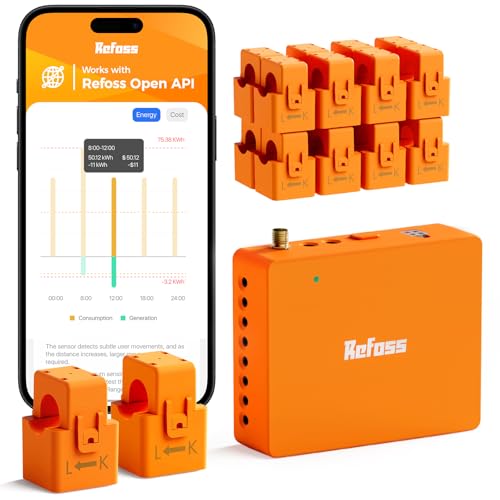
- Tracks two main and 16 branch circuits
- Five years of daily data with CSV export
- Local integrations plus smart fault and usage alerts
Best For: Detailed energy audits, solar optimization, and multi-circuit homes
Best Overall Value
Meross Smart Home Energy Monitor
- Monitors two main and up to 16 branch circuits
- Stores five years of usage data with ±1% stated accuracy
- No subscriptions; supports alerts, local data, and Home Assistant
Best For: Detailed whole-home, circuit-level, and solar monitoring
Best Simple Whole-Home Pick
Eyedro Smart Home Energy Monitor

- Measures whole-home or solar usage with two 200A sensors
- Works over 2.4GHz Wi-Fi or Ethernet
- Cloud access and real-time tracking come without a subscription
Best For: Straightforward whole-home, solar, or net-meter monitoring
Best for Circuit Insights

- Monitors mains and up to 16 individual branch circuits
- Includes app-based real-time tracking and abnormal-use alerts
- Adds peak-demand, net-metering, and excess-solar functions
Best For: Panel-level monitoring and advanced energy management
Best Whole-Home Value – Emporia Vue 3
The Emporia Vue 3 is a strong choice for shoppers comparing budget home energy monitors that can track whole-home usage, solar, and net metering. Its clamp-on sensors, app-based reporting, and optional branch sensors provide a practical path from broad energy awareness to appliance-level monitoring.
Best For: Homes wanting whole-home monitoring with optional circuit-level expansion and solar tracking.
Pros:
- UL Listed and designed for several supported residential electrical configurations.
- Tracks real-time usage through iPhone, Android, and web apps over 2.4 GHz WiFi.
- Supports solar and net metering, plus up to 16 optional branch sensors.
Cons:
- Requires electrical-panel installation and a 2.4 GHz internet connection.
- Branch sensors are sold separately.
- One-second data is available only while the app is actively open and retained for three hours.
Choose the Vue 3 if you want a well-rounded monitor with safety certification and room to add appliance tracking later. Its one-year warranty and cloud data tools add convenience, though the total cost can rise with optional sensors.
Best Low-Cost Circuit Monitor – WiFi 3-Circuit Energy Monitor
This compact monitor suits shoppers seeking budget home energy monitors for a few priority circuits rather than the entire electrical panel. Three included 80A CT clamps let you compare selected loads such as HVAC, water heating, laundry, or solar-related circuits in the Smart Life or Tuya app.
Best For: Monitoring up to three high-power circuits in a home, workshop, rental unit, or small business.
Pros:
- Includes three CT clamps for simultaneous selected-circuit monitoring.
- Displays voltage, current, power, and energy consumption through a 2.4 GHz WiFi app.
- Offers historical usage data, temperature alerts, and remote control for one connected circuit.
Cons:
- Designed for selected circuits, not stated as a whole-home monitor.
- Panel wiring should be handled by a qualified electrician if you are unfamiliar with electrical work.
- Remote relay control is limited to 15A.
Its three-channel setup is useful when you want targeted information without outfitting every circuit. Consider it a focused, app-connected option for identifying which major loads deserve attention.
Best for Advanced Home Automation – Meross 18-Circuit Monitor
The Meross EM16 stands out among budget home energy monitors for its unusually broad circuit coverage and local automation features. It monitors two main circuits plus up to 16 branch circuits, while Home Assistant support enables solar-surplus routines without a subscription.
Best For: Smart-home users who need extensive circuit monitoring, local data, and Home Assistant automation.
Pros:
- Monitors up to 18 circuits: two 200A main circuits and 16 branch circuits.
- Supports Home Assistant, Open API, Web Control, and local data storage without subscriptions.
- Provides usage charts, smart alerts, solar-surplus detection, and up to five years of data storage.
Cons:
- Its broader feature set may be more than needed for basic energy tracking.
- Installation still involves work inside the electrical panel.
- Home Assistant features may require additional setup and compatible equipment.
For households building an energy-focused smart home, the EM16 offers the most expansive monitoring and automation package in this group. Its two-year warranty and local-data approach are additional advantages for long-term use.
Best for Solar and Load Balancing – WiFi 120A Energy Monitor
This Blindsmart monitor is a practical pick among budget home energy monitors for single-phase homes with solar or battery storage. Its two 120A split-core CTs measure household consumption and grid export, while Smart Life integration adds alerts and automation scenes.
Best For: Solar-equipped homes needing bidirectional tracking, zero-export support, or dynamic load balancing.
Pros:
- Supports bidirectional power monitoring for solar and battery systems.
- Includes two 120A split-core CTs and compact pluggable terminals.
- Offers Smart Life app analysis, alerts, automation scenes, dynamic load balancing, and zero-grid-export mode.
Cons:
- Specified for single-phase 3-wire systems.
- Requires 2.4 GHz WiFi and app setup for connected features.
- The supplied notes do not specify a warranty or safety certification.
Its strongest advantage is solar-aware measurement rather than general-purpose whole-home reporting. If export control and energy-management functions matter more than broad system compatibility, this model is worth considering.
Best Privacy-Focused Pick – Refoss EM16P Local Energy Monitor
For shoppers comparing budget home energy monitors, the Refoss EM16P stands out when local control and privacy matter. It provides circuit-level readings, supports Home Assistant, and stores historical data without requiring cloud services or subscriptions.
Best For: Privacy-conscious households, Home Assistant users, and solar homes seeking circuit-level monitoring and automation.
Pros:
- Local Web UI, Open API, and MQTT access keep data on your home network.
- Native Home Assistant integration and OpenClaw support enable flexible automation.
- Supports two main sensors and up to 16 branch sensors, with stated accuracy as low as ±1%.
- Stores daily data for up to five years and supports data export without subscription fees.
Cons:
- Installation requires access to the circuit panel and appropriate electrical expertise.
- Its advanced local integrations may be more than casual users need.
The EM16P is a strong value for technically minded buyers who want detailed monitoring without cloud dependence. Its solar-focused automation features make it especially useful for homes with excess daytime generation.
Best Certified Cloud Option – Emporia Vue 3 Whole-Home Monitor
The Emporia Vue 3 is a practical choice among budget home energy monitors for buyers who prefer app-based monitoring and certified electrical hardware. It installs in the circuit panel with clamp-on sensors and provides live usage, solar, net-metering, and cost-management data through its connected app.
Best For: Households wanting UL-listed monitoring with iPhone, Android, or web access and cloud-based energy analytics.
Pros:
- UL and CE listed for added confidence in the monitoring hardware.
- Supports single-phase, split-phase, and compatible 2-wire systems.
- The Emporia app can help manage time-of-use rates, peak demand, excess solar, and rewards programs.
- Includes eight circuit sensors and supports solar and net-metering monitoring.
Cons:
- Requires 2.4 GHz Wi-Fi and an internet connection.
- Data retention varies: one-second readings last three hours, while minute-level cloud data lasts seven days.
- Some three-phase configurations require an additional 200A sensor sold separately.
The Vue 3 makes sense for buyers who prioritize a polished, remotely accessible app over local-only operation. Its certification and broad energy-management features are appealing, though cloud and internet requirements should be considered before purchase.
Best Circuit-Level Audit Pick – Refoss EM16P 18-Circuit Monitor
For detailed home energy audits on a budget, this Refoss monitor tracks two main circuits plus 16 branch circuits. It combines local access, long-term exportable data, and alerts for unusual appliance consumption, making it useful for finding energy vampires and investigating bill increases.
Best For: Homeowners who want granular circuit monitoring, local integrations, solar optimization, and long-term usage records.
Pros:
- Monitors up to 18 circuits with stated professional precision of ±1%.
- Provides Local Web UI, Open API, MQTT, WebSocket, and Home Assistant support without subscription fees.
- Stores daily usage data for five years and allows CSV export.
- Supports single-phase, split-phase, and 3-phase 4-wire Wye systems, with an external antenna for Wi-Fi stability.
Cons:
- Panel installation may require a qualified electrician or suitable electrical experience.
- Its extensive circuit capacity can be unnecessary for smaller or simpler homes.
This model is best suited to buyers who want more than a whole-home estimate. The combination of 16 branch sensors, fault alerts, local control, and five-year analytics gives it strong value for systematic energy audits and solar-use planning.
Best Overall Value – Meross Smart Home Energy Monitor
For shoppers comparing budget home energy monitors, the Meross stands out for broad circuit coverage, detailed tracking, and no subscription fees. Its clamp-on sensors support whole-home and branch-circuit monitoring, while the app records power, voltage, current, cost, and power factor data.
Best For: Homes that want detailed circuit-level monitoring, local data control, or solar automation through Home Assistant.
Pros:
- Supports two 200A main circuits and up to 16 branch circuits.
- Tracks usage and costs with stated accuracy of ±1% and stores up to five years of data.
- Offers custom alerts, local data access, Open API support, and no subscription fees.
- ETL-certified and compliant with the UL 61010 testing standard, with a two-year warranty.
Cons:
- Installation is intended for compatible electrical systems and may require panel work.
- Home Assistant solar automation features may be more than casual users need.
The Meross is a strong value pick when “budget” means getting more monitoring capability without ongoing fees. Its extensive sensor support makes it especially useful for households investigating individual circuits or optimizing solar surplus.
Best Simple Whole-Home Pick – Eyedro Smart Home Energy Monitor
The Eyedro is a practical option among budget home energy monitors for homeowners who want real-time whole-home or solar tracking without a subscription. It connects by 2.4GHz Wi-Fi or Ethernet and presents usage in watts, amps, volts, and dollars through the MyEyedro cloud.
Best For: Homeowners, solar users, and DIY-minded shoppers seeking straightforward whole-home or single-purpose solar monitoring.
Pros:
- Includes two 200A directional sensors for whole-home or solar measurement.
- Supports both 2.4GHz Wi-Fi and wired Ethernet connections.
- Provides real-time and historical data through the MyEyedro cloud with no subscription.
- Includes the sensor module, power adapter, Ethernet cable, and quick-start guide.
Cons:
- A single unit monitors grid energy, solar, or net metering—not all simultaneously.
- Separate grid-versus-solar tracking requires two EYEDRO-HOME meters.
- It does not provide the supplied circuit-level sensor coverage of the Meross or Siemens models.
The Eyedro keeps the setup focused and its connection options flexible. It is a sensible choice for tracking a home’s overall electricity flow, but shoppers planning detailed branch-circuit analysis or combined grid-and-solar monitoring should account for its limitations.
Best for Circuit Insights – Siemens Inhab Energy Monitor
The Siemens Inhab is a capable choice for budget home energy monitors when circuit-level visibility matters. It measures usage at the main panel and across up to 16 individual branch circuits, with a mobile app for real-time and historical tracking in the United States and Canada.
Best For: Households that want panel-based monitoring, personalized alerts, and advanced energy-management features such as peak-demand or excess-solar control.
Pros:
- Measures whole-home usage at the mains and individual consumption across up to 16 circuits.
- Provides 24/7 real-time and historical monitoring through a mobile app.
- Supports alerts for abnormal behavior, time-of-use management, peak demand, net metering, and excess solar.
- UL Listed in the United States and Canada and designed for new or existing panels.
Cons:
- Mobile-app availability is specified for the United States and Canada only.
- Installation involves electrical-panel wiring and multiple sensor connections.
- Some advanced load-management features may require compatible EV chargers or smart devices.
The Inhab offers a deeper look at where household electricity goes than a basic whole-home meter. Its branch-circuit sensors and management features make it a good fit for energy-conscious homeowners who are prepared for a more involved panel installation.
How We Picked These Budget Home Energy Monitors
We focused on the features that matter most in an affordable whole-home monitor: measurement accuracy, current-transformer capacity, circuit coverage, installation requirements, app usability, connectivity, and compatibility with solar or home-automation systems. We also considered whether each model offers cloud access, local control, open APIs, Home Assistant support, or Ethernet connectivity.
Because electrical panels vary widely, specifications should be checked carefully before purchase. A qualified electrician should handle installation inside a panel, particularly when the monitor uses multiple circuit clamps or requires connection to a breaker.
Quick Comparison
| Best For | Features to Prioritize |
|---|---|
| Basic whole-home tracking | Main-panel CT clamps, Wi-Fi, clear usage graphs |
| Circuit-level monitoring | Multiple sensor inputs and compatible circuit clamps |
| Solar households | Bidirectional or net-metering support and solar surplus tracking |
| Smart-home automation | Home Assistant compatibility, API access, or local control |
| Large electrical services | High-amperage main sensors and suitable panel compatibility |
Key Buying Factors for Budget Home Energy Monitors
Sensor Capacity and Panel Compatibility
Check the amperage rating and physical size of the included CT clamps. Main-service monitors may use 120A, 200A, or similarly rated sensors, while circuit-level systems often use smaller clamps. Confirm that your panel has enough room and that the monitor supports your service configuration.
Whole-Home Versus Circuit-Level Data
A basic system can reveal total consumption, while circuit monitoring helps identify whether heating, cooling, water heating, or appliances are driving costs. More sensor inputs provide better visibility but usually increase installation complexity and expense.
Connectivity, Privacy, and Integrations
Wi-Fi is convenient, but a reliable local network is important. Ethernet can improve stability, while local-control and no-cloud designs may appeal to privacy-conscious users. If you use Home Assistant, verify that the exact model—not just the brand—supports your preferred integration.
Solar and Cost Tracking
Solar owners should look for import, export, and net-metering capabilities rather than simple consumption totals. Cost estimates also depend on accurate utility-rate settings, including time-of-use pricing where supported.
Who Should Buy Which Budget Home Energy Monitors?
Choose a simple whole-home monitor if your main goal is understanding daily usage and reducing obvious waste. Pick a circuit-level model if you want to compare major appliances or investigate unexpected consumption. Solar owners should prioritize models with bidirectional measurement and surplus or net-metering features.
For automation enthusiasts, open APIs, Home Assistant support, and local processing are more valuable than a polished cloud dashboard alone. Renters or users seeking minimal installation may prefer a less expansive system, while owners of larger homes or high-demand electrical services should verify sensor ratings and panel compatibility before ordering.