Reliable blood pressure data starts with a monitor that fits correctly, uses a validated measurement approach, and remains easy to operate across repeated readings. This roundup compares 10 commercial-grade blood pressure monitors and clinical-style upper-arm options for professional and home use.
We focus on cuff flexibility, display clarity, memory features, portability, app connectivity, and practical usability so you can choose a monitor that matches your workflow rather than simply chasing the lowest price.
Best 10 Commercial-Grade Blood Pressure Monitors Picks for 2026
Clinical Workflow Choice
OMRON IntelliSense Professional

- Validated Gold Standard Accuracy
- Three clinical measurement modes
- Four cuffs for 7–20-inch arms
Best For: Clinics and research-oriented patient evaluation
Connected Heart-Health Pick
- AFib detection and morning averages
- 100 readings for two users
- Bluetooth app and health-platform support
Best For: Connected home monitoring and doctor-ready tracking
Multi-User Convenience Pick

- No-wrap slide-in operation
- Four users with 199 readings each
- Large display and USB operation
Best For: Families sharing a straightforward home monitor
Clinical-Grade Pick

- SureBP clinical-grade technology
- About 20-second readings
- App tracking for Apple and Android
Best For: Users wanting fast readings and physician-associated technology
Most Flexible Cuff Kit

- Three cuffs fit 7–21-inch arms
- Three users, 500 readings each
- Backlit display with battery or USB power
Best For: Families sharing one monitor across different arm sizes
Best Connected Simplicity
- Two-button operation with large display
- Stores readings and syncs to the iHealth app
- Includes rhythm-disturbance alert
Best For: Phone users who want simple controls and digital tracking
Best for High-Capacity Tracking
Invaxe Automatic Upper Arm Monitor

- Stores 199 readings for each of two users
- 4.5-inch backlit display with large buttons
- Includes 9-to-17-inch cuff and dual power options
Best For: Households needing extensive memory and an easy-to-read display
Best for Connected Health Tracking
OMRON Silver Upper Arm Monitor
- Bluetooth syncs with the OMRON connect app
- Detects irregular heartbeats and elevated readings
- Includes 9-to-17-inch ComFit cuff and case
Best For: Users who want app-based trends and report sharing
Best for Simple Connected Monitoring
OMRON Bronze Upper Arm Monitor

- Bluetooth enables unlimited app-based reading storage
- Includes hypertension and irregular-heartbeat indicators
- Wide-range 9-to-17-inch cuff included
Best For: Adults wanting essential alerts with smartphone tracking
Clinical Workflow Choice – OMRON IntelliSense Professional
For clinics seeking commercial-grade blood pressure monitors, the OMRON HEM 907XL emphasizes validated accuracy, flexible measurement modes, and broad cuff coverage. Its IntelliSense inflation system is designed to simplify repeatable patient measurements.
Best For: Clinical environments, patient evaluation, and research-oriented workflows requiring multiple measurement options.
Pros:
- Gold Standard Accuracy validated through internationally recognized protocols.
- Three modes support auscultation, single automated readings, or averaged readings.
- Four cuff sizes accommodate arm circumferences from 7 to 20 inches.
- Irregular pulse indication adds context during evaluation.
Cons:
- Its professional feature set may be more than needed for casual home monitoring.
- The listed unit weighs 3 pounds, making it less portable than compact home models.
With a five-year manufacturer warranty and clinical-research usage history, this is the most purpose-built option here for professional workflows. The selectable modes and cuff range are particularly useful when different patients and measurement protocols are involved.
Simple Shared-Home Pick – FITA No-Wrap Barrel Monitor
The FITA uses a no-wrap barrel design that can make routine monitoring easier for seniors and families. While it is positioned for home use rather than clinical workflows, its FDA-cleared design, dual-user memory, and rechargeable battery offer practical everyday convenience.
Best For: Families wanting a simple upper-arm monitor with shared tracking and minimal cuff setup.
Pros:
- One-touch slide-in design avoids traditional cuff wrapping.
- Fits arm circumferences from 7.1 to 16.5 inches.
- Stores up to 99 readings for each of two users.
- Three-color LCD and USB-C rechargeable battery support easy daily use.
Cons:
- It is designed for adult home monitoring, not specifically for professional clinical workflows.
- The barrel design requires correct arm positioning and a suitable table setup for consistent readings.
This model is a convenience-focused alternative for home monitoring. Its guided positioning instructions and memory capacity make it useful for families tracking readings over time, though professional buyers may prefer a monitor with dedicated clinical measurement modes.
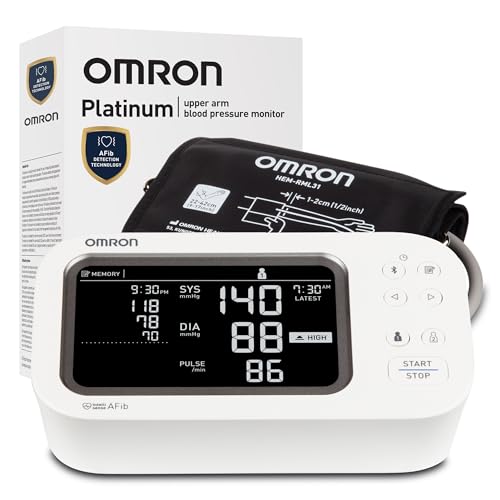
Connected Heart-Health Pick – OMRON Platinum
The OMRON Platinum combines clinically validated home monitoring with AFib detection, dual-user storage, and app connectivity. It is not a dedicated clinic unit, but its reporting features can help users organize readings to discuss with a doctor.
Best For: Home users who want advanced rhythm screening, trend tracking, and shareable digital records.
Pros:
- AFib Detection screens for unusual heart rhythms during measurements.
- Stores 100 readings each for two users.
- Bluetooth connectivity works with the OMRON connect app, Apple Health, and Google Fit.
- Includes a wide-range cuff for 9- to 17-inch arms, an AC adapter, case, and batteries.
Cons:
- The included cuff does not cover arms outside the listed 9- to 17-inch range.
- Its connected features may be unnecessary for buyers who only need basic readings.
Choose this model when data management and heart-rhythm context matter as much as the blood pressure reading itself. The high-morning-average indicator and app reports add useful tracking tools for ongoing home monitoring.
Multi-User Convenience Pick – Saker No-Wrap BP Monitor
The Saker is a no-wrap, FDA-cleared upper-arm monitor built for straightforward household tracking. Its four-user memory and large display make it practical for families, although its home-focused design is less tailored to professional measurement protocols than dedicated commercial-grade blood pressure monitors.
Best For: Households that need simple operation and separate long-term records for several users.
Pros:
- Slide-in design eliminates traditional cuff wrapping.
- Supports four users with up to 199 stored readings per user.
- Large display and one-touch operation suit adults and seniors.
- Can run from a USB port using the included data cable.
Cons:
- The listed arm-fit range is narrower than the professional OMRON option.
- It lacks the advanced app connectivity and AFib features offered by the OMRON Platinum.
For a busy household, the Saker’s storage capacity is its strongest advantage. The no-wrap format reduces setup friction, while USB operation can help avoid frequent battery changes during regular use.
Clinical-Grade Pick – Welch Allyn Home 1700
For shoppers comparing commercial-grade blood pressure monitors, the Welch Allyn Home 1700 stands out for its SureBP clinical-grade technology, one-touch operation, and fast readings. It includes a standard wide-size upper-arm cuff and now works with the Welch Allyn Home by VSee app for tracking and sharing measurements.
Best For: Users who prioritize physician-associated technology, quick measurements, and app-based tracking.
Pros:
- Uses SureBP technology featured in Welch Allyn vital signs monitors.
- Captures readings in about 20 seconds while inflating to reduce squeezing.
- One-touch operation and compatibility with Apple and Android devices through the updated app.
- Additional extra-small and extra-large cuffs are available separately.
Cons:
- The package includes a standard wide-size cuff; other sizes require separate purchase.
- Requires four AA batteries, though batteries are included.
This is the strongest fit for buyers seeking a recognized clinical-technology approach in a straightforward home monitor. Correct cuff sizing and proper positioning remain important for accurate readings.
Most Flexible Cuff Kit – AQESO Upper-Arm Monitor
The AQESO is a practical option among commercial-grade blood pressure monitors for households sharing one device. Its three included cuffs cover arms from 7 to 21 inches, while a backlit display, one-touch operation, and extensive per-user memory make routine monitoring easier.
Best For: Families or households needing multiple cuff sizes and separate reading histories.
Pros:
- Includes small, medium/large, and extra-large cuffs for 7- to 21-inch arms.
- Supports three users with up to 500 stored readings per user.
- Large backlit LCD and WHO classification bar improve readability.
- Can run on four AAA batteries or USB Type-C power.
Cons:
- USB use requires a continuous power connection; the device is not rechargeable.
- Its software-update support is listed as unknown.
The included cuff range is the main advantage here, especially when several people with different arm sizes share the monitor. Its memory capacity also makes it useful for tracking trends over time without relying on a phone.
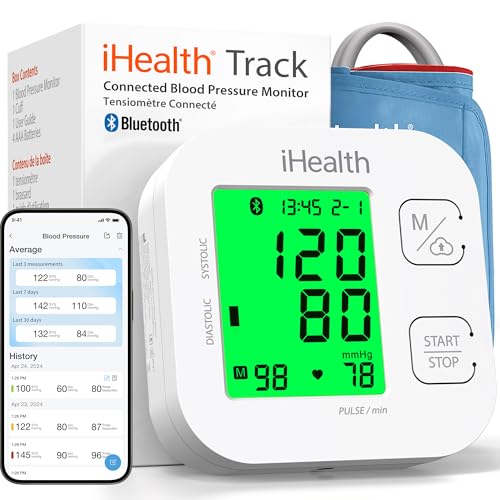
Best Connected Simplicity – iHealth Track Smart Monitor
The iHealth Track offers a simple, connected approach for shoppers evaluating commercial-grade blood pressure monitors. It uses two-button operation, provides a large multicolor display, stores up to 99 readings on the device, and can sync unlimited readings to the iHealth app on compatible iOS and Android phones.
Best For: Smartphone users who want uncomplicated operation, visual reading feedback, and app-based history.
Pros:
- Meets ESH 2010 performance standards and requires no calibration.
- Large green/yellow/red backlit display makes results easier to interpret at a glance.
- Tracks 99 readings on the monitor and unlimited readings in the iHealth app.
- Automatically identifies and alerts users to potential heart rhythm disturbances.
Cons:
- The included wide-range cuff fits 8.7- to 16.5-inch upper arms, a narrower range than the AQESO kit.
- App use requires compatible Bluetooth 4.0 hardware and supported iOS or Android versions.
- Includes a one-year warranty rather than a longer coverage period.
This monitor is a good match for buyers who value easy controls and smartphone history more than multiple cuff options. Read the manual carefully and follow the setup guidance before relying on measurements.
Best for High-Capacity Tracking – Invaxe Automatic Upper Arm Monitor
For shoppers comparing commercial-grade blood pressure monitors, the Invaxe stands out for its generous memory, oversized display, and flexible power options. It supports two users with 199 stored readings per person, calculates the average of the last three measurements, and includes irregular-heartbeat detection.
Best For: Households that need extensive reading storage, an easy-to-read display, and a cuff suitable for larger adult arms.
Pros:
- Stores up to 199 readings for each of two users.
- Large 4.5-inch backlit screen with oversized numbers and buttons.
- Includes a 9-to-17-inch cuff, USB cable, four AAA batteries, and carrying bag.
- Automatically detects irregular heartbeats and averages the last three readings.
Cons:
- The USB cable is included, but an AC adapter is not.
- Its feature set is geared toward home monitoring rather than app-based tracking.
Choose this model if accessible controls and long-term on-device history matter more than smartphone connectivity. The dual-user memory and portable design make it practical for shared household use.
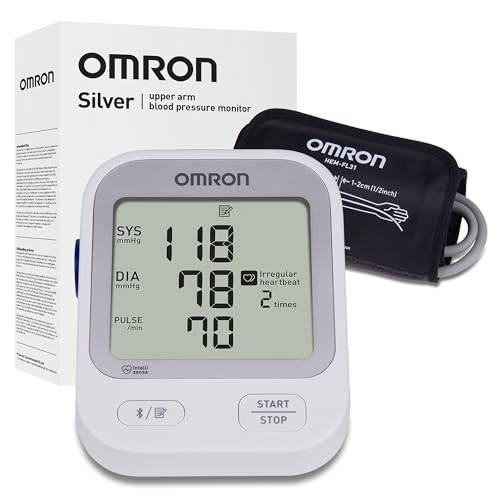
Best for Connected Health Tracking – OMRON Silver Upper Arm Monitor
The OMRON Silver is a strong option for buyers seeking commercial-grade blood pressure monitors with app connectivity. Its Advanced Accuracy Technology, irregular-heartbeat detection, hypertension indicator, and Bluetooth connection support routine monitoring and convenient sharing with a doctor.
Best For: Users who want a trusted-brand upper-arm monitor with Bluetooth trend tracking and broad 9-to-17-inch cuff coverage.
Pros:
- Connects to the OMRON connect app for unlimited stored readings and trend reports.
- Compatible with Apple Health and Google Fit.
- Detects irregular heartbeats and provides a hypertension indicator.
- Includes a ComFit cuff, storage case, and four AA batteries.
Cons:
- The monitor itself stores up to 30 readings.
- It is battery powered and does not list an alternate power source.
The Silver model makes the most sense when digital recordkeeping is part of your monitoring routine. Bluetooth app support adds more useful history and sharing options than relying on the device’s onboard memory alone.
Best for Simple Connected Monitoring – OMRON Bronze Upper Arm Monitor
The OMRON Bronze offers a straightforward way to compare commercial-grade blood pressure monitors without giving up smartphone connectivity. It combines Advanced Accuracy Technology with irregular-heartbeat detection, a hypertension indicator, and Bluetooth access to the OMRON connect app.
Best For: Adults who want a clinically validated upper-arm monitor with essential alerts and app-based tracking in a simple package.
Pros:
- Bluetooth connects with the OMRON connect app for unlimited reading storage and trends.
- Includes irregular-heartbeat detection and a hypertension indicator.
- Wide-range 9-to-17-inch D-ring cuff accommodates many adult arms.
- Comes with a storage case, quick-start guide, and four AA batteries.
Cons:
- On-device memory is limited to 14 readings.
- Battery power is the listed power source.
This is a practical pick for users who plan to use the app as their main recordkeeping tool. Its smaller onboard memory is less restrictive when readings are routinely transferred to a phone.
How We Picked the Best Commercial-Grade Blood Pressure Monitors
We evaluated these monitors for the features that matter during repeated, routine measurements: upper-arm operation, cuff fit, ease of positioning, display readability, memory capacity, measurement guidance, and data-sharing options. We also considered whether a model is suited to professional environments, home-care programs, or individual users managing readings over time.
“Commercial-grade” does not automatically mean every device is appropriate for every clinical application. Before buying for a medical practice, confirm the model’s current validation status, regulatory clearance, warranty, and compatibility with your organization’s procedures.
Quick Comparison
| Best For | Features to Prioritize | Recommended Type |
|---|---|---|
| Clinics and care teams | Durable construction, repeatable readings, easy cleaning, professional cuff options | Professional or clinical-style upper-arm monitor |
| Home monitoring | Simple controls, large display, memory, correct cuff sizing | Automatic upper-arm monitor |
| Multiple users | Separate memory profiles or generous reading storage | Multi-user smart monitor |
| Remote tracking | Bluetooth or app support, exportable history, dependable synchronization | Connected upper-arm monitor |
| Households with varied arm sizes | Wide-range or multiple interchangeable cuffs | Monitor with expanded cuff coverage |
Key Buying Factors for Commercial-Grade Blood Pressure Monitors
Validation and Measurement Consistency
Look for documented clinical validation or FDA clearance where applicable, and follow the manufacturer’s positioning instructions. A high-quality monitor cannot compensate for unsupported feet, a talking user, a crossed arm, or an incorrectly placed cuff.
Cuff Size and Fit
Cuff fit is one of the most important purchasing decisions. Measure the user’s upper-arm circumference and choose a cuff whose stated range includes it. Wide-range cuffs are convenient, while multiple cuffs may provide a better fit for teams serving many patients.
Workflow and Data Management
For repeated measurements, prioritize fast setup, clear buttons, readable screens, and automatic storage. App connectivity can simplify trend sharing, but it should not replace a usable device when a phone is unavailable.
Durability and Ownership Costs
Professional buyers should review warranty coverage, replacement cuffs, batteries or adapters, cleaning guidance, and expected usage. A slightly higher upfront price may be worthwhile if accessories are readily available and the device supports frequent operation.
Who Should Buy Which Commercial-Grade Blood Pressure Monitors?
Choose a professional or clinical-style model for clinics, home-health teams, and organizations that need a more durable workflow and dependable repeat measurements.
Choose a simple automatic upper-arm monitor for household users who want straightforward readings, large controls, and stored results without app setup.
Choose a wide-range or multi-cuff option when several people will share the monitor or arm sizes vary substantially.
Choose a connected model if you regularly send readings to a clinician or maintain digital blood pressure logs. Regardless of category, confirm cuff fit, sit quietly for several minutes, and take measurements according to your healthcare professional’s instructions.