Reliable humidity control is essential when valuable cameras, lenses, and electronic equipment are stored in damp or changing conditions. The best commercial-grade camera dry cabinets provide enclosed protection, adjustable storage, and precise digital control without taking up unnecessary space.
Our roundup compares 10 cabinets across 30L to 125L capacities, including lockable designs, multi-shelf layouts, LED displays, and energy-saving dehumidification systems. Use the guide below to match cabinet size and features to your equipment collection.
Best 10 Commercial-Grade Camera Dry Cabinets Picks for 2026
Compact Professional Pick

- 50-liter electronic dry cabinet
- 35–60% RH adjustment with LCD
- Locking door, LED light, and padded shelves
Best For: Compact camera and lens collections
Large-Capacity Studio Choice

- 125-liter cabinet with four adjustable shelves
- 25–60% RH control and real-time monitoring
- Quiet, lockable steel-and-glass construction
Best For: Studios and extensive professional gear collections
Wide-Cabinet Workhorse

- 80-liter electronically controlled cabinet
- Adjustable steel shelves with foam liners
- 35–60% RH range, LCD, LED, and lock
Best For: Medium-sized gear collections needing sturdy shelving
Precision-Control Value

- 100-liter-class cabinet with five layers
- 25–60% RH range with stated ±1% accuracy
- Dual display and low 8W operation
Best For: Quiet, digitally monitored camera and lens storage
Compact Pro Pick
RUGGARD EDC-30LC 30L Dry Cabinet

- 30L compact storage with electronically controlled humidity reduction
- Combination lock and sealed, water-resistant door
- Includes adjustable shelf, liners, LED light, and LCD display
Best For: Small camera and lens collections in space-conscious workspaces
High-Capacity Workhorse
Slinger 125L Five-Shelf Dry Cabinet

- 125L capacity for cameras, long lenses, and electronics
- Five foam-padded shelves for organized storage
- 30–60% humidity control with dual LED monitoring
Best For: Studios and photographers with extensive equipment collections
Design-Focused Large Cabinet
Oak 125L Electronic Dry Cabinet

- 125L humidity-controlled storage with oak finish
- 30–60% control and quiet thermoelectric dehumidification
- Combination lock, sealed doors, and adjustable padded shelves
Best For: Large home or office setups where appearance and capacity both matter
Best Overall Capacity
80L Digital Dehumidifying Dry Cabinet

- 80L storage with four adjustable slide-out shelves
- 25%–60% RH control with dual digital display
- Quiet 8W operation with lockable glass door
Best For: Studios and photographers storing substantial camera collections
Best Touchscreen Option

- 85L capacity with four adjustable shelves
- Touch-screen controls and real-time humidity monitoring
- Lockable glass door with built-in LED lighting
Best For: Users wanting roomy storage and modern touch controls
Best Compact Value
50L Digital Dehumidifying Dry Cabinet
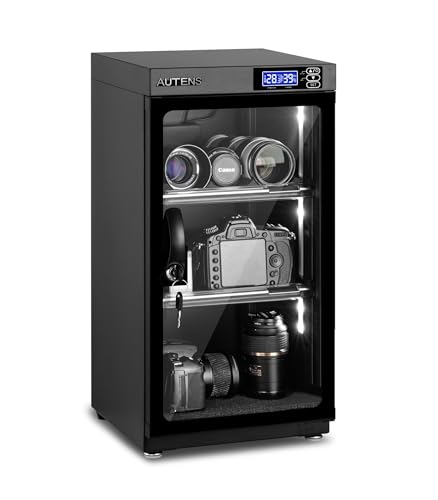
- 50L storage with three adjustable slide-out shelves
- 25%–60% RH control with claimed ±1%RH accuracy
- Quiet 8W design with dual display and lockable door
Best For: Smaller studios and moderate camera collections
Compact Professional Pick – RUGGARD EDC-50L
For buyers seeking commercial-grade camera dry cabinets in a compact format, the RUGGARD EDC-50L combines electronic moisture control, a locking sealed door, and adjustable shelving in a 50-liter cabinet. Its 35–60% RH range and multi-voltage power supply make it practical for cameras, lenses, and other photographic equipment.
Best For: Photographers who need a space-efficient cabinet for essential camera and lens storage.
Pros:
- Electronically adjustable humidity control from 35–60% RH.
- Locking sealed door, interior LED lighting, and easy-to-read LCD.
- Adjustable shelves include padded and contoured foam liners.
- Virtually silent operation with automatic moisture removal.
Cons:
- 50-liter capacity is more limited than larger cabinets for extensive collections.
- Plastic shelving may be less substantial than steel-shelf alternatives.
The EDC-50L is a sensible starting point for a controlled, lockable storage setup when floor space matters more than maximum capacity.
Large-Capacity Studio Choice – FORSPARK 125L
The FORSPARK 125L is a strong option among commercial-grade camera dry cabinets for studios, professional users, and larger equipment collections. Its spacious layout, four adjustable shelves, real-time humidity monitoring, and steel-and-tempered-glass construction are designed for organized, long-term storage.
Best For: Professionals storing multiple camera bodies, telephoto lenses, drones, and collectibles.
Pros:
- Large 125-liter capacity with four adjustable shelves and five storage zones.
- Maintains a stated 25–60% RH range with real-time monitoring.
- Cold-rolled steel frame, 4mm tempered glass, and magnetic sealing help block dust and humidity.
- Quiet operation under 30dB, 15W power use, LED lighting, and child-safe locking.
Cons:
- Its larger footprint requires more dedicated floor space.
- The cabinet is not rated as water resistant.
- Only one included component is listed as a shelf, despite the advertised four-shelf layout.
With its high capacity and modular interior, the FORSPARK is particularly appealing when a growing gear inventory needs clear separation and quick access.
Wide-Cabinet Workhorse – RUGGARD EDC-80L
For photographers comparing commercial-grade camera dry cabinets with a wider footprint, the RUGGARD EDC-80L offers 80 liters of electronically controlled storage. It includes adjustable steel shelves, foam liners, a sealed locking door, and a 35–60% RH setting range for cameras, lenses, and related electronics.
Best For: Users who want sturdier steel shelving and a broad cabinet layout for medium-sized gear collections.
Pros:
- 80-liter capacity with two adjustable steel shelves.
- Electronic humidity adjustment from 35–60% RH with an easy-to-read LCD.
- Sealed locking door, interior LED lighting, and two keys.
- Low 8W power use and virtually silent operation.
Cons:
- Its horizontal, wide design may be less suitable for narrow spaces.
- Capacity is below the 125-liter option for very large collections.
The EDC-80L balances capacity and durable shelving, making it a practical middle ground for photographers who need more room than a compact cabinet provides.
Precision-Control Value – AUTENS AD-100L
The AUTENS AD-100L is a practical choice for buyers evaluating commercial-grade camera dry cabinets with digital monitoring and low energy use. Its microprocessor-controlled TE cooling system, dual temperature-and-humidity display, and 25–60% RH range support stable storage for camera equipment and other sensitive valuables.
Best For: Users who prioritize precise digital monitoring, quiet operation, and a large multi-shelf cabinet.
Pros:
- 100-liter-class storage with five layers and adjustable sliding shelves.
- Stated humidity accuracy of ±1% RH from laboratory data.
- Dual display shows temperature and humidity simultaneously.
- 8W operation, noiseless and heatless design, LED lighting, and a lockable glass door.
Cons:
- The supplied specifications list both 100-liter tank volume and 105-liter capacity, so buyers should verify the usable volume.
- Product dimensions and naming details are presented inconsistently in the supplied specifications.
The AD-100L stands out for its display and stated precision, while its five-layer layout gives photographers flexibility when organizing lenses and other electronic equipment.
Compact Pro Pick – RUGGARD EDC-30LC 30L Dry Cabinet
For photographers seeking commercial-grade camera dry cabinets in a compact format, the RUGGARD EDC-30LC combines electronically controlled humidity reduction with practical protection. Its 30-liter interior, combination lock, foam lining, and adjustable shelf suit smaller collections of cameras, lenses, and sensitive gear.
Best For: Photographers who need secure, space-efficient storage for a modest equipment collection.
Pros:
- Electronically reduces relative humidity from 60% to 35%.
- Combination lock, sealed door, and water-resistant construction add protection.
- Includes adjustable shelf, padded liners, interior LED lighting, and LCD display.
- Virtually silent operation and included multi-voltage power supply support convenient placement.
Cons:
- 30-liter capacity is limited for large camera systems or extensive lens collections.
- Only one storage compartment is listed.
The EDC-30LC is a sensible choice when secure, quiet, low-humidity storage matters more than maximum capacity. Its compact footprint and included interior fittings make it especially practical for home studios and smaller workspaces.
High-Capacity Workhorse – Slinger 125L Five-Shelf Dry Cabinet
This 125-liter Slinger cabinet is one of the more spacious commercial-grade camera dry cabinets for organizing multiple DSLR or mirrorless bodies, long lenses, and electronic equipment. Thermoelectric dehumidification, dual LED monitoring, five padded shelves, and a combination lock create a practical storage setup for larger collections.
Best For: Photographers, studios, and equipment owners needing high-capacity, multi-shelf storage.
Pros:
- 125-liter capacity provides substantially more room than compact cabinets.
- Humidity can be programmed between 30% and 60%.
- Five foam-padded shelves support flexible organization.
- Quiet, energy-efficient thermoelectric operation uses less than 15W and produces no additional heat.
Cons:
- Its large freestanding form requires more floor space.
- The supplied information does not specify the cabinet’s exterior dimensions.
Choose the Slinger when capacity and organization are priorities. Its five shelves and live temperature-and-humidity display make it well suited to a busy studio, while quiet thermoelectric operation allows placement in living or working areas.
Design-Focused Large Cabinet – Oak 125L Electronic Dry Cabinet
For buyers who want commercial-grade camera dry cabinets with a more furniture-friendly appearance, this oak-finish 125-liter model pairs humidity control with a distinctive wood-tone exterior. Its combination lock, sealed double doors, adjustable foam-padded shelves, and digital display support organized storage for cameras, lenses, drones, microphones, and electronics.
Best For: Home studios, offices, and photographers who want large-capacity storage with an oak finish.
Pros:
- 125-liter capacity accommodates bodies, long lenses, video gear, and audio equipment.
- Adjustable humidity control spans 30% to 60%.
- Quiet thermoelectric system uses less than 15W and avoids compressor heat buildup.
- Combination lock, dual rubber-sealed doors, and real-time LED readings add convenience and protection.
Cons:
- At 33.5 inches deep, 17 inches wide, and 37.8 inches high, it needs substantial space.
- Only three shelves are listed, fewer than the comparable five-shelf model.
The oak cabinet is a strong fit when appearance matters alongside storage volume. It offers the capacity and humidity range needed for a broad equipment collection, but buyers should plan carefully for its full-size footprint.
Best Overall Capacity – 80L Digital Dehumidifying Dry Cabinet
For photographers comparing commercial-grade camera dry cabinets, the AUTENS 80L model combines high storage capacity with automatic humidity monitoring. Its microprocessor-controlled TE cooling system maintains a selectable 25%–60% RH range, making it suitable for organized storage of camera gear and other moisture-sensitive equipment.
Best For: Studios, equipment rooms, and photographers needing generous capacity for multiple lenses, cameras, or mixed valuables.
Pros:
- 80L tank volume with four adjustable, slide-out shelves.
- Automatic humidity control with claimed ±1%RH accuracy and a 25%–60% RH setting range.
- Uses 8W, operates noiselessly, and produces no heat according to the supplied specifications.
- Dual temperature-and-humidity display, interior LED lighting, sealed glass door, and lock.
Cons:
- The cabinet has a relatively deep 16.5-inch footprint, so placement space should be measured first.
- The supplied specifications list both 80L tank volume and 105L capacity, which may require clarification before purchase.
This is the strongest capacity-focused option in the group, especially where quiet operation, adjustable shelving, and detailed environmental control matter. Verify the listed dimensions and capacity information to ensure it fits your workspace and storage plan.
Best Touchscreen Option – 85L Touch-Screen Dry Cabinet
This 85L cabinet is a practical choice for shoppers seeking commercial-grade camera dry cabinets with a touch-screen interface. It monitors humidity in real time, automatically cycles dehumidification around the selected setting, and provides a visible temperature-and-humidity display for straightforward equipment storage.
Best For: Users who prioritize a modern touch-screen control panel and large cabinet capacity for camera lenses, electronics, or mixed valuables.
Pros:
- 85L capacity with four adjustable shelves for larger lenses and equipment.
- Automatic humidity control supports a 25%–60% RH range.
- Toughened magnetic glass door includes a lock and key, while interior LEDs improve visibility.
- Digital temperature and humidity display makes conditions easy to monitor.
Cons:
- The listed humidity accuracy is ±3%RH, less precise than the ±1%RH claim on the AUTENS models.
- The supplied details recommend residential use, so buyers should confirm suitability for demanding commercial environments.
- It should be run empty for eight hours initially to stabilize humidity.
The touch interface and 85L capacity make this model appealing when convenient controls and roomy storage are more important than the tightest stated humidity accuracy. Its residential-use designation is worth considering for professional installations.
Best Compact Value – 50L Digital Dehumidifying Dry Cabinet
For buyers who need commercial-grade camera dry cabinets without the footprint of a larger unit, the AUTENS 50L model offers automatic humidity control in a more compact format. It uses microprocessor monitoring and TE cooling to maintain a selectable 25%–60% RH environment for camera equipment and other moisture-sensitive items.
Best For: Smaller studios, offices, and photographers who need dedicated storage for a moderate camera and lens collection.
Pros:
- 50L tank volume with three adjustable, slide-out shelves.
- Claims ±1%RH humidity accuracy and automatic cycling within the 25%–60% RH range.
- 8W power use, noiseless operation, and no-heat design according to the supplied notes.
- Dual temperature-and-humidity display, interior LEDs, and a lockable sealed glass door.
Cons:
- Its three shelves and 50L volume provide less room than the 80L and 85L alternatives.
- The supplied specifications list both 50L tank volume and 105L capacity, so capacity details should be confirmed.
- The listed dehumidification capacity is 5 liters per day, which may be less suitable for unusually damp environments.
This model is the sensible space-conscious pick, retaining the key monitoring, shelving, and locking features of the larger AUTENS cabinet. Choose it when your gear collection is moderate and a smaller storage solution is preferable.
How We Picked the Best Commercial-Grade Camera Dry Cabinets
We evaluated these cabinets by focusing on the factors that matter most for long-term equipment storage: usable capacity, humidity-control design, shelf configuration, display readability, access security, operating noise, energy efficiency, and overall practicality. Capacity ratings are useful starting points, but internal shelf spacing and cabinet dimensions determine how well a model accommodates camera bodies, long lenses, flashes, and accessories.
We also considered the needs of photographers, studios, retailers, schools, and production teams that may require more consistent protection than a basic storage box can provide. Since features vary by model and configuration, verify the current specifications, included shelves, dimensions, and warranty before ordering.
Quick Comparison
| Capacity range | Best suited to | Typical advantage |
|---|---|---|
| 30L–50L | Small personal kits | Compact footprint and lower cost |
| 80L–85L | Growing collections | More room for multiple bodies and lenses |
| 100L–125L | Studios and shared equipment | High-capacity storage with flexible shelving |
Key Buying Factors for Commercial-Grade Camera Dry Cabinets
Capacity and Shelf Layout
Choose a cabinet with extra room rather than filling every shelf immediately. A 30L or 50L model can suit one compact kit, while 80L and larger cabinets are more practical for multiple camera bodies, telephoto lenses, drones, or shared equipment. Adjustable or removable shelves make it easier to store items of different heights.
Humidity Control and Display
Look for a clear digital humidity display and controls that are simple to adjust. A stable target range is generally more useful than a wide adjustment range, and an easy-to-read display helps you confirm operation at a glance. Avoid assuming that a cabinet controls temperature unless the manufacturer specifically states it.
Build Quality, Access, and Security
Solid doors, dependable seals, sturdy shelves, and consistent construction matter for frequent use. A combination lock can add convenient access control in studios, classrooms, or retail environments, although it should not be treated as a replacement for a secure room or alarm system.
Noise, Power, and Placement
For bedrooms, editing rooms, and client-facing spaces, noiseless or low-noise operation is a meaningful advantage. Check power requirements and leave adequate ventilation around the cabinet. Place it on a stable, level surface away from direct sunlight, leaks, and large temperature swings.
Who Should Buy Which Commercial-Grade Camera Dry Cabinets?
Choose a 30L–50L cabinet if you need dedicated protection for one camera system, a few lenses, or a compact electronics collection. These models are easier to place in smaller offices and workspaces.
Choose an 80L–85L cabinet for a growing enthusiast kit or a working photographer who needs room for several bodies, lenses, and accessories while maintaining a manageable footprint.
Choose a 100L–125L cabinet for studios, retailers, schools, and teams sharing equipment. The added volume and shelf space reduce crowding and make inventory easier to organize. A lockable model is especially useful where multiple people need controlled access.