If you’re looking to enhance your Plex streaming experience, choosing the right NAS is essential. The TERRAMASTER F4-425 and F2-425 models offer impressive features like powerful CPUs and efficient transcoding capabilities. But what exactly sets them apart for your media needs? Let’s explore their key attributes to help you make a well-informed decision.
TERRAMASTER F4-425 4-Bay NAS Storage

The TERRAMASTER F4-425 4-Bay NAS Storage is perfect for media enthusiasts who crave seamless 4K transcoding for their Plex library. With its Intel x86 Quad-Core CPU and 4GB RAM, you’ll effortlessly manage multiple streams. The 2.5GbE LAN port guarantees ultra-fast file transfers, enhancing your overall experience. You can expand your storage up to 120TB and enjoy hardware-level 4K H.265 decoding. Plus, the user-friendly TNAS Mobile app simplifies setup and synchronization. With quiet operation at only 21dB(A), this NAS fits perfectly in any environment, making it an ideal choice for anyone looking to elevate their media streaming game.
Best For: Media enthusiasts looking for seamless 4K transcoding and multi-stream capabilities.
Pros:
- Ultra-fast file transfers with 2.5GbE LAN port for enhanced performance.
- User-friendly mobile app for easy setup, photo/video backups, and synchronization.
- Supports up to 120TB of storage, accommodating extensive media libraries.
Cons:
- Diskless design requires additional investment in hard drives.
- Initial setup may require some technical knowledge for optimal configuration.
- Limited to 4 bays, which may be insufficient for users with larger storage needs.
TERRAMASTER F2-425 2-Bay NAS Storage
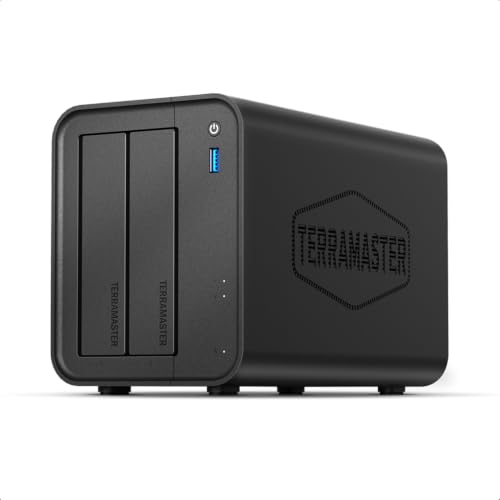
For those seeking a powerful yet compact solution for multimedia streaming, the TERRAMASTER F2-425 2-Bay NAS Storage stands out with its impressive Intel x86 quad-core CPU and 4GB of RAM. You’ll enjoy ultra-fast file transfers thanks to its 2.5GbE LAN, making 4K transcoding and multitasking a breeze. Compatible with Plex, Emby, and Jellyfin, it guarantees smooth HD playback. You can manage everything via the TNAS Mobile app, and with its tool-free design, HDD installation takes just 10 seconds. Plus, the F2-425 supports up to 60TB storage, allowing your media library to grow without limits.
Best For: Those who need a high-performance NAS solution for seamless multimedia streaming and extensive storage capacity.
Pros:
- Ultra-fast file transfers with 2.5GbE LAN and efficient 4K transcoding capabilities.
- User-friendly setup and management via TNAS Mobile app, with tool-free HDD installation.
- Flexible storage options supporting up to 60TB and advanced security features for data protection.
Cons:
- Limited to 2 bays, which may not be sufficient for users with larger storage needs.
- 4GB RAM might be inadequate for extensive multitasking in more demanding environments.
- Noise level at 19dB(A) may not be suitable for extremely quiet settings.
Factors to Consider When Choosing Nas With GPU Transcoding for Plex
When you’re choosing a NAS with GPU transcoding for Plex, you need to take into account several key factors. Look at transcoding capabilities to guarantee smooth streaming, along with storage capacity options that fit your media library. Don’t forget to check network speed requirements and multimedia compatibility to enhance your viewing experience.
Transcoding Capabilities
Choosing the right NAS with GPU transcoding for Plex hinges on understanding its transcoding capabilities. You’ll want a device that can convert video files in real-time, especially for high-definition content. Look for NAS options that support hardware-level decoding, like 4K H.265, to boost playback efficiency and lessen CPU strain. If you have multiple users streaming simultaneously, confirm the NAS can handle several transcoding streams without causing buffering issues. A powerful processor, such as an Intel x86 quad-core CPU, can drastically enhance transcoding performance, allowing quicker file conversions and better multitasking. Finally, make sure the NAS has at least 4GB of RAM to support efficient transcoding and prevent slowdowns during peak usage.
Storage Capacity Options
Transcoding capabilities are just one part of the equation; storage capacity plays a significant role in your NAS selection for Plex. When choosing a NAS, consider the maximum storage capacity—2-bay systems can hold up to 60TB, while 4-bay systems can accommodate 120TB. The number of bays directly impacts your total storage potential, with each bay typically supporting high-capacity drives, such as 30TB each. Also, think about RAID configurations; for instance, TRAID can boost storage efficiency by up to 30%. Scalability is crucial, too—some NAS models allow future upgrades by adding or replacing drives. Finally, verify you balance storage capacity with performance to maintain smooth streaming and transcoding without lag.
Network Speed Requirements
To guarantee smooth streaming, especially with high-resolution content like 4K, you’ll need to pay close attention to your network speed requirements. A 2.5GbE LAN connection is ideal, offering bandwidth up to 2.5 Gbps for ultra-fast file transfers. This is essential if you’re streaming multiple concurrent videos. Make sure your network’s upload and download speeds exceed 100 Mbps to avoid buffering issues during playback and transcoding. Also, consider how many users will access the NAS at once; each added stream demands more bandwidth. Utilizing DLNA support can streamline multi-device streaming, helping you manage network traffic efficiently and ensuring quality video playback across all your devices. Prioritize these factors for the best streaming experience.
User Management Features
When you’re looking for a NAS with GPU transcoding capabilities for Plex, user management features play an essential role in guaranteeing seamless access and security for everyone in your household or team. Look for NAS devices that support 50+ independent user accounts, allowing efficient management of access for multiple users. Ascertain the NAS has customizable permissions, so you can control who accesses specific files and folders. Integrated security modules, like SPC, enhance data protection and user management. Consider systems with mobile apps that simplify user setup and enable real-time synchronization of data across devices. Finally, evaluate if the NAS supports various user roles, allowing differentiated access levels and responsibilities among family members or team members.
Multimedia Compatibility Support
User management features set the stage for a seamless experience, but multimedia compatibility support takes it to the next level, especially when you’re planning to use your NAS for GPU transcoding with Plex. Confirm your NAS supports hardware-level decoding formats like 4K H.265, as this optimizes your streaming performance. Look for NAS devices compatible with popular media server applications, including Plex, Emby, and Jellyfin, to enhance video playback capabilities. Additionally, choose a NAS that supports DLNA for smooth streaming across multiple devices. Intelligent photo management tools, like AI smart album functionality, are also a plus for organizing your images. Finally, confirm your NAS can handle multitasking and concurrent access, allowing multiple users to stream without any performance hiccups.
Installation Ease
Choosing a NAS with GPU transcoding capabilities for Plex becomes much smoother if you prioritize installation ease. Look for NAS systems with tool-free installation designs, letting you set up HDDs quickly—often in about 10 seconds—without any extra tools. Consider units that support mobile app setup, allowing you to configure them conveniently from your smartphone instead of a PC. Efficient file management features like automatic photo and video backups can streamline the process and enhance your overall experience. Additionally, verify your NAS can multitask effectively, so installation doesn’t interfere with performance during transcoding or file transfers. By focusing on these aspects, you’ll enjoy a hassle-free setup and a seamless streaming experience.
Noise Level Considerations
After enjoying an easy installation process, the next factor to take into account is the noise level of your NAS. Noise levels can greatly impact your comfort, especially in noise-sensitive spaces like bedrooms or home theaters. Look for models that operate around 19-21 dB(A), as this range is comparable to a quiet library. A quiet NAS not only enhances your streaming experience but also keeps your environment peaceful. When selecting a NAS for GPU transcoding, prioritize those that balance powerful performance with low operational noise. Pay attention to design and cooling mechanisms, as efficient airflow can lead to quieter operation. Ultimately, you want a NAS that delivers seamless streaming without disturbing your space.
Data Security Measures
When it comes to selecting a NAS with GPU transcoding for Plex, data security measures should be a top priority. Look for systems that support multiple user accounts—ideally 50 or more—to manage access control effectively. Consider NAS options with flexible data redundancy solutions like TRAID or TRAID+, which offer better storage efficiency than traditional RAID setups. Make sure your NAS includes an SPC security module to safeguard against unauthorized access and data breaches. Cloud synchronization capabilities with services like Google Drive, OneDrive, and Dropbox provide secure off-site backups. Finally, features like TerraSync enable two-way synchronization between your NAS and PCs or Macs, enhancing data protection and accessibility for all users.