Charging several devices from one battery sounds simple—until you run out of ports, forget a cable, or find that charging slows when everything is plugged in. The right power bank depends on what you carry and how long you’ll be away from an outlet.
These 10 options span compact, built-in-cable chargers, large-capacity phone backups, and higher-wattage USB-C models suited to some laptops. Here’s how to choose the one that fits your setup.
Best 10 Power Bank for Multiple Devices Picks for 2026
Most Charging Options
50,800mAh Power Bank with Built-In Cables

- Six simultaneous outputs
- Three built-in cable types
- Up to 25W USB-C PD
Best For: Groups with mixed devices and limited access to outlets
Best Lighter Pick
LanLuk 40,800mAh Five-Device Charger

- Five simultaneous outputs
- Listed weight of 14.5 oz
- Up to 25W fast charging
Best For: Ground travel and outdoor trips with several devices
Best Cable Variety
YILANS 50,000mAh Charger with Four Built-In Cables

- Four integrated cable types
- Charges up to six devices
- Up to 22.5W fast charging
Best For: Groups with mixed connectors that want fewer loose cables
Largest Stated Capacity
IAPOS 60,000mAh Five-Device Power Bank
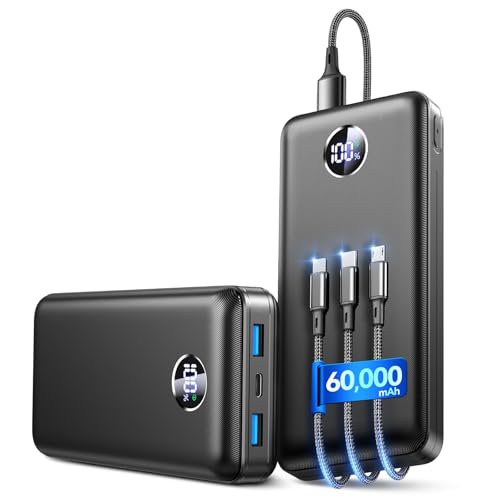
- 60,000mAh stated capacity
- Charges up to five devices
- Up to 22.5W fast charging
Best For: Extended off-grid use with several small electronics
Best for Laptop and Phone
UGREEN Nexode 145W 25,000mAh Power Bank

- Up to 145W total output
- Two USB-C ports and one USB-A port
- Digital battery-level display
Best For: Travelers charging a laptop and smaller devices
Best for Shared Phone Charging
YILANS 50,000mAh Power Bank with Built-In Cables

- Four built-in cables
- Charges up to six devices at once
- LED battery-percentage display
Best For: Groups sharing power for phones and accessories
Best for Two High-Power Devices
UGREEN Nexode 200W 25,000mAh Power Bank

- Up to 200W combined output
- Three charging ports
- TFT display with power details
Best For: Charging two demanding USB-C devices
Best Cable-Free Setup

- Four built-in cables
- Charges up to six devices
- 22.5W output and digital display
Best For: Groups sharing a charger on trips
Best for Extended Trips

- Five simultaneous outputs
- Two USB-A ports rated up to 30W
- About 1 kg; not for laptops
Best For: Group USB charging on extended trips
Best Slim Cable-Included Pick

- Four built-in connectors
- 19mm-thick design
- 22.5W charging and digital display
Best For: Commuting and weekend trips with several devices
Most Charging Options – 50,800mAh Power Bank with Built-In Cables
If you need a power bank for multiple devices without packing separate cords, this 50,800mAh model combines built-in USB-C, iPhone-compatible, and Micro-USB cables with three additional ports. Its six outputs can charge up to six devices at once.
Best For: Groups carrying a mix of phones, tablets, and older Micro-USB accessories on extended outings.
Pros:
- Six outputs and two ways to recharge the power bank.
- Up to 25W PD charging through the built-in USB-C cable or USB-C port.
- LCD shows the remaining battery level.
Cons:
- At 1.42 lb, it is better suited to a bag than a pocket.
- Sharing six outputs does not mean every device receives the maximum 25W.
Choose this one for connection flexibility and substantial reserve capacity; its size is the trade-off for the all-in-one design.
Best Lighter Pick – LanLuk 40,800mAh Five-Device Charger
This LanLuk power bank for multiple devices offers five simultaneous outputs in a listed 14.5 oz package. It pairs built-in USB-C and iPhone-compatible output cables with two USB-A ports and a USB-C port.
Best For: Road trips and outdoor use when you want several charging connections in a lighter pack.
Pros:
- Charges up to five devices at once.
- Supports up to 25W fast charging with compatible devices.
- LED display makes the remaining charge easy to check.
Cons:
- The product notes say this battery cannot be carried on flights.
- Its 40,800mAh stated capacity is lower than the other models here.
It is a practical choice for ground travel, particularly if you value a less bulky charger over the highest stated capacity.
Best Cable Variety – YILANS 50,000mAh Charger with Four Built-In Cables
For a power bank for multiple devices that keeps cords close at hand, this 50,000mAh YILANS model has four built-in cables: USB-C, iPhone-compatible, Micro-USB, and USB-A. It can power up to six devices simultaneously through its cables and ports.
Best For: Families or groups whose devices need different connectors and who want fewer loose cables.
Pros:
- Four integrated cable types cover a broad mix of devices.
- Up to 22.5W fast charging for compatible devices.
- Digital display shows the remaining battery percentage.
Cons:
- At about 503g, it adds noticeable weight to a day bag.
- Actual charging time varies by device and usage.
The built-in cable selection is its strongest reason to buy. Pick it when avoiding forgotten cords matters more than keeping your bag as light as possible.
Largest Stated Capacity – IAPOS 60,000mAh Five-Device Power Bank
If reserve capacity is your priority in a power bank for multiple devices, the IAPOS lists 60,000mAh—the highest stated capacity in this group. Two USB-A ports, a USB-C port, and a three-connector cable support charging up to five devices at once.
Best For: Camping, outages, or extended days away from outlets with several small electronics to charge.
Pros:
- 60,000mAh stated capacity for extended use.
- Supports up to 22.5W fast charging.
- Digital display tracks the remaining battery percentage.
Cons:
- The supplied notes give conflicting descriptions of whether the three-connector cable is integrated or included separately.
- Three device connections rely on that multi-connector cable rather than individual ports.
This model makes sense when maximum stated capacity comes first. Check the cable arrangement before buying if an attached, grab-and-go cable is essential.
Best for Laptop and Phone – UGREEN Nexode 145W 25,000mAh Power Bank
If you need a power bank for multiple devices that can handle a laptop alongside smaller gear, this UGREEN Nexode offers two USB-C ports, one USB-A port, and up to 145W total output.
Best For: Travelers carrying a laptop, phone, and another USB-powered device.
Pros:
- USB-C1 supports up to 140W for a compatible laptop.
- 25,000mAh capacity and three charging ports.
- Digital display shows remaining battery level.
Cons:
- A 65W or higher charger for the advertised roughly two-hour recharge is not included.
- Full USB-C performance requires the included 5A cable or another certified 5A cable.
Its strongest selling point is high-power laptop charging without giving up ports for a phone and accessory. Check your devices’ charging requirements to make the most of the available output.
Best for Shared Phone Charging – YILANS 50,000mAh Power Bank with Built-In Cables
For a power bank for multiple devices that minimizes loose cables, the YILANS combines four built-in cables with extra ports and supports charging up to six devices at once.
Best For: Groups or families sharing a charger for phones, tablets, and earbuds.
Pros:
- Four built-in cables reduce the need to pack separate leads.
- 50,000mAh stated capacity supports repeated device charging.
- LED display shows the remaining battery percentage.
Cons:
- 22.5W fast charging is less suited to high-power laptop needs than the higher-output options here.
- At a stated 503g, it adds noticeable weight to a bag.
Choose this model when the number of phones and accessories matters more than laptop-class output. Its built-in cables make shared charging especially convenient.
Best for Two High-Power Devices – UGREEN Nexode 200W 25,000mAh Power Bank
When a power bank for multiple devices needs to support demanding USB-C gear, this UGREEN Nexode delivers up to 200W total output across three ports, with two USB-C ports capable of a combined 200W.
Best For: Professionals or gamers who need to charge two high-power USB-C devices alongside a third device.
Pros:
- USB-C1 supports up to 140W and USB-C2 up to 100W individually.
- 25,000mAh capacity and three-device charging.
- TFT display shows battery level, remaining time, and power details.
Cons:
- At a stated 0.51 kg, it is not a lightweight pocket charger.
- Individual port maximums do not mean both USB-C ports can deliver their maximums simultaneously; combined output is capped at 200W.
This is the stronger fit when simultaneous USB-C power is the priority. The detailed display also helps you monitor how the bank is performing while devices are connected.
Best Cable-Free Setup – OHOVIV 50,000mAh Power Bank
If you want a power bank for multiple devices without packing a bundle of cords, the OHOVIV pairs a stated 50,000mAh capacity with four built-in cables and additional charging ports. It is geared toward shared charging on trips and at campsites.
Best For: Groups that need several phone and tablet charging options in one pack.
Pros:
- Supports charging up to six devices at once.
- Built-in phone, USB-C, Micro-USB, and USB-A cables reduce the need to carry separate cords.
- Up to 22.5W output and a digital battery display.
Cons:
- At 1.07 lb, it is substantial for a pocket charger.
- A wall charger is not included.
The integrated cables are the main reason to choose this model; its size and weight make it more comfortable in a bag than a pocket.
Best for Extended Trips – Liahomco 80,000mAh Power Bank
For camping or an extended power outage, this power bank for multiple devices emphasizes capacity over portability. Its stated 80,000mAh battery and five outputs let a group share power across phones, tablets, and other 5V USB gear.
Best For: Extended trips and group charging where the bank can stay in a pack or at a campsite.
Pros:
- Five outputs support charging five devices simultaneously.
- Two USB-A outputs are rated up to 30W, with a USB-C output rated up to 20W.
- LED battery display, textured grips, non-slip base, and lanyard aid campsite use.
Cons:
- Weighs about 1 kg, making it less convenient for everyday carry.
- Not compatible with laptops.
Choose this one when you need a shared USB charging reserve rather than a compact commuter battery; note that its ports do not make it a laptop charger.
Best Slim Cable-Included Pick – VRURC 20,000mAh Power Bank
If you need a power bank for multiple devices that is easier to carry than a high-capacity brick, the VRURC combines a stated 20,000mAh capacity with four built-in cables. Its 19mm-thick design suits commuting and weekend travel.
Best For: Travelers who want common charging connectors attached to a slimmer power bank.
Pros:
- Built-in Type-C, phone, Micro-USB, and USB-A connectors minimize loose cables.
- Additional USB-A and USB-C ports provide more connection options.
- Supports up to 22.5W charging and includes a digital display.
Cons:
- Its 20,000mAh stated capacity is lower than the other two models here.
- Built-in cable lengths may limit how far devices can sit from the bank.
This is the practical pick when cable convenience and a thin profile matter more than maximizing backup capacity.
How We Picked the Best Power Bank for Multiple Devices
We compared the listed capacities, port and built-in-cable arrangements, advertised charging wattages, and intended use of these 10 power banks. The selection covers two distinct needs: keeping several phones and accessories going, and supplying enough USB-C power for devices such as compatible laptops. Manufacturer capacity and wattage claims are useful starting points, not guarantees of real-world runtime or charging speed; we have not independently tested these products.
Quick Comparison: Which Type Fits Your Devices?
For phones, earbuds, and other small electronics, the built-in-cable models offer convenience when several people need to plug in. The VRURC 20,000mAh option is the smaller-capacity choice in this group; the roughly 40,000–50,800mAh models prioritize longer stretches between recharges. The IAPOS 60,000mAh and listed 80,000mAh models emphasize capacity, but expect more bulk.
If a laptop is on your packing list, start with the UGREEN Nexode 25,000mAh models. Their advertised 145W and 200W outputs set them apart from the 22.5W–30W phone-oriented options. Check the power rating of the specific USB-C port you plan to use rather than relying on a bank’s headline wattage.
Key Buying Factors for a Power Bank for Multiple Devices
Ports, Cables, and Simultaneous Charging
Count the devices you need to charge at the same time, then check both the number and type of available connections. Built-in cables can reduce what you pack, but their connectors may not suit every device and are less flexible than replaceable cables. A product advertised with five or six outputs may divide its available power when several are in use; verify its simultaneous-output specifications if speed matters.
Capacity Versus Portability
A larger mAh figure generally means more stored energy, but usable output is lower after voltage conversion and charging losses. Bigger batteries also tend to be heavier and take longer to refill. For air travel, check the bank’s printed watt-hour (Wh) rating and your airline’s current rules before buying: batteries above 100Wh may need airline approval, and those above 160Wh are generally prohibited on passenger flights. Large-capacity listings deserve particular scrutiny; a mAh figure alone does not establish whether a bank is flight-eligible.
Power Delivery and Recharging
Match output to your most demanding device. Around 22.5W–30W is geared toward phones and smaller accessories; many USB-C laptops need substantially more power. Also check input wattage, since a large bank can be impractical if it takes too long to recharge. A suitable wall charger and cable may be required to reach advertised speeds.
Who Should Buy Which Power Bank for Multiple Devices?
Choose a smaller built-in-cable bank if you value a tidy everyday carry over maximum runtime. Pick a 40,000–50,800mAh phone-focused model for group charging away from outlets, provided its size works for you. Consider the 60,000mAh or 80,000mAh listings for stationary backup use rather than assuming they are travel-friendly. For a laptop plus other devices, compare the UGREEN models’ per-port output and shared-power behavior against your laptop’s charging requirements. The best Power Bank for Multiple Devices is the one whose connections, real-world portability, and power delivery all match what you actually carry.