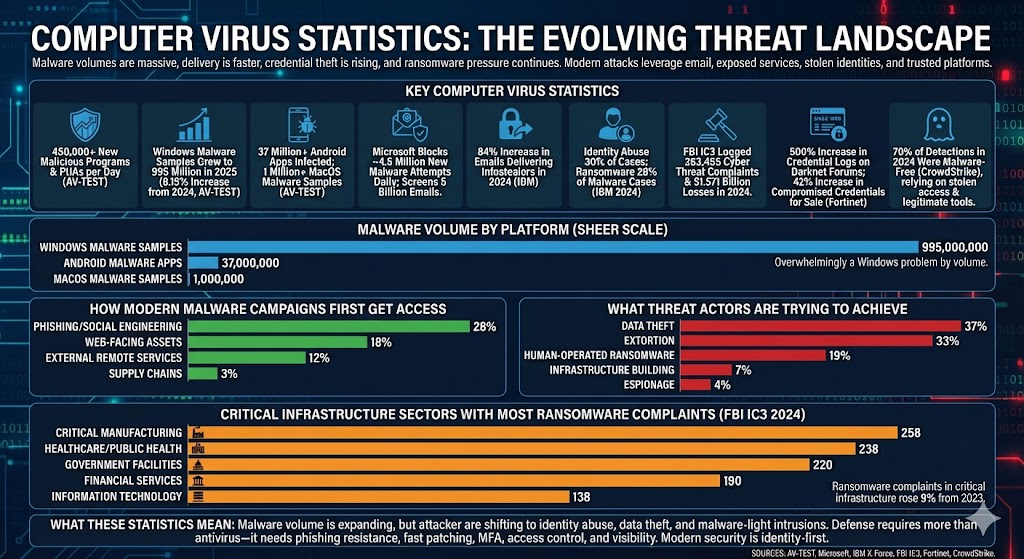
Computer viruses are no longer just a consumer PC problem. The latest data shows a threat landscape shaped by massive malware volumes, faster delivery methods, more credential theft, and continued ransomware pressure across critical sectors. The numbers below show how large the malware ecosystem has become and how modern attacks now spread through email, exposed services, stolen identities, and trusted platforms.
computer virus statistics
Key computer virus statistics
AV-TEST says it now registers over 450,000 new malicious programs and potentially unwanted applications per day.
Windows malware samples in AV-TEST’s AV-ATLAS database grew from 920 million to 995 million from 2024 to 2025, an increase of 8.15%.
AV-TEST also reports over 37 million Android apps infected with malware and 1 million MacOS malware samples.
Microsoft says it blocks approximately 4.5 million new malware attempts every day and screens 5 billion emails for malware and phishing.
IBM observed an 84% increase in emails delivering infostealers in 2024.
IBM says identity abuse accounted for 30% of cases in 2024, while ransomware represented 28% of malware cases.
The FBI’s IC3 logged 263,455 cyber threat complaints and $1.571 billion in losses in 2024.
IC3 also recorded 4,878 critical infrastructure complaints, and ransomware complaints in critical infrastructure rose 9% from 2023.
Fortinet reported a 42% increase in compromised credentials for sale and a 500% increase in credential logs on darknet forums.
CrowdStrike found that 79% of detections in 2024 were malware-free, showing that many modern intrusions now rely on stolen access and legitimate tools instead of classic virus payloads.
Malware volume by platform
Classic malware is still overwhelmingly a Windows problem by sheer volume, but Android and Mac threats remain large enough to matter at consumer and enterprise scale.
Label
Bar
Value
Windows malware samples
995,000,000
Android malware apps
37,000,000
MacOS malware samples
1,000,000
Max = 995,000,000. Widths: Windows malware samples 100.00%, Android malware apps 3.72%, MacOS malware samples 0.10%.
How modern malware campaigns first get access
Email and human manipulation still matter, but exposed web assets and remote services remain major entry points. That means patching and email security have to work together, not separately.
Modern malware activity is usually tied to money or monetizable data. Even when a ransomware payload is not deployed, data theft and extortion remain core outcomes.
Label
Bar
Value
Data theft
37%
Extortion
33%
Human-operated ransomware
19%
Infrastructure building
7%
Espionage
4%
Max = 37. Widths: Data theft 100.00%, Extortion 89.19%, Human-operated ransomware 51.35%, Infrastructure building 18.92%, Espionage 10.81%.
Critical infrastructure sectors with the most ransomware complaints
Ransomware pressure is especially visible in critical infrastructure. Manufacturing, healthcare, and government facilities each posted large complaint counts in the FBI’s latest IC3 data.
Label
Bar
Value
Critical manufacturing
258
Healthcare/public health
238
Government facilities
220
Financial services
190
Information technology
138
Max = 258. Widths: Critical manufacturing 100.00%, Healthcare/public health 92.25%, Government facilities 85.27%, Financial services 73.64%, Information technology 53.49%.
What these computer virus statistics mean
The biggest takeaway is that malware volume is still expanding even as attackers increasingly shift toward identity abuse, data theft, and malware-light intrusions. In other words, organizations still have to defend against classic viruses, trojans, spyware, and ransomware, but they also have to protect credentials, browsers, cloud tenants, email systems, and remote access tools.
That change is why the modern computer virus story is no longer just about executable files. It is also about infostealers, credential resale markets, and trusted tools used maliciously. When almost four out of five detections can be malware-free, stopping infection means combining endpoint security with phishing resistance, fast patching, MFA, access control, and better visibility across the environment.
For businesses, the practical lesson is simple: malware defense still matters, but it now has to sit inside a broader identity-first security strategy. For consumers, the same trend means safer browsing habits, software updates, password managers, and phishing-resistant MFA are now just as important as antivirus software.
Microsoft. Microsoft Digital Defense Report 2025. https://www.microsoft.com/en-us/corporate-responsibility/cybersecurity/microsoft-digital-defense-report-2025/
Optimize your workspace with the 10 best 6K monitors for PC professionals; discover features that could transform your productivity and comfort in surprising ways.
Perfect your iMac's audio with the top 10 subwoofer setups that promise unmatched sound quality—discover which one will elevate your listening experience.