Gigabit Dual NIC Intel 82576 is a straightforward choice if you want a dual-port 1Gb network card with broad OS support and a practical low-profile bracket.
This Gigabit Dual NIC Intel 82576 review focuses on where it fits best and where the listing leaves room for caution.
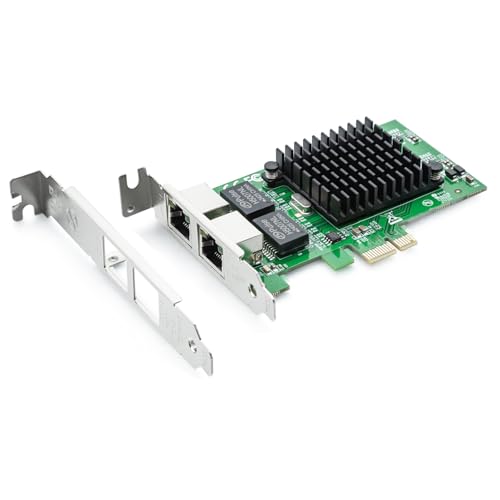
Gigabit Dual NIC Intel 82576 Review Summary
If you need a dependable add-in NIC for a desktop, workstation, or small server, this card makes a clear case for itself.
The appeal is simple: dual RJ45 ports, Intel 82576-based networking, PCIe compatibility, and a long list of supported operating systems that makes it attractive for mixed-environment setups.
Best for buyers who want a utilitarian network upgrade rather than a flashy one. The listing points to a card aimed at stability, compatibility, and flexible installation, not extra features you would never use.
It should suit homelabs, server replacements, virtualization hosts that stay within the supported ESXi range, and Windows or Linux systems that need two wired ports.
Review Scorecard
| Category | Score | Buyer-focused rationale |
|---|---|---|
| Compatibility | 9/10 | Supports many Windows, Windows Server, Linux, BSD, and older ESXi versions. |
| Network flexibility | 9/10 | Two RJ45 ports make it more versatile than a single-port NIC. |
| Installation ease | 8/10 | Includes both low-profile and full-height brackets for different cases. |
| Stability focus | 8/10 | Intel 82576 controller and QoS positioning suggest a reliability-first design. |
| Virtualization fit | 7/10 | Useful for some ESXi environments, but the listing excludes ESXi 7.0. |
| Value for practical use | 8/10 | Strong feature set for buyers who need dual-port wired networking. |
| Risk of mismatch | 6/10 | Clear limitations matter, especially for Mac users and newer VMware plans. |
Key Features and Specifications of Gigabit Dual NIC Intel 82576
This card is built around an Intel 82576 controller and is positioned as a compare-to Intel E1G42ET-style dual network adapter.
The core pitch is 1Gb Ethernet with two RJ45 ports, so it is meant for users who need two wired connections on one expansion card rather than a single uplink.
The listing specifies PCI Express 2.0 x1 compatibility and says the card works in PCIe x1, x4, x8, and x16 slots.
That matters because it makes the card easier to fit into many systems, including compact machines where slot space is tight.
Supported operating systems listed by the seller include:
- Windows 7, 8, 10, and 11
- Windows Server 2008, 2012, 2016, and 2019
- CentOS / RHEL 6, 7, and 8
- Ubuntu 16, 18, 19, and 20
- Debian 9, 10, and 11
- FreeBSD 10, 11, and 12
- VMware ESXi 5 and 6
The card also ships with both a low-profile bracket and a full-height bracket, which is useful if you are moving the adapter between a slim desktop and a standard tower or server chassis.
The listing explicitly says it is not compatible with Mac OS, bypass mode, or VMware ESXi 7.0.
Other notable listing claims include:
- 10/100/1000 Mbps support on the RJ45 ports
- Cat5e cable support
- QoS support through the Intel controller
- 24/7 customer service
- 30-day free returns
- 3-year warranty
- lifetime technology support
Pros and Cons of Gigabit Dual NIC Intel 82576
Pros
- Two RJ45 ports provide more routing, bridging, or multi-network flexibility than a single-port card.
- Broad OS support makes it easier to deploy across Windows and Linux environments.
- Low-profile and full-height brackets widen case compatibility.
- Intel 82576 branding suggests a stability-first networking approach.
- PCIe x1 support keeps installation requirements modest.
Cons
- The listing excludes Mac OS, so it is not a universal option.
- VMware ESXi 7.0 is not supported according to the product page.
- The product description is strong on compatibility claims, but it does not provide deeper implementation details.
- Buyers who need newer-generation server features may want a more modern NIC.
Who Should Buy Gigabit Dual NIC Intel 82576?
This card makes the most sense for buyers who need two dependable wired Ethernet ports in one slot and want broad compatibility without overcomplicating the setup.
It is a good fit for homelabs, budget servers, network segmentation projects, and general-purpose machines that need separate LAN paths.
It also fits buyers who care about physical flexibility.
The included brackets make it more practical for mixed cases, and the PCIe x1 design lowers the barrier to installation in older or space-constrained systems.
You should probably skip it if you need Mac support, VMware ESXi 7.0 compatibility, or a more modern feature set for advanced virtualization or server networking.
In those cases, the limitations are not minor; they are hard stop issues.
Dual-Port PCIe Networking Notes for Gigabit Dual NIC Intel 82576
Dual RJ45 Layout
The main advantage is obvious: two wired ports on one card.
That gives you more freedom for separate networks, backups, bridge configurations, or simply adding a second physical connection without using another expansion slot.
Broad OS Coverage
The supported OS list is one of the strongest reasons to consider this card.
If you manage a mixed Windows and Linux environment, that compatibility range reduces the odds of ending up with an adapter that is technically capable but annoying to deploy.
Case and Slot Fit
The included low-profile and full-height brackets are a practical detail that matters more than the marketing copy suggests.
They make the card easier to deploy in compact desktops, towers, and server chassis without hunting for spare mounting hardware.
Clear Boundaries
The biggest decision factor is not what the card can do, but where it stops.
No Mac OS support and no ESXi 7.0 support means this is a targeted utility part, not a universal networking fix.
Alternatives to Gigabit Dual NIC Intel 82576
If you want a different path, compare it with a few well-known Amazon search options:
- Intel I350 dual-port NIC
- TP-Link PCIe gigabit network adapter
- StarTech dual port gigabit network card
- Mellanox ConnectX network adapter
The best comparison depends on whether you value newer silicon, better virtualization compatibility, or simply a lower-cost dual-port wired upgrade.
Intel-based alternatives often make sense for buyers who want to stay in the same reliability-first lane, while TP-Link or StarTech can be useful when you want a simpler consumer-friendly path.
Is Gigabit Dual NIC Intel 82576 Worth It?
Yes, if your priority is a practical dual-port NIC with wide OS support and straightforward installation. It is especially sensible for Windows and Linux users, homelab builders, and server owners who need two wired ports without adding complexity.
No, if you need Mac support, ESXi 7.0 compatibility, or newer networking features. Those are hard limitations, so buyers in those categories should move to a different adapter line instead of trying to force this one into the wrong use case.
For the right buyer, Gigabit Dual NIC Intel 82576 is worth it because it solves a specific networking problem cleanly: two stable Ethernet ports, broad compatibility, and simple physical fit in one card.