10Gtek 10G SFP+ to RJ45 Transceiver RTL8261 review is for buyers who need a straightforward way to turn an SFP+ port into a copper 10GbE link.
It is a specialized adapter, not a universal networking fix, but that is exactly why it can make sense.
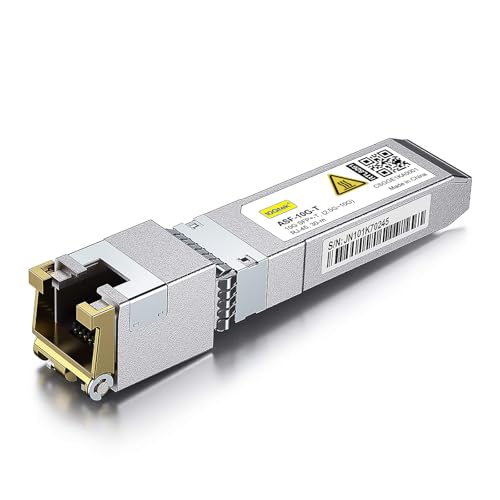
10Gtek 10G SFP+ to RJ45 Transceiver RTL8261 Review Summary
This 10Gtek 10G SFP+ to RJ45 Transceiver RTL8261 review comes down to one simple question: do you need a short-run 10GbE copper bridge and already have compatible SFP+ hardware?
If yes, this module is aimed squarely at that job.
It is best for network setups that need an RJ-45 endpoint, CAT6A/CAT7 cabling, and up to 30 meters of reach without introducing a separate media converter.
Verdict: strong fit for short copper 10GbE connections, especially in mixed environments where an SFP+ switch, router, or server port has to talk to an RJ-45 device.
The tradeoff is that it is a heat-producing active module, so buyers need to value convenience and compatibility more than absolute efficiency.
Review Scorecard
| Category | Score | Buyer-level rationale |
|---|---|---|
| Compatibility breadth | 8/10 | Listing claims support for Cisco, Ubiquiti, Meraki, MikroTik, Supermicro, TP-Link, D-Link, and Netgear, which is useful for mixed fleets. |
| Copper link convenience | 9/10 | One module converts SFP+ to RJ-45 directly, which simplifies short-run 10GbE deployments. |
| Cable flexibility | 8/10 | Support for CAT6A/CAT7 and up to 30 meters covers many rack, closet, and nearby workstation links. |
| Thermal management | 5/10 | The RTL8261 chip can run hot and may stop working when overheated, so cooling and placement matter. |
| Setup simplicity | 9/10 | The product is described as plug and play with no software or technician setup required. |
| Power efficiency | 6/10 | The module has a stated maximum power consumption of 3W, which is fine for a transceiver but still reflects an active design. |
| Overall fit for purpose | 8/10 | It solves a specific interoperability problem well, as long as the user accepts the heat and distance limits. |
Key Features and Specifications of 10Gtek 10G SFP+ to RJ45 Transceiver RTL8261
The core appeal of the 10Gtek 10G SFP+ to RJ45 Transceiver RTL8261 is its role as a copper bridge for 10GbE.
It uses an SFP+ form factor on one side and an RJ-45 interface on the other, so it can connect a 10G SFP+ port to endpoints with embedded 10GBASE-T ports.
The listing says it supports 10Gbps operation and also mentions 5G and 2.5G support, which gives it some flexibility in multi-speed environments.
Key listed facts include:
- Built around a Realtek RTL8261 chip
- Maximum power consumption listed at 3W
- Supports CAT6A/CAT7 cabling
- Supports distances up to 30 meters
- Compatible with many brands, including Cisco, Ubiquiti, UniFi, Meraki, MikroTik, Supermicro, TP-Link, D-Link, and Netgear, provided the host has a 10G SFP+ port
- Hot pluggable
- Described as plug and play with no software installation required
For buyers, the important detail is not just the raw speed.
It is the combination of SFP+ compatibility and RJ-45 convenience.
That is what makes this type of module useful when a switch or server has optical-style SFP+ cages but the rest of the network segment is copper.
The limitation is equally important: this is a short-range part.
The 30-meter figure is enough for rack-to-rack, closet-to-desk, or nearby equipment connections, but it is not intended for broader building runs or long-distance backbone work.
If the installation needs serious reach, a different transport method is the better answer.
Pros and Cons of 10Gtek 10G SFP+ to RJ45 Transceiver RTL8261
Pros
- Simple bridge from SFP+ to RJ-45 for common copper 10GbE needs
- Supports multiple speeds according to the listing, including 10G, 5G, and 2.5G
- Wide compatibility claims across major networking brands
- No software setup if the host accepts the module as advertised
- Useful 30-meter reach for short infrastructure runs
Cons
- Runs hot because the chip is active and the listing warns about overheating
- Not ideal for long cabling distances
- Depends on host compatibility, especially with SFP+ support
- Higher complexity than passive cabling because it adds an active transceiver in the path
The strongest pro is convenience.
The strongest con is thermal behavior.
That combination matters because buyers often choose this style of transceiver to simplify a deployment, only to discover that airflow and enclosure density can make or break reliability.
Who Should Buy 10Gtek 10G SFP+ to RJ45 Transceiver RTL8261?
Buy this if you already have a device with a 10G SFP+ port and you need to connect it to standard copper Ethernet equipment without changing the broader network design.
It is a sensible option for small server rooms, short rack interconnects, and upgrade projects where RJ-45 remains the practical standard on one side of the link.
It also makes sense for buyers who want a direct module instead of a separate media converter.
If the goal is fewer boxes, fewer power adapters, and a cleaner physical install, this kind of transceiver can be the right tool.
Skip it if you need long cable runs, if your gear is not truly compatible with 10G SFP+ modules, or if your environment has poor airflow and already runs hot.
In those cases, the module’s thermal design becomes more of a risk than a benefit.
Real-World Network Fit of 10Gtek 10G SFP+ to RJ45 Transceiver RTL8261
Short-Run Rack Links
The most natural use case is a short copper hop between nearby devices.
The 30-meter rating and CAT6A/CAT7 support point to clean rack or closet deployments rather than campus-scale infrastructure.
For that kind of job, the product is doing exactly what buyers want: translating between SFP+ hardware and RJ-45 copper without extra conversion gear.
Compatibility in Mixed Environments
The compatibility list is one of the strongest reasons to consider it.
Cisco, Ubiquiti, Meraki, MikroTik, Supermicro, and others all appear in the listing, which suggests this module is meant for heterogeneous environments.
That matters because many buyers are not rebuilding a single-vendor network; they are trying to make new 10G ports work with existing copper segments.
Heat and Placement Considerations
The heat warning should be read as a design constraint, not a footnote.
An active module with a listed 3W maximum draw is normal for this category, but the product page is explicit that the chip can get hot and may stop working if overheated.
In practice, that means buyers should pay attention to airflow, port spacing, and nearby heat sources.
Where It Makes Sense
This is a good fit when reliability comes from simplicity and short distance, not from elegance or minimal power use.
If your network design already assumes SFP+ on one end and copper 10GBASE-T on the other, the 10Gtek module is purpose-built for that bridge.
Alternatives to 10Gtek 10G SFP+ to RJ45 Transceiver RTL8261
If you want to compare options, look at other Amazon-sold SFP+ to RJ45 transceiver lines from established networking brands:
- MikroTik S+RJ10
- Ubiquiti 10G SFP+ to RJ45 transceiver
- Cisco SFP-10G-T-S compatible module
- TP-Link 10G SFP+ to RJ45 module
Those alternatives are worth checking if you already standardize on one vendor, want a different compatibility profile, or need to compare thermal behavior across similar modules.
For this category, the best choice often comes down less to raw speed and more to which module behaves best in your specific switch or router.
Is 10Gtek 10G SFP+ to RJ45 Transceiver RTL8261 Worth It?
Yes, if you need a short-range SFP+ to RJ-45 bridge and your host hardware supports it.
The 10Gtek 10G SFP+ to RJ45 Transceiver RTL8261 is not a flashy product, but it is practical, targeted, and easy to understand.
That is a strength in networking hardware.
The main reason to buy it is to solve a very specific problem cleanly: get copper 10GbE working from an SFP+ port without extra boxes or complicated setup.
The main reason to skip it is equally specific: if you cannot tolerate heat, need longer reach, or are unsure about compatibility, another approach is safer.
Bottom line: this is a sensible buy for short, compatibility-driven 10G copper links.
If that is your exact use case, it is worth considering.
If not, look at a different transceiver family or a different transport method altogether.