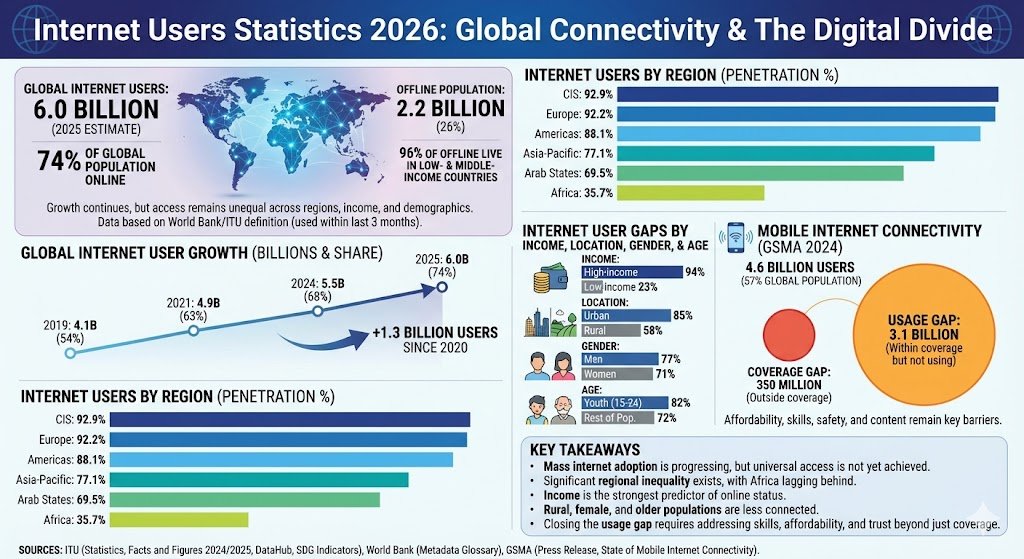
The latest verified figures show that internet adoption keeps rising worldwide, but access is still uneven across regions, income groups, and demographics. ITU estimates that 6.0 billion people, or 74% of the world’s population, are using the internet in 2025, while 2.2 billion people remain offline. For consistency, this article uses the World Bank and ITU definition of an internet user: a person who has used the internet from any location within the last 3 months.
internet users statistics
Key internet users statistics
About 6.0 billion people are using the internet in 2025, equal to 74% of the global population.
About 2.2 billion people remain offline in 2025.
Global internet penetration increased from 40% in 2015 to 68% in 2024, then to 74% in 2025.
ITU says 1.3 billion people came online between 2020 and 2025.
96% of people who remain offline live in low- and middle-income countries.
Internet use is 94% in high-income countries versus 23% in low-income countries.
85% of urban residents use the internet, compared with 58% of rural residents.
77% of men use the internet globally, compared with 71% of women.
82% of people aged 15 to 24 use the internet, versus 72% for the rest of the population.
GSMA reported that 4.6 billion people, or 57% of the global population, were using mobile internet on their own device in 2024.
GSMA also reported a 350 million person mobile coverage gap and a 3.1 billion person usage gap.
Global internet user growth
Internet adoption has expanded quickly in absolute terms and as a share of the population. The biggest acceleration happened during and after the pandemic, but growth has continued as more countries expand access, affordability, and mobile connectivity.
Year
Internet users
Share of population
2019
4.1 billion
54%
2021
4.9 billion
63%
2024
5.5 billion
68%
2025
6.0 billion
74%
Internet users by region
Regional differences remain large. CIS and Europe are close to universal adoption, the Americas are also highly connected, Asia-Pacific and the Arab States sit near or above the global average, and Africa remains the least connected major region.
Label
Bar
Value
CIS
92.9%
Europe
92.2%
Americas
88.1%
Asia-Pacific
77.1%
Arab States
69.5%
Africa
35.7%
Max = 92.9. Widths: CIS 100.00%, Europe 99.25%, Americas 94.83%, Asia-Pacific 82.99%, Arab States 74.81%, Africa 38.43%
Internet user gaps by income, location, gender, and age
The biggest internet user gaps are tied to affordability, infrastructure quality, digital skills, and device access. Income still matters the most, but urban-rural and gender gaps also remain visible. Younger people are more connected than older age groups almost everywhere.
Label
Bar
Value
High-income
94%
Low-income
23%
Urban
85%
Rural
58%
Men
77%
Women
71%
Youth 15-24
82%
Rest of population
72%
Max = 94. Widths: High-income 100.00%, Low-income 24.47%, Urban 90.43%, Rural 61.70%, Men 81.91%, Women 75.53%, Youth 87.23%, Rest of population 76.60%
Mobile internet users statistics
Mobile connectivity is a major reason internet user totals keep rising. GSMA reported that 4.6 billion people were already using mobile internet on their own device in 2024, equal to 57% of the world’s population. At the same time, the biggest remaining barrier is no longer only network reach. GSMA estimated that 350 million people still lived outside mobile broadband coverage, but a much larger 3.1 billion lived within coverage and still did not use mobile internet, which highlights the importance of affordability, digital skills, online safety, and relevant content.
What these internet user statistics show
The world is moving steadily toward mass internet adoption, but universal use has not been reached.
Regional inequality is still large, with Africa far behind Europe, CIS, and the Americas.
Income remains the strongest predictor of whether people are online.
Rural, female, and older populations remain less connected than urban, male, and younger groups.
Closing the usage gap now depends as much on skills, affordability, and trust as on network coverage.
Sources
ITU Statistics overview: https://www.itu.int/en/ITU-D/Statistics/pages/stat/default.aspx
ITU Facts and Figures 2025, Internet use: https://www.itu.int/itu-d/reports/statistics/2025/10/15/ff25-internet-use/
ITU DataHub, Individuals using the Internet: https://datahub.itu.int/data/?i=11624
ITU Facts and Figures 2025, The gender digital divide: https://www.itu.int/itu-d/reports/statistics/2025/10/15/ff25-the-gender-digital-divide/
ITU Facts and Figures 2025, Internet use in urban and rural areas: https://www.itu.int/itu-d/reports/statistics/2025/10/15/ff25-internet-use-in-urban-and-rural-areas/
ITU Facts and Figures 2025, Youth Internet use: https://www.itu.int/itu-d/reports/statistics/2025/10/15/ff25-youth-internet-use/
ITU ICT SDG indicators page: https://www.itu.int/en/ITU-D/Statistics/Pages/SDGs-ITU-ICT-indicators.aspx
ITU Facts and Figures 2024, Internet use: https://www.itu.int/itu-d/reports/statistics/2024/11/10/ff24-internet-use/
World Bank metadata glossary, Individuals using the Internet (% of population): https://databank.worldbank.org/metadataglossary/world-development-indicators/series/IT.NET.USER.ZS
GSMA press release on mobile internet connectivity: https://www.gsma.com/newsroom/press-release/new-gsma-report-shows-mobile-internet-connectivity-continues-to-grow-globally-but-barriers-for-3-45-billion-unconnected-people-remain/
GSMA State of Mobile Internet Connectivity: https://www.gsma.com/somic/
Unlock the potential of your gaming space with the 10 best desks featuring RGB edge lighting that promises to elevate your setup—discover which ones made the list!