Kensaker Drafting Chair is a straightforward fit for people who need a tall, adjustable seat for a standing desk, art studio, or bar-height workstation.
If you are comparing a Kensaker Drafting Chair review against other drafting chairs, the appeal is its mix of height range, foot support, and space-saving armrests.
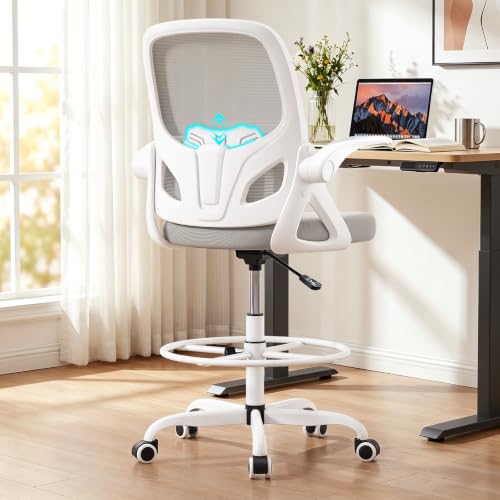
Kensaker Drafting Chair Review Summary
The Kensaker Drafting Chair makes the most sense for buyers who want a practical tall office chair rather than a plush executive seat.
It is built around the basics that matter at elevated work surfaces: a 7.9-inch height adjustment, an adjustable foot ring, flip-up armrests, a breathable mesh back, and a claimed 300 lb support limit.
That combination gives it a clear audience.
It suits users at standing desks, drafting tables, art stations, and counter-height work areas who need better posture support than a stool can provide, but do not want a bulky chair that fights the desk layout.
It is especially relevant if your feet need a stable perch and your workspace changes throughout the day.
Review Scorecard
| Category | Score | Why it earns that score |
|---|---|---|
| Height adjustability | 9/10 | A 7.9-inch range is well suited to tall desks and drafting stations. |
| Foot support | 9/10 | The adjustable foot ring is a real benefit for long seated sessions at higher surfaces. |
| Comfort | 7/10 | Mesh and high-density foam should help airflow and cushion, but it is still a task chair, not a lounge chair. |
| Space efficiency | 8/10 | Flip-up arms make it easier to tuck the chair away and move in tighter rooms. |
| Stability and mobility | 8/10 | The upgraded five-claw base and silent PU casters are aimed at steadier rolling. |
| Build-for-purpose value | 8/10 | The feature set is focused on the use case instead of adding unnecessary extras. |
| Assembly and ownership ease | 8/10 | The listing promises quick assembly and standard hardware, which matters for office setup. |
Key Features and Specifications of Kensaker Drafting Chair
The most important detail is the chair’s height range.
Kensaker says the seat adjusts by 7.9 inches, which is the core reason to consider this model for standing desks and drafting tables.
A regular office chair often sits too low for those setups, while this one is designed to meet the desk instead of forcing your posture to adapt downward.
The foot ring is another functional feature, not a decorative one.
The listing highlights an upgraded locking knob and a 9.45-inch adjustment range.
That matters because a drafting chair without a dependable foot perch quickly becomes tiring: your legs either dangle or you end up bracing awkwardly.
Here, the manufacturer is clearly trying to solve that problem.
Other listed features include:
- Breathable mesh top on the seat cushion
- High-density foam with claimed resilience support
- Y-shaped backrest with vertical height adjustment
- 90-degree flip-up armrests
- Silent PU casters
- Five-claw base
- Claimed 300 lb capacity
The chair is also positioned as a space-saving piece for home offices and craft rooms.
That is a useful detail because tall chairs can be awkward in smaller rooms.
Flip-up arms make it easier to slide the chair under a desk when not in use, which is more valuable than it sounds if the chair lives in a shared room.
Assembly is another point in its favor on paper.
Kensaker says the chair can be assembled in about 15 to 20 minutes with included hardware and instructions.
For a chair in this category, that is a reasonable promise and suggests a relatively standard setup process.
Pros and Cons of Kensaker Drafting Chair
Pros
- Strong fit for standing desks, drafting tables, and bar-height work
- Adjustable foot ring is important for comfort at tall surfaces
- Flip-up armrests improve flexibility in tight spaces
- Mesh back should help airflow during longer sessions
- Claimed 300 lb support gives it a broader usable range than lighter stools
- 360-degree swivel and rolling casters add everyday convenience
Cons
- The chair is purpose-built, so it will not feel as plush as a padded executive chair
- Mesh and foam comfort are practical, but not luxurious
- Buyers who do not need a taller seat may be paying for features they will never use
- The value depends heavily on whether the foot ring and height range match your desk setup
The biggest takeaway is that the pros are all tied to real use at elevated workstations.
The chair is not trying to impress with style-first extras.
Its strengths are functional, and that is the right strategy for this category.
Who Should Buy Kensaker Drafting Chair?
Buy this chair if you regularly sit at a standing desk, art table, drafting station, or counter-height workstation.
It is also a sensible pick if you want a tall chair with a foot ring because your legs feel better when they have a place to rest.
That combination usually matters more than a softer seat when you work for hours at a higher surface.
It is a strong fit for home offices, studios, and multipurpose rooms where the chair needs to move in and out of the way.
The flip-up armrests and 360-degree swivel make it more adaptable than a fixed stool.
Skip it if you only need an ordinary desk chair, if you prefer a deeply cushioned lounge-style seat, or if your desk height does not justify a drafting chair.
In those cases, the extra adjustability is less useful, and you may be happier with a standard ergonomic office chair.
How Kensaker Drafting Chair Fits Tall-Desk Work
Height and Desk Match
The 7.9-inch adjustment range is the defining spec here.
For tall workstations, the chair needs to meet the desk without forcing your shoulders up or your wrists down.
Kensaker is built around that requirement, which makes it more relevant than a generic office chair that only works at standard desk height.
Foot Ring and Leg Support
The foot ring is more than a convenience feature.
At drafting height, good foot support helps keep pressure off the lower back and thighs.
The listing’s locking knob and adjustable range suggest the designer understood a common failure point in cheaper drafting chairs: foot rings that slip and become unusable over time.
Back, Arms, and Daily Movement
The Y-shaped backrest and vertical back adjustment are aimed at keeping support centered where the body needs it.
The flip-up armrests also matter because they reduce clearance problems when you are moving in close to a work surface.
In a studio or shared office, that flexibility can matter more than extra padding.
Airflow, Stability, and Noise
Mesh and silent PU casters are small but useful details.
Mesh should help when the chair is used through long office sessions or creative work, and quieter wheels are welcome in apartments or shared rooms.
The upgraded five-claw base also suggests the chair is trying to address wobble, which is a common complaint in budget drafting chairs.
Alternatives to Kensaker Drafting Chair
If you want to compare options before buying, these Amazon search pages are a good starting point:
- Vari drafting chair
- Alera drafting chair
- BOSS Office Products drafting chair
- OFM drafting chair
- HON drafting chair
These alternatives are worth checking if you want a different balance of seat padding, base style, or armrest layout.
Vari is a common comparison point for standing-desk users, while Alera, OFM, BOSS, and HON often show up in office and task-chair searches.
The best choice depends on whether you care most about foot support, compactness, or a more conventional chair feel.
Is Kensaker Drafting Chair Worth It?
Yes, if your workspace actually calls for a tall chair.
Kensaker’s feature set is not flashy, but it is targeted in the right places: height, foot support, airflow, and space-saving usability.
That makes it a reasonable choice for standing desks, drafting tables, art studios, and counter-height work.
If you need a dedicated drafting chair with practical ergonomics rather than a soft general-purpose office chair, this one is worth considering.
If your setup is standard desk height, or if you want a more premium seating experience, look elsewhere.