The best network video recorders make it easier to power, manage, record, and review footage from compatible IP security cameras. The right model depends on camera count, resolution, storage needs, and the ecosystem you plan to use.
We selected 10 NVRs ranging from compact four-camera systems to expandable 36-channel solutions, including options for home monitoring, small businesses, and larger installations.
Best 10 Network Video Recorders Picks for 2026
Best for Large Reolink Systems

- Supports up to 36 Reolink IP cameras
- Three bays support up to 48TB
- Requires external PoE switches
Best For: Large Reolink surveillance installations
Best for UniFi Protect Expansion

- Works with UniFi Protect
- Supports up to 60 cameras
- Stores footage locally
Best For: Expanding UniFi camera systems
Best Plug-and-Play Pick

- Eight built-in PoE channels
- Includes a 2TB hard drive
- Supports Reolink app access
Best For: Smaller Reolink PoE camera systems
Best Simple UniFi Recorder

- Supports up to four channels
- Uses Ethernet and USB connectivity
- Designed for UniFi camera systems
Best For: Small UniFi IP camera installations
Best Reolink NVR for Large PoE Systems
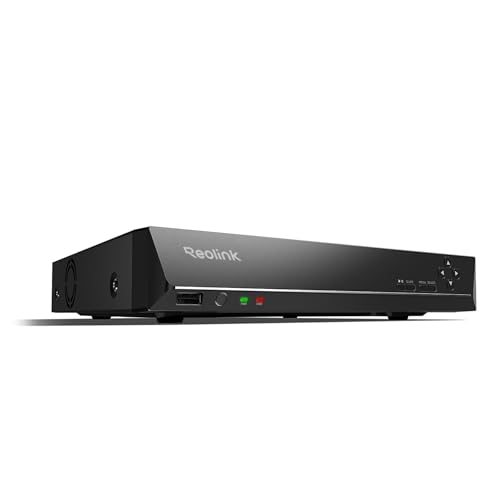
- Supports up to 16 Reolink PoE cameras
- Includes a pre-installed 4TB HDD
- Free remote access with no monthly fees
Best For: Large Reolink-based PoE camera installations
Best ANNKE NVR for AI Camera Features

- Supports compatible ANNKE cameras up to 12MP
- Uses H.265+ for more efficient storage
- Ships without a hard drive for flexible storage choices
Best For: ANNKE-focused systems using compatible AI cameras
Best Expandable Hiseeu NVR

- Eight built-in PoE ports support camera power and data
- Expandable from 8 to 16 channels with a PoE switch
- Supports up to 12TB HDD storage, sold separately
Best For: Expandable Hiseeu PoE systems with user-supplied storage
Best Value 4K Setup

- 4K recording for detailed surveillance footage
- Eight built-in PoE ports for simpler installation
- Includes 3TB HDD and no monthly fees
Best For: Small home, office, warehouse, and business systems
Best for Larger Installations

- Supports up to 16 PoE cameras
- 4K/8MP recording with H.265 compression
- Remote viewing through mobile and computer apps
Best For: Expandable business and multi-camera surveillance systems
Best for Reolink Users

- Local 24/7 recording with up to 8TB HDD support
- AI-powered local search for people and vehicles
- Plug-and-play PoE with Reolink cameras
Best For: Reolink-based home and small-business security systems
Best for Large Reolink Systems – 36-Channel RLN36
The REOLINK RLN36 is a high-capacity choice among network video recorders for larger Reolink camera installations. It supports up to 36 Reolink IP cameras and offers three drive bays for up to 48TB of storage, but it requires external PoE switches because it has no built-in PoE ports.
Best For: Large Reolink-based home, business, or property surveillance systems needing centralized recording and expandable storage.
Pros:
- Supports up to 36 compatible Reolink IP cameras.
- Three HDD bays support up to 16TB each, for up to 48TB total storage.
- Supports human and vehicle detection integration, playback, two-way talk, and USB 3.0 backups.
Cons:
- Works only with Reolink IP cameras.
- Has no PoE ports, so external PoE switches are required and not included.
- No hard drives are included.
The RLN36 is built for scale rather than simplicity. It makes sense when you already use Reolink equipment and need many camera channels, substantial local storage, and centralized management.
Best for UniFi Protect Expansion – UniFi NVR Pro
The Ubiquiti UniFi Network Video Recorder Pro is a strong option among network video recorders for users building around the UniFi Protect application. It supports adding up to 60 cameras, provides local footage storage, and allows remote access without relying on a cloud server.
Best For: UniFi Protect users who want a scalable, locally stored surveillance system with remote access.
Pros:
- Works with the UniFi Protect application.
- Supports adding up to 60 cameras to the system.
- Stores footage locally and supports remote access to streams and recordings.
Cons:
- Designed for compatible UniFi camera systems rather than general-purpose camera mixing.
- The supplied specifications list 8TB of storage and one USB port.
The UNVR-Pro is most compelling for buyers already invested in UniFi. Its camera capacity and local-storage approach make it suitable for expanding coverage while keeping recordings on-site.
Best Plug-and-Play Pick – Reolink RLN8-410
The REOLINK RLN8-410 is a practical entry point among network video recorders for smaller Reolink installations. Its eight PoE ports simplify setup by carrying power and data over one Ethernet cable, while the included 2TB hard drive supports continuous recording.
Best For: Smaller Reolink camera systems where straightforward PoE installation, local recording, and remote app access are priorities.
Pros:
- Manages up to eight compatible Reolink cameras.
- Built-in PoE supports plug-and-play installation with one Ethernet cable per camera.
- Includes a 2TB hard drive and supports an additional drive up to 8TB through eSATA.
- Offers local and remote access through Reolink apps and clients without monthly fees.
Cons:
- Works only with Reolink cameras and does not support third-party cameras.
- Limited to eight camera channels.
The RLN8-410 is a convenient choice when eight channels are enough and you want PoE built in. It combines simpler wiring with Reolink detection features, 24/7 recording, and app-based access.
Best Simple UniFi Recorder – UniFi Protect NVR
The Ubiquiti UniFi Protect Network Video Recorder is a compact option among network video recorders for a straightforward UniFi Protect setup. The supplied specifications identify Ethernet and USB connectivity, IP video input, and support for up to four channels.
Best For: Users seeking a basic UniFi-compatible recorder for a small IP camera installation.
Pros:
- Designed for camera use with the UniFi Protect ecosystem.
- Supports Ethernet and USB connectivity.
- Provides IP video input in a compact two-pound unit.
Cons:
- Listed capacity is limited to four channels.
- The supplied notes do not specify included storage capacity or detailed recording features.
- Its compatibility is centered on compatible UniFi cameras.
This recorder is best considered for a smaller, focused UniFi installation. Buyers who need more camera capacity or clearly specified storage should compare it with a larger UniFi recorder.
Best Reolink NVR for Large PoE Systems – RLN16-410 16-Channel NVR
For buyers comparing network video recorders for a larger Reolink camera installation, the RLN16-410 combines 16 channels, PoE connectivity, and a pre-installed 4TB hard drive. It is designed exclusively for compatible Reolink IP cameras and supports simultaneous recording from up to 16 cameras.
Best For: Reolink users building a 16-camera PoE security system with local and remote viewing.
Pros:
- Supports up to 16 Reolink PoE cameras and 24/7 recording.
- Includes a pre-installed 4TB HDD, with support for adding up to 8TB more.
- One Ethernet cable can carry power and data up to 330 feet.
- Free Reolink apps and client software provide local and remote access without monthly fees.
Cons:
- Works only with Reolink IP cameras.
- Its larger 16-channel capacity may be unnecessary for smaller systems.
The included storage and high channel count make this a practical choice for expanding Reolink installations. Confirm camera compatibility before buying, since this recorder is not a general-purpose third-party NVR.
Best ANNKE NVR for AI Camera Features – 12MP 8-Channel PoE NVR
This ANNKE model is a flexible option among network video recorders for an ANNKE-based surveillance setup. It supports up to 12MP cameras, H.265+ compression, and PoE connections, but it ships without a hard drive, so storage must be added separately.
Best For: ANNKE camera owners who want efficient 24/7 recording and compatibility with ANNKE AI cameras.
Pros:
- Supports compatible ANNKE cameras up to 12MP.
- H.265+ can reduce storage usage by up to 75% compared with H.264.
- One PoE cable carries power and data, with up to 30W output.
- Free ANNKE Vision apps support remote live viewing and playback.
Cons:
- No hard drive is included.
- The NVR itself has no built-in AI functions; AI features depend on compatible ANNKE cameras.
- Third-party camera compatibility should be confirmed with ANNKE support.
This recorder offers useful compression and camera-dependent AI support, but its no-HDD configuration adds an immediate storage decision. It is best suited to buyers already committed to the ANNKE ecosystem.
Best Expandable Hiseeu NVR – 4K 8-Port PoE Recorder
For shoppers seeking network video recorders with room to expand, this Hiseeu NVR provides eight built-in PoE ports and can extend to 16 channels through an additional PoE switch. It supports up to 4K/8MP cameras and remote access without a monthly fee, but a hard drive is not included.
Best For: Hiseeu users who need an expandable PoE recorder and are comfortable adding their own storage.
Pros:
- Eight built-in PoE ports can power cameras over Ethernet.
- Can expand to 16 channels with a separately purchased PoE switch.
- Supports up to 4K/8MP cameras and up to 12TB of HDD storage.
- Free Guard Live and Guard Station software enables remote viewing.
Cons:
- No hard disk is included, so recording and playback require a separate HDD.
- Third-party camera compatibility is limited and may require manual network configuration.
- The PoE switch needed for 16-channel expansion is sold separately.
This is a capable starting point for a Hiseeu PoE system, especially when future expansion matters. Budget for both a compatible hard drive and, if needed, an additional PoE switch.
Best Value 4K Setup – OOSSXX 8-Channel PoE NVR
For shoppers comparing network video recorders, the OOSSXX offers an 8-channel 4K platform with built-in PoE ports, remote access, and local recording. Its included 3TB HDD provides a ready-to-use foundation for home, office, warehouse, or small-business monitoring.
Best For: Buyers who want a straightforward 4K PoE system with included storage and no monthly access fees.
Pros:
- Records up to 4K video and supports up to eight IP cameras.
- Eight built-in PoE ports simplify power and data connections.
- Includes a 3TB HDD, free app access, and no subscription fees.
- Supports ONVIF-compatible cameras after manual protocol setup.
Cons:
- Third-party ONVIF cameras may require manual configuration.
- The eight-channel capacity may be limiting for larger installations.
The OOSSXX is a practical choice when included storage and simple PoE installation matter. Its 4K support and expandable storage capability add flexibility, while the eight-camera limit keeps it best suited to smaller systems.
Best for Larger Installations – 16-Channel 4K PoE NVR
This 16-channel unit is one of the more expandable network video recorders for users planning a larger wired camera system. It supports up to 4K/8MP cameras, provides 16 independent PoE ports, and uses H.265 compression to help reduce storage demands.
Best For: Larger homes, offices, and businesses that need to power and manage up to 16 PoE cameras.
Pros:
- Supports up to 16 PoE cameras simultaneously.
- Handles resolutions including 4K, 2K, 8MP, 5MP, 3MP, and 1080p.
- H.265 compression can save up to 50% of hard-drive storage.
- Offers mobile and PC/Mac remote viewing through dedicated apps and software.
Cons:
- No hard disk drive is included.
- Some third-party cameras may require IP-address or protocol configuration.
- Its larger capacity may be unnecessary for small camera systems.
Choose this Vonnision recorder when camera count and expansion are higher priorities than an included drive. The 16 independent PoE interfaces make deployment convenient, but buyers should budget for storage and verify compatibility with existing cameras.
Best for Reolink Users – REOLINK RLN4E PoE NVR
The REOLINK RLN4E is a focused option among network video recorders for customers building around Reolink cameras. It combines plug-and-play PoE, local continuous recording, local AI video search, and remote multi-user access in a compact four-channel recorder.
Best For: Reolink camera owners who want private local storage, stable wired connections, and easier footage searching.
Pros:
- Supports continuous local recording with up to 8TB HDD storage.
- PoE carries power and data over one Ethernet cable for compatible Reolink cameras.
- Local AI search can help find people, vehicles, or events by keywords.
- Supports remote access, simultaneous multi-user viewing, and permission management.
Cons:
- Works only with Reolink IP cameras.
- HDD and microSD card are not included.
- Four PoE channels may not suit larger camera deployments.
The RLN4E stands out for Reolink-focused installations that value local processing and recording without subscriptions. Its ecosystem restriction is significant, but within that ecosystem it offers stable PoE operation and useful search and sharing features.
How We Picked the Best Network Video Recorders
We compared these Network Video Recorders by channel capacity, PoE port availability, supported video resolution, storage configuration, expandability, software ecosystem, and installation flexibility. We also considered whether each unit is better suited to a plug-and-play camera kit or a mixed-camera deployment.
Channel count is an important starting point, but it is not the only consideration. A recorder should have enough capacity for your current cameras plus reasonable room for future additions. We also looked for practical features such as remote viewing, motion recording, H.265 compression, user-friendly management software, and compatibility with the cameras you already own.
Quick Comparison
| Best For | Recommended Capacity | What to Prioritize |
|---|---|---|
| Small home system | 4–8 channels | Built-in PoE, simple setup, remote access |
| Growing home or small business | 8–16 channels | Extra ports, larger hard drive, expandable storage |
| Large property or business | 16–36 channels | High throughput, multiple-drive support, centralized management |
| Brand-specific camera system | Varies | Matching the recorder to the camera ecosystem |
Key Buying Factors for Network Video Recorders
Channel Count and PoE Ports
Choose a recorder with more channels than you currently need if you expect to add cameras. Built-in Power over Ethernet ports simplify installation by carrying power and data over one cable, while higher-capacity models may use an external PoE switch for flexible expansion.
Resolution and Recording Bandwidth
Confirm that the NVR can record the resolution and frame rate of your cameras simultaneously. A unit advertised as 4K may still have limits on total recording bandwidth, especially when several cameras are active at once.
Storage and Retention
Storage capacity determines how many days of footage you can keep. A 3TB drive may be adequate for a small motion-recording setup, while continuous recording from multiple high-resolution cameras can require substantially more space. Check whether the recorder includes a hard drive and whether it supports additional drives or external storage.
Compatibility and Remote Access
For the most reliable setup, pair an NVR with cameras from the same manufacturer or verify ONVIF and codec support before buying. Review the mobile app, desktop software, notification controls, and account-security features as carefully as the hardware.
Who Should Buy Which Network Video Recorders?
Choose a four- or eight-channel PoE recorder for a typical home, apartment, or small shop with a limited number of cameras. An eight- to 16-channel model is a better fit for larger homes, workshops, offices, and installations likely to expand. Buyers managing many cameras or several buildings should consider a 16- or 36-channel recorder with stronger storage and networking options.
If you already use a unified camera platform, staying within that ecosystem can simplify configuration and everyday monitoring. For a budget-focused system, verify included storage, camera compatibility, and warranty terms before comparing headline resolution alone.