Choosing the right network video recorder is easier when you start with your camera count, storage expectations, and preferred surveillance ecosystem. The options in this roundup range from compact eight-channel systems to high-capacity enterprise recorders.
Use the comparison and buying advice below to narrow your shortlist based on deployment size, video resolution, installation requirements, and long-term expansion plans.
Best 10 Professional Network Video Recorders Picks for 2026
High-Capacity Choice

- Manages up to 36 Reolink cameras
- Three bays support up to 48TB
- Requires external PoE switches and HDDs
Best For: Large Reolink camera deployments
Expandable UniFi Pick
Ubiquiti UniFi Protect NVR Pro

- Works with UniFi Protect
- Supports up to 60 cameras
- Stores footage locally
Best For: Scalable UniFi Protect systems
Analytics-Focused Option

- Records up to 32 cameras in 4K
- Four bays support up to 48TB
- Adds compatible-camera AI analytics
Best For: Professional systems needing analytics and expansion
Compact UniFi Recorder

- Supports up to four IP cameras
- Designed for UniFi Protect
- Includes Ethernet and USB connectivity
Best For: Small UniFi Protect installations
Flexible 16-Channel NVR

- 16-channel wired recorder
- Supports H.265+, H.264+, and MPEG-4
- HDMI and VGA connectivity; storage sold separately
Best For: Professional 16-camera systems needing flexible video-format support
PoE+ Deployment Choice

- 16-channel PoE+ recorder
- Lists 10 TB capacity and 20 TB hard-drive size
- HDMI video and RCA audio inputs
Best For: PoE+ camera systems where listed storage capacity is a priority
Enterprise-Scale Storage NVR
Ubiquiti Enterprise Network Video Recorder
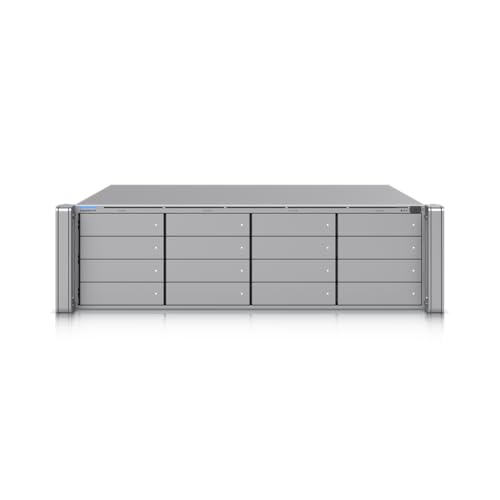
- Supports up to 70 channels
- Accepts 16 3.5-inch HDD or SSD drives
- Includes 10GbE connectivity and redundant hot-swap PSUs
Best For: Large surveillance deployments requiring storage expansion and power redundancy
High-Capacity Reolink Hub
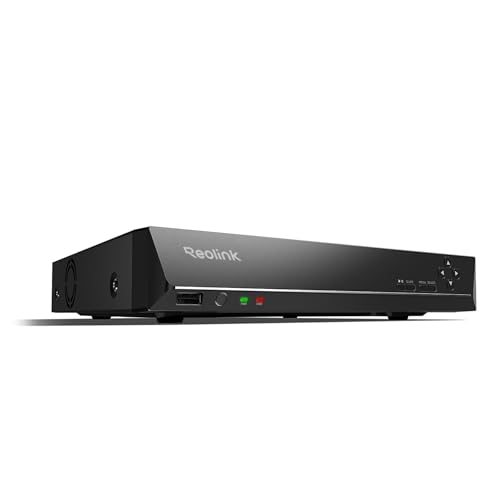
- 16-channel support for Reolink IP cameras
- Includes a 4TB HDD for 24/7 recording
- PoE setup and remote apps without monthly fees
Best For: Reolink systems needing centralized recording for up to 16 cameras
Compact Ubiquiti Solution

- Built-in six-port PoE switch
- Supports up to six 4K or 15 Full HD cameras
- Provides HDMI viewing and 3.5-inch HDD compatibility
Best For: Ubiquiti networks needing a compact recorder with integrated PoE
Expandable Reolink Option
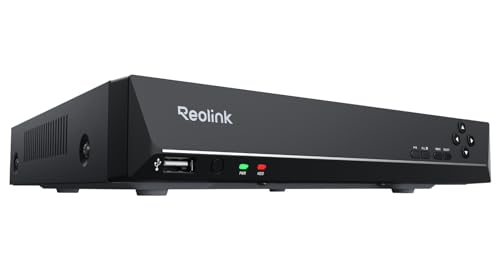
- Records up to eight compatible Reolink cameras
- Supports up to 16TB across internal and eSATA storage
- Single-cable PoE installation up to 330 feet
Best For: Home systems with up to eight Reolink PoE cameras
High-Capacity Choice – Reolink RLN36
For buyers comparing professional network video recorders, the Reolink RLN36 is a high-channel option built specifically for Reolink IP cameras. It manages up to 36 cameras and uses external PoE switches rather than built-in PoE ports, making it a fit for larger, centrally managed systems.
Best For: Large Reolink camera deployments that need centralized recording and substantial local storage.
Pros:
- Supports up to 36 compatible Reolink IP cameras.
- Three HDD bays support up to 48TB total storage.
- Includes USB 3.0 for faster footage backup and supports compatible smart-camera features.
Cons:
- Works only with Reolink IP cameras.
- Has no built-in PoE ports; external PoE switches are required.
- Hard drives are not included.
The RLN36 is particularly compelling when channel count and storage expansion matter most. Confirm camera and firmware compatibility before building the system, and budget for compatible HDDs and external PoE switches.
Expandable UniFi Pick – Ubiquiti UniFi Protect NVR Pro
Among professional network video recorders, the Ubiquiti UniFi Network Video Recorder Pro is designed for systems using the UniFi Protect application. It supports adding up to 60 cameras, offers remote access, and stores recordings locally instead of on a cloud server.
Best For: UniFi Protect users building a scalable, locally stored camera system.
Pros:
- Works with the UniFi Protect application.
- Supports adding up to 60 cameras.
- Provides remote stream and recording access while keeping footage local.
Cons:
- Requires a UniFi Protect camera ecosystem.
- The supplied details list 8TB of storage without specifying additional bay capacity.
- Camera compatibility should be confirmed before purchase.
The UNVR-Pro is a strong ecosystem-focused choice for buyers who want broad camera expansion and local video storage. Its main appeal is integration with UniFi Protect rather than general-purpose camera compatibility.
Analytics-Focused Option – GeoVision GV-RNVR3240-N
The GeoVision GV-RNVR3240-N is one of the more feature-rich professional network video recorders in this group, combining 32-channel 4K recording with AI-oriented capabilities. Its Linux-embedded design supports standalone monitoring, while multiple display and remote-access options add installation flexibility.
Best For: Professional installations needing high-resolution recording, AI analytics, and expandable storage.
Pros:
- Supports up to 32 IP cameras with recording up to 12MP.
- Four SATA bays provide up to 48TB, with eSATA expansion available.
- Offers face recognition and analytics with compatible GV-R Series cameras.
- Supports dual-display local viewing and remote access through browser, GV-Control Center, or GV-Eye.
Cons:
- Advanced AI features depend on compatible GV-R Series cameras.
- Hard-drive installation requirements should be planned separately.
- Includes a one-year warranty.
This NVR stands out for installations that need more than basic recording, especially where analytics and direct local viewing are priorities. ONVIF support adds integration potential, but advanced functions remain tied to compatible GeoVision equipment.
Compact UniFi Recorder – Ubiquiti UniFi Protect NVR
For buyers seeking professional network video recorders in a smaller UniFi setup, this Ubiquiti UniFi Protect Network Video Recorder provides IP-camera recording through Ethernet and includes USB connectivity. The supplied specifications identify it as a four-channel recorder, making it better suited to a limited camera installation.
Best For: Small UniFi Protect camera systems with up to four IP-camera channels.
Pros:
- Designed for camera use with UniFi Protect.
- Supports up to four IP-camera channels.
- Provides Ethernet and USB connectivity.
Cons:
- Four-channel capacity limits expansion.
- The supplied details do not specify included storage capacity.
- Camera and software compatibility should be verified before purchase.
This model makes the most sense when a UniFi-based system has modest channel requirements. Buyers planning a larger installation should compare its four-channel limit with higher-capacity UniFi recorders.
Flexible 16-Channel NVR – Hikvision DS-7600NI-Q2/P
For professional network video recorders in a wired 16-camera setup, the Hikvision DS-7600NI-Q2/P offers broad video-format support and practical display connectivity. It is a recorder-only unit, so plan separately for cameras and storage.
Best For: Professional or small-business surveillance systems needing 16 channels and HDMI/VGA connectivity.
Pros:
- Supports 16 channels for larger camera deployments.
- Handles MPEG-4, H.264, H.264+, H.265, and H.265+ video formats.
- Includes HDMI and VGA connectivity, plus RCA audio input and output.
- TAA compliant for applicable procurement requirements.
Cons:
- Hard drive is not included.
- Only one USB port is listed.
- Does not provide a stated built-in camera package.
Its channel count and format compatibility make it a flexible foundation for professional installations, but the lack of included storage increases the setup planning required.
PoE+ Deployment Choice – TP-Link VIGI NVR2016H-16MP
The TP-Link VIGI NVR2016H-16MP is a practical option among professional network video recorders for a 16-camera PoE+ installation. Its listed storage specifications make it worth considering when capacity is a central purchasing factor.
Best For: 16-channel camera systems that prioritize PoE+ integration and substantial listed storage capacity.
Pros:
- Provides 16 channels for multi-camera installations.
- Designed as a PoE+ network video recorder.
- Lists 10 TB of memory storage capacity and a 20 TB hard-drive size.
- Includes HDMI video input and RCA audio input.
Cons:
- The supplied details do not specify supported video compression formats.
- Only HDMI connectivity is listed.
- Built-in media is listed as unavailable, so confirm the storage configuration before buying.
This VIGI model stands out for its PoE+ focus and stated capacity figures. Verify the exact included storage arrangement if recording retention is important to your installation.
Enterprise-Scale Storage NVR – Ubiquiti Enterprise Network Video Recorder
The Ubiquiti Enterprise Network Video Recorder is the most expandable option in this group of professional network video recorders. It supports up to 16 3.5-inch HDD or SSD drives, along with high-speed network uplinks and redundant power supplies.
Best For: Enterprise surveillance environments needing extensive drive support, high-speed networking, and power redundancy.
Pros:
- Supports up to 16 3.5-inch HDD or SSD drives.
- Offers two 10G SFP+ uplinks and one 10 GbE RJ45 port.
- Includes two hot-swap PSUs for power redundancy.
- Lists support for up to 70 channels.
Cons:
- The supplied details do not state that storage drives are included.
- Its enterprise-oriented design may be more than smaller installations need.
- The listed manufacturer warranty is six months.
With 70-channel support, extensive drive bays, and redundant power, the ENVR is built around scalability rather than a basic installation. Confirm drive requirements and warranty expectations before deployment.
High-Capacity Reolink Hub – 16-Channel PoE NVR
For buyers comparing professional network video recorders, the REOLINK RLN16-410 is a 16-channel option designed exclusively for compatible Reolink IP cameras. It includes a 4TB hard drive, supports 24/7 recording, and uses one Ethernet cable per PoE camera for power and data.
Best For: Reolink camera owners who need centralized recording for up to 16 cameras.
Pros:
- Supports up to 16 Reolink PoE cameras simultaneously.
- Pre-installed 4TB HDD supports continuous recording, with an additional 8TB HDD supported.
- Built-in DHCP enables an independently running system, while Reolink apps support local and remote viewing without monthly fees.
- Integrates compatible Reolink detection features, including human, vehicle, and pet detection.
Cons:
- Works only with Reolink IP cameras.
- Advanced camera features depend on adding compatible Reolink models.
The RLN16-410 is a strong fit when capacity and plug-and-play PoE installation matter most. Its Reolink-only compatibility is the key limitation, so confirm your camera lineup before buying.
Compact Ubiquiti Solution – UNVR-Instant Network Recorder
The Ubiquiti UNVR-Instant is a compact choice among professional network video recorders, combining a network video recorder with a built-in six-port PoE switch. It supports up to six 4K cameras or 15 Full HD cameras and includes an HDMI viewing port.
Best For: Ubiquiti users building a smaller camera system with integrated PoE connectivity.
Pros:
- Built-in six-port PoE switch simplifies compatible camera connections.
- Supports up to six 4K or 15 Full HD cameras.
- Includes an HDMI view port for connected display access.
- Compatible with a 3.5-inch HDD.
Cons:
- Requires linking to a Gateway or Layer 3 switch.
- Camera capacity varies substantially depending on resolution.
The UNVR-Instant is best evaluated as part of a Ubiquiti network rather than as a standalone recorder. Its integrated PoE switch and HDMI output are useful, but the required network link should be planned in advance.
Expandable Reolink Option – 8-Channel PoE NVR
For smaller installations, the REOLINK RLN8-410 is one of the more straightforward professional network video recorders to consider. It handles up to eight compatible Reolink cameras, supports PoE over a single Ethernet cable, and offers internal and external storage expansion.
Best For: Home security systems using up to eight Reolink PoE cameras.
Pros:
- Supports simultaneous recording from up to eight Reolink cameras.
- Supports one internal HDD up to 8TB plus an external HDD up to 8TB through eSATA.
- PoE simplifies installation by carrying power and data over one Ethernet cable up to 330 feet.
- Works with Reolink detection features and free apps for local or remote access.
Cons:
- Hard drive is not included.
- Compatible with Reolink security cameras and excludes 4G LTE cameras.
- Firmware updates and compatibility checks may be needed before use.
The RLN8-410 offers a practical balance for an eight-camera Reolink setup, especially if you want flexible storage capacity. Budget for a compatible HDD and verify firmware and camera compatibility before installation.
How We Picked the Best Professional Network Video Recorders
We focused on recorders suited to serious home, small-business, commercial, and enterprise surveillance installations. Key considerations included channel capacity, supported camera resolution, PoE availability, storage expansion, compression support, remote management, and compatibility with each manufacturer’s camera ecosystem.
We also considered practical installation details. A recorder with many channels is not automatically the best choice if it lacks sufficient network bandwidth, drive bays, or a straightforward management platform. Systems with integrated PoE can simplify deployment, while standalone NVRs may offer more flexibility for cameras connected through existing network switches.
Quick Comparison
- Small installations: An eight-channel recorder is generally appropriate for a modest home or small office system.
- Growing systems: Sixteen-channel models provide room for additional cameras without immediately requiring a replacement.
- Large deployments: Thirty-two- and thirty-six-channel recorders are better suited to businesses, multi-building properties, and larger camera layouts.
- Unified ecosystems: Ubiquiti UniFi Protect models are most attractive when your cameras and network infrastructure already use UniFi management.
- Flexible camera networks: Standalone NVRs from brands such as Hikvision, GeoVision, TP-Link, and Reolink can be a practical fit for compatible mixed or brand-specific deployments.
Key Buying Factors for Professional Network Video Recorders
Channel Count and Expansion
Choose more channels than you currently need if cameras may be added later. Also verify whether the stated channel count applies to all network cameras or changes when higher-resolution streams, analytics, or decoding are enabled.
PoE and Network Design
Integrated Power over Ethernet can carry power and data over one cable, reducing installation complexity. Check the number and speed of PoE ports, total power budget, and whether the recorder can connect to additional cameras through an external switch.
Storage and Retention
Storage needs depend on camera count, resolution, frame rate, motion activity, and retention targets. H.265 or H.265+ compression can reduce storage use, but confirm that your cameras support the selected format. Review drive-bay count, maximum capacity, RAID options, and whether surveillance-rated hard drives are recommended.
Compatibility and Management
Brand-matched systems often provide the smoothest setup, mobile access, firmware support, and event notifications. For mixed-camera installations, check ONVIF support, stream limits, audio features, and compatibility with the recorder’s recording and playback functions.
Recording, Playback, and Security
Look for dependable continuous and motion recording, useful search tools, export options, user permissions, encryption, and two-factor authentication where available. Remote access should be secured through current firmware and strong account controls rather than exposed ports whenever possible.
Who Should Buy Which Professional Network Video Recorders?
Homeowners and small offices should prioritize compact eight- or sixteen-channel systems with simple PoE installation and easy mobile viewing. Growing businesses should consider extra channels, multiple drive bays, and a recorder that supports external network cameras. Large commercial or multi-site users should focus on storage scalability, centralized management, higher throughput, and integration with their existing network and security policies.
If your cameras already belong to a UniFi Protect installation, a compatible Ubiquiti recorder is usually the most streamlined choice. For a dedicated Reolink deployment, matching RLN-series hardware can simplify setup. Buyers assembling a broader professional system should compare standards support, storage flexibility, and serviceability before choosing based on channel count alone.