Accurate alignment helps reduce uneven tire wear, improve handling, and make suspension or drivetrain work easier to verify. The right tool depends on whether you are checking motorcycle chain alignment, front-end toe, or detailed camber and caster angles.
We compared 10 laser wheel alignment tools and related alignment gauges for DIY garages, riders, and light automotive work. Use the guide below to match the tool’s measuring method, fit, and adjustment range to your vehicle.
Best 10 Laser Wheel Alignment Tools Picks for 2026
Best Motorcycle Chain Alignment Tool

- Works with chain- and belt-driven motorcycles
- Projects a laser along the drivetrain centerline
- Compact and simple to use
Best For: Motorcycle drivetrain alignment
Best Precision Chain Alignment Tool

- CNC-machined aluminum construction
- Factory-certified to 1 mm over 1 meter
- Suitable for motorcycles, ATVs, and karts
Best For: Precision powersports chain and sprocket alignment
Best Rim-Mounted Alignment Clamp
AutoSolo 3D DSP Wheel Alignment Clamp

- Fits 11- to 25-inch rims
- Provides a magnetic gauge mounting surface
- Tool-free adjustment with reversible locator pins
Best For: Home-garage camber and caster setups
Caliper-Free Toe Alignment
Reinforced 2-Piece Toe Alignment Plates

- Works without brake caliper removal
- Tape measures accurate to 1/32 inch
- Detachable, storage-friendly iron design
Best For: DIY toe checks across cars, trucks, SUVs, and powersports vehicles
Three-Angle Magnetic Gauge
Camber, Caster & KPI Alignment Gauge
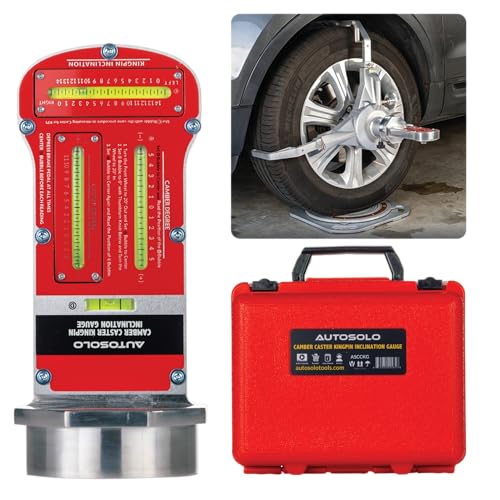
- Reads three front-end angles
- No batteries, charging, or software
- Includes a composite carry case
Best For: Home alignment checks on cars and light trucks
3-in-1 Adjustable Plates
Toe and Camber Alignment Tool Kit

- Measures toe and camber
- Designed to avoid caliper removal
- Includes plates, tapes, and adjustable gauge
Best For: DIY alignment work on cars, trucks, SUVs, and ATVs
Most Versatile
4-in-1 Magnetic Camber Alignment Kit

- Measures camber, caster, toe-in, and toe-out
- No caliper removal or electronic equipment required
- Folding metal design with dual 10-foot tape measures
Best For: DIY mechanics and garages needing multiple manual alignment measurements
Best for Basic Toe Checks
Stainless Steel DIY Toe Plates

- Checks toe-in and toe-out at home
- Stainless steel resists rust and corrosion
- Tape slots and hanging points simplify use and storage
Best For: DIY owners performing basic manual toe checks
Best Budget DIY Option
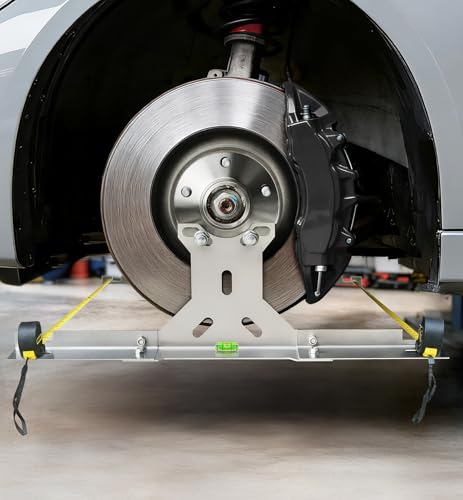
- Quick front-end toe checks with dual tape measures
- Stainless steel plates and hub stands resist corrosion
- No calibration or electronics needed
Best For: Home garages monitoring toe between professional alignment visits
Best Motorcycle Chain Alignment Tool – Tru-Tension Laser Monkey
For riders comparing laser wheel alignment tools, the Tru-Tension Laser Monkey offers a fast way to align a motorcycle’s rear wheel using the chain or belt drive. Its laser projects along the centerline from the sprocket or pulley toward the front sprocket.
Best For: Motorcycle owners who want a simple alignment tool for chain- or belt-driven bikes.
Pros:
- Works with motorcycles of any make or model, including chain and belt drives.
- Uses the sprocket or pulley to project a direct alignment laser.
- Compact 190 g design with a straightforward adjustment process.
Cons:
- Designed specifically for motorcycle chain and belt alignment rather than automotive camber or caster measurement.
- Its alignment method depends on accurately positioning the laser with the front sprocket.
The Laser Monkey is a focused choice for routine motorcycle drivetrain alignment. It can help support handling and reduce premature wear on chains, belts, and related components without a complicated setup.
Best Digital Camber Gauge – KAISAL Digital Camber Gauge
Among laser wheel alignment tools and related alignment gauges, the KAISAL Digital Camber Gauge is intended for measuring wheel or brake-disc camber. Its digital display, magnetic base, and wide measurement range make it useful for suspension adjustment and verification.
Best For: DIY mechanics checking or restoring camber on cars, motorcycles, trucks, and vans.
Pros:
- Measures from -90° to +90° with a clear backlit LCD display.
- Magnetic base and positioning bubble support placement on compatible brake-disc surfaces.
- Zero-reset function retains the last reference value, and the aluminum body is designed for durability.
- Includes a stated three-year warranty.
Cons:
- Measures camber; it is not a complete wheel-alignment system.
- The magnetic attachment requires a suitable magnetic surface.
This gauge is a practical supplement to a home alignment setup. It is particularly useful when comparing camber before and after suspension work, but additional equipment may be needed for a full alignment.
Best Precision Chain Alignment Tool – Gearhead Zone Laser Tool
The Gearhead Zone Chain and Sprocket Alignment Tool is a precision-focused option for riders comparing laser wheel alignment tools. Its CNC-machined aluminum body uses a laser centerline and coplanar clamp face to help align motorcycle, ATV, and kart drivetrains.
Best For: Motorcycle, ATV, and kart owners who want a durable tool for chain and sprocket alignment.
Pros:
- Designed for motorcycles, ATVs, and karts.
- Five-axis CNC-machined aluminum body with a black anodized finish.
- Factory-certified accuracy is stated at 1 mm over 1 meter.
- Laser alignment can help reduce drivetrain friction and support chain and sprocket life.
Cons:
- Focused on chain and sprocket alignment rather than general vehicle wheel alignment.
- Requires six LR44 batteries, although they are included.
With its rigid machined construction and stated accuracy specification, this tool suits riders who want a more precise alternative to visual alignment or short straight rods. It is best matched to powersports drivetrain work.
Best Rim-Mounted Alignment Clamp – AutoSolo 3D DSP Wheel Alignment Clamp
The AutoSolo 3D DSP Wheel Alignment Clamp is a mounting accessory for home-garage alignment work. While it is not itself a laser wheel alignment tool or measuring gauge, it provides a rigid magnetic mounting surface for checking camber and caster on rims from 11 to 25 inches.
Best For: DIY mechanics who already have a compatible magnetic camber or caster gauge.
Pros:
- Adjustable slider rods fit 11- to 25-inch rims.
- Tool-free knob adjustment makes mounting and moving between wheels convenient.
- Reversible locator pins accommodate different wheel profiles.
- Steel construction, storage slots, and wall-mounting points suit repeated garage use.
Cons:
- The listing includes only the clamp and magnetic adapter plate; gauges and other equipment are not included.
- At 8 pounds and 25 inches long, it is substantially larger than handheld alignment tools.
- It requires zeroing against the rim before use.
This clamp is most useful as the foundation of a home alignment station rather than as a standalone solution. Confirm your rim size and ensure you already have the required digital or magnetic gauge before buying.
Caliper-Free Toe Alignment – Reinforced 2-Piece Toe Alignment Plates
For DIYers comparing laser wheel alignment tools and toe-measurement equipment, this two-piece setup focuses on fast front-end measurements without removing the brake calipers. Its detachable design and included tape measures make it practical for garage storage and repeat use.
Best For: DIY toe checks on cars, trucks, SUVs, Jeeps, dirt bikes, and UTVs/ATVs with nuts under 15 mm.
Pros:
- Extension pieces allow use without removing the brake calipers.
- Two 16.4-foot imperial tape measures are accurate to 1/32 inch.
- Reinforced iron construction and a rust-resistant painted finish support durability.
- Detaches to a compact 16-inch size and includes a hanging hole.
Cons:
- This is primarily a toe-measurement tool rather than a complete angle-alignment system.
- Its 10.01-pound weight is less convenient than lighter handheld gauges.
This is a strong choice when your priority is straightforward toe measurement with broad vehicle compatibility. It is less suitable if you specifically need built-in camber or caster readings.
Three-Angle Magnetic Gauge – Camber, Caster & KPI Alignment Gauge
Among laser wheel alignment tools and manual alternatives, this magnetic gauge is designed for measuring camber, caster, and kingpin inclination at home. It uses bubble vials rather than batteries or software, making it a focused option for DIY front-end checks on level ground.
Best For: DIY alignment diagnosis on cars and light trucks with steel wheels, brake discs, or a suitable flat magnetic adapter plate.
Pros:
- Measures camber, caster, and kingpin inclination with one gauge.
- Requires no battery, charging, or software.
- Magnetic base can mount to a steel wheel, brake disc, or clean bare hub face.
- Includes a composite carry case for storage and transport.
Cons:
- The pictured wheel clamps, turn plates, ramps, and alloy-wheel adapter plate are not included.
- Caster measurement requires a 20-degree sweep procedure and calculation.
- It is intended for cars and light trucks rather than a broad range of vehicle types.
This gauge is best when you need several front-end angle readings from a compact, non-powered tool. Check the mounting requirements carefully, especially if your vehicle has alloy wheels.
3-in-1 Adjustable Plates – Toe and Camber Alignment Tool Kit
This adjustable kit gives shoppers comparing laser wheel alignment tools a combined toe-and-camber measurement option. It includes plates, magnetic tapes, and an adjustable gauge, with a design intended to work around low ground clearance and unusual caliper bracket positioning.
Best For: DIY alignment work on cars, trucks, SUVs, ATVs, and similar vehicles where caliper removal or limited clearance may complicate setup.
Pros:
- Combines toe and camber measurement in a three-in-one kit.
- Designed for use without removing the brake caliper.
- Includes two magnetic tapes and an adjustable magnetic gauge.
- Steel plates have a durable silver coating and integrated hanging hooks.
Cons:
- The supplied notes do not specify the measurement accuracy or angle ranges.
- Its 6.3-pound weight is heavier than a simple handheld gauge.
- It is a manual measurement kit, not a powered or laser-based alignment system.
This is a versatile pick for DIYers who want toe and camber capability in one portable kit. Its strongest advantage is setup flexibility, particularly on vehicles with tight clearance or awkward caliper positioning.
Most Versatile – 4-in-1 Magnetic Camber Alignment Kit
For shoppers comparing laser wheel alignment tools and other alignment equipment, this metal kit stands out by measuring camber, caster, toe-in, and toe-out. Its magnetic camber gauge, dual 10-foot tape measures, and no-caliper-removal setup make it a practical option for DIY users and technicians.
Best For: DIY mechanics and garages wanting broader alignment measurements in a compact tool.
Pros:
- Measures four key alignment angles: camber, caster, toe-in, and toe-out.
- Sets up without caliper removal, calibration, or electronic equipment.
- Folding telescopic design is approximately 40% more compact for storage.
- All-metal construction with baked-on paint helps resist water, rust, and wear.
Cons:
- It uses imperial tape measures, which may be less convenient for metric-only users.
- The kit provides manual measurements rather than electronic alignment readings.
This is the most complete choice of the three for users who need more than a basic toe check. Its compact folding design and included magnetic gauge add versatility without requiring electronic equipment.
Best for Basic Toe Checks – Stainless Steel DIY Toe Plates
If you are comparing laser wheel alignment tools for straightforward home maintenance, this stainless steel toe plate kit focuses on checking toe-in and toe-out. Built-in tape-measure slots and a simple setup make it useful for basic checks before professional service.
Best For: Car owners who want a reusable garage tool for manual toe checks and basic adjustments.
Pros:
- Helps check toe-in and toe-out at home to reduce unnecessary shop visits.
- Stainless steel construction resists rust and corrosion.
- Built-in tape-measure slots help keep the tape in position.
- Fits most cars, trucks, and SUVs and includes hanging points for storage.
Cons:
- Focused on toe alignment rather than camber, caster, or a full alignment measurement.
- Manual tape readings require the user to compare measurements carefully.
This is a focused, practical pick when toe alignment is your main concern. The stainless steel plates and storage-friendly design suit repeated garage use, while the straightforward operation is approachable for DIY owners.
Best Budget DIY Option – Home Garage Toe Plate Kit
Among laser wheel alignment tools and manual alternatives, this kit is designed for quick front-end toe checks in a home garage. Its dual tape measures, stainless steel plates, and no-electronics setup help users verify toe after tire, steering, or minor suspension work.
Best For: Home-garage users who need an affordable way to monitor front-end toe between shop visits.
Pros:
- Designed for front-end toe-in and toe-out checks on cars, trucks, and SUVs.
- Dual tape measures provide a simple reference for comparing readings.
- Heavy-duty stainless steel plates and hub stands resist bending and corrosion.
- Quick setup requires no calibration, electronics, or special skills.
Cons:
- It is a toe reference and adjustment tool, not a computerized four-wheel alignment system.
- Its usefulness is centered on front-end toe rather than broader alignment angles.
This kit makes sense for routine driveway checks and basic adjustments rather than comprehensive alignment work. It offers a durable, compact way to help reduce tire scrub and maintain straight-line tracking between professional visits.
How We Picked These Laser Wheel Alignment Tools
We focused on tools that address common alignment tasks without requiring a professional alignment rack. The selection includes motorcycle chain and wheel alignment devices, toe plates, magnetic camber gauges, caster and kingpin tools, and multi-function kits. We considered measuring range, attachment method, compatibility with wheel sizes, readability, construction, and how easily a home mechanic can repeat a measurement.
Because these products are not interchangeable, we also looked at the type of adjustment each tool supports. A laser guide can help establish a reference line, while toe plates and angle gauges provide different ways to measure suspension geometry.
Quick Comparison
- Motorcycle chain or rear-wheel alignment: Choose a dedicated laser chain and sprocket alignment tool.
- Front-end toe checks: Stainless-steel toe plates with tape measures are simple and fast.
- Camber measurement: Select a digital or magnetic camber gauge that mounts securely to the hub, wheel, or brake surface.
- Caster and kingpin measurements: Use a tool specifically designed for caster, camber, and kingpin inclination.
- Multiple DIY adjustments: A 3-in-1 or 4-in-1 kit can cover more tasks, but may involve more setup and calibration.
Key Buying Factors for Laser Wheel Alignment Tools
Vehicle Compatibility
Check whether the tool is intended for motorcycles, cars, or light trucks. For wheel-mounted products, confirm the supported rim diameter and whether the attachment works with alloy, steel, or brake-hub surfaces.
Measurement Type and Range
Toe plates measure front-end toe, while camber gauges measure wheel angle relative to vertical. Digital models may offer a broad positive and negative range, but their accuracy depends on calibration and a stable mounting surface.
Mounting and Reference Stability
Magnets, clamps, and plates must remain square and secure during measurement. A loose mount can create larger errors than the stated precision of the gauge. Clean the contact surface and follow the tool’s leveling or zeroing procedure.
Readability and Repeatability
Look for clear scales, a bright laser or digital display, and an adjustment process that can be repeated consistently. Dual tape measures are useful for quick toe comparisons, while digital displays are easier to read in tight spaces.
Build Quality and Included Hardware
Prioritize rigid plates, durable stainless steel or aluminum components, reliable magnets, and complete mounting hardware. A case or protective storage is helpful if the tool will be used regularly.
Who Should Buy Which Laser Wheel Alignment Tools?
Motorcycle owners should choose a dedicated laser chain or wheel alignment tool designed around the rear sprocket and swingarm. DIY car owners who need occasional toe checks may prefer stainless-steel toe plates because they are straightforward and quick to deploy. Suspension tuners should consider a digital camber gauge or a caster-camber tool with a secure magnetic mount. Home garages handling several alignment tasks may benefit from a multi-function kit, provided its individual measurements meet the required accuracy.
Whichever tool you choose, use level ground, set tire pressures consistently, remove obvious play from steering and suspension components, and treat the reading as a setup reference rather than a substitute for a professional alignment when precise factory specifications are required.