Budget solar phone chargers can keep your phone usable during camping trips, outages, travel, and other situations where wall power is unavailable. The best choice depends on whether you prioritize battery capacity, solar charging, portability, or built-in backup features.
This roundup compares 10 options with practical features such as USB-C charging, wireless output, built-in cables, flashlights, and hand-crank power. Use the guide below to match the charger to your devices and typical outdoor needs.
Best 10 Budget Solar Phone Chargers Picks for 2026
Best Emergency Features
BLAVOR Hand-Crank Solar Power Bank

- 20,000mAh capacity with 20W USB-C charging
- Hand crank, solar input, wireless charging, and built-in cables
- Includes lights and several outdoor survival tools
Best For: Emergency kits and feature-focused outdoor use
Best High-Capacity Backup

- Large listed 49,800mAh battery capacity
- Two USB-A ports plus USB-C connectivity
- Dual flashlights with steady, strobe, and SOS modes
Best For: Extended outdoor trips and emergency backup
Best All-Around Value
BLAVOR 20,000mAh Solar Power Bank

- Charges up to six devices with cables, ports, and wireless power
- 20W USB-C fast charging plus Qi wireless charging
- Rugged outdoor design with lights and emergency tools
Best For: Flexible travel, camping, and emergency charging
Best High-Capacity Pick
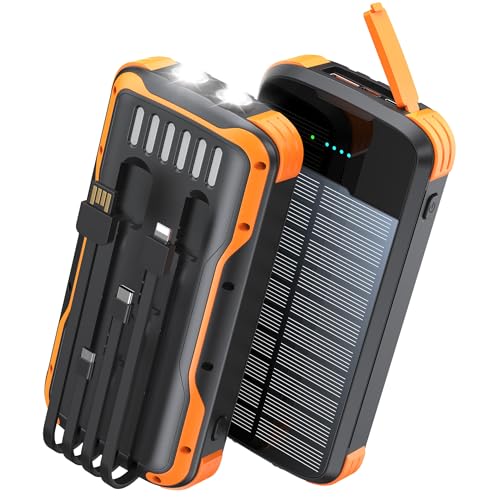
- Large 40,000mAh battery for extended backup power
- 20W USB-C PD charging and up to five connected devices
- IP67 build with dual multi-mode flashlights
Best For: Long trips, outages, and high-capacity emergency backup
Best Wireless Charging Value
20,000mAh Solid-State Solar Charger

- Qi wireless charging for compatible phones
- Built-in cables and ports can charge up to six devices
- Fast charging and solid-state 20,000mAh battery
Best For: Wireless phone charging during travel and off-grid use
Lightweight Trail Backup
YELOMIN 38800mAh Solar Power Bank

- 9.9-ounce design with a stated 38800mAh capacity
- Two USB-A ports plus USB-C input/output
- Dual LED flashlight with SOS and strobe modes
Best For: Hiking, camping, travel, and emergency backup
Pocket Wireless Outdoor Pick
BLAVOR 10000mAh Solar Power Bank

- Compact 10000mAh battery with Qi wireless charging
- USB-C output supports up to 20W charging
- IPX5 protection, dual flashlights, and compass carabiner
Best For: Portable camping, travel, and everyday phone backup
Cable-Free High-Capacity Kit
BLASOUL 49800mAh Solar Power Bank

- Four built-in cables reduce the need to pack extras
- 49800mAh stated capacity with 22.5W wired charging
- IP65 protection and 15W wireless charging
Best For: Extended camping, group travel, and emergency preparedness
Best Multi-Device Backup – 20,000mAh Solar Power Bank
This 20,000mAh battery pack is a practical budget solar phone charger for camping and emergency backup. Its built-in USB-C, Lightning, and Micro-USB cables reduce cable clutter, while the integrated solar panel is best treated as an emergency top-up rather than a primary charging method.
Best For: Campers and families who want one backup battery for several types of devices.
Pros:
- 20,000mAh capacity offers approximately two to three full smartphone charges.
- Includes built-in USB-C, Lightning, and Micro-USB cables, plus USB output and wireless charging.
- 15W output, LED flashlight, and multi-protection features add useful emergency functionality.
Cons:
- Solar charging is very slow and should not be relied on as the main power source.
- The unit may require a 6–8 hour initial charge to activate its cells.
- It is splash-resistant but not fully waterproof.
Choose this model if versatility matters more than compactness. Fully charge it from a wall adapter before leaving, then use its solar panel as a limited backup when outlets are unavailable.
Best Lightweight Panel – BLAVOR 10W Foldable Solar Charger
The BLAVOR 10W is a budget solar phone charger designed to turn direct sunlight into USB power without carrying a battery bank. Its foldable format, dual USB outputs, and included carabiners make it useful for hiking, camping, and backpacking.
Best For: Hikers and travelers who want a lightweight solar panel to charge phones, power banks, or small USB devices.
Pros:
- Up to 24% conversion efficiency is supported by an ETFE high-transmission surface.
- Two USB outputs can charge multiple compatible devices simultaneously.
- Weighs 0.81 pounds, folds compactly, and includes two carabiners.
- Oxford cloth construction and IPX4 water resistance suit outdoor use.
Cons:
- It provides up to 10W and 5V/2A, so charging performance depends heavily on sunlight.
- It does not store power on its own and works best with a compatible power bank.
This is the more practical choice when portability is the priority. Pair it with a charged power bank for steadier phone charging when clouds or changing sunlight make direct charging inconsistent.
Best Emergency Features – BLAVOR Hand-Crank Solar Power Bank
This BLAVOR model combines a 20,000mAh power bank with solar charging and a hand-crank generator, making it a feature-rich budget solar phone charger for emergencies. It also adds wireless charging, built-in cables, lights, and outdoor survival accessories.
Best For: Emergency kits and outdoor users who value multiple backup charging and lighting options.
Pros:
- Hand crank provides an alternative emergency power source and can produce lighting after cranking.
- 20,000mAh capacity, 20W USB-C fast charging, and wireless charging support several charging methods.
- Four built-in cables and three ports can support charging up to seven devices simultaneously.
- Includes a flashlight, camping lantern, compass, thermometer, carabiner, and rope.
Cons:
- At 1.3 pounds and 1.7 inches thick, it is less compact than a basic power bank.
- Solar and hand-crank charging are emergency options rather than substitutes for regular wall charging.
This is a strong fit when emergency versatility outweighs size and simplicity. Its wide feature set can reduce the number of separate items needed for camping or outage preparation.
Best High-Capacity Backup – 49,800mAh Solar Power Bank
This high-capacity model is a budget solar phone charger aimed at extended camping, travel, and emergency backup. It has two USB-A ports, USB-C connectivity, built-in charging cables, and dual flashlights, while its integrated solar panel provides supplementary power in direct sunlight.
Best For: Outdoor users who want a large battery reserve and built-in lighting in one device.
Pros:
- Listed 49,800mAh capacity provides a substantial backup reserve.
- USB-C and two USB-A ports support simultaneous charging of multiple devices.
- Dual flashlights offer steady, strobe, and SOS modes and can run for up to 80 hours.
- ABS construction is described as water-, drop-, and dust-proof for outdoor use.
Cons:
- The solar panel charges slowly, with up to 400mA under ideal lighting conditions.
- Its large capacity may be more than necessary for short trips.
- Charging results depend on sunlight and should be supplemented with Type-C charging at home.
Consider this option if battery reserve and lighting are more important than minimal size. For reliable trips, charge it through USB-C before departure and use solar charging to extend runtime outdoors.
Best All-Around Value – BLAVOR 20,000mAh Solar Power Bank
For shoppers comparing budget solar phone chargers, the BLAVOR stands out as a versatile 20,000mAh backup with built-in cables, wireless charging, and useful outdoor tools. Its 20W USB-C output and rugged construction make it practical for travel, camping, and emergency kits.
Best For: Buyers who want one durable charger for phones, watches, and several small devices.
Pros:
- Charges up to six devices using built-in cables, ports, and wireless charging.
- 20W USB-C fast charging and Qi wireless charging support.
- Includes flashlight modes, camping light, compass, thermometer, carabiner, and rope.
- Waterproof, shockproof, and dustproof design with charging protection.
Cons:
- Solar charging is best treated as backup power rather than a primary recharging method.
- The broad feature set may add bulk compared with a basic power bank.
This is a strong budget-friendly choice when flexibility matters more than minimal size. The combination of 20,000mAh capacity, fast wired charging, wireless support, and outdoor-focused features gives it broad everyday and emergency usefulness.
Best High-Capacity Pick – 40,000mAh PD20W Solar Charger
Among budget solar phone chargers, this model is geared toward users who prioritize maximum battery capacity. Its 40,000mAh battery, 20W PD charging, built-in cables, and IP67-rated outdoor construction provide substantial backup power for extended trips or outages.
Best For: Campers, travelers, and emergency-preparedness users who need multiple charges and built-in lighting.
Pros:
- Large 40,000mAh capacity provides multiple full charges for electronics.
- 20W USB-C PD fast charging and support for up to five devices.
- Dual flashlights offer four modes and up to 30 hours of continuous illumination.
- IP67 waterproof, shockproof, and dustproof construction.
Cons:
- The large battery takes relatively long to recharge through the solar panel.
- Solar input is intended for emergency backup; a 5V/2A-or-higher adapter is recommended for faster recharging.
This is the capacity-focused option in the group. It makes the most sense when keeping several devices running matters more than compactness or quick solar replenishment.
Best Wireless Charging Value – 20,000mAh Solid-State Solar Charger
For shoppers seeking budget solar phone chargers with convenient wireless power, this 20,000mAh model combines Qi charging, fast wired output, and multiple built-in cables. Its solid-state battery design and support for up to six devices make it a useful option for travel and off-grid backup.
Best For: Qi-compatible phone users who want cable-free charging alongside broad device compatibility.
Pros:
- Qi wireless charging works with compatible iPhone, Samsung Galaxy, Google Pixel, and other devices.
- Claims a 60% smartphone charge in about 30 minutes with fast charging.
- Built-in USB-A, Lightning, and USB-C cables plus additional ports can support up to six devices.
- 20,000mAh solid-state battery is presented as stable across changing temperatures.
Cons:
- Solar charging is described as emergency backup and is not fast.
- Wireless charging requires a Qi-compatible device and may be less convenient with some phone cases.
This model is a good fit when convenience is the priority. Its wireless pad reduces cable clutter, while the built-in cords and multiple outputs help support a group of devices during travel or a power outage.
Lightweight Trail Backup – YELOMIN 38800mAh Solar Power Bank
For shoppers comparing budget solar phone chargers, the YELOMIN combines a large stated battery capacity with a relatively light 9.9-ounce design. Its solar panel is best treated as a supplemental emergency backup, while USB-C recharging handles routine preparation before a trip.
Best For: Day hikes, camping, travel, and emergency kits where low weight and multiple charging ports matter.
Pros:
- 38800mAh stated capacity in a 9.9-ounce body.
- Two USB-A outputs plus USB-C input/output support several charging setups.
- Dual LED lights include steady, SOS, and strobe modes.
- Carabiner and protective port covers add outdoor convenience.
Cons:
- The solar panel adds power slowly and may require dozens of effective sunlight hours or longer for a full recharge.
- Routine charging is best done through USB-C rather than relying on sunlight.
The YELOMIN is a practical budget solar phone charger for buyers who want capacity, lighting, and flexible ports without a heavier outdoor battery. Just plan to charge it by USB-C before heading out.
Pocket Wireless Outdoor Pick – BLAVOR 10000mAh Solar Power Bank
The BLAVOR is a compact option among budget solar phone chargers, with a stated 10000mAh capacity, wireless charging, and USB-C output. Its solar function supports outdoor preparedness, but the supplied specifications identify corded electric power as the main source, so precharging is the sensible approach.
Best For: Campers and travelers who prefer a pocket-size charger with wireless charging and built-in safety features.
Pros:
- Small, lightweight design with wireless Qi charging.
- USB-C output supports up to 20W charging, with a stated iPhone 15 result of 65% in 30 minutes.
- IPX5 waterproof, dustproof, and shockproof construction.
- Dual flashlights and a compass carabiner add outdoor utility.
Cons:
- Its 10000mAh capacity is lower than the larger power banks in this roundup.
- The supplied details list corded electric as the power source, so solar charging should not be treated as the primary method.
Choose the BLAVOR if portability and wireless convenience are more important than maximum battery capacity. It is a well-equipped compact backup for phones, earbuds, and other USB devices.
Cable-Free High-Capacity Kit – BLASOUL 49800mAh Solar Power Bank
For buyers seeking budget solar phone chargers with maximum convenience, the BLASOUL includes four built-in cables, wireless charging, and a stated 49800mAh capacity. It is designed for extended outdoor use, though its larger 7-by-3.66-by-1.28-inch body may take more room in a pack.
Best For: Camping, hiking, travel, outages, and users who want one power bank for several connector types.
Pros:
- Four integrated cables cover iOS, USB-C, Micro USB, and USB-A input.
- 49800mAh stated capacity supports multiple device charges.
- 22.5W wired charging and up to 15W wireless charging are supported.
- IP65 water, shock, and dust resistance plus a three-mode flashlight suit outdoor use.
Cons:
- The larger dimensions may be less convenient for lightweight packing.
- Solar charging is included, but the supplied notes do not specify recharge time or solar input performance.
The BLASOUL stands out for reducing cable clutter while offering the highest stated capacity of these three options. It is a strong fit for group trips and emergency readiness when size is a secondary concern.
How We Picked These Budget Solar Phone Chargers
We focused on portable chargers that combine a rechargeable battery with solar input or solar-panel functionality. The selection spans compact foldable panels, high-capacity power banks, wireless models, and emergency-oriented designs with flashlights or hand cranks. We also considered charging versatility, including USB-C, USB-A, built-in Lightning and Micro-USB cables, wireless charging, and advertised power delivery.
Capacity and speed claims are manufacturer specifications. Actual solar charging performance varies substantially with sunlight, panel size, temperature, and charging losses, so a solar power bank is best treated as a battery backup rather than a guaranteed replacement for a wall charger.
Quick Comparison
| Type | Best For | What to Look For |
|---|---|---|
| Compact solar panel | Direct outdoor charging | Foldable design, USB output, panel wattage |
| 10,000–20,000mAh power bank | Everyday carry and short trips | Weight, cable compatibility, wireless output |
| 38,800–49,800mAh power bank | Extended outages or group use | Size, recharge time, port selection |
| Hand-crank model | Emergency preparedness | Crank practicality, flashlight, weather resistance |
Key Buying Factors for Budget Solar Phone Chargers
Capacity and Realistic Runtime
Higher mAh ratings generally provide more phone recharges, but they also add bulk and take longer to replenish. A 10,000mAh model suits daily carry, while 20,000mAh is a useful middle ground. Larger units make more sense for outages, camping groups, or multiple devices.
Solar Performance and Charging Speed
Small integrated panels are convenient but typically charge slowly. Choose a foldable panel when solar collection is a priority. For faster everyday charging, prioritize USB-C input and output, PD support, or a clearly stated wattage rating. Wireless charging is convenient but may be slower and less efficient than a cable.
Ports, Cables, and Compatibility
Built-in USB-C, Lightning, and Micro-USB cables reduce the accessories you need to pack. Check whether USB-C supports input, output, or both. Multiple USB ports are useful for sharing power, but simultaneous charging can reduce speed.
Durability and Emergency Features
Flashlights, rugged housings, water resistance, and hand cranks can be valuable during emergencies. Verify the product’s stated weather rating rather than assuming every solar charger is waterproof. A hand crank is a backup feature, not a convenient primary charging method.
Who Should Buy Which Budget Solar Phone Chargers?
Choose a compact panel if you already own a power bank and mainly need a way to collect sunlight. Pick a 10,000–20,000mAh model for commuting, travel, and occasional camping. Select a high-capacity unit for extended outages or several phones, provided you can accept the additional weight. Wireless models suit cable-light setups, while built-in-cable designs are convenient for mixed-device households. For emergency kits, a hand-crank model with a flashlight offers the broadest backup utility.