In 2025, having a reliable and efficient home office network is vital for productivity. With the right Ethernet switch, you can enhance your connectivity and streamline your workflow. Whether you’re gaming, streaming, or managing business tasks, selecting the best model can make a significant difference. Let’s explore the top options available today and see how they can elevate your home office experience.
NETGEAR 8-Port Gigabit Ethernet Unmanaged Switch (GS308)
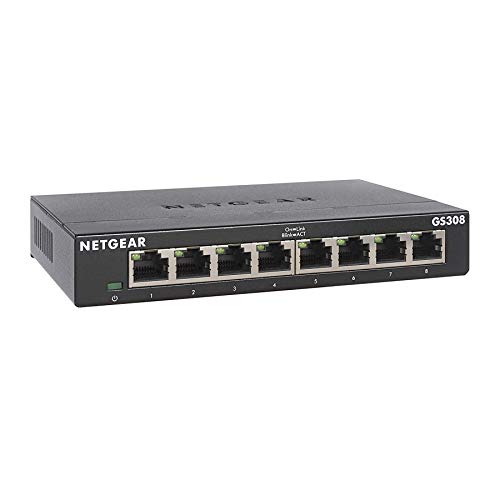
If you’re looking for a reliable and user-friendly networking solution for your home office, the NETGEAR 8-Port Gigabit Ethernet Unmanaged Switch (GS308) is an excellent choice. With eight Gigabit Ethernet ports, it offers plug-and-play simplicity, eliminating the need for software installation. You can easily mount it on your desk or wall, and its rugged metal casing guarantees durability. Enjoy silent operation, perfect for noise-sensitive environments, while benefiting from energy-efficient technology. Rated 4.8 out of 5 stars, this switch handles multiple devices smoothly, providing consistent connections without interruptions. Plus, it comes with a solid three-year warranty for peace of mind.
Best For: Home offices and small businesses seeking a reliable, easy-to-use networking solution.
Pros:
- Plug-and-play setup with no software installation required, making it user-friendly.
- Silent operation ideal for noise-sensitive environments, like offices or libraries.
- Durable metal casing and energy-efficient design contribute to long-term reliability and lower operational costs.
Cons:
- Limited to unmanaged functionality, which may not suit advanced users needing more control.
- Only 8 ports may be insufficient for larger networks or growing businesses.
- Lacks advanced features such as VLAN support or QoS settings found in managed switches.
TP-Link TL-SG105 5 Port Gigabit Unmanaged Ethernet Switch

The TP-Link TL-SG105 5 Port Gigabit Unmanaged Ethernet Switch is an excellent choice for home office users needing a reliable, high-speed connection without the hassle of complicated setups. With five 10/100/1000Mbps ports, you can easily connect multiple devices. Its plug-and-play feature guarantees a simple installation—just connect it to your router and you’re good to go. The fanless design keeps it quiet, while energy-efficient technology helps reduce power consumption. Users praise its performance and stability, making it perfect for gaming and streaming. With a solid build and a three-year warranty, it’s a smart investment for your home network.
Best For: Home office users needing a reliable and high-speed connection for multiple devices without complicated setups.
Pros:
- Plug-and-play installation for easy setup with no software needed.
- Fanless design for quiet operation, making it suitable for home environments.
- High-speed performance with stable connections, ideal for gaming and streaming.
Cons:
- Unmanaged switch that does not assign IP addresses, relying on the router for DHCP.
- Limited to five ports, which may not be sufficient for larger networks.
- Lacks advanced features like VLAN support or network management options.
NETGEAR 5-Port Gigabit Ethernet Unmanaged Switch (GS305)

Designed specifically for home networks and small offices, the NETGEAR 5-Port Gigabit Ethernet Unmanaged Switch (GS305) stands out with its plug-and-play setup, allowing you to connect multiple devices effortlessly. With five Gigabit Ethernet ports, you’ll enjoy fast data transfer rates of up to 1,000 Megabits per second. Its compact, lightweight design makes placement easy, whether on a desktop or wall-mounted. Plus, the energy-efficient architecture and silent operation guarantee it won’t disturb your workspace. Users rave about its reliability and performance, making it a top choice for enhancing your network security and connectivity.
Best For: Home users and small office environments looking for an easy-to-use, reliable network switch to connect multiple devices.
Pros:
- Plug-and-play setup for quick and hassle-free installation.
- Compact and lightweight design suitable for versatile placement options.
- Energy-efficient and silent operation, ideal for noise-sensitive spaces.
Cons:
- Not suitable for use outside of the U.S. and Canada due to power supply limitations.
- Some users may find the power connector location inconvenient.
- Limited features compared to managed switches for advanced network management.
NETGEAR 8-Port Gigabit Ethernet Managed Switch (GS308E)

Looking for a reliable and efficient networking solution for your home office? The NETGEAR 8-Port Gigabit Ethernet Managed Switch (GS308E) is an excellent choice. It offers eight Gigabit Ethernet ports for fast data transfer, perfect for connecting multiple devices. Its silent operation and energy-efficient design make it ideal for any workspace. With user-friendly management features like VLANs and QoS, you can easily optimize your network. Plus, the durable metal construction guarantees it stands the test of time. Highly rated by users, this switch simplifies setup while providing the control you need for your growing home office network.
Best For: Users seeking a reliable and efficient networking solution for their home offices or small business environments with multiple devices.
Pros:
- Easy to set up and manage, making it ideal for users transitioning from unmanaged switches.
- Silent operation and energy-efficient design ensure minimal disruption in the workspace.
- Durable metal construction provides long-lasting performance and reliability.
Cons:
- Limited to 8 ports, which may not suffice for larger networks.
- Basic managed capabilities may not meet the needs of advanced network configurations.
- Designed for use in U.S. & CA only, limiting availability for international users.
TP-Link 8 Port Gigabit Ethernet Network Switch (TL-SG108)

If you’re seeking a reliable and efficient solution for connecting multiple devices in your home office, the TP-Link 8 Port Gigabit Ethernet Network Switch (TL-SG108) stands out with its eight 10/100/1000Mbps ports. This unmanaged switch offers a plug-and-play setup, letting you connect directly to your router without any configuration. Its durable metal casing guarantees heat dissipation and EMI protection, while the fanless design assures silent operation. With a maximum power consumption of just 2.77 Watts, it’s energy-efficient too. Users praise its performance for streaming 4K videos and online gaming, consistently rating it 4.7 out of 5 stars.
Best For: Home office users and gamers looking for a reliable and efficient solution to connect multiple devices seamlessly.
Pros:
- Plug-and-play setup allows for easy installation without the need for configuration.
- Durable metal casing provides enhanced durability and effective heat dissipation.
- Energy-efficient design consumes only 2.77 Watts, reducing electricity costs.
Cons:
- Unmanaged switch may lack advanced features for network management.
- Limited to 8 ports, which might not be sufficient for larger networks.
- No built-in power redundancy, which could be a concern for critical applications.
8 Port PoE Gigabit Ethernet Switch

For those needing a reliable and efficient networking solution in a home office, the AUMOX PRO SG308P 8-Port PoE Gigabit Ethernet Switch stands out with its impressive power budget of 120W. This unmanaged switch supports 802.3af/at standards, providing up to 30W per port for high-speed devices. With a compact, fanless design, it guarantees silent operation while delivering a robust 16Gbps switching capacity. Installation is a breeze with its plug-and-play setup, making it perfect for small offices. Users appreciate its durability and performance, often connecting devices like PoE cameras and workstations seamlessly for enhanced productivity.
Best For: Small offices or home users seeking a reliable and efficient unmanaged networking solution with PoE support.
Pros:
- High power budget of 120W allows for multiple devices to be connected and powered simultaneously.
- Fanless design ensures silent operation, making it ideal for noise-sensitive environments.
- Plug-and-play installation simplifies setup, requiring no configuration and making it user-friendly.
Cons:
- Limited to unmanaged switch capabilities, which may not suit advanced networking needs.
- Some users report performance issues after extended use, indicating a need for monitoring.
- Not suitable for larger networks, as it only supports 8 ports, which may limit scalability.
Linksys LGS116 16 Port Gigabit Unmanaged Network Switch

The Linksys LGS116 16 Port Gigabit Unmanaged Network Switch is an ideal choice for home office setups that require robust connectivity without the hassle of complex configurations. With 16 Gigabit Ethernet auto-sensing ports, you’ll enjoy wired connection speeds up to 1000 Mbps. Its durable metal housing allows for wall mounting or desktop use, fitting seamlessly into your space. Plus, the plug-and-play setup guarantees you can start connecting devices right away—no configuration needed. With Quality of Service (QoS) for traffic prioritization and energy efficiency standards met, this switch enhances your network performance while being environmentally friendly.
Best For: Home office users who need a reliable, easy-to-use network switch for connecting multiple devices.
Pros:
- Easy plug-and-play installation eliminates the need for complicated configurations.
- High-speed connectivity with wired speeds up to 1000 Mbps across all 16 ports.
- Durable metal housing allows for versatile placement options, including wall mounting.
Cons:
- Unmanaged switch means no advanced features for network management or customization.
- Limited to wired connections, which may not suit users preferring wireless options.
- No built-in power over Ethernet (PoE) capability for powering devices like IP cameras or access points.
TP-Link 16 Port Gigabit Ethernet Network Switch (TL-SG116)
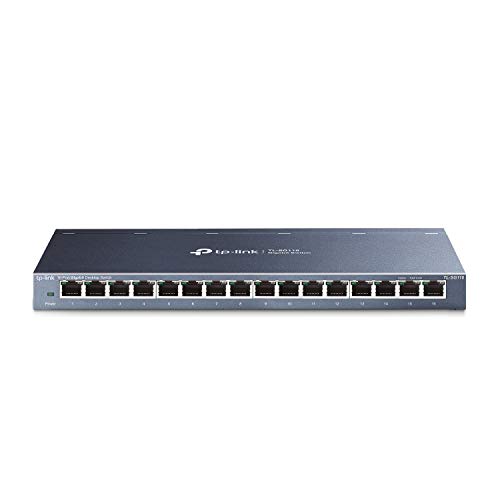
Looking for a reliable Ethernet switch that can handle multiple devices in your home office? The TP-Link 16 Port Gigabit Ethernet Network Switch (TL-SG116) is a solid choice. With 16 RJ45 ports offering speeds up to 1000Mbps, it supports Auto Negotiation for seamless connections. Its fanless design guarantees quiet operation, making it perfect for your workspace. Plus, innovative energy-efficient technology helps lower power consumption, saving you money. The plug-and-play setup requires no software, and the sturdy metal case allows for flexible installation. Backed by a 3-year warranty and free technical support, it’s a dependable option for enhancing your network performance.
Best For: Home office users or small businesses looking for a reliable and efficient Ethernet switch to connect multiple devices.
Pros:
- Quiet Operation: The fanless design ensures that the switch operates silently, making it suitable for workspaces.
- Energy Efficiency: Innovative technology reduces power consumption, helping save on energy costs.
- Easy Installation: Plug-and-play setup requires no software installation or configuration, allowing for quick and hassle-free deployment.
Cons:
- Limited Features: Lacks advanced management features found in higher-end switches, which may be necessary for larger networks.
- No PoE Support: Does not support Power over Ethernet (PoE), which may be a drawback for powering devices like IP cameras or phones.
- Fixed Ports: The 16 ports are fixed and cannot be expanded, limiting future scalability options.
TP-Link 5 Port Gigabit PoE Switch (TL-SG1005P)

Ideal for small home offices or workspaces, the TP-Link 5 Port Gigabit PoE Switch (TL-SG1005P) offers four Power over Ethernet (PoE+) ports, delivering up to 30W each, ensuring you can power multiple devices like IP cameras and access points without the hassle of additional power adapters. With a total PoE power budget of 65W and one Gigabit non-PoE port, it supports high-speed connections. The plug-and-play setup makes installation a breeze, while its durable metal casing provides flexibility for desktop or wall mounting. Enjoy quiet operation thanks to its fanless design, backed by a solid 3-year warranty.
Best For: Small home offices or workspaces needing reliable Power over Ethernet (PoE) capabilities for devices like IP cameras and access points.
Pros:
- Plug-and-play setup allows for easy installation without software.
- Durable metal casing provides flexibility for both desktop and wall mounting.
- Fanless design ensures quiet operation, making it suitable for any environment.
Cons:
- Not compatible with Omada control, which may limit integration with certain systems.
- Slightly higher price point compared to non-PoE switches.
- Limited to a total PoE power budget of 65W, which may restrict the number of devices powered.
TP-Link LS108GP 8 Port PoE Gigabit Ethernet Switch

For those setting up a home office with multiple PoE devices, the TP-Link LS108GP 8 Port PoE Gigabit Ethernet Switch stands out as a reliable solution. With eight PoE+ ports and a total power budget of 65W, it easily supports your IP cameras and access points. Its 16 Gbps switching capacity guarantees smooth data transfer, while the plug-and-play feature makes setup a breeze. You’ll appreciate the fanless design for silent operation, perfect for noise-sensitive spaces. Plus, its extended PoE transmission reaches up to 820 feet, ideal for larger areas. Enjoy robust performance in a compact, sturdy package.
Best For: Home office users and small businesses needing reliable PoE connectivity for multiple devices like IP cameras and access points.
Pros:
- Easy plug-and-play setup with no configuration required.
- Silent operation thanks to the fanless design, suitable for quiet environments.
- Extended PoE transmission capability of up to 820 feet, ideal for large surveillance areas.
Cons:
- Limited to 8 ports, which may not be enough for larger setups.
- Total PoE power budget of 65W may restrict the use of high-power devices.
- No advanced management features for network monitoring or configuration.
Factors to Consider When Choosing Ethernet Switches for Home Offices
When choosing an Ethernet switch for your home office, you need to take into account several key factors. Think about the number of ports you’ll need, the data transfer speed that suits your setup, and whether you require Power Over Ethernet. Also, keep in mind the size, form factor, and energy efficiency standards to guarantee you make the best choice for your workspace.
Number of Ports
Choosing the right number of ports on an Ethernet switch is essential for ensuring your home office runs smoothly. Typically, you’ll find models ranging from 5 to 16 ports. If you expect to connect multiple devices like PCs, printers, and smart TVs, opting for an 8-port or 16-port switch is wise. This not only accommodates your current needs but also allows for future expansion without needing extra switches. Consider your office layout; a switch with sufficient ports can simplify your network setup and avoid the complications of daisy-chaining. Aim for a switch where the number of ports matches or slightly exceeds your devices, factoring in potential additions and the type of network traffic expected for peak performance.
Data Transfer Speed
Understanding data transfer speed is essential for enhancing your home office network. Modern Ethernet switches typically support speeds up to 1000 Mbps (1 Gbps), making them ideal for high-bandwidth tasks like video streaming and online gaming. If you’re still using older Fast Ethernet switches limited to 100 Mbps, consider upgrading to Gigabit Ethernet for a significant performance boost.
When selecting a switch, think about how many devices you’ll connect and their speed requirements. Non-blocking switching architecture allows all ports to maintain maximum speeds simultaneously, preventing bottlenecks. Additionally, look for energy-efficient models, such as those adhering to IEEE802.3az standards, which reduce power consumption while keeping data transfer rates efficient. Your network’s efficiency hinges on these factors, so choose wisely!
Power Over Ethernet
Power Over Ethernet (PoE) technology transforms how you power devices in your home office by delivering both data and electrical power through the same Ethernet cable. This eliminates the hassle of separate power sources for devices like IP cameras and access points. When choosing a PoE switch, consider the PoE standards—IEEE 802.3af supplies up to 15.4W, while 802.3at provides up to 30W per port. Pay attention to the total power budget of the switch, which typically ranges from 65W to 120W for multi-port options. If your setup requires longer distances, look for extended PoE transmission modes that can deliver power up to 820 feet, making it ideal for larger installations.
Size and Form Factor
When it comes to setting up your home office, the size and form factor of your Ethernet switch can make a world of difference. Compact models fit easily on desks or can be wall-mounted, saving valuable space. Consider whether you need a desktop switch, which usually has a lower profile, or a rack-mounted option that may require extra infrastructure. Match the number of ports to your needs—small 5-port switches are ideal for minimal setups, while 16-port models cater to extensive networking. Weighing the switch is also important; lighter options are easier to move, but heavier models often offer more durability. Choosing the right size and form factor guarantees your home office remains organized and efficient.
Energy Efficiency Standards
Choosing an Ethernet switch that meets energy efficiency standards can greatly impact your home office’s operational costs and environmental footprint. Look for switches compliant with IEEE 802.3az, which reduce power consumption during low network activity. Many modern, energy-efficient switches have fanless designs, leading to silent operation and lower energy usage compared to traditional models with cooling fans. Innovative energy-saving technology optimizes power based on connected devices, ensuring unused ports consume minimal energy. By selecting switches with energy efficiency ratings, you not only save money but also contribute to a more sustainable home office setup. This aligns your work environment with environmentally-conscious practices, proving that you can be both productive and responsible.
Managed vs. Unmanaged
Understanding the difference between managed and unmanaged Ethernet switches is essential for optimizing your home office network. Managed switches provide advanced features like VLANs, QoS, and network monitoring, giving you greater control over your network traffic. This can be vital if you handle high data demands, such as streaming or gaming. On the other hand, unmanaged switches are plug-and-play, making them a simple and cost-effective choice for basic networking needs. They usually consume less power and operate quietly, which is perfect for noise-sensitive environments. Ultimately, your choice should depend on your specific requirements—if you need flexibility and control, go for a managed switch; if you prioritize ease of use and affordability, an unmanaged switch will suffice.
Installation and Setup
Installing and setting up an Ethernet switch for your home office can be a straightforward process, especially if you opt for an unmanaged model. These switches typically feature a plug-and-play setup, letting you connect devices without any software installation. Many include auto MDI/MDIX capabilities, which eliminate the hassle of crossover cables, simplifying your connections. Their compact designs make them easy to place on your desktop or mount on a wall, fitting seamlessly into your workspace. Plus, most operate silently, ensuring they won’t disrupt your work environment. Clear LED indicators on the ports help you quickly assess connection status, making troubleshooting a breeze as you get everything up and running. Enjoy a hassle-free setup and boost your network performance!