Stable water conditions are essential for healthy fish, corals, plants, and beneficial bacteria, but manual testing can make it easy to miss gradual changes. The best aquarium monitoring systems help you track important parameters more consistently and respond before a small issue becomes a serious problem.
This roundup compares continuous Wi-Fi monitors, controller displays, digital meters, and test strips, with options for both beginners and experienced aquarists. Use the guide below to match features, accuracy, connectivity, and ongoing testing costs to your tank.
Best 10 Aquarium Monitoring Systems Picks for 2026
Most Comprehensive
8-in-1 WiFi Water Quality Meter

- Measures pH, S.G., EC, salinity, ORP, TDS, CF, and temperature
- Tuya app enables real-time monitoring and data exports
- Wall-mounted design with three LCD screens
Best For: Detailed aquarium, hydroponic, and laboratory water tracking
Best Room-Environment Add-On

- Tracks ambient temperature and humidity
- Monitors CO2 and VOC levels
- Designed for Neptune Apex controller setups
Best For: Apex users monitoring aquarium-room conditions
Best Calibration Value

- Measures six water-quality parameters continuously
- App offers remote access and 30-day trend history
- Includes three-point automatic calibration
Best For: Aquarium and hydroponic users wanting simple connected monitoring
Best Dedicated Display
Insight Standard Aquarium Controller

- Displays real-time Apex parameters on a 4-inch touchscreen
- Connects wirelessly through Apex Local WiFi
- Customizable dashboard with stand included
Best For: Neptune Apex owners seeking an always-on tank display
Best Smart Multi-Parameter Monitor
Wireless WiFi Aquarium Water Quality Tester

- Tracks seven water parameters in real time
- Sends customizable alerts through the Tuya Smart App
- Supports clip, suction-cup, and floating installation
Best For: Remote, continuous aquarium monitoring across freshwater and saltwater setups
Best Budget Testing Option
EASYTEST 8-Way Aquarium Test Strips

- Checks eight common aquarium water metrics
- Provides results in roughly 15 to 60 seconds
- Includes 50 strips for freshwater, saltwater, and ponds
Best For: Affordable, periodic manual water testing at home
Best App-Controlled Display
Smart 7-in-1 Aquarium Water Monitor

- Measures seven parameters in real time
- Combines a color screen with Tuya app alerts
- Includes a replaceable probe and automatic temperature compensation
Best For: Aquarists wanting local display readings plus remote monitoring
Best Budget Test Kit

- Checks 11 aquarium water parameters
- Includes 150 strips and a color chart
- Works for freshwater, saltwater, and ponds
Best For: Affordable, frequent at-home water testing
Best Connected Meter

- Measures eight water-quality parameters
- Offers WiFi app access and remote monitoring
- Logs data for historical analysis
Best For: Continuous monitoring with app-based tracking
Best Smart Saltwater Monitor
Kactoily 7-in-1 WiFi Aquarium Tester
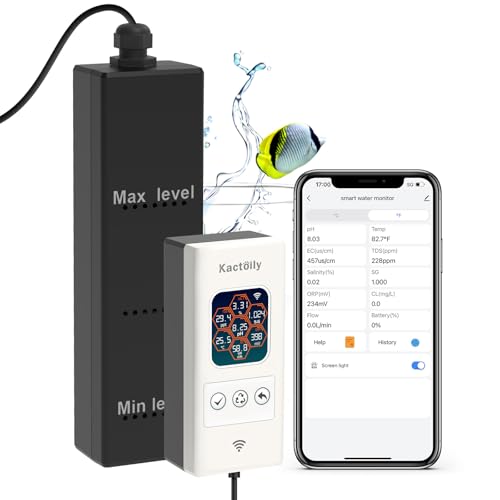
- Monitors seven parameters continuously
- Sends customizable app, phone, or SMS alerts
- Includes pH and ORP calibration materials
Best For: Connected freshwater and saltwater monitoring with alerts
Most Comprehensive – 8-in-1 WiFi Water Quality Meter
For shoppers comparing aquarium monitoring systems, this wall-mounted Tuya WiFi meter stands out for measuring eight water-quality parameters in one display. It provides readings for pH, specific gravity, EC, salinity, ORP, TDS, CF, and temperature, with app access for remote tracking.
Best For: Aquarists, hydroponic growers, and labs that want broad parameter coverage and downloadable monitoring records.
Pros:
- Measures eight key water parameters in one unit.
- Tuya Smart app supports real-time remote monitoring.
- Three LCD screens show readings clearly, while data logs can be exported for daily, weekly, and monthly reports.
- Includes accessories for wall mounting.
Cons:
- The tester is not waterproof and must be protected from moisture.
- Requires a wall-mounted installation and DC 6V power.
This is a feature-rich choice when you need more than basic pH and temperature readings. Its broad sensor set and reporting tools are useful for detailed oversight, provided the unit is installed in a dry location.
Best Room-Environment Add-On – Insight Pro Apex Display
Among aquarium monitoring systems, the New Wave Aquaria AvidAqua Insight Pro is aimed at monitoring the environment around an aquarium rather than directly measuring tank water. Designed as a display for a Neptune Apex controller, it tracks room temperature, humidity, CO2, and VOCs.
Best For: Neptune Apex users who want a dedicated screen for surrounding-room conditions.
Pros:
- Monitors ambient temperature and humidity.
- Tracks CO2 and volatile organic compounds.
- Provides a dedicated display for Apex-based aquarium monitoring.
Cons:
- Its supplied monitoring features focus on room conditions, not direct water measurements.
- Compatibility is centered on Neptune Apex systems.
This display is most useful as an environmental companion to an existing Apex setup. Choose it when room air conditions matter to your aquarium management, rather than as a standalone water-quality meter.
Best Calibration Value – 6-in-1 WiFi Water Monitor
This 6-in-1 unit is a practical option for aquarium monitoring systems when you want continuous readings without a large feature list. It measures pH, EC, TDS, salinity, specific gravity, and temperature, then sends data to a mobile app over 2.4GHz WiFi.
Best For: Aquarium and hydroponic users who prioritize remote access, trend tracking, and straightforward calibration.
Pros:
- Continuously monitors six commonly used water parameters.
- Mobile app supports remote viewing and a 30-day data curve.
- Three-point automatic calibration simplifies setup.
- Compact wall-mounted design saves space.
Cons:
- Mobile connectivity requires a 2.4GHz WiFi network.
- It monitors fewer parameters than an 8-in-1 meter.
For routine aquarium maintenance, this model balances essential measurements with useful app history. Its automatic calibration is particularly convenient for users who want ongoing monitoring without a complicated setup process.
Best Dedicated Display – Insight Standard Aquarium Controller
AvidAqua Insight Standard Aquarium Controller Display | Neptune Apex, Hydros Monitoring Screen
Check Price On AmazonThe Insight Standard is a dedicated screen for Neptune Apex aquarium monitoring systems. Its 4-inch capacitive touchscreen displays real-time Apex data, including pH, temperature, salinity, ORP, and Trident-controlled alkalinity, calcium, and magnesium parameters.
Best For: Neptune Apex owners who want always-on tank data in a convenient tabletop or wall-mounted location.
Pros:
- Shows key aquarium parameters on a clear 4-inch touchscreen.
- Connects wirelessly through Apex Local over an existing WiFi network.
- Customizable dashboard lets users choose displayed widgets.
- Includes a table stand and supports optional magnetic mounting.
Cons:
- Designed exclusively for Neptune Systems Apex controllers.
- Room CO2, humidity, ambient temperature, and VOC monitoring are listed for the Pro model, not this Standard model.
- Magnetic mounts are sold separately.
This is a strong convenience upgrade for an existing Apex installation, especially if you prefer glanceable information over repeatedly opening a mobile app. It is not a standalone water monitor, so compatibility should be confirmed before purchase.
Best Smart Multi-Parameter Monitor – Wireless WiFi Aquarium Water Quality Tester
For aquarium monitoring systems that provide continuous data instead of occasional spot checks, this wireless tester tracks seven key water parameters through the Tuya Smart App. It is designed for freshwater, saltwater, planted tanks, and ponds, with customizable alerts when readings move outside your selected ranges.
Best For: Aquarists who want app-based, real-time monitoring across multiple water parameters.
Pros:
- Monitors pH, ORP, TDS, conductivity, salinity, specific gravity, and temperature in real time.
- Provides Wi-Fi app notifications for customizable unsafe-level alerts.
- Offers clip, suction-cup, or floating probe installation for different tank setups.
- Includes calibration powders, mounting options, and power plugs for setup.
Cons:
- Requires a 2.4GHz Wi-Fi connection and the Tuya Smart App.
- Its broad feature set may be more than needed for simple routine testing.
This is a strong choice when remote alerts and ongoing visibility matter more than a basic test routine. The replaceable, temperature-compensated probe and flexible mounting options also make it practical for varied aquarium sizes.
Best Budget Testing Option – EASYTEST 8-Way Aquarium Test Strips
These test strips offer a straightforward alternative to electronic aquarium monitoring systems for aquarists who prefer quick, at-home checks. Each strip tests eight core metrics, with color-chart readings designed for freshwater, saltwater, shrimp tanks, planted tanks, and ponds.
Best For: Routine manual testing and budget-conscious aquarists managing one or more tanks.
Pros:
- Tests pH, hardness, alkalinity, chlorine, nitrate, nitrite, carbonate, and ammonia nitrogen.
- Uses a simple dip, develop, and compare process with readings available in about 15 to 60 seconds.
- Works across freshwater and saltwater aquariums, betta and shrimp tanks, and outdoor ponds.
- Includes 50 strips without requiring extra testing equipment.
Cons:
- Requires manual color comparison rather than automatic app tracking.
- Testing is recommended twice weekly, so it does not provide continuous monitoring.
- The ammonia pad must be cut off for accurate ammonia testing.
Choose this kit if you want broad parameter coverage and low-effort routine checks without investing in connected hardware. It is especially useful for establishing a regular testing schedule across multiple aquatic environments.
Best App-Controlled Display – Smart 7-in-1 Aquarium Water Monitor
This smart monitor is one of the more feature-rich aquarium monitoring systems for aquarists who want both an onboard display and connected alerts. It measures seven parameters in real time, while the Tuya Smart App supports remote viewing and notifications over 2.4GHz Wi-Fi.
Best For: Freshwater, marine, reef, and pond keepers who want a screen-based monitor with remote app access.
Pros:
- Tracks pH, temperature, TDS, conductivity, salinity, specific gravity, and ORP.
- Combines a color screen with app control, remote monitoring, and real-time alerts.
- Includes three-point pH calibration, automatic temperature compensation, and auto-switching TDS/EC units.
- Uses a replaceable platinum probe with a long cable, suction cups, and floater rings.
Cons:
- App connectivity depends on a 2.4GHz Wi-Fi network.
- The advanced monitoring functions may be unnecessary for aquarists who only need occasional testing.
Its combination of a color display, calibration features, and replaceable probe makes this a versatile option for ongoing water-quality management. It is particularly appealing when you want local readings at the tank plus alerts while away.
Best Budget Test Kit – 11-in-1 Aquarium Test Strips
For aquarium keepers who want broad coverage without a powered device, this test-strip kit is a practical entry in aquarium monitoring systems. It checks 11 parameters, including ammonia, pH, nitrate, nitrite, hardness, alkalinity, copper, chlorine, iron, carbonate, and temperature, using a simple dip-and-compare process.
Best For: Freshwater and saltwater aquarium owners who want an inexpensive way to perform frequent, at-home water checks.
Pros:
- Tests 11 key water-quality parameters in one kit.
- Includes 150 strips, with some separately packaged to help maintain freshness.
- Color chart, testing tubes, thermometer capability, and an aquarium-water ebook are included.
- Suitable for freshwater tanks, saltwater aquariums, betta tanks, and fish ponds.
Cons:
- Results require visual comparison with a color chart rather than digital readings.
- Opened strips are recommended for use within three months for maximum accuracy.
This is a strong choice for routine screening and broad parameter coverage, particularly for hobbyists managing multiple tanks. It is less suitable if you want remote alerts, automatic logging, or continuous monitoring.
Best Connected Meter – WiFi pH, EC and ORP Monitor
This connected meter is designed for users who want more than occasional dip tests from their aquarium monitoring systems. It measures eight water-quality parameters, provides a real-time LCD readout, and uses WiFi connectivity with an app for remote viewing, automated collection, and historical analysis.
Best For: Aquarium or hydroponic users who value continuous monitoring, app access, and trend tracking across pH, conductivity, dissolved-solids, and related readings.
Pros:
- Monitors eight parameters, including pH, EC, PPM, ORP, salinity, and humidity.
- WiFi connectivity supports remote monitoring through a dedicated mobile application.
- LCD screen provides clear real-time readings.
- Automated data collection and historical analysis help track changes over time.
Cons:
- The supplied notes do not specify included calibration solutions or probe-maintenance accessories.
- Its feature set may be more than needed for users who only want occasional basic checks.
Choose this model when remote access and recorded trends are priorities. Its combination of a local display, WiFi monitoring, and data logging gives it a more hands-off feel than strip-based testing, though buyers should verify calibration requirements before purchase.
Best Smart Saltwater Monitor – Kactoily 7-in-1 WiFi Aquarium Tester
For fish keepers seeking alerts and continuous readings, this Kactoily unit is one of the more feature-rich aquarium monitoring systems in the group. Its probe tracks pH, ORP, salinity, specific gravity, TDS, EC, and temperature, while the Tuya Smart app supports thresholds and notifications.
Best For: Freshwater and saltwater aquarium owners who want 24-hour monitoring, customizable limits, and smartphone alerts.
Pros:
- Combines seven measurements in one monitor, including pH, ORP, salinity, specific gravity, and temperature.
- Supports WiFi access and monitoring from a smartphone.
- Tuya Smart app allows custom high and low limits with app, phone, or SMS notifications.
- Includes materials for three-point pH calibration and ORP calibration.
Cons:
- EC calibration solution is not included and must be purchased separately.
- The probe should be placed in consistent flow and away from protein separators in saltwater setups.
- The protective cap must be replaced before use according to the supplied instructions.
This is the strongest fit for users who want active oversight rather than periodic testing, especially in saltwater systems where salinity and specific gravity matter. Its calibration and placement requirements add setup work, but the alert-based monitoring can make ongoing maintenance more convenient.
How We Picked the Best Aquarium Monitoring Systems
We focused on the measurements most useful for routine aquarium care: pH, temperature, salinity, specific gravity, TDS, EC, ORP, and ammonia. We also considered whether each product supports continuous monitoring, Wi-Fi or app access, real-time alerts, wall mounting, and freshwater or saltwater use.
Because no single tester suits every aquarium, the selection includes connected systems for remote oversight, display-based controllers for at-a-glance checks, handheld meters for spot testing, and strips for affordable baseline testing. A useful system should be simple enough to use consistently and provide measurements that fit your livestock and maintenance routine.
Quick Comparison
- Best for remote monitoring: Wi-Fi meters with app access and configurable alerts.
- Best for controller setups: Dedicated display screens designed for compatible aquarium controllers.
- Best for broad parameter coverage: Multi-parameter digital testers that measure pH, temperature, salinity, EC, TDS, or ORP.
- Best for budget testing: Multi-way strips with enough tests for frequent checks.
- Best for troubleshooting: A handheld pH/EC or ORP meter used to verify unexpected readings.
Key Buying Factors for Aquarium Monitoring Systems
Parameters and Compatibility
Choose measurements based on your setup. Freshwater tanks commonly need pH and temperature checks, while planted tanks may benefit from conductivity or TDS readings. Reef and marine aquariums often require salinity or specific gravity, temperature, pH, and sometimes ORP. Confirm that the listed ranges and sensors suit your water type.
Continuous Access and Alerts
Wi-Fi monitoring is valuable when you travel, manage delicate livestock, or want notification of sudden temperature or water-quality changes. Check whether alerts require an app, cloud account, or stable 2.4GHz network, and verify how the device behaves if Wi-Fi disconnects.
Accuracy, Calibration, and Maintenance
Digital probes require calibration, cleaning, and occasional replacement. Look for clear calibration instructions and readily available solutions or sensors. Test strips are faster and inexpensive, but they generally provide less precise readings than a properly maintained digital meter.
Installation and Operating Cost
Wall-mounted units save space but need a nearby outlet and a suitable installation location. Also consider replacement probes, batteries, reagent strips, calibration fluid, and subscription costs before choosing a system.
Who Should Buy Which Aquarium Monitoring Systems?
Choose a Wi-Fi multi-parameter monitor if you want remote access, continuous readings, and alerts for a high-value reef or heavily stocked tank. Choose a controller display if you already use a compatible aquarium controller and want clearer information at the tank. Choose a handheld digital meter for occasional testing, water changes, or confirming unusual strip results. Choose test strips if you are new to aquariums, maintain several tanks, or need an economical screening tool. For critical systems, pairing strips with a calibrated digital meter can provide both convenience and verification.