When you’re looking to produce music on your PC, the right audio interface can make all the difference in sound quality. Whether you’re an aspiring musician or a seasoned producer, choosing an interface that fits your needs is essential. From the Focusrite Scarlett series to versatile options like the MAONO PS22 Lite, there’s a range of choices available. Let’s explore the top audio interfaces that could elevate your production game.
Focusrite Scarlett Solo 3rd Gen USB Audio Interface

The Focusrite Scarlett Solo 3rd Gen USB Audio Interface is perfect for guitarists, vocalists, and podcasters looking to elevate their sound quality without breaking the bank. With high-performance mic pre-amps and 24-bit/192kHz AD-DA converters, you’ll achieve professional audio quality effortlessly. You’ll appreciate its USB-C connectivity, which guarantees a hassle-free setup on both Mac and PC, requiring no external power. Plus, the two high-headroom instrument inputs and Gain Halo metering prevent distortion, making your recordings shine. This portable interface also includes a robust software bundle, offering powerful tools to enhance your production experience. Get ready to create!
Best For: Guitarists, vocalists, and podcasters seeking high-quality audio recording in a budget-friendly package.
Pros:
- High-performance mic pre-amps with switchable Air mode for enhanced recordings.
- 24-bit/192kHz AD-DA converters ensure professional sound quality.
- Portable design with durable build, perfect for musicians on the go.
Cons:
- Some users have reported software and driver issues with specific applications.
- Limited number of input/output options may not suit larger setups.
- No MIDI input/output, which may be a drawback for some producers.
Focusrite Scarlett Solo 4th Gen USB Audio Interface

Designed specifically for guitarists, vocalists, and producers, the Focusrite Scarlett Solo 4th Gen USB Audio Interface delivers studio-quality recordings that elevate your music production. With a 120dB dynamic range and improved Air mode, you’ll notice enhanced presence in your vocals and guitars. Its lightweight design features intuitive volume knobs and USB-C connectivity for easy setup. You’ll also enjoy a powerful software bundle, including Pro Tools Intro+ and Auto-Tune Access. Highly rated by users for sound quality and low latency, Focusrite backs it with 24/7 support and a three-year warranty, ensuring you’re always ready to create.
Best For: The Focusrite Scarlett Solo 4th Gen USB Audio Interface is best for guitarists, vocalists, and producers seeking high-fidelity studio-quality recordings.
Pros:
- Excellent sound quality with a 120dB dynamic range and improved Air mode for enhanced vocals and guitars.
- Lightweight design with easy USB-C connectivity and intuitive volume controls.
- Comprehensive software bundle including Pro Tools Intro+ and Auto-Tune Access, along with responsive customer support and a three-year warranty.
Cons:
- Some users report driver issues with certain games, although updates are provided regularly.
- Limited input options may not meet the needs of those requiring multiple simultaneous recordings.
- The lightweight build may raise concerns about durability for heavy use.
MAONO USB Audio Interface for PC (PS22 Lite Black)

For aspiring musicians and podcasters seeking high-quality audio without breaking the bank, the MAONO USB Audio Interface (PS22 Lite Black) stands out. With 24-bit/192kHz recording and a 106dB dynamic range, it captures sound with impressive clarity. You’ll appreciate its compatibility with both condenser and dynamic microphones, plus a dedicated instrument input for your guitar. The included ProStudio Routing Software enhances your live streaming experience, while plug-and-play functionality guarantees easy setup across devices. Compact and lightweight, it fits right in your hand, making it perfect for on-the-go recording. Experience pro-level audio without the hefty price tag!
Best For: Aspiring musicians and podcasters looking for a budget-friendly audio interface that delivers high-quality sound.
Pros:
- High-resolution 24-bit/192kHz recording for exceptional audio clarity.
- Compact and lightweight design for easy portability.
- Easy plug-and-play setup with compatibility across multiple devices.
Cons:
- Limited physical controls may require software for advanced features.
- Some users may find the dynamic light ring distracting during recording.
- May not include additional accessories like microphones or stands.
M-AUDIO M-Track Duo USB Audio Interface for Recording and Streaming
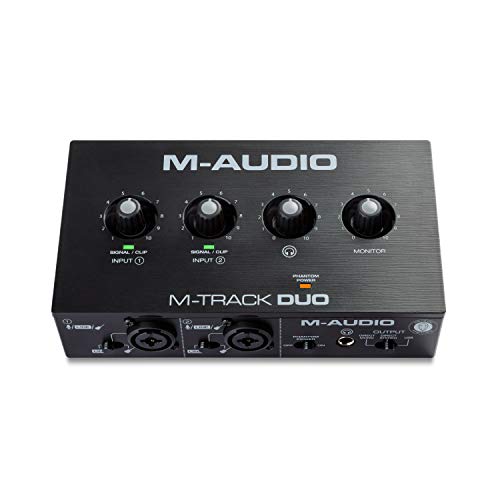
If you’re looking for a reliable audio interface that excels in recording, streaming, or podcasting, the M-AUDIO M-Track Duo is a fantastic choice. With two combo XLR/Line/Instrument inputs and crystal preamps, it delivers high-quality sound at 48 kHz. Its compact design makes it easy to transport, while the zero-latency monitoring guarantees you hear everything in real-time. Plus, it’s compatible with both Mac and PC, and the included software like MPC Beats enhances your production experience. Just keep in mind that gain adjustments might be needed for different inputs, but overall, it’s a solid investment for any creator.
Best For: The M-AUDIO M-Track Duo is best for musicians, podcasters, and streamers seeking a budget-friendly audio interface with high-quality sound and ease of use.
Pros:
- Compact and portable design for easy transport.
- High-quality sound resolution at 48 kHz with minimal noise.
- Compatible with various operating systems and includes useful software.
Cons:
- Gain control may require frequent adjustments for different inputs.
- Outputs are combined into a single signal, which may limit recording flexibility.
- Plastic build may raise concerns regarding durability for heavy use.
M-AUDIO M-Track Solo USB Audio Interface
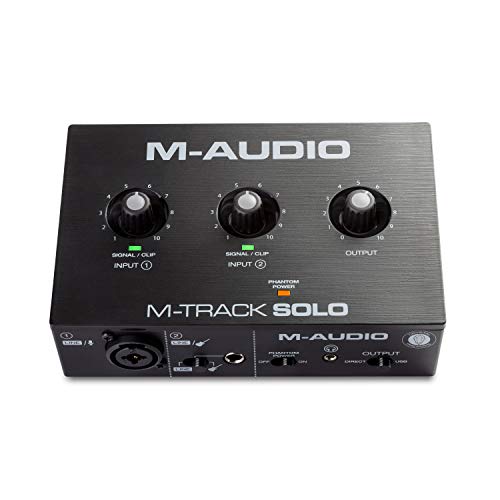
The M-Audio M-Track Solo USB Audio Interface stands out as an excellent choice for beginner to intermediate music producers seeking high-quality recordings without breaking the bank. With 48 kHz audio resolution, you’ll enjoy clear sound on both Mac and PC. The interface features one combo XLR/Line input with phantom power and an additional Line/Instrument input, making it versatile for various instruments. You can monitor your recordings in real-time with zero latency, thanks to the headphone output. Plus, it’s compact and USB-powered, perfect for on-the-go sessions. With included MPC Beats software, you’re all set to start producing right away!
Best For: Beginner to intermediate music producers looking for a portable and affordable audio interface for high-quality recordings.
Pros:
- Compact and USB-powered design enhances portability for on-the-go recording.
- Offers real-time zero-latency monitoring for seamless recording experiences.
- Includes MPC Beats software, providing essential tools for music production.
Cons:
- Limited to two-channel recording, which may not suit more complex setups.
- Lacks loopback functionality for recording multiple tracks simultaneously.
- Some users reported durability issues under rough handling.
FIFINE Gaming Audio Mixer for Podcast and Gaming

Designed with gamers and podcasters in mind, the FIFINE Gaming Audio Mixer (AmpliGame SC3) stands out for its XLR mic input, which supports high-quality condenser microphones. Weighing just 1.1 pounds and powered via USB-C, it offers four independent channels for precise audio control. You’ll appreciate the mute and monitor buttons for easy access to background noise reduction and real-time feedback. With customizable sound effects, RGB lighting, and plug-and-play compatibility, it’s perfect for streaming and podcasting. While some users noted static issues, many praised its clear sound quality, making it a solid budget-friendly choice for beginners.
Best For: The FIFINE Gaming Audio Mixer is best for beginner gamers and podcasters looking for an affordable yet versatile audio mixing solution.
Pros:
- Easy plug-and-play setup compatible with both Mac OS and Windows.
- Offers customizable sound effects and RGB lighting for a visually appealing setup.
- Four independent channels allow for precise audio control and adjustments.
Cons:
- Some users reported static issues during playback.
- Non-linear volume control may affect sound consistency.
- Quality of customizable sound effects may not meet all users’ expectations.
PreSonus AudioBox USB 96 Bundle – USB Audio Interface and Recording Package

Looking for a complete recording solution that caters to both beginners and seasoned musicians? The PreSonus AudioBox USB 96 Bundle has everything you need. This package includes a USB-C audio interface, Studio One Pro software, Eris 3.5 studio monitors, an M7 MKII microphone, and HD7 professional headphones. With its 24-bit/96 kHz resolution and switchable phantom power, you’ll capture clear, high-quality sound. The ergonomic headphones and acoustic-tuned monitors guarantee an immersive listening experience. Plus, the simple setup and plug-and-play functionality make it easy to plunge into music production without feeling overwhelmed. Release your creative potential with this all-in-one package!
Best For: The PreSonus AudioBox USB 96 Bundle is best for beginners and seasoned musicians looking for a comprehensive recording solution that delivers high-quality audio and ease of use.
Pros:
- Excellent audio quality with 24-bit/96 kHz resolution and low-latency monitoring.
- Complete package with all essential recording tools, including software, microphone, monitors, and headphones.
- Simple setup process and plug-and-play functionality, ideal for users of all experience levels.
Cons:
- Limited to 2×2 inputs, which may not be sufficient for larger recording sessions.
- The included software may be overwhelming for complete beginners despite its user-friendly design.
- Studio monitors may not provide enough bass response for professional mixing needs.
PreSonus AudioBox USB 96 Studio with Studio One Pro Software

For aspiring musicians and podcasters seeking an all-in-one solution, the PreSonus AudioBox USB 96 Studio stands out with its complete package that includes an audio/MIDI interface, a condenser microphone, headphones, and user-friendly software. This bundle features the popular AudioBox USB 96, which captures studio-quality audio at 24-bit resolution. The versatile M7 microphone is perfect for vocals and instruments, while the HD7 headphones guarantee you mix and monitor comfortably. You’ll also appreciate the included Studio One Artist software, which is intuitive and compatible with major DAWs, making your recording experience seamless and efficient. It’s a fantastic choice for any creative project.
Best For: Aspiring musicians and podcasters looking for a comprehensive and user-friendly recording solution.
Pros:
- High-quality audio capture with 24-bit resolution at 96 kHz for studio-grade recordings.
- Complete package includes everything needed for recording: audio interface, microphone, headphones, and software.
- User-friendly software (Studio One Artist) is accessible for both beginners and experienced producers, supporting major DAWs.
Cons:
- Limited advanced features may not satisfy professional users requiring more complex functionalities.
- Headphones may not provide the highest sound fidelity compared to higher-end models.
- Bulkiness of equipment might be inconvenient for mobile recording setups.
PreSonus AudioBox GO USB-C Audio Interface

The PreSonus AudioBox GO USB-C audio interface is perfect for musicians and podcasters on the move, thanks to its ultra-compact design and professional sound quality. This budget-friendly device connects easily to your Apple or Android devices without needing an extra power supply. You can simultaneously plug in an instrument and a microphone, plus enjoy zero-latency monitoring through the headphone output. With studio-grade converters, it supports up to 24-bit/96 kHz recording, ensuring crystal-clear audio. The included Studio One Prime DAW and Studio Magic bundle give you everything you need to start creating right away.
Best For: Musicians and podcasters looking for an affordable, portable audio interface with professional sound quality.
Pros:
- Compact and lightweight design, perfect for mobile recording.
- Bus-powered via USB-C, eliminating the need for an external power supply.
- Includes Studio One Prime DAW and Studio Magic software bundle for immediate use.
Cons:
- Limited to one instrument and one microphone input at a time.
- May not have as many features as higher-end audio interfaces.
- The headphone output may require additional adjustment for optimal monitoring.
USB Audio Interface for Recording Music
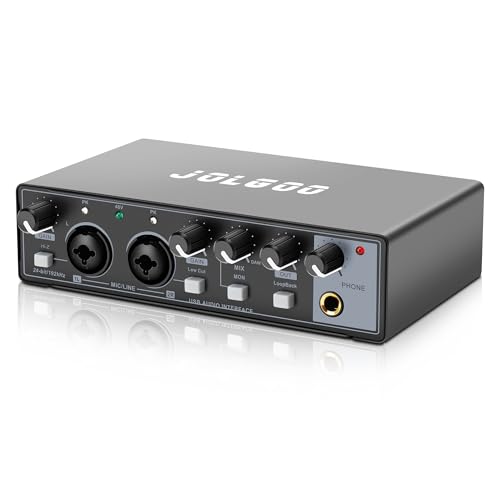
A USB audio interface for recording music is perfect for aspiring musicians and content creators who crave studio-grade sound without the hassle of complicated setups. With a resolution of 24-Bit/192kHz, you’ll enjoy high-fidelity audio conversion and ultra-low latency for real-time monitoring. Its dual combo XLR/LINE inputs support both dynamic and condenser mics, while LED peak indicators help avoid clipping. Plus, it seamlessly connects to Windows, MacOS, and popular DAWs, making it incredibly user-friendly. Compact and durable, this interface is a reliable choice for anyone looking to enhance their home studio experience and achieve professional results effortlessly.
Best For: Musicians, content creators, and producers seeking professional-quality audio recording in a convenient and user-friendly package.
Pros:
- High-Quality Audio: 24-Bit/192kHz resolution ensures studio-grade sound and high-fidelity audio conversion.
- Easy Setup: Plug and Play compatibility with no drivers or complex configurations required.
- Versatile Inputs: Dual combo XLR/LINE inputs with phantom power support dynamic and condenser microphones.
Cons:
- Limited Advanced Features: May lack advanced features found in higher-end interfaces for professional studios.
- USB Dependency: Requires a USB connection, which may limit portability with some devices.
- Potential for Clipping: LED peak indicators help, but inexperienced users may still encounter clipping if levels are not monitored closely.
Factors to Consider When Choosing Audio Interface for Music Production Pc
When choosing an audio interface for your music production PC, you need to take into account several key factors. Audio quality standards, input/output options, and software compatibility can greatly impact your workflow. Plus, don’t forget about portability, design, and your budget to guarantee you get the best value for your needs.
Audio Quality Standards
Choosing the right audio interface for your music production setup involves understanding several audio quality standards that can greatly impact your recordings. Look for interfaces that support high-resolution standards like 24-bit/192kHz, ensuring professional sound quality and capturing every detail. Pay attention to the dynamic range, measured in decibels (dB); a higher dynamic range, like 120dB, means clearer, more nuanced recordings. Quality analog-to-digital (AD) and digital-to-analog (DA) converters are essential for maintaining audio fidelity. Low latency is another key factor—aim for less than 10ms for real-time monitoring without delays. Finally, consider phantom power (+48V), which allows you to use condenser microphones effectively, boosting your sound quality.
Input/Output Options
Selecting the right input/output options is essential for optimizing your music production experience. First, consider how many inputs and outputs you need. Most audio interfaces offer a mix of XLR, line, and instrument inputs to suit various audio sources. If you plan to use condenser microphones, look for interfaces with phantom power support. Evaluate the outputs too; balanced TRS outputs are ideal for studio monitors, while headphone outputs allow for direct monitoring, enhancing playback quality. Check for direct monitoring options to minimize latency during recording, giving you real-time audio feedback. Finally, verify the interface supports necessary connectivity options like USB-C or USB-A, especially if you’ll be recording on the go.
Software Compatibility
After confirming your audio interface has the right input/output options, the next step is to check its software compatibility. Make sure the interface works seamlessly with major digital audio workstations (DAWs) like Pro Tools, Ableton Live, and FL Studio. This guarantees you can maximize your recording and editing capabilities. It’s also vital to evaluate compatibility with both Mac and Windows operating systems for added flexibility. Look for plug-and-play functionality for a hassle-free setup, avoiding complex driver installations. Additionally, verify compatibility with specific software features like ASIO drivers, which help achieve low-latency performance essential for real-time monitoring. Finally, check if the included software bundle enhances your production capabilities, giving you access to valuable tools and effects.
Portability and Design
When you’re on the hunt for an audio interface for music production, portability and design are key factors that can greatly impact your workflow. Look for lightweight designs that make on-the-go recording a breeze. Ideally, choose a compact model with dimensions around 1.5 to 2 inches in height and 5 to 6 inches in width, so it fits easily in your gear bag or tight spaces. Durability matters too—opt for interfaces made from sturdy materials that can withstand frequent travel. User-friendly features, like physical volume knobs, are essential for quick adjustments during mobile sessions. Additionally, models with USB-C connectivity offer modern compatibility and bus power, enhancing convenience for your recording adventures.
Budget and Value
Finding the right audio interface for music production doesn’t have to break the bank. Prices can range from about $50 to over $500, so it’s vital to set a budget that fits your needs. Look for interfaces offering high-resolution recording, like 24-bit/192kHz, to guarantee professional sound quality without overspending. Many interfaces come with bundled software, adding value by saving you money on essential tools for recording and production. Consider how many inputs and outputs you need; more channels can be beneficial for multi-instrument sessions. Finally, read user reviews and ratings to gauge reliability and performance. Products with high ratings often suggest better quality and user satisfaction, helping you make an informed decision.