The best commercial-grade single-board computer kits combine capable processors, practical connectivity, dependable software support, and the accessories needed to move from prototype to deployment.
This roundup compares 10 options across AI acceleration, robotics, FPGA development, embedded Linux, networking, and beginner-friendly project builds so you can choose the right platform for your workload.
Best 10 Commercial-Grade Single-Board Computer Kits Picks for 2026
High-Performance AI Pick

- 12-core processor with 45 TOPS NPU
- 16GB LPDDR5 and dual M.2 storage support
- Broad OS and peripheral compatibility
Best For: Edge AI and demanding development workloads
Connected Expansion Platform

- Integrated RTL-SDR, LoRa, GPS, and RTC
- Adds USB 3.0, hub, and RJ45 Ethernet
- Includes a broad antenna bundle
Best For: Wireless and navigation-focused uConsole projects
Edge-AI Development Kit

- Up to 67 TOPS AI performance
- Ampere GPU with 32 Tensor Cores
- CUDA, TensorRT, cuDNN, and OpenCV support
Best For: Computer vision, robotics, and edge-AI development
Compact Vision Controller

- 1 TOPS NPU for quantized edge inference
- 8MP camera ISP with HDR and WDR
- Broad embedded I/O and wireless connectivity
Best For: Embedded vision and lightweight edge-AI devices
Top Performance Pick
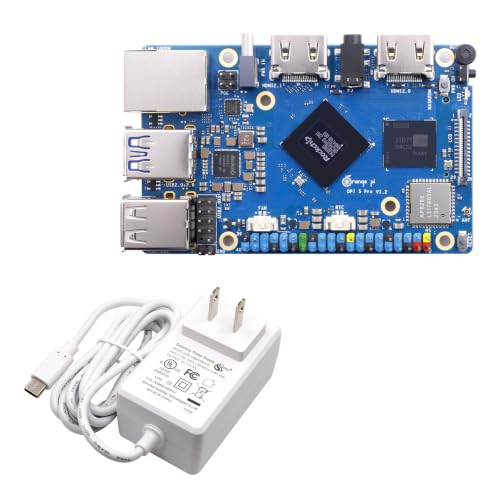
- 8-core RK3588S processor with 8GB LPDDR5
- Up to 8K@60Hz video decoding
- 6 TOPS NPU and extensive expansion options
Best For: Edge AI, multimedia, and demanding embedded projects
Complete Starter Choice
CanaKit Raspberry Pi 5 Essentials Kit

- Raspberry Pi 5 with 4GB RAM
- Linux support for familiar development
- Works with cameras, displays, USB devices, and storage
Best For: General-purpose Linux projects and Raspberry Pi development
Storage Value Pick

- 2GB DDR memory with built-in 16GB eMMC
- Android 12 and Ubuntu 22.04 support
- 4K@60Hz decoding and 20-pin expansion
Best For: Embedded gateways, media terminals, and custom IoT projects
Best All-in-One Pick
Raspberry Pi 5 4GB Starter Kit

- Complete kit includes cooler, case, and screwdriver
- 4GB RAM with quad-core Arm Cortex-A76 processor
- Wi-Fi, Bluetooth, Gigabit Ethernet, HDMI, USB, and GPIO
Best For: Beginners and hobbyists building IoT, robotics, gaming, or media projects
Best FPGA Throughput Platform

- GW5AST FPGA with 138,240 LUT4 resources and 12 PLLs
- PCIe 2.0 x4, dual SFP, and high-speed transceivers
- Compact SOM with 187 GPIOs and 1GB DDR3
Best For: Advanced FPGA development, industrial prototyping, and image processing
Best Custom Integration Board
Tang Mega 138K Pro Dock RISC-V Kit

- FPGA platform with 138,240 LUTs and 12 PLLs
- PCIe 3.0 x4 and SFP/SFP+ high-speed connectivity
- Core-board design supports custom baseboard development
Best For: Custom FPGA integration, communications projects, and industrial development
High-Performance AI Pick – Orange Pi 6 Plus 16GB
For buyers seeking commercial-grade single-board computer kits with substantial memory and edge-AI capability, the Orange Pi 6 Plus stands out with a 12-core processor, 16GB of LPDDR5 RAM, and a 45 TOPS NPU. Its broad operating-system support and extensive connectivity make it suitable for demanding development and deployment projects.
Best For: Edge AI, high-performance personal computing, industrial automation, home servers, and AI development workstations.
Pros:
- 12-core 64-bit CIX processor with 45 TOPS AI computing performance.
- 16GB LPDDR5 memory and two M.2 Key-M 2280 interfaces for fast, expandable storage.
- Supports Debian, Ubuntu, Android, Windows, and ROS2, with USB, HDMI, 5G Ethernet, camera, and 40-pin expansion connectivity.
Cons:
- Its advanced hardware may be more capability than basic SBC projects require.
- The supplied listing does not include a warranty.
The Orange Pi 6 Plus is a strong choice when compute headroom, AI acceleration, and flexible software support matter more than a minimal footprint. The included cooling assembly is useful for sustained workloads.
Connected Expansion Platform – uConsole AIO V2
The uConsole AIO V2 is a connectivity-focused option among commercial-grade single-board computer kits. Rather than serving as a standalone computer, it adds wireless, navigation, timing, networking, and USB expansion features for compatible uConsole projects.
Best For: Wireless communication, GPS-enabled projects, LoRa applications, networked devices, and uConsole expansion.
Pros:
- Combines RTL-SDR, LoRa, GPS, RTC, USB hub, USB 3.0, and RJ45 Ethernet functions.
- Includes multiple antennas for Wi-Fi, LoRa, Bluetooth, GNSS, and other supported functions.
- Designed for straightforward installation with compatible uConsole hardware.
Cons:
- The uConsole itself is not included.
- It is an expansion board rather than a complete standalone SBC kit.
- The listed manufacturer warranty is only six months.
Choose this board when your project needs a concentrated set of communications and connectivity interfaces. Confirm uConsole compatibility and account for the separate host system before ordering.
Edge-AI Development Kit – Jetson Orin Nano Super
For commercial-grade single-board computer kits aimed at accelerated AI development, the Yahboom Jetson Orin Nano kit pairs an Orin Nano module with a compatible carrier board and Ubuntu-based software stack. Its Ampere GPU, Tensor Cores, and support for CUDA, TensorRT, cuDNN, and OpenCV target computer vision and multimodal edge applications.
Best For: Edge AI, computer vision, large-language and vision models, robotics, and real-time video analysis.
Pros:
- Up to 34–67 TOPS AI performance with a 1024-core Ampere GPU and 32 Tensor Cores.
- Carrier board supports the 25W power mode for larger and more complex neural networks.
- Ubuntu 22.04 environment includes CUDA 12.6, TensorRT 10.7.0, cuDNN 9.6.0, and OpenCV 4.10.0 support.
Cons:
- The listed configuration specifies 4GB of installed memory, which may limit some workloads.
- Storage is external NVMe rather than built-in, so additional storage planning may be needed.
- The supplied warranty information indicates product delivery within 90 days.
This kit is best suited to developers who need GPU-accelerated AI tools in a compact platform. Its software ecosystem and 25W-capable carrier board give it more room for serious experimentation than basic SBCs.
Compact Vision Controller – KLAYERS RV1106G3 Linux SBC
The KLAYERS RV1106G3 is a compact, application-focused choice among commercial-grade single-board computer kits. Its Cortex-A7 processor, 1 TOPS NPU, camera-oriented ISP, and Linux support make it a practical fit for embedded imaging and lightweight edge-AI inference rather than general-purpose high-performance computing.
Best For: Embedded cameras, smart imaging, Linux-based edge inference, and space-conscious device designs.
Pros:
- 1 TOPS NPU supports INT4, INT8, and INT16 hybrid-quantization inference.
- ISP supports 8-megapixel sensors with HDR, WDR, and multilevel noise reduction.
- Provides MIPI CSI, GPIO, UART, SPI, I2C, USB, Wi-Fi, and Bluetooth connectivity.
Cons:
- Single-core Cortex-A7 processor and 256MB DDR3L RAM limit general-purpose workloads.
- Only one USB port is listed.
- Its strengths are specialized imaging and embedded AI rather than broad desktop use.
The KLAYERS board makes sense when low-power vision features and compact embedded integration are the priorities. Its camera processing and flexible hardware interfaces are more important here than raw CPU performance.
Top Performance Pick – Orange Pi 5 Pro 8GB
For demanding commercial-grade single-board computer kits, the Orange Pi 5 Pro stands out with an 8-core Rockchip processor, 8GB of LPDDR5 memory, and up to 6 TOPS of NPU computing. It is a strong choice for edge computing, multimedia, and expandable embedded projects.
Best For: Edge AI, high-resolution video, smart-home systems, and demanding development projects.
Pros:
- RK3588S 8-core processor with fast LPDDR5 memory.
- Supports up to 8K video decoding at 60Hz.
- Built-in NPU provides up to 6 TOPS for edge computing.
- Includes dual-band Wi-Fi 5, Bluetooth 5.0, Gigabit LAN, GPIO, and an M.2 slot.
Cons:
- Power supply, eMMC, and PoE+ HAT requirements may add to the project cost.
- Its broad feature set may be more than simple beginner projects need.
- No warranty is listed in the supplied details.
The Orange Pi 5 Pro is the most capable option here for compute-intensive and video-focused builds. Its memory, NPU, storage expansion, and connectivity make it well suited to projects intended for sustained development or deployment.
Complete Starter Choice – CanaKit Raspberry Pi 5 Essentials Kit
The CanaKit Raspberry Pi 5 Essentials Starter Kit is a practical entry point for commercial-grade single-board computer kits when you want a familiar Linux-based platform and broad peripheral compatibility. Its 4GB configuration is suited to general development and connected projects.
Best For: Linux development, camera projects, desktop-style builds, and general-purpose Raspberry Pi applications.
Pros:
- Includes a Raspberry Pi 5 with 4GB of RAM.
- Linux operating system support offers a familiar development environment.
- Compatible with cameras, keyboards, mice, monitors, speakers, storage, and USB devices.
- Backed by a listed one-year limited manufacturer warranty.
Cons:
- The supplied details do not specify the kit’s included accessories beyond the Raspberry Pi 5.
- Connectivity details are less extensive than those listed for some competing boards.
- Only 4GB of RAM is included.
This kit is the straightforward choice for buyers who value Raspberry Pi compatibility and a familiar Linux workflow. It is less specialized than the Orange Pi or K2B, but its broad device compatibility makes it flexible for everyday prototyping.
Storage Value Pick – KICKPI K2B 2GB with 16GB eMMC
The KICKPI K2B is a compact option among commercial-grade single-board computer kits, combining 2GB DDR memory, 16GB of eMMC storage, Gigabit Ethernet, and dual-band wireless connectivity. Its Android 12 and Ubuntu 22.04 support make it adaptable for embedded and multimedia applications.
Best For: IoT gateways, media terminals, set-top boxes, projectors, and custom embedded builds.
Pros:
- Built-in 16GB eMMC storage simplifies deployment compared with a storage-free board.
- Supports Android 12 and Ubuntu 22.04.
- Hardware decoding supports 4K video at 60Hz.
- Includes Gigabit Ethernet, dual-band Wi-Fi, Bluetooth, and a 20-pin expansion interface.
Cons:
- Its 2GB memory configuration is more limited for intensive multitasking.
- Only two USB ports are listed in the supplied specifications.
- The warranty description is not specific.
The KICKPI K2B offers a useful balance of integrated storage, wireless connectivity, and operating-system flexibility. It is a sensible fit for focused embedded deployments, though buyers needing heavier computing performance should consider a more powerful board.
Best All-in-One Pick – Raspberry Pi 5 4GB Starter Kit
For shoppers seeking commercial-grade single-board computer kits with a straightforward setup, this Raspberry Pi 5 bundle is a practical option. It combines a 4GB Raspberry Pi 5 board with active cooling, an ABS case, and a screwdriver, making it ready for projects such as IoT, robotics, retro gaming, and home media servers.
Best For: Beginners, hobbyists, students, and developers who want a complete Raspberry Pi 5 kit for sustained workloads and DIY projects.
Pros:
- Includes the board, active cooler, protective case, and screwdriver.
- 4GB RAM and a quad-core Arm Cortex-A76 processor support programming, 4K playback, and AI projects.
- Built-in Gigabit Ethernet, Wi-Fi 5, Bluetooth 5.0, HDMI, USB, and GPIO connectivity.
- Active cooling is designed to reduce heat and help prevent performance throttling under extended loads.
Cons:
- The included case cannot accommodate an M.2 HAT add-on board and solid-state drive.
- The kit is limited to 4GB of RAM.
This is the most accessible choice of the three, especially when you value included accessories and broad Raspberry Pi OS compatibility. Its main limitation is the case design if you plan to add M.2 storage hardware.
Best FPGA Throughput Platform – Tang Mega 138K Pro Dock
This Tang Mega 138K Pro Dock targets buyers who need commercial-grade single-board computer kits for FPGA experimentation, high-speed data movement, and AI image processing. Its GW5AST FPGA, RISC-V hardcore SoC, DDR3 memory, PCIe 2.0 x4, SFP connectivity, and extensive GPIO make it oriented toward advanced development rather than general desktop use.
Best For: FPGA developers and industrial prototyping teams working with parallel processing, fiber communication, image acquisition, and custom digital logic.
Pros:
- GW5AST FPGA provides 138,240 LUT4 resources and 12 PLLs for complex logic designs.
- Includes an AE350 RISC-V hardcore SoC and 1GB DDR3 memory.
- Eight transceivers support up to 12.5Gbps per lane, with PCIe 2.0 x4 and dual SFP slots.
- Compact 70mm by 50mm SOM format and 187 GPIOs support system integration and prototyping.
Cons:
- Its 1GB memory capacity is modest for broader computing workloads.
- The FPGA-focused design is less turnkey than a general-purpose Raspberry Pi kit.
- Only two USB ports are listed in the specifications.
This board is best evaluated as a specialized FPGA development platform. It offers substantial logic and high-speed interface resources, but it assumes that the buyer has the tools and experience to work with RISC-V and FPGA designs.
Best Custom Integration Board – Tang Mega 138K Pro Dock RISC-V Kit
For buyers comparing commercial-grade single-board computer kits for custom hardware integration, this Tang Mega 138K Pro Dock emphasizes high-speed communication and expandable system design. The FPGA-based board includes a RISC-V processor, PCIe 3.0 x4 support, SFP/SFP+ connectivity, camera and display interfaces, and a core-board format intended for a customized baseboard.
Best For: FPGA learners, communications developers, and industrial users who want to design or integrate a custom carrier board.
Pros:
- GW5AST FPGA includes 138,240 LUTs and registers plus 12 PLLs.
- Integrated 800MHz RISC-V processor supports embedded development.
- PCIe 3.0 x4 can provide up to 32GT/s, while SFP/SFP+ links support up to 10Gbps per channel.
- 50mm by 70mm core-board format can be paired with a customer-designed baseboard.
Cons:
- The core-board package is intended for customization rather than immediate standalone use.
- Its FPGA and high-speed interface focus may be demanding for beginners.
- The supplied specifications contain inconsistent memory listings, so buyers should confirm the exact configuration.
This version stands out when custom carrier-board design and high-speed interconnects matter more than plug-and-play operation. It is a strong fit for development and industrial integration, but less suitable for casual desktop or general-purpose use.
How We Picked These Commercial-Grade Single-Board Computer Kits
We selected boards and kits based on processing capability, memory, storage options, expansion interfaces, networking, operating-system support, cooling requirements, and the completeness of the included accessories. The list spans familiar Raspberry Pi starter kits, high-performance Orange Pi systems, Jetson AI hardware, compact embedded boards, and Sipeed RISC-V FPGA platforms.
Because “commercial-grade” can mean different things, we prioritized practical deployment features rather than treating a single specification as decisive. Documentation, community resources, expansion flexibility, and suitability for sustained workloads are especially important when a board will support a business, product prototype, classroom lab, or automation system.
Quick Comparison
| Best For | Recommended Direction | What to Prioritize |
|---|---|---|
| General-purpose projects | Raspberry Pi 5 kits | Software support, accessories, cooling |
| AI and computer vision | Jetson Orin Nano or Orange Pi 6 Plus | NPU/GPU performance, frameworks, thermals |
| High-resolution media | Orange Pi 5 Pro or Orange Pi 6 Plus | Video decoding, RAM, display output |
| Embedded control | KLAYERS RV1106G3 or K2B | GPIO, serial buses, wireless, low cost |
| FPGA and high-speed hardware design | Sipeed Tang Mega 138K Pro Dock | Programmable logic, PCIe, SFP/SFP+ support |
| Portable or connected field builds | uConsole AIO V2 | Integrated peripherals, power, enclosure |
Key Buying Factors for Commercial-Grade Single-Board Computer Kits
Performance and Workload Fit
Match the processor and accelerator to the job. CPU cores help with multitasking and services, while an NPU, GPU, or FPGA is more valuable for AI inference, graphics, signal processing, or specialized acceleration. More RAM also helps with containers, compilers, databases, and demanding desktop workloads.
Connectivity and Expansion
Check for the interfaces your project actually needs: Gigabit Ethernet, dual-band Wi-Fi, Bluetooth, USB 3.0, MIPI camera connectors, GPIO, UART, SPI, I2C, PCIe, or SFP networking. Expansion headers and accessible documentation can matter more than peak benchmark scores in an embedded product.
Thermals, Power, and Storage
High-performance boards often need active cooling and a reliable power supply for sustained loads. Confirm whether the kit includes a cooler, case, storage, or power adapter. For deployment, consider eMMC or other onboard storage where available, but also verify backup and replacement options.
Software and Lifecycle Considerations
Review Linux, Android, Windows, ROS2, or vendor-specific support before buying. A board with strong community documentation may reduce development time, while specialized FPGA or AI platforms can require a steeper learning curve. Also confirm kernel, driver, and accessory compatibility for your intended production horizon.
Who Should Buy Which Commercial-Grade Single-Board Computer Kits?
Choose a Raspberry Pi 5 kit for the broadest beginner and maker ecosystem, especially for IoT, robotics, education, and home automation. Pick the Orange Pi 6 Plus when you need substantial memory and AI-focused acceleration, or the Orange Pi 5 Pro for capable multimedia and general-purpose Linux projects.
The Jetson Orin Nano is the stronger fit for NVIDIA-based computer vision and edge-AI workflows. Choose the KLAYERS or K2B when cost, compact embedded integration, and standard hardware interfaces matter most. The uConsole is suited to portable experimentation and field-oriented builds with integrated peripherals.
Finally, select a Sipeed Tang Mega 138K Pro Dock when programmable logic, high-speed links, or FPGA development is central to the project. Before ordering, verify the exact version, included accessories, operating-system image, power requirements, and connector layout—small kit differences can have a major effect on deployment time.