Commercial-grade smart air quality monitors make it easier to spot ventilation problems, airborne particles, chemical pollutants, and uncomfortable humidity before they affect occupants. The best models combine broad sensor coverage with clear displays, useful alerts, and dependable app connectivity.
We compare 10 options ranging from connected home monitors to portable multi-parameter testers, focusing on measurement coverage, usability, monitoring features, and the needs of offices, classrooms, facilities, and other occupied spaces.
Best 10 Commercial-Grade Smart Air Quality Monitors Picks for 2026
Best for Smart Building Integration
Atmocube Professional 12-in-1 Monitor

- Tracks 12 air and environmental parameters
- Offers Wi-Fi, Ethernet, and PoE connectivity
- Includes cloud analytics and building-system APIs
Best For: Offices, schools, healthcare facilities, and advanced automation setups
Best Alexa Value
Amazon Smart Air Quality Monitor 2-Pack
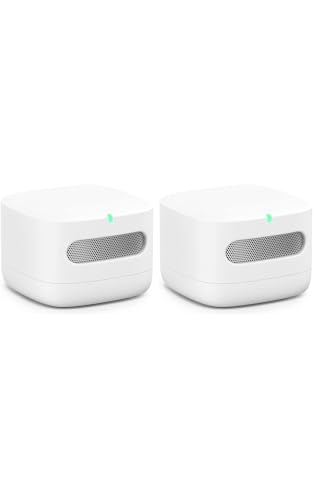
- Monitors five core indoor air factors
- Sends Alexa app and Echo alerts
- Supports routines for compatible climate devices
Best For: Alexa-equipped homes needing coverage in multiple rooms
Best for On-Device Readability
YNAK 16-in-1 Air Quality Monitor
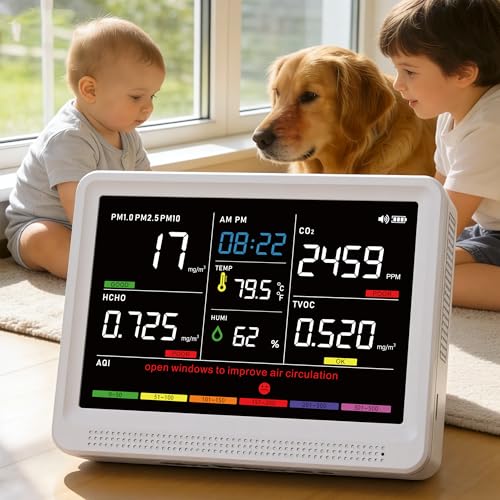
- Shows detailed readings on a 5.5-inch HD display
- Provides seven AQI alert functions
- Runs up to 10 hours and charges via USB-C
Best For: Portable, screen-first monitoring in rooms, vehicles, and campsites
Best Single-Unit Alexa Pick
Amazon Smart Air Quality Monitor

- Measures PM2.5, VOCs, CO, humidity, and temperature
- Provides Alexa alerts and air-quality scoring
- Can automate compatible climate devices
Best For: Single-room monitoring in Alexa-connected homes
Most Portable
10-in-1 Real-Time Air Quality Monitor

- Measures particles, gases, AQI, temperature, and humidity
- Color-coded display with audible alerts and simple controls
- Up to 96 hours of battery-powered monitoring
Best For: Portable, app-free monitoring across multiple indoor locations
Best Connected Option
Aeropulse Smart Air Quality Monitor

- Wi-Fi, mobile app, and cloud dashboard support
- Tracks particles, gases, pressure, temperature, and humidity
- Up to 300-plus days at 60-minute intervals
Best For: Remote monitoring and trend tracking in homes or commercial spaces
Best Value Coverage
16-in-1 Color Screen Air Quality Tester

- Broad particle, gas, temperature, and humidity monitoring
- High-definition color screen with 1.5-second updates
- Simple controls, Type-C charging, and included AC adapter
Best For: Straightforward portable testing with comprehensive local readings
Best for Trend Tracking
Temtop LKC-1000S+ Air Quality Monitor

- Tracks seven parameters with real-time AQI
- Includes trend history and Excel data export
- Supports USB continuous monitoring and portable checks
Best For: Renovation monitoring, ventilation checks, and long-term reporting
Best Smart Sensor Array
Lwyinp MT13S 10-in-1 Air Quality Monitor

- Measures CO2, gases, particles, AQI, and climate data
- Uses dedicated and electrochemical sensing technology
- Provides color-coded alerts on a compact display
Best For: Broad indoor monitoring across homes, offices, vehicles, and public spaces
Best for Smart Building Integration – Atmocube Professional 12-in-1 Monitor
For buyers seeking commercial-grade smart air quality monitors, the Atmocube stands out for its broad sensor coverage and professional connectivity. It tracks 12 environmental parameters, including CO2, particulate matter, formaldehyde, TVOCs, noise, and light, while supporting Wi-Fi, Ethernet, and PoE.
Best For: Offices, schools, healthcare facilities, and advanced home or building automation setups.
Pros:
- Measures CO2, PM1, PM2.5, PM10, TVOCs, formaldehyde, temperature, humidity, pressure, light, and noise.
- Supports Wi-Fi, Bluetooth, Ethernet, and PoE connectivity.
- Works with MQTT, Modbus RTU/TCP, and REST API integrations.
- Cloud dashboard supports historical analysis and report exports.
Cons:
- Its advanced integration features may be more than casual users need.
- The supplied notes do not specify standalone battery operation.
The Atmocube is the strongest fit here for users who need detailed monitoring and smart-building compatibility rather than a basic plug-in air-quality readout.
Best Alexa Value – Amazon Smart Air Quality Monitor 2-Pack
This two-pack is a practical choice for households that want commercial-grade smart air quality monitors with straightforward Alexa integration. Each monitor tracks PM2.5, VOCs, carbon monoxide, humidity, and temperature, then sends alerts and automation triggers through the Alexa app.
Best For: Alexa-equipped homes that want to monitor air quality in multiple rooms.
Pros:
- Monitors PM2.5, VOCs, carbon monoxide, humidity, and temperature.
- Provides color-coded LED status and an air-quality score in the Alexa app.
- Sends phone notifications or Echo announcements when air quality drops.
- Can trigger compatible purifiers, fans, dehumidifiers, and thermostats.
Cons:
- Measures five key factors rather than the broader range offered by specialized monitors.
- Its smart features rely on the Alexa ecosystem.
The two-monitor package makes room-to-room coverage simple, especially if Alexa already manages your home’s climate devices.
Best for On-Device Readability – YNAK 16-in-1 Air Quality Monitor
The YNAK is a strong option for shoppers comparing commercial-grade smart air quality monitors with portable, screen-based designs. Its external sensors monitor CO2, particulate matter, formaldehyde, TVOC, temperature, humidity, and AQI, while the 5.5-inch HD display keeps readings visible without requiring an app.
Best For: Users who want detailed readings, audible AQI alerts, and portable operation in rooms, vehicles, or campsites.
Pros:
- Displays CO2, PM1.0, PM2.5, PM10, HCHO, TVOC, temperature, humidity, and AQI.
- Offers seven AQI alert functions with a mute button.
- Large 5.5-inch HD screen has three brightness levels.
- USB-C charging provides up to 10 hours of runtime according to the supplied notes.
Cons:
- The “16-in-1” count combines nine detected parameters with seven alert types.
- The supplied notes do not list Wi-Fi, cloud dashboards, or smart-home integrations.
- Sensors should be protected from perfumes and strong odors to help maintain accuracy.
This monitor prioritizes immediate, at-a-glance information and portability, making it better suited to hands-on monitoring than connected building management.
Best Single-Unit Alexa Pick – Amazon Smart Air Quality Monitor
For a simple connected setup, this Amazon monitor offers an accessible entry point among commercial-grade smart air quality monitors. It measures PM2.5, VOCs, carbon monoxide, humidity, and temperature, with status information, alerts, and automation handled through Alexa.
Best For: Individual rooms where convenient Alexa alerts and basic environmental monitoring matter most.
Pros:
- Tracks PM2.5, VOCs, carbon monoxide, humidity, and temperature.
- Shows status through a color-coded LED and Alexa air-quality score.
- Can send phone notifications or announcements to Echo devices.
- Supports routines for compatible purifiers, fans, dehumidifiers, and thermostats.
Cons:
- Provides a narrower set of measurements than multi-sensor professional monitors.
- Alexa is required for app-based scores, alerts, and routines.
- This listing is for one monitor rather than the supplied two-pack alternative.
Choose this model when easy setup and Alexa control outweigh the need for expanded pollutant coverage or professional wired integrations.
Most Portable – 10-in-1 Real-Time Air Quality Monitor
For shoppers comparing commercial-grade smart air quality monitors, this 10-in-1 model emphasizes broad measurement coverage and easy portability. It tracks particles, gases, temperature, humidity, and AQI, while its color display and audible alerts make changing conditions easier to spot without an app.
Best For: Portable monitoring across homes, offices, vehicles, and other indoor spaces.
Pros:
- Measures PM0.3, PM2.5, PM10, CO2, CO, HCHO, TVOC, AQI, temperature, and humidity.
- Samples and processes readings every 1.2 seconds for responsive monitoring.
- Includes a color-coded display, audible alerts, one-button operation, and no Wi-Fi setup.
- Rechargeable 2000mAh battery provides up to 96 hours of continuous monitoring.
Cons:
- Does not offer app or cloud connectivity.
- The supplied notes do not specify certification standards or a data-history feature.
This is a practical choice when you want many readings in a compact, self-contained tester. Its long claimed battery life and simple controls are especially useful for moving the monitor between rooms or locations.
Best Connected Option – Aeropulse Smart Air Quality Monitor
Aeropulse Indoor Air Quality Monitor (PM, TVOC, CO2, Temp, Humidity, Pressure, Nox)
Check Price On AmazonAmong commercial-grade smart air quality monitors, the Aeropulse stands out for connected tracking and stated building-standard certifications. It monitors particulate matter, gases, and environmental conditions, then makes the information available through Wi-Fi, a mobile app, and a cloud dashboard.
Best For: Users who want remote monitoring, trends, alerts, and long-term placement in homes or commercial spaces.
Pros:
- Tracks PM2.5, PM10, NOx, CO2, TVOC, humidity, temperature, and air pressure.
- Uses stated photoacoustic NDIR, MEMS, and light-scattering sensor technologies.
- Supports 2.4G and 5G Wi-Fi, app access, cloud dashboards, trend viewing, and alerts.
- Claims up to 300-plus days of battery life at 60-minute intervals.
Cons:
- Wi-Fi and app connectivity may be more setup than a standalone monitor.
- The extended battery-life claim applies to 60-minute sampling intervals, not necessarily continuous sampling.
The Aeropulse is the strongest fit for buyers who value remote access and historical context over simple grab-and-go testing. Its stated ANSI/ASHRAE, California Title 24, RESET, and WELL-related certifications add useful context for commercial and building-focused use.
Best Value Coverage – 16-in-1 Color Screen Air Quality Tester
This 16-in-1 model is a compelling option for shoppers seeking commercial-grade smart air quality monitors with broad indoor coverage and straightforward operation. Its high-definition color screen presents readings clearly, while adjustable audio prompts and quiet sampling support use in bedrooms, offices, vehicles, and other spaces.
Best For: Buyers who want comprehensive local readings and a simple, portable interface.
Pros:
- Monitors PM1.0, PM2.5, PM10, CO2, TVOC, HCHO, temperature, and humidity.
- Updates readings every 1.5 seconds and uses color-coded air-quality levels.
- Single-button controls and adjustable audio prompts support simple operation.
- Includes Type-C charging, an AC adapter, a cable, and 12-month quality support.
Cons:
- Continuous runtime is listed as approximately 4–5 hours per charge.
- The supplied notes do not mention Wi-Fi, app, or cloud connectivity.
This monitor favors breadth and ease of use rather than connected data management. It makes sense for hands-on spot checks and frequent relocation, though buyers needing all-day battery operation or remote dashboards should consider the other options.
Best for Trend Tracking – Temtop LKC-1000S+ Air Quality Monitor
For buyers comparing commercial-grade smart air quality monitors, the Temtop LKC-1000S+ stands out for its broad measurement range and reporting features. It tracks PM2.5, PM10, formaldehyde, VOCs, temperature, humidity, and AQI, while its trend histogram and USB data export make it useful beyond occasional spot checks.
Best For: Renovation monitoring, ventilation checks, long-term tracking, and users who need Excel-compatible records.
Pros:
- Measures seven air-quality and environmental parameters, including real-time AQI.
- Uses a laser particle sensor and Dart electrochemical formaldehyde sensor.
- Provides a 12-hour trend histogram and up to three months of data export.
- Can operate continuously by USB or for approximately six to eight hours on battery.
Cons:
- Does not detect carbon monoxide or other gas leaks.
- Requires a warm-up period after moving between hot and cold environments for stable readings.
- Its feature set may be more than needed for simple, occasional checks.
The LKC-1000S+ is a strong choice when actionable history matters as much as live readings. Its export tools and trend display give it a more professional monitoring focus than basic indoor meters.
Best Smart Sensor Array – Lwyinp MT13S 10-in-1 Air Quality Monitor
The Lwyinp MT13S is a practical option among commercial-grade smart air quality monitors for buyers who want a wide range of readings in a compact device. It monitors CO2, formaldehyde, TVOC, PM1.0, PM2.5, PM10, AQI, temperature, and humidity, with Bluetooth connectivity for clock calibration.
Best For: Homes, offices, cars, schools, hotels, and other spaces where broad real-time monitoring is useful.
Pros:
- Offers a 10-in-1 setup covering gases, particles, temperature, humidity, AQI, and time.
- Uses dedicated CO2 sensing and electrochemical sensors for formaldehyde and TVOC monitoring.
- Color-coded screen changes help identify readings that exceed safety thresholds.
- Portable design supports use across rooms and other indoor environments.
Cons:
- Bluetooth is described for time calibration rather than full app-based monitoring.
- The supplied notes do not specify battery runtime, data export, or continuous logging.
- Its compact display may be less suitable for viewing from across a large room.
The MT13S is best suited to buyers prioritizing sensor coverage and straightforward operation. It delivers many commonly requested readings without requiring Wi-Fi or a subscription-based system.
Best Large-Display Alerts – Sainlogic 16-in-1 VOC and CO2 Monitor
For buyers who want commercial-grade smart air quality monitors that are easy to read across a room, the Sainlogic model combines nine core measurements with a large 7.2-inch display. It monitors CO2, PM1.0, PM2.5, PM10, AQI, formaldehyde, TVOC, temperature, and humidity, while customizable thresholds provide clear visual and audible alerts.
Best For: Living rooms, bedrooms, nurseries, offices, and users who want visible ventilation prompts without an app or Wi-Fi connection.
Pros:
- Large screen presents readings in an easy-to-view format from across a room.
- Offers seven user-defined alert thresholds and a ventilation reminder when readings rise.
- Refreshes readings every one to two seconds and samples at 1.5-second intervals.
- Built-in 2500mAh battery provides up to eight hours of wireless use.
Cons:
- Tracks nine environmental parameters, despite the product title referring to 16-in-1 functionality.
- Wireless operation is limited to up to eight hours per charge according to the supplied notes.
- The supplied information does not mention data export or remote app monitoring.
The Sainlogic is a compelling fit when visibility and fast alerts are more important than historical reporting. Its adjustable brightness, large screen, and cordless operation make it especially convenient for shared household spaces.
How We Picked These Commercial-Grade Smart Air Quality Monitors
We prioritized monitors that measure several meaningful indoor-air indicators rather than relying on a single AQI score. The selection includes models covering combinations of CO2, PM1.0, PM2.5, PM10, TVOCs, formaldehyde, carbon monoxide, nitrogen oxides, temperature, humidity, pressure, noise, and light.
We also considered practical deployment details: display readability, notification or app support, portability, sensor information, and whether the device is suited to continuous monitoring. A long list of sensors does not automatically guarantee laboratory-grade accuracy, so buyers should treat these products as monitoring and decision-support tools unless a model has documented calibration and performance data for their intended use.
Quick Comparison
| Best For | Look For | Most Useful Features |
|---|---|---|
| Offices and classrooms | CO2, PM2.5, humidity | Alerts, readable display, continuous operation |
| Homes and smart routines | CO2, VOCs, PM2.5 | Wi-Fi or app notifications |
| Broad pollutant screening | Formaldehyde, TVOCs, NOx, particles | Multi-sensor coverage and AQI trends |
| Field checks | Portable design and battery operation | Fast readings, compact size, onboard screen |
Key Buying Factors for Commercial-Grade Smart Air Quality Monitors
Sensor Coverage
CO2 is one of the most useful indicators of ventilation in occupied rooms. PM2.5 and PM10 help identify smoke, dust, and combustion-related particles, while TVOC and formaldehyde readings can flag potential chemical sources. Choose sensors based on the problems you need to investigate, not simply the advertised parameter count.
Accuracy, Calibration, and Placement
Look for documented accuracy ranges, calibration guidance, warm-up requirements, and sensor replacement information. Place the monitor away from windows, vents, direct sunlight, cooking appliances, and strong localized sources. Readings are most useful when the device remains in a representative breathing zone and is compared over time.
Connectivity and Alerts
Wi-Fi and app notifications are valuable when staff cannot watch a screen continuously. Confirm whether alerts are configurable, whether data is stored historically, and whether the device works with your preferred smart-home or facility platform. For privacy-sensitive environments, an offline display may be preferable.
Display and Deployment
A large, high-contrast screen is helpful in shared spaces, while a portable battery-powered model suits inspections and room-to-room comparisons. Consider power requirements, mounting options, noise, network setup, and whether multiple units can be managed consistently.
Who Should Buy Which Commercial-Grade Smart Air Quality Monitors?
Choose a connected Amazon monitor for straightforward home notifications and simple smart-home integration. Consider Atmocube or Aeropulse when broader pollutant coverage and richer environmental data matter. Multi-parameter 10-in-1 and 16-in-1 monitors are practical for buyers who want an at-a-glance screen and flexible room checks. Temtop is worth considering for users focused on particle, formaldehyde, and VOC investigation, especially when portability matters. Sainlogic’s large display suits shared rooms where readings need to be visible from across the space.
For schools, offices, and commercial facilities, buy enough units to represent different zones rather than relying on one monitor at a central desk. Use readings to guide ventilation and maintenance decisions, and verify serious or disputed air-quality concerns with professionally calibrated instruments.