Indoor air can change quickly, especially in bedrooms, offices, nurseries, and smaller homes. The best compact smart air quality monitors make those changes easier to see by tracking pollutants, ventilation indicators, and comfort conditions in real time.
We selected 10 models covering connected alerts, portable monitoring, broad sensor coverage, clear displays, and practical everyday use. Use the guide below to match features and accuracy priorities with your space and budget.
Best 10 Compact Smart Air Quality Monitors Picks for 2026
Best Alexa-Connected Pick
Amazon Smart Air Quality Monitor

- Tracks PM2.5, VOCs, CO, temperature, and humidity
- Sends alerts and supports Alexa routines
- Plug-in setup through the Alexa app
Best For: Alexa households seeking automated air-quality responses
Best Battery Life

- Measures CO2, PM2.5, TVOCs, temperature, and humidity
- Up to 60 days of battery life with an e-ink display
- Bluetooth app supports live and historical data
Best For: Bedrooms, nurseries, and offices needing portable monitoring
Best for Govee Automation

- Refreshes PM2.5, temperature, and humidity data every two seconds
- Supports Bluetooth, 2.4G Wi-Fi, and long-term data export
- Automates compatible Govee appliances
Best For: GoveeHome users wanting connected climate control
Best Sidewalk Connectivity

- Monitors CO, PM2.5, temperature, and humidity
- Offers actionable indoor-air suggestions
- Connects through Amazon Sidewalk without a base station
Best For: Amazon-connected homes wanting simple condition alerts
Best Matter-Compatible Pick
SONOFF SAWF-07P Air Quality Monitor

- Matter support for major smart-home platforms
- Displays PM2.5, PM10, temperature, and humidity
- 12-month history with customizable alerts
Best For: Bedrooms, nurseries, offices, and connected smart homes
Best Full-Spectrum Monitor

- Tracks CO2, particles, TVOC, and formaldehyde
- 90-day app history with data export
- Up to six hours of portable battery use
Best For: Detailed home, office, classroom, and bedroom monitoring
Best Portable Value
16-in-1 Indoor Air Quality Monitor

- Measures particles, CO2, VOCs, formaldehyde, and climate data
- HD screen refreshes readings every 1.5 seconds
- USB-C rechargeable for home, car, and office use
Best For: Portable, app-free air checks across multiple indoor spaces
Portable Multi-Gas Monitor
10-in-1 Smart Air Quality Monitor
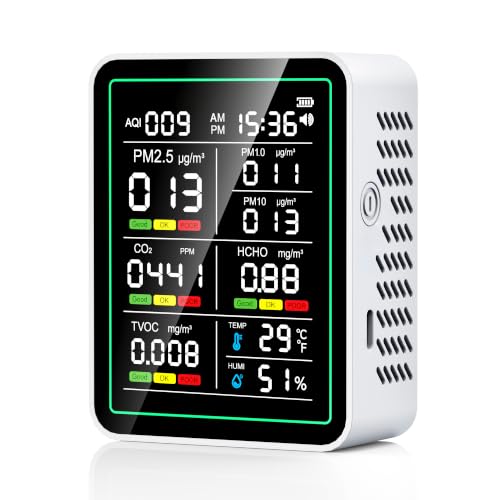
- Tracks gases, particles, and temperature
- Color display highlights air-quality changes
- Up to 20 hours of battery monitoring
Best For: Portable checks across homes, cars, offices, and plant areas
Long-Run Alert Monitor
10-in-1 Color Display Air Quality Monitor

- Measures particles, gases, temperature, and humidity
- Samples readings every 1.2 seconds
- Up to 96 hours of battery monitoring
Best For: Extended monitoring with audible threshold alerts
Wall-Friendly Air Tester
Smart PM2.5 and CO2 Air Quality Monitor

- Tracks particles, gases, humidity, and temperature
- Includes a wall hanging hole and buzzer alert
- USB-C rechargeable with energy-saving mode
Best For: Visible monitoring in homes, offices, kitchens, and grow spaces
Best Alexa-Connected Pick – Amazon Smart Air Quality Monitor
For shoppers comparing compact smart air quality monitors, the Amazon Smart Air Quality Monitor is a practical choice for Alexa households. It tracks PM2.5, VOCs, carbon monoxide, temperature, and humidity, then presents an easy-to-understand score in the Alexa app.
Best For: Alexa users who want app alerts and routines that can trigger compatible purifiers, fans, dehumidifiers, or other smart-home devices.
Pros:
- Measures five key indoor air factors, including PM2.5, VOCs, and CO.
- Provides color-coded status information, app details, and real-time notifications.
- Supports Alexa announcements and routines for compatible climate devices.
- Simple plug-in setup through the Alexa app.
Cons:
- Its smart-home features are centered on the Alexa ecosystem.
- It must be plugged in rather than used as a battery-powered monitor.
This is a strong fit when automated responses matter as much as monitoring. Its broad sensor coverage and Alexa integration make it especially useful for connected homes, though shoppers wanting a portable, battery-powered design should consider another option.
Best Battery Life – Temtop M10+ 6-in-1 Monitor
The Temtop M10+ stands out among compact smart air quality monitors for its portable, battery-powered design and e-ink display. It tracks CO2, PM2.5, TVOCs, temperature, and humidity, while Bluetooth app connectivity supports live readings and historical data.
Best For: Bedrooms, nurseries, offices, and other spaces where long battery life, quiet operation, and close-range phone monitoring are useful.
Pros:
- Measures CO2, PM2.5, TVOCs, temperature, and humidity.
- Offers up to 60 days of battery life according to the supplied details.
- E-ink display and fully muteable alarm suit bedrooms and workspaces.
- Bluetooth app provides real-time readings, hourly logging, calibration, and OTA updates.
Cons:
- Bluetooth monitoring requires the smartphone to remain nearby.
- It is less suited to users seeking broad Wi-Fi-based remote access.
The M10+ is a versatile option for personal indoor monitoring, especially when recharging interruptions are undesirable. Its compact 3.2-inch-square footprint and quiet display make it convenient for bedside or desk use.
Best for Govee Automation – GoveeLife H5106 Monitor
The wired GoveeLife H5106 is a useful pick among compact smart air quality monitors for shoppers already using GoveeHome appliances. It measures PM2.5, temperature, and humidity, refreshes readings in about two seconds, and can help automate compatible Govee devices.
Best For: Govee users who want remote monitoring, long-term data export, and automatic control of supported purifiers, humidifiers, or fans.
Pros:
- Fast two-second refresh for PM2.5, temperature, and humidity changes.
- Offers Bluetooth or 2.4G Wi-Fi connectivity for remote viewing.
- Supports 13-day online graphs and data export covering up to two years.
- Can link with compatible GoveeHome appliances for automatic responses.
Cons:
- Requires continuous power and has no built-in battery.
- Its measurements cover three indexes and do not include CO2 or VOCs.
- Wi-Fi features require a 2.4G network.
This monitor makes the most sense as part of a Govee setup rather than as a standalone general-purpose sensor. The fast refresh and extensive data history are valuable, but its wired-only design limits placement flexibility.
Best Sidewalk Connectivity – Ring Air Quality Monitor
The Ring Air Quality Monitor is a straightforward option among compact smart air quality monitors for tracking everyday indoor conditions. It measures carbon monoxide, PM2.5, temperature, and humidity, and provides actionable suggestions such as opening a window or running a purifier.
Best For: Ring or Amazon households that want connected monitoring and practical prompts without installing a separate base station.
Pros:
- Tracks CO, PM2.5, temperature, and humidity.
- Provides suggestions related to ventilation, purification, and appliance service.
- Uses Amazon Sidewalk without requiring a base station.
- Offers flexible coverage throughout the home and beyond, subject to Sidewalk coverage.
Cons:
- Amazon Sidewalk is required, and coverage may vary.
- It is not certified as a carbon monoxide alarm or detector.
- It does not measure CO2 or radon and has no microphone or speaker for alarm sounds.
The Ring monitor is best viewed as an awareness and notification tool, not a replacement for certified safety alarms. Its Sidewalk connection and practical recommendations may appeal to Amazon-connected homes, provided the limitations are understood.
Best Matter-Compatible Pick – SONOFF SAWF-07P Air Quality Monitor
For shoppers comparing compact smart air quality monitors, the SONOFF SAWF-07P emphasizes at-a-glance readings and smart-home integration. Its 3.73-inch display shows PM2.5, PM10, temperature, and humidity, while Matter compatibility supports several popular platforms.
Best For: Bedrooms, nurseries, offices, and Matter-enabled smart homes that need clear local readings.
Pros:
- Matter-compatible with Apple Home, Alexa, Google Home, SmartThings, and Home Assistant.
- Displays PM2.5, PM10, temperature, and humidity together.
- Offers sound, LED, and app notifications with customizable thresholds.
- Stores up to 12 months of history and supports data export.
Cons:
- The supplied notes do not mention battery operation, so it may be better suited to a powered location.
- It uses 2.4GHz Wi-Fi rather than a stated 5GHz connection.
The SAWF-07P is a practical choice when smart-home compatibility and a simple physical display matter more than tracking a broad range of gases. Its long history and configurable alerts add useful context for ongoing indoor monitoring.
Best Full-Spectrum Monitor – BREATHE Airmonitor Plus Gen 2
The BREATHE Airmonitor Plus Gen 2 stands out among compact smart air quality monitors for its broad sensor coverage. It tracks carbon dioxide, particulate sizes, TVOC, formaldehyde, temperature, and humidity, with app history, alerts, and export tools for deeper review.
Best For: Homes, offices, classrooms, and bedrooms where gas, particle, and ventilation trends all matter.
Pros:
- Monitors eight categories, including NDIR CO2, PM1, PM2.5, PM10, TVOC, and HCHO.
- Provides configurable CO2 and PM2.5 alerts through the app.
- Stores 90 days of data and supports export for analysis.
- Offers up to six hours of battery use and can run from USB-C power.
Cons:
- Portable battery operation lasts up to six hours, which is shorter than all-day cordless use.
- App connectivity requires 2.4GHz Wi-Fi.
This model is the strongest fit for buyers who want more than particle readings. Its dedicated CO2, VOC, and formaldehyde sensing can help connect indoor-air changes with cooking, cleaning, occupancy, and ventilation, while the portable design adds flexibility.
Best Portable Value – 16-in-1 Indoor Air Quality Monitor
This 16-in-1 monitor is a flexible option among compact smart air quality monitors for buyers who want broad readings without relying on an app. Its HD color screen provides real-time information on particles, CO2, TVOC, formaldehyde, temperature, and humidity for use in multiple indoor locations.
Best For: Portable checks around the home, office, bedroom, vehicle, school, or campsite.
Pros:
- Measures PM1.0, PM2.5, PM10, CO2, TVOC, HCHO, temperature, and humidity.
- Updates readings every 1.5 seconds on a high-definition color display.
- Runs for approximately four to five hours per charge and uses USB-C charging.
- Includes an adjustable audio prompt and quiet sampling mode.
Cons:
- Battery runtime is limited to about four to five hours.
- The supplied notes do not mention app connectivity, smart-home integration, or historical data storage.
The AK16C makes the most sense for straightforward, mobile testing. Its broad measurement set and quick screen updates are useful when moving between rooms or vehicles, though shoppers seeking remote alerts or stored trends should consider a connected model instead.
Portable Multi-Gas Monitor – 10-in-1 Smart Air Quality Monitor
For shoppers seeking compact smart air quality monitors, this portable 10-in-1 model covers key indoor pollutants and environmental readings in a lightweight, rechargeable design. Its color display, automatic assessment, and claimed error margin below ±5% make it practical for checking conditions at home, in a car, office, workshop, or plant area.
Best For: Portable, broad-spectrum monitoring across multiple rooms and everyday locations.
Pros:
- Monitors CO2, HCHO, TVOC, benzene, PM2.5, PM10, temperature, and related air-quality readings.
- Color screen and automatic quality assessment make changes easy to spot.
- 2000mAh battery provides up to 20 hours of continuous detection.
- Simple button controls and automatic detection start reduce setup effort.
Cons:
- The supplied notes do not specify a humidity reading or audible alarm.
- Charging uses the included USB cable, so a power adapter may be needed separately.
This is a versatile choice if you want one compact monitor for gases, particles, and basic environmental conditions without relying on Wi-Fi or an app. Its shorter stated runtime than some alternatives is the main trade-off for portability.
Long-Run Alert Monitor – 10-in-1 Color Display Air Quality Monitor
This model stands out among compact smart air quality monitors for its broad sensor list, fast 1.2-second sampling, audible alerts, and unusually long stated battery life. It measures particles, gases, temperature, and humidity, while its color-coded display keeps readings easy to interpret without an app.
Best For: Users who want extended portable monitoring with audible alerts and humidity readings.
Pros:
- Measures PM0.3, PM2.5, PM10, CO2, CO, HCHO, TVOC, AQI, temperature, and humidity.
- Samples and processes air data every 1.2 seconds for quick changes from cooking, smoke, or ventilation.
- Color-coded levels and an audible alarm make threshold changes easy to notice.
- 2000mAh rechargeable battery is rated for up to 96 hours of continuous monitoring.
Cons:
- The supplied notes do not include specific measurement error figures.
- There is no Wi-Fi, Bluetooth, or app connectivity for remote monitoring.
- The included battery is described as a nonstandard battery.
Choose this monitor when runtime and quick, easy-to-read alerts matter more than smart-home integration. Its combination of humidity measurement, broad pollutant coverage, and long battery life makes it especially flexible for moving between rooms, vehicles, and offices.
Wall-Friendly Air Tester – Smart PM2.5 and CO2 Air Quality Monitor
If you want compact smart air quality monitors for a visible home or office setup, this green model combines a high-definition color screen with a rear hanging hole. It tracks common particles, gases, temperature, humidity, time, and AQI, and includes a buzzer alert for changing conditions.
Best For: Wall-mounted or desktop monitoring in rooms, offices, kitchens, grow spaces, and cars.
Pros:
- Displays PM2.5, PM10, CO2, HCHO, TVOC, PM1, AQI, temperature, humidity, and time.
- Color display is designed for quick reading, while the buzzer helps flag air-quality changes.
- Rear hanging hole supports wall placement for easier viewing.
- Automatic energy-saving mode activates after 30 minutes of operation.
Cons:
- Battery life is listed at about 7 hours of continuous use.
- The supplied notes do not provide exact accuracy figures or a full list of the claimed 13 parameters.
- At 14 ounces, it is heavier than some compact portable monitors.
This is a practical pick for keeping an air-quality display in one frequently used location, especially where wall visibility is useful. Its shorter battery runtime favors stationary use near regular USB-C charging rather than all-day travel.
How We Picked the Best Compact Smart Air Quality Monitors
We focused on monitors that combine a small footprint with useful indoor-air readings and straightforward operation. The selection includes connected models with phone notifications, display-first devices for at-a-glance checks, and portable testers designed to measure several air-quality factors at once.
We compared the sensors each monitor claims to provide, including CO2, PM2.5, PM10, TVOC, carbon monoxide, formaldehyde, temperature, humidity, and AQI. We also considered display readability, alert support, portability, smart-home compatibility, and whether the feature set makes sense for everyday home use.
Quick Comparison
For simple connected monitoring, Amazon and Ring models are convenient choices for households already using compatible Amazon services. Temtop and BREATHE are better suited to buyers who want more dedicated measurement capabilities. GoveeLife and SONOFF offer a balance of display visibility and smart functionality. The multi-parameter portable monitors prioritize broad readings and on-device information, though buyers should verify sensor specifications and app support before purchase.
Key Buying Factors for Compact Smart Air Quality Monitors
Choose the Right Sensors
CO2 is especially useful for identifying poor ventilation, while PM2.5 and PM10 help track fine and coarse particles from smoke, cooking, dust, and outdoor pollution. TVOC can indicate a broad range of airborne chemicals, but it is not a diagnosis of a specific substance. Carbon monoxide monitoring is valuable, yet a dedicated certified CO alarm should remain the primary safety device.
Check Alerts and Connectivity
Smart notifications are useful when you want warnings while away from the room. Confirm whether alerts require Wi-Fi, a particular app, a hub, or a subscription. If you prefer fewer dependencies, choose a monitor with a clear built-in display and local alarms or thresholds.
Consider Placement and Power
Compact monitors work best when placed in a central, unobstructed area away from windows, vents, kitchens, and direct sunlight. Wired models are practical for continuous tracking, while battery-powered designs are easier to move between rooms. Check cable length, battery life, and display visibility before buying.
Understand Measurement Limits
More listed parameters do not automatically mean better accuracy. Look for clear specifications, calibration guidance, operating limits, and a reputable support process. A monitor is most useful for spotting trends and prompting action, not replacing professional testing.
Who Should Buy Which Compact Smart Air Quality Monitors?
Choose an Amazon or Ring monitor if convenient alerts and ecosystem integration matter most. Pick Temtop or BREATHE if you want a more dedicated indoor-air instrument. GoveeLife or SONOFF suits shoppers seeking a visible display with connected features. Choose one of the 10-in-1 or 16-in-1 portable models when broad, on-screen measurements and room-to-room flexibility are more important than a polished smart-home experience.