Indoor air can change quickly, but the right monitor makes those changes visible. These premium smart air quality monitors track important conditions such as CO2, PM2.5, VOCs, humidity, and temperature, with select models adding radon, formaldehyde, or app alerts.
We selected options for different priorities, including whole-home awareness, portable CO2 tracking, detailed multi-sensor readings, and smart-home notifications. Use the guide below to narrow the list by sensor coverage, connectivity, display, and everyday usability.
Best 10 Premium Smart Air Quality Monitors Picks for 2026
Top Radon Coverage

- Tracks radon plus PM2.5, CO2, VOCs, and climate data
- Battery-powered with customizable eInk display
- App alerts and trend analysis require internet access
Best For: Homes needing dedicated radon monitoring alongside broad air-quality data
Most Portable Data
16-in-1 Indoor Air Quality Monitor

- Measures particles, gases, temperature, and humidity
- Refreshes readings every 1.5 seconds on a color screen
- Portable USB-C design runs about four to five hours per charge
Best For: Checking air quality in different rooms, vehicles, and workspaces
Best CO2 Alerts

- Fast CO2 readings with temperature and humidity display
- Buzzer, app, and email alerts with customizable thresholds
- Two years of history, CSV export, and smart-home support
Best For: Bedrooms, nurseries, and offices focused on continuous CO2 monitoring
Best Alexa Integration
Amazon Smart Air Quality Monitor

- Tracks PM2.5, VOCs, carbon monoxide, humidity, and temperature
- Provides Alexa app scores and real-time notifications
- Supports routines for compatible purifiers, fans, and dehumidifiers
Best For: Alexa households wanting simple monitoring and home automation
Best Cable-Free Pick
Aranet4 Indoor Air Quality Monitor
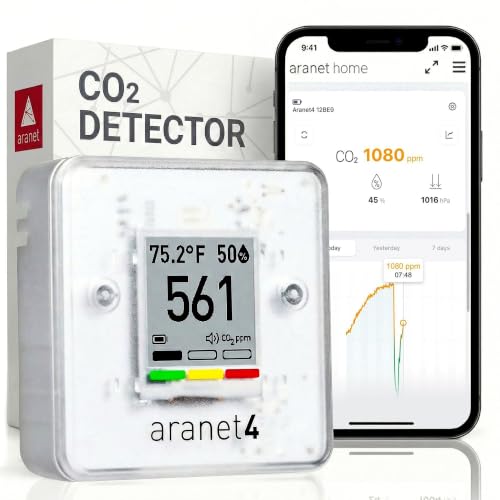
- Accurate NDIR CO2 monitoring
- Up to four years of battery life
- Tracks CO2, temperature, humidity, and pressure
Best For: Cable-free ventilation monitoring at home or work
Best Smart Home Integration
GoveeLife Smart Air Quality Monitor

- Two-second PM2.5 refresh rate
- Works with compatible GoveeLife appliances
- Stores and exports up to two years of data
Best For: Connected homes tracking PM2.5 and humidity
Best Full-Spectrum Coverage
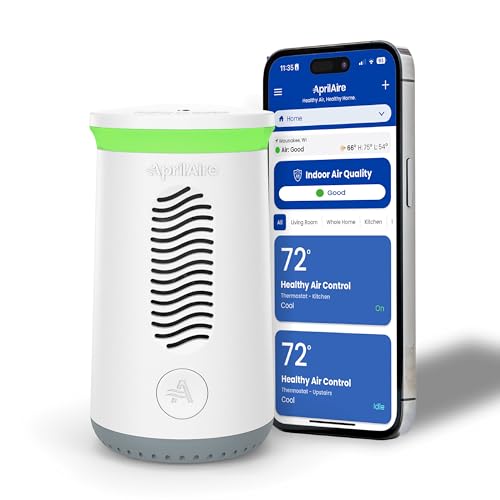
- Tracks PM2.5, VOCs, CO2, humidity, and temperature
- Includes app alerts and trend guidance
- Compatible with select AprilAire systems
Best For: Whole-home IAQ awareness and five-sensor coverage
Best for Detailed Tracking

- Eight-in-one monitoring with CO2, particles, VOCs, and formaldehyde
- 90-day app history with CSV export and configurable alerts
- Up to six hours of portable use; USB-C operation supported
Best For: Detailed home, office, classroom, or bedroom air-quality analysis
Best for Remote Monitoring

- Six-in-one readings with CO2, PM2.5, TVOC, AQI, temperature, and humidity
- Remote app access, alerts, logging controls, and data export
- E-ink display and up to 40 days in power-saving mode
Best For: Long-running monitoring with remote access and flexible logging
Best for Portable Coverage
AirKnight AT1000 Indoor Air Quality Monitor
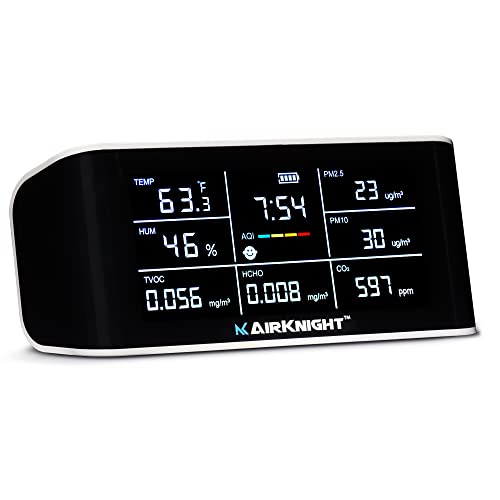
- 10-in-1 real-time monitoring with particles, VOCs, formaldehyde, and CO2
- Large LCD screen provides an at-a-glance view
- 3000 mAh rechargeable battery for moving between locations
Best For: Simple portable monitoring across rooms, work, school, or a car
Top Radon Coverage – Airthings View Plus
For shoppers comparing premium smart air quality monitors, the Airthings View Plus stands out by combining radon detection with monitoring for PM2.5, CO2, VOCs, humidity, temperature, and air pressure. Its battery-powered design and customizable eInk display make flexible placement easy, while the app provides alerts and trend analysis.
Best For: Homes that need broad indoor-air tracking with dedicated radon monitoring.
Pros:
- Measures radon, PM2.5, CO2, VOCs, humidity, temperature, and pressure.
- Battery-powered for cable-free placement, with an advertised battery life of up to two years.
- App-based alerts, historical analysis, and local pollen information.
- Optional free extended warranty registration can provide five years of coverage.
Cons:
- The monitor and app require internet access.
- An Airthings account and app are required for use.
This is the strongest fit for buyers who prioritize radon awareness and continuous, multi-parameter monitoring over a completely offline experience.
Most Portable Data – 16-in-1 Indoor Air Quality Monitor
This 16-in-1 monitor is a practical option for shoppers seeking premium smart air quality monitors with a portable, real-time display. It measures particulate matter, CO2, TVOC, HCHO, temperature, and humidity, updating readings every 1.5 seconds on a high-definition color screen.
Best For: Users who want to check air conditions across rooms, vehicles, offices, and other indoor spaces.
Pros:
- Tracks PM1.0, PM2.5, PM10, CO2, TVOC, HCHO, temperature, and humidity.
- Large color display provides continuously updated, color-coded readings.
- Compact design supports handheld or flexible placement in multiple locations.
- USB-C charging and included adapter support convenient recharging.
Cons:
- Continuous runtime is approximately four to five hours per charge.
- The supplied notes do not identify app connectivity or remote alerts.
Choose this model if immediate, on-device readings and portability matter more than cloud history or smart-home integration.
Best CO2 Alerts – GoveeLife H5140
Among premium smart air quality monitors, the GoveeLife H5140 is focused on dependable CO2 awareness with a five-second refresh rate and an SCD4x sensor. It also displays temperature, humidity, and time, while its app adds customizable alerts, historical charts, CSV exports, and smart-home connections.
Best For: Bedrooms, nurseries, and offices where continuous CO2 monitoring and layered alerts are priorities.
Pros:
- Uses an SCD4x CO2 sensor with stated accuracy of ±(40 ppm + 5%).
- Provides buzzer, app, and email warnings for configurable conditions.
- Stores up to two years of historical data and supports CSV export.
- Works with Alexa and Google Assistant and can connect with humidifiers and tower fans.
Cons:
- AC-powered operation requires a nearby outlet.
- It does not monitor PM2.5, VOCs, or radon.
- The clock requires app connection, and outdoor calibration may be needed.
This is a strong targeted choice for ventilation awareness and smart-home routines, but buyers seeking particulate or radon data will need a broader sensor system.
Best Alexa Integration – Amazon Smart Air Quality Monitor
The Amazon Smart Air Quality Monitor is a straightforward choice for shoppers comparing premium smart air quality monitors within an Alexa-based home. It tracks PM2.5, VOCs, carbon monoxide, humidity, and temperature, then delivers a color-coded status, app-based score, and alerts through compatible Echo devices.
Best For: Alexa users who want simple monitoring and automated responses from compatible home devices.
Pros:
- Measures PM2.5, VOCs, carbon monoxide, humidity, and temperature.
- Alexa app provides an air-quality score and detailed information.
- Can send phone notifications or announcements on Echo devices.
- Alexa Routines can control compatible purifiers, dehumidifiers, and fans.
Cons:
- It requires a power outlet and Alexa app setup.
- The supplied notes do not indicate radon or CO2 monitoring.
- Advanced data access and automation are centered on the Alexa ecosystem.
This monitor makes the most sense for Alexa households that value easy setup and automation rather than the widest possible range of sensors.
Best Cable-Free Pick – Aranet4 Indoor Air Quality Monitor
For shoppers seeking premium smart air quality monitors focused on ventilation, the Aranet4 tracks CO2, temperature, relative humidity, and atmospheric pressure in real time. Its wireless design, e-ink display, and NDIR CO2 sensor make it a practical choice for ongoing home or office monitoring.
Best For: Cable-free CO2 monitoring in bedrooms, living spaces, and offices where long battery life matters.
Pros:
- Measures CO2, temperature, humidity, and atmospheric pressure.
- Runs on two included AA batteries for up to four years.
- Displays prominent CO2 readings with color coding and an optional buzzer.
- App provides graphs and up to 90 days of historical data.
Cons:
- Tracks fewer air-quality factors than multi-sensor monitors that include PM2.5 and VOCs.
- App history is limited to 90 days.
The Aranet4 is a strong fit when accurate, highly visible CO2 monitoring is the priority. It is especially convenient for users who want a low-maintenance monitor without a power cable.
Best Smart Home Integration – GoveeLife Smart Air Quality Monitor
The GoveeLife H5106 is one of the more connected premium smart air quality monitors for shoppers focused on PM2.5 trends and automation. It measures PM2.5, temperature, and humidity, refreshes readings every two seconds, and works with compatible GoveeLife appliances.
Best For: Users who want remote monitoring, data export, and automatic coordination with compatible GoveeLife air appliances.
Pros:
- Measures PM2.5, temperature, and humidity with two-second refresh data.
- Supports Bluetooth and 2.4 GHz Wi-Fi for remote monitoring.
- Stores up to two years of data for viewing and export.
- Can trigger compatible GoveeLife purifiers, humidifiers, and fans.
Cons:
- Requires continuous Type-C power and has no built-in battery.
- 2.4 GHz Wi-Fi is required for some connected features.
- Does not measure CO2 or VOCs.
This monitor makes the most sense for a Govee-equipped home. Its fast updates and long data-storage period are useful for spotting PM2.5 changes, while the wired design is better suited to a fixed location.
Best Full-Spectrum Coverage – AprilAire Healthy Air Monitor
For broad indoor coverage, the AprilAire ZAWTHCPV stands out among premium smart air quality monitors by tracking PM2.5, VOCs, CO2, humidity, and temperature. Its Healthy Air App adds notifications, trend information, explanations, and suggested actions for interpreting readings.
Best For: Households wanting a five-in-one monitor with app guidance and potential integration with AprilAire ventilation or filtration equipment.
Pros:
- Monitors PM2.5, VOCs, CO2, humidity, and temperature.
- Provides instant app notifications and real-time trend information.
- Uses color-coded status indicators for quick at-a-glance checks.
- Offers three light options and optional integration with select AprilAire systems.
Cons:
- Requires the AprilAire Healthy Air App to function.
- Uses corded electric power rather than a battery.
- AprilAire thermostat integration requires compatible equipment sold separately.
The AprilAire is the broadest sensor package of these options and is well suited to users who want more than CO2 or particulate readings alone. Its app-dependent setup and ecosystem requirements are worth considering before purchase.
Best for Detailed Tracking – BREATHE Airmonitor Plus Gen 2
For shoppers comparing premium smart air quality monitors, the BREATHE Airmonitor Plus Gen 2 stands out for broad pollutant coverage and deeper trend analysis. It measures CO2, PM1, PM2.5, PM10, TVOC, formaldehyde, temperature, and humidity, while its app adds alerts, 90-day history, and CSV data export.
Best For: Homeowners who want detailed, exportable indoor air-quality data across multiple pollutant types.
Pros:
- Professional NDIR CO2 sensing plus laser particle, TVOC, and formaldehyde detection.
- Tracks eight measurements in real time, including three particulate sizes.
- Offers app alerts, 90-day history, data export, and up to six hours of portable battery use.
Cons:
- App connectivity requires a 2.4 GHz Wi-Fi network.
- Six-hour battery life is shorter than some dedicated long-runtime monitors.
The BREATHE model is a strong choice when data depth matters more than maximum battery endurance. Its combination of sensor coverage, historical graphs, and export tools makes it especially useful for investigating changes caused by cooking, cleaning, ventilation, or occupancy.
Best for Remote Monitoring – Temtop M10+ WiFi
The Temtop M10+ WiFi is a practical pick among premium smart air quality monitors for people who want remote access and flexible logging. It tracks PM2.5, CO2, TVOC, AQI, temperature, and humidity, then sends readings to the Temtop app over Bluetooth and 2.4 GHz Wi-Fi.
Best For: Users who want long battery life, remote app access, and customizable data logging.
Pros:
- Provides six measurements with remote monitoring, threshold settings, and push notifications.
- Supports one-, five-, 10-, or 30-minute logging intervals and data export.
- E-ink display, audible alarm, and a rechargeable battery rated for up to 40 days in power-saving mode.
Cons:
- It does not list formaldehyde detection among its six monitored measurements.
- Remote access depends on Bluetooth and a 2.4 GHz Wi-Fi connection.
Choose the Temtop if convenience and endurance are priorities. Its e-ink screen is designed for clear viewing and lower power use, while intelligent detection can adjust sampling based on air stability for more efficient monitoring.
Best for Portable Coverage – AirKnight AT1000 Indoor Air Quality Monitor
The AirKnight AT1000 offers broad, easy-to-read monitoring for shoppers seeking premium smart air quality monitors with a portable design. Its 10-in-1 sensor system displays CO2, PM2.5, PM10, TVOC, formaldehyde, and other readings on a large LCD screen.
Best For: Households that want a straightforward monitor they can move between rooms, workspaces, school, or a car.
Pros:
- Real-time detection covers CO2, PM2.5, PM10, TVOC, formaldehyde, and additional air-quality readings.
- Large LCD screen presents readings in one place.
- Rechargeable 3000 mAh lithium-polymer battery supports portable use.
- Includes an instructional video, user manual, and US-based customer support.
Cons:
- The supplied notes do not mention app connectivity, remote monitoring, or historical data export.
- Specific battery runtime is not provided.
The AirKnight is best suited to buyers who value broad sensing and simple, immediate readouts over connected analytics. Its portable battery and large display make it convenient for checking conditions in different locations, including during wildfire-related air-quality concerns.
How We Picked the Best Premium Smart Air Quality Monitors
We focused on monitors that measure meaningful indoor-air indicators and present the information clearly. The selection includes devices for CO2 awareness, particulate monitoring, VOC detection, humidity and temperature tracking, and specialized concerns such as radon or formaldehyde. We also considered whether each monitor offers app access, wireless connectivity, audible or visual alerts, portability, and a practical display.
Because “smart” can mean different things, we separated simple local monitoring from models that connect to Wi-Fi, provide notifications, or integrate with a broader smart-home setup. A higher sensor count is not automatically better; accuracy, calibration options, placement flexibility, and useful alerts matter just as much.
Quick Comparison
- Best for broad home monitoring: Airthings View Plus combines several air-quality readings with radon tracking and battery operation.
- Best for straightforward CO2 tracking: Aranet4 is compact, wireless, and easy to carry between rooms.
- Best for smart-home alerts: Amazon and GoveeLife models offer accessible displays and notification-focused features.
- Best for detailed measurements: The 16-in-1, Temtop, AirKnight, and BREATHE models target buyers who want more sensor data.
- Best for connected whole-room monitoring: AprilAire provides Wi-Fi access alongside several core air-quality measurements.
Key Buying Factors for Premium Smart Air Quality Monitors
Sensor Coverage
CO2 is useful for judging ventilation, while PM2.5 helps reveal fine particles from cooking, smoke, dust, or outdoor pollution. VOC sensors can indicate chemical pollutants, but they generally provide an overall trend rather than identifying one specific substance. Humidity and temperature readings add context, especially in bedrooms, nurseries, and basements. If radon or formaldehyde is a specific concern, choose a model that explicitly includes that sensor rather than assuming a general air-quality monitor covers it.
Connectivity and Alerts
Wi-Fi models are convenient for remote notifications and historical data, but they depend on a network and often require an app. Bluetooth devices can be more private and energy-efficient but may need your phone nearby. Look for adjustable thresholds, clear alarms, and useful graphs instead of notifications that are difficult to customize.
Display, Power, and Placement
A bright display suits a desk or living room, while a battery-powered unit is easier to move or place away from outlets. Check whether the monitor is designed for continuous operation, how often it needs charging, and whether readings update quickly enough for your use. Keep any monitor away from windows, vents, kitchens, bathrooms, and direct sunlight unless you are intentionally measuring those conditions.
Who Should Buy Which Premium Smart Air Quality Monitors?
Choose a broad-sensor model if you want one device to oversee several rooms or investigate multiple possible air-quality issues. Pick a compact CO2 monitor if ventilation is your main concern and you want to move the device between a home office, bedroom, and classroom. A Wi-Fi-connected monitor is the better choice for caregivers, property managers, or anyone who cannot check the display regularly. Finally, select a model with the specific sensor you need—particularly radon or formaldehyde—and treat its readings as decision-support data, not a substitute for certified testing when health or safety is at stake.