In 2025, choosing the right graphics card for your PC gaming setup is more essential than ever. With options ranging from the powerful ASUS TUF Gaming GeForce RTX 5070 to budget-friendly models like the ASUS Dual NVIDIA GeForce RTX 3050, there’s something for everyone. Each card brings unique features and performance levels that can elevate your gaming experience. So, what should you consider when making your selection? Let’s explore the top contenders and their standout qualities.
ASUS TUF Gaming GeForce RTX 5070 Graphics Card

If you’re a serious gamer looking for top-tier performance in 2025, the ASUS TUF Gaming GeForce RTX 5070 is your go-to choice. This graphics card boasts NVIDIA’s Blackwell architecture and DLSS 4, ensuring stunning visuals and smooth gameplay. Its military-grade components enhance durability, while the phase-change GPU thermal pad keeps temperatures low during intense sessions. With a 3.125-slot design and three Axial-tech fans, airflow is maximized for efficient cooling. Plus, protective features like PCB coating and ASUS GPU Guard keep your investment safe. Use the GPU Tweak III software for seamless performance tweaking and monitoring, making your gaming experience even better.
Best For: Serious gamers seeking top-tier performance and durability in high-demand gaming scenarios.
Pros:
- High performance with NVIDIA’s Blackwell architecture and DLSS 4 for stunning visuals.
- Durable construction featuring military-grade components and a protective PCB coating.
- Efficient cooling system with a 3.125-slot design and three Axial-tech fans for optimized airflow.
Cons:
- Larger size may not fit in all PC cases due to the 3.125-slot design.
- Potentially high power consumption under heavy loads, requiring a robust power supply.
- Price point may be on the higher side, making it less accessible for budget-conscious gamers.
MSI Gaming GeForce RTX 3060 Graphics Card

The MSI Gaming GeForce RTX 3060 12GB GDDR6 Graphics Card is an excellent choice for gamers looking to balance performance and affordability in 2025. With a GPU clock speed of 1710 MHz and a memory clock speed of 1807 MHz, you’ll experience smooth gameplay at high settings. Its 12GB GDDR6 memory and 192-bit memory interface guarantee efficient data handling. You can connect multiple displays with three DisplayPort 1.4a outputs and one HDMI 2.1. Plus, the Torx Twin Fan Design keeps your system cool during intense gaming sessions. PCIe 4 compatibility means it’s ready for future upgrades.
Best For: Gamers seeking a powerful yet affordable graphics card that can handle high settings and multiple displays in 2025.
Pros:
- Excellent performance with a GPU clock speed of 1710 MHz and 12GB GDDR6 memory for smooth gameplay.
- Multiple display connectivity options with three DisplayPort 1.4a and one HDMI 2.1 output.
- Effective cooling system with Torx Twin Fan Design, ensuring optimal performance during intense gaming sessions.
Cons:
- May not be suitable for ultra-high-end gaming at 4K resolutions due to its mid-range positioning.
- Limited availability in some regions may lead to inflated prices.
- Requires a compatible motherboard to fully utilize PCIe 4 performance benefits.
ASUS Dual NVIDIA GeForce RTX 3050 Gaming Graphics Card

For gamers seeking an affordable yet powerful upgrade, the ASUS Dual NVIDIA GeForce RTX 3050 6GB OC Edition stands out as an excellent choice. It features PCIe 4.0 and 6GB of GDDR6 memory, delivering impressive performance. The NVIDIA Ampere architecture enhances power efficiency while the 2nd Generation RT Cores dramatically boost ray-tracing capabilities. With advanced AI algorithms like DLSS, you’ll experience significant performance gains. The axial-tech fan design guarantees peak cooling, maintaining stability even in compact cases. Plus, its 2-slot design ensures compatibility without sacrificing thermal efficiency, making it perfect for both casual and competitive gaming experiences.
Best For: Gamers looking for an affordable graphics card upgrade that balances performance and efficiency for both casual and competitive play.
Pros:
- Impressive Performance: Equipped with PCIe 4.0 and 6GB GDDR6 memory, offering great gaming performance.
- Ray-Tracing Capabilities: 2nd Generation RT Cores enhance ray-tracing performance for more realistic graphics.
- Effective Cooling Design: Axial-tech fan design ensures optimal cooling, even in compact builds.
Cons:
- Limited VRAM: 6GB of memory may not be sufficient for more demanding titles at higher resolutions.
- Power Consumption: While efficient, it still requires adequate power supply considerations for optimal performance.
- Availability: As a popular choice, it may be difficult to find in stock at times.
GIGABYTE GeForce RTX 3060 Gaming OC Graphics Card
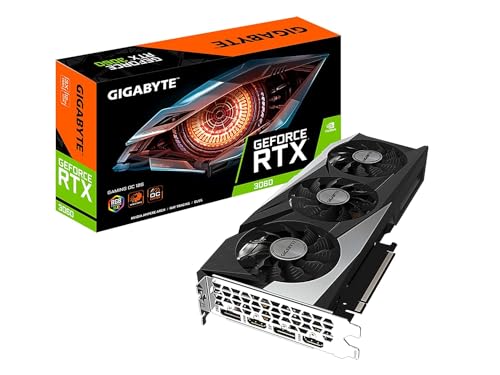
Gamers seeking a solid balance between performance and affordability will find the GIGABYTE GeForce RTX 3060 Gaming OC Graphics Card an excellent choice. With 12GB of GDDR6 memory and NVIDIA’s Ampere architecture, you’ll enjoy stunning visuals and fast frame rates. It handles AAA titles effortlessly, achieving around 97 FPS at 1080p with ultra settings. The innovative WINDFORCE 3X cooling system guarantees quiet operation, while the RGB Fusion 2.0 adds a touch of flair. Just keep in mind it needs a larger case for ideal cooling. Overall, it’s a fantastic option that delivers impressive gaming experiences without breaking the bank.
Best For: Gamers looking for a powerful yet affordable graphics card that excels in performance for both gaming and creative applications.
Pros:
- Exceptional performance with 12GB of GDDR6 memory, achieving fast frame rates in AAA titles.
- Efficient WINDFORCE 3X cooling system ensures quiet operation during intense gaming sessions.
- Attractive design with RGB Fusion 2.0 for customizable lighting effects.
Cons:
- Requires a larger case for optimal cooling and installation.
- Struggles with some DX12 titles, potentially impacting performance in certain games.
- Compatibility issues with power supply units may arise, needing a 6+2 pin or 8-pin configuration.
GIGABYTE Radeon RX 7600 XT Gaming OC Graphics Card

With its powerful 16GB GDDR6 memory, the GIGABYTE Radeon RX 7600 XT Gaming OC Graphics Card stands out as an excellent choice for enthusiasts seeking high-quality gaming experiences in 2025. This dedicated graphics card features a 128-bit memory interface and PCI Express 4.0 support, ensuring exceptional performance. The WINDFORCE cooling system with three fans keeps temperatures low, while RGB Fusion allows you to customize the lighting. With a max resolution of 7680×4320 pixels and a solid customer rating of 4.6 stars, this graphics card offers both reliability and style for your gaming setup.
Best For: Gamers and enthusiasts looking for high-performance graphics with customizable features and exceptional resolution capabilities.
Pros:
- High memory capacity of 16GB GDDR6 for smooth gaming and multitasking.
- Advanced cooling system with WINDFORCE technology to maintain optimal temperatures during intense gaming sessions.
- Customizable RGB lighting for a personalized aesthetic that enhances any gaming setup.
Cons:
- Relatively large size may require ample space in PC cases for installation.
- Potentially high power consumption compared to lower-end graphics cards.
- Limited availability in certain markets may affect purchase options.
ASUS Dual NVIDIA GeForce RTX 3060 V2 OC Edition Gaming Graphics Card
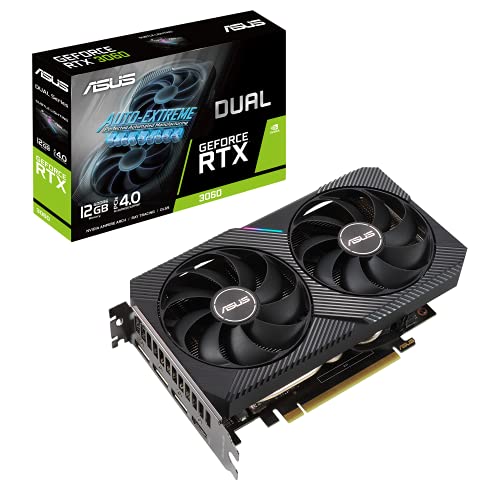
The ASUS Dual NVIDIA GeForce RTX 3060 V2 OC Edition Gaming Graphics Card stands out for its impressive 12GB GDDR6 memory, making it an ideal choice for those who crave high-resolution gaming experiences. With PCIe 4.0 compatibility and support for HDMI 2.1 and DisplayPort 1.4a, you’ll enjoy seamless connectivity. The Axial-tech Fan Design guarantees efficient cooling, keeping your system quiet with 0dB technology. Thanks to the NVIDIA Ampere architecture, you’ll benefit from enhanced ray tracing performance and AI capabilities, delivering stunning visuals. Boost clocks reach 1867 MHz, providing smooth gameplay that’ll elevate your gaming sessions to the next level.
Best For: Gamers who demand high-resolution performance and advanced graphics capabilities for immersive gaming experiences.
Pros:
- 12GB GDDR6 memory for high-resolution gaming and multitasking.
- PCIe 4.0 compatibility ensures fast data transfer rates and future-proofing.
- Axial-tech Fan Design with 0dB technology provides efficient cooling while maintaining quiet operation.
Cons:
- May be overkill for casual gamers who don’t require high-end performance.
- Availability can be limited due to high demand and supply chain issues.
- The 2-Slot design may require more space in smaller cases.
CyberPowerPC Gamer Xtreme VR Gaming PC (GXiVR8060A40)

For those seeking an immersive gaming experience in 2025, the CyberPowerPC Gamer Xtreme VR Gaming PC (GXiVR8060A40) stands out with its powerful NVIDIA GeForce RTX 5060 graphics card. With an Intel Core i5-13400F processor and 16GB of DDR5 RAM, you’ll enjoy smooth gameplay and fast performance. The 1TB PCIe 4.0 NVMe SSD guarantees quick boot times and ample storage for your games. Plus, customizable RGB lighting and a cooling system keep your rig looking and performing its best. With a solid warranty and lifetime tech support, you’re set for an exceptional gaming journey.
Best For: Gamers looking for a powerful and efficient gaming PC that delivers high performance and stunning graphics for an immersive experience.
Pros:
- Fast boot and shutdown times thanks to the 1TB PCIe 4.0 NVMe SSD.
- Customizable RGB lighting adds a personal touch and enhances aesthetics.
- Ample connectivity options with multiple USB ports, WiFi 6, and Bluetooth 5.3.
Cons:
- Occasional user errors may lead to system crashes.
- Some users prefer built-in WiFi antennas instead of external ones.
- Weighs 30 pounds, which may be cumbersome for transport.
PNY NVIDIA GeForce RTX 5060 8GB Graphics Card

Gaming enthusiasts seeking superior performance will find the PNY NVIDIA GeForce RTX™ 5060 8GB Graphics Card an excellent choice. With its DLSS 4 technology and NVIDIA Blackwell architecture, expect enhanced gaming experiences and stunning visuals. The card supports PCIe® 5.0, HDMI®/DP 2.1, and boasts Epic-X™ RGB Lighting for a stylish build. You’ll appreciate the fifth-gen Tensor Cores and fourth-gen Ray Tracing Cores that elevate both gaming and creative tasks. Weighing just 2.22 pounds and offering a max resolution of 7680×4320, this graphics card strikes the perfect balance between power and performance, making it ideal for your setup.
Best For: Gaming enthusiasts and creative professionals seeking high performance and stunning visuals in their graphics card.
Pros:
- DLSS 4 technology enhances frame rates and image quality for a superior gaming experience.
- Lightweight design at 2.22 pounds makes it easy to install in various setups.
- Versatile performance supports both gaming and creative applications with optimized technologies.
Cons:
- Limited warranty with only a 30-day return policy for unopened items.
- Potential compatibility issues with older systems due to PCIe® 5.0 support.
- Higher price point compared to some entry-level graphics cards may not be suitable for budget-conscious buyers.
GIGABYTE GeForce RTX 5060 Gaming OC 8G Graphics Card

With its powerful 8GB GDDR7 memory and NVIDIA Blackwell architecture, the GIGABYTE GeForce RTX 5060 Gaming OC 8G Graphics Card is ideal for gamers seeking smooth performance at both 1080p and 1440p resolutions. It delivers impressive frame rates, reaching up to 90 FPS at 1440p Ultra settings for games like BF6 Beta. The WINDFORCE cooling system keeps temperatures in check, guaranteeing peak performance during long gaming sessions. Plus, its PCIe 5.0 interface guarantees compatibility with the latest systems. Whether you’re gaming or editing, this card’s solid performance and compact design make it a top choice for 2025 and beyond.
Best For: Gamers and content creators looking for a high-performance graphics card that excels at 1080p and 1440p gaming.
Pros:
- Exceptional performance at 1080p and 1440p, with up to 90 FPS in demanding games.
- Efficient cooling system that maintains low temperatures during intensive gaming sessions.
- Future-proof with PCIe 5.0 compatibility and support for the latest gaming technologies like DLSS and Ray Tracing.
Cons:
- Higher TDP may require a robust power supply for optimal performance.
- Limited availability may affect purchase options and pricing.
- Weight may be an issue for some compact builds or cases.
Radeon RX 580 8GB Graphics Card for PC Gaming

The Radeon RX 580 8GB Graphics Card stands out as an excellent choice for budget-conscious gamers seeking solid performance without breaking the bank. With 2048 stream processors and GDDR5 memory, it handles modern titles like Star Wars: Jedi Survivor at medium to ultra settings. You’ll appreciate its ability to support up to 4K resolution across three monitors. The dual cooling fans guarantee quieter gameplay, while its compatibility with various systems makes installation a breeze. Plus, with a two-year warranty, you can game with confidence. Overall, it’s a great value for anyone looking to enhance their gaming experience.
Best For: Budget-conscious gamers looking for solid performance in modern titles without overspending.
Pros:
- Great performance for mainstream gaming, capable of running newer titles at medium to ultra settings.
- Supports up to 4K resolution with multi-monitor output, enhancing the gaming and multitasking experience.
- Easy installation and compatibility with various systems, making it accessible for users with older hardware.
Cons:
- Some users report durability issues, particularly with the fans after several months of use.
- May require a power cable adaptor, which could be a hassle for some users.
- Mixed reviews on customer support responsiveness for warranty issues.
Factors to Consider When Choosing Graphics Cards for PC Gaming
When you’re choosing a graphics card for your PC gaming setup, several key factors can make a big difference. You’ll want to take into account performance benchmarks, memory capacity, and cooling solutions to guarantee ideal gameplay. Also, don’t forget about compatibility with your system and the all-important price-to-performance ratio.
Performance Benchmarks
Choosing the right graphics card for PC gaming hinges on understanding performance benchmarks, as they directly impact your gaming experience. Look for frames per second (FPS) metrics; higher FPS results in smoother gameplay, especially in demanding titles where 60 FPS or more is ideal. The core clock speed, measured in megahertz (MHz), also affects performance—higher speeds generally lead to better frame rates. Additionally, consider ray tracing capabilities, as second-generation RT cores provide enhanced visual fidelity with realistic lighting and reflections. Finally, use benchmark tests like Unigine Heaven and 3DMark to compare GPUs under various settings and resolutions. This way, you can make an informed choice that suits your gaming needs.
Memory Capacity
Memory capacity plays an essential role in your graphics card selection for PC gaming. Typically measured in gigabytes (GB), it directly impacts your ability to handle high-resolution textures and complex graphics. For mainstream gaming, you’ll want a card with 6GB to 12GB of memory. If you’re into 4K gaming or using multiple monitors, opting for 8GB or more of GDDR6 memory is vital for peak performance in AAA titles. Additionally, consider the memory interface; a wider interface (like 256-bit vs. 128-bit) enables faster data transfer, enhancing performance at higher resolutions. Insufficient memory can cause bottlenecks, resulting in lower frame rates and longer loading times, so choose wisely to match your gaming needs.
Cooling Solutions
High-performance gaming pushes your graphics card to its limits, making effective cooling solutions a key factor in maintaining peak performance. Efficient cooling prevents overheating during intense sessions and extends your GPU’s lifespan. Look for advanced technologies, like multiple fan designs and enhanced airflow configurations, to improve thermal management. High-quality thermal pads and compounds improve heat transfer from the GPU to the heatsink, boosting overall cooling effectiveness. Graphics cards with larger heatsinks and more fans typically deliver better cooling, enabling higher clock speeds and improved performance without thermal throttling. Additionally, features like zero RPM modes keep fans quiet during lighter tasks while still providing robust cooling when gaming heats up. Prioritize these aspects for an exceptional gaming experience.
Compatibility and Interface
When it comes to upgrading your gaming rig, ensuring compatibility between your graphics card and other components is essential for ideal performance. First, check that your motherboard supports the card’s PCIe interface; most modern options use PCIe 4.0 or 5.0 for peak performance. Next, consider the physical dimensions of the card—some models with larger cooling systems or multi-slot designs may not fit in your case. Don’t forget to verify that your power supply unit (PSU) has enough wattage and the right power connectors, like 6-pin or 8-pin, to support the graphics card. Finally, make sure the card can handle your display’s maximum resolution, especially if you’re into high-resolution gaming.
Price-to-Performance Ratio
Upgrading your graphics card isn’t just about compatibility; it’s also about getting the best bang for your buck. The price-to-performance ratio is essential, as it measures how much gaming performance you gain for each dollar spent. You can calculate this by dividing the card’s performance metrics, like FPS in benchmarks, by its price. Look for cards with higher memory bandwidth and clock speeds, as they provide better performance for higher settings. Also, consider how well the card handles modern technologies like ray tracing and DLSS. Finally, comparing performance benchmarks across different resolutions can help you find the best value for your gaming setup, while user reviews and expert analyses offer insights into real-world performance.
Power Consumption
Choosing the right graphics card involves more than just performance; you also need to take into account power consumption. Power consumption is measured in watts (W), and opting for a graphics card with a lower TDP (Thermal Design Power) can lead to reduced energy costs and less heat generation in your system. High-performance cards may require 130 watts or more, so make sure your power supply unit (PSU) can handle that demand. Pay attention to the PSU’s efficiency rating—higher ratings like 80 Plus Gold can minimize overall energy use. Remember, the graphics card’s power draw impacts the entire system, so keep it within the PSU’s limits. Using monitoring software can also help you track real-time power usage and optimize settings.
Brand Reputation
Trust plays an essential role in selecting a graphics card for PC gaming, and brand reputation is at the forefront of that trust. Established brands often showcase a history of reliability and performance, giving you confidence in your investment. These well-regarded companies invest heavily in research and development, leading to innovative technologies that enhance your gaming experience. Checking customer reviews and ratings can offer valuable insight into a brand’s reputation; high ratings usually indicate satisfaction with both performance and customer service. Additionally, reputable manufacturers tend to provide better warranty terms and support, which is vital for long-term ownership. Remember, a strong brand reputation can even influence resale value, ensuring your investment retains its worth over time.