In 2025, finding the right audio interface for your Mac Pro can make a significant difference in your sound quality. With a range of options available, from budget-friendly models to high-end solutions, it is crucial to know what each offers. Whether you’re a seasoned professional or an aspiring musician, the right choice can elevate your audio production. Let’s explore the top contenders and what sets them apart in this competitive landscape.
Focusrite Scarlett Solo 3rd Gen USB Audio Interface

If you’re a guitarist, vocalist, podcaster, or producer looking for a reliable audio interface, the Focusrite Scarlett Solo 3rd Gen USB Audio Interface is a standout choice. This compact device records and plays back studio-quality sound with ease. Featuring high-performance mic pre-amps and 24-bit/192kHz AD-DA converters, it guarantees professional audio quality. You’ll appreciate its USB-C connectivity, which requires no external power, making it perfect for on-the-go setups. With two high-headroom instrument inputs and low-noise balanced outputs, you can achieve clean recordings effortlessly. Plus, the included software bundle enhances your creative possibilities, assuring you’re well-equipped for any project.
Best For: Guitarists, vocalists, podcasters, and producers seeking a portable and high-quality audio interface for recording and playback.
Pros:
- High-performance mic pre-amps with switchable Air mode for enhanced sound quality.
- Compact and durable design, perfect for travel and on-the-go use.
- Includes a comprehensive software bundle to expand creative possibilities.
Cons:
- Some users have reported software and driver issues with specific applications.
- Limited number of inputs may not be sufficient for larger setups.
- No MIDI input/output, which may limit connectivity options for certain users.
M-AUDIO M-Track Duo USB Audio Interface

The M-AUDIO M-Track Duo USB Audio Interface is perfect for aspiring musicians and podcasters seeking high-quality sound without breaking the bank. With two combo XLR/Line/Instrument inputs and crystal preamps, you’ll capture every detail of your recordings at 48 kHz. It’s compatible with Mac and PC, making it a versatile choice for any setup. The zero-latency monitoring feature is a game-changer, allowing you to hear your performance in real-time. Plus, the included software, like MPC Beats and Ableton Live Lite, provides everything you need to kickstart your projects. Just plug it in, and you’re ready to create!
Best For: Aspiring musicians, podcasters, and streamers looking for a budget-friendly audio interface with high-quality sound and easy setup.
Pros:
- High-Quality Sound: Records at 48 kHz with crystal preamps for optimal sound clarity.
- User-Friendly: Simple plug-and-play setup compatible with various operating systems.
- Zero-Latency Monitoring: Allows real-time performance feedback through headphone outputs.
Cons:
- Gain Adjustment Needed: May require frequent gain control adjustments for different inputs.
- Combined Outputs: Outputs are mixed into a single signal, which may not fit all recording needs.
- Durability Concerns: Plastic construction could be less durable for heavy use compared to metal alternatives.
M-AUDIO M-Track Solo USB Audio Interface
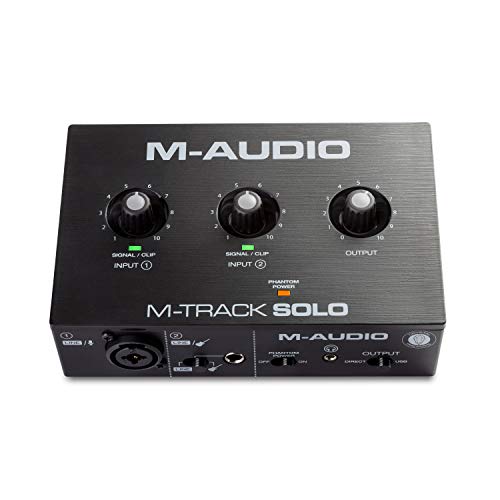
For aspiring musicians and podcasters seeking high-quality recordings without breaking the bank, the M-Audio M-Track Solo USB Audio Interface stands out. It delivers 48 kHz audio resolution, ensuring your recordings sound professional on both Mac and PC. With one combo XLR/Line input and another Line/Instrument input, you can easily connect various devices. The zero-latency monitoring feature makes it a breeze to track new parts. Plus, it comes bundled with MPC Beats software and is compatible with popular DAWs like Ableton Live Lite. Lightweight and portable, it’s perfect for on-the-go recording sessions and casual jam sessions alike.
Best For: Aspiring musicians and podcasters looking for an affordable, high-quality audio interface for recording and streaming.
Pros:
- Versatile input options with one combo XLR/Line input and an additional Line/Instrument input for connecting various devices.
- Zero-latency monitoring allows for seamless tracking and recording without delay.
- Lightweight and portable design makes it ideal for on-the-go recording sessions and casual jam sessions.
Cons:
- Limited loopback functionality may hinder recording multiple tracks simultaneously.
- Some users report durability concerns with rough handling despite its portable design.
- Basic software bundle may not satisfy advanced users looking for extensive production tools.
MAONO USB Audio Interface for PC (PS22 Lite Black)

Designed for aspiring musicians and podcasters, the MAONO USB Audio Interface (PS22 Lite Black) delivers exceptional 24-bit/192kHz recording quality that captures every nuance of your sound. With a dynamic range of 106dB, it guarantees clarity and realism in your recordings. You can connect condenser and dynamic microphones, thanks to 56 dB of preamp and 48V phantom power. The device features a dedicated instrument input for your guitar and adjustable impedance for authentic sound. Compact and lightweight, it’s easy to transport. Plus, it’s compatible with Mac, Windows, and iPads, making setup effortless with plug-and-play functionality.
Best For: Aspiring musicians and podcasters seeking high-quality audio recording and streaming capabilities.
Pros:
- Exceptional audio quality with 24-bit/192kHz recording and a dynamic range of 106dB.
- Versatile compatibility with both condenser and dynamic microphones, as well as dedicated instrument input for guitars.
- Compact and portable design makes it easy to transport and set up on various devices like Mac, Windows, and iPads.
Cons:
- Limited to USB connection which may restrict use with devices lacking USB ports.
- Basic software included may not meet the advanced needs of professional users.
- No built-in effects or processing options, requiring additional software for enhanced sound manipulation.
USB Audio Interface for Recording Music
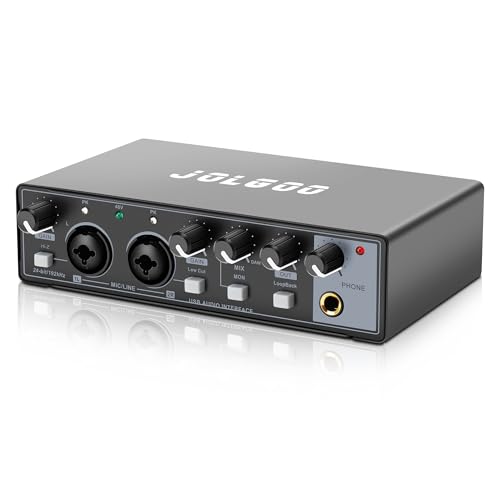
When you’re looking to elevate your music recordings, a USB audio interface offers studio-grade sound quality that can markedly enhance your projects. With 24-bit/192kHz resolution and ultra-low latency, you’ll enjoy high-fidelity audio conversion and real-time monitoring. The dual combo XLR/LINE inputs support dynamic and condenser mics, ensuring you capture every nuance. Plus, its plug-and-play compatibility with PCs, Macs, and smartphones means you can start recording right away, without complicated setups. Compact and durable, this interface is perfect for musicians and content creators alike, providing reliable performance that earns top ratings from users who appreciate its ease of use and sound quality.
Best For: Musicians, content creators, and producers seeking professional recording quality at home.
Pros:
- High-resolution audio: Offers 24-bit/192kHz resolution for studio-grade sound quality.
- Ease of use: Plug-and-play compatibility with PC, Mac, and smartphones, requiring no complex setup.
- Durable design: Compact and sturdy metal housing ensures reliability for both beginners and professionals.
Cons:
- Limited input options: Only two combo XLR/LINE inputs may not suffice for larger setups.
- No onboard effects: Lacks built-in effects processing, requiring external software for sound enhancement.
- Power requirement: Requires USB power, which may limit portability if a power source is unavailable.
Universal Audio Volt 176 USB Recording Studio Audio Interface

The Universal Audio Volt 176 USB Recording Studio Audio Interface stands out as an exceptional choice for musicians, podcasters, and livestreamers who demand professional sound quality. With its 24-bit/192 kHz audio quality, you’ll enjoy rich, detailed recordings. Its classic 610 preamps and built-in analog compressor enhance your sound, making it perfect for any project. Plus, you’ll appreciate the included LUNA Digital Audio Workstation and UAD plug-ins. Weighing just 1.44 pounds and compatible with various devices, it’s portable and user-friendly. Rated 4.6 stars by users, the Volt 176 delivers high-quality performance and reliability for your home studio setup.
Best For: Musicians, podcasters, and livestreamers seeking professional sound quality in a portable audio interface.
Pros:
- Exceptional audio quality with up to 24-bit/192 kHz recording capability.
- Includes classic 610 preamps and built-in analog compressor for enhanced sound.
- Compatible with multiple devices and software, making it versatile for various use cases.
Cons:
- Not compatible with PlayStation 5 for recording purposes.
- Phantom power resets when the computer goes to sleep, which may disrupt sessions.
- Some users may find the compact size limiting for extensive studio setups.
Behringer U-PHORIA UMC404HD Audiophile USB Audio/MIDI Interface

For those seeking an affordable yet high-quality audio interface, the Behringer U-PHORIA UMC404HD stands out with its impressive 24-Bit/192 kHz resolution. This 4×4 USB 2.0 interface features four MIDAS-designed mic preamps and offers ultra-low latency performance. You’ll appreciate its balanced XLR and 1/4 TRS connectors, making it compatible with popular DAWs like Pro Tools and Ableton Live. While its all-or-nothing phantom power may pose a limitation, the sound quality remains clear with minimal noise. Priced around $99, it delivers exceptional value, making it a strong contender for budget-conscious users looking for reliable recording solutions.
Best For: Budget-conscious users seeking a reliable audio interface for home recording and multimedia projects.
Pros:
- High-quality 24-Bit/192 kHz audio resolution for clear sound.
- Equipped with four MIDAS-designed mic preamps and ultra-low latency performance.
- Compatible with various popular DAWs, enhancing versatility for different users.
Cons:
- Phantom power is all-or-nothing for all inputs, limiting flexibility.
- Headphone/monitor output is restricted to two channels at a time.
- Mixed reviews on long-term reliability and potential software compatibility issues.
PreSonus AudioBox GO USB-C Audio Interface

Looking for an ultra-affordable and compact solution for your home or mobile recording needs? The PreSonus AudioBox GO USB-C Audio Interface delivers professional sound quality without breaking the bank. It connects effortlessly to your Apple or Android devices, powered directly through USB-C—no extra power supply required. With simultaneous inputs for an instrument and a microphone, plus studio-grade converters supporting up to 24-bit/96 kHz audio, your recordings will shine. You’ll also get Studio One Prime DAW and the Studio Magic software bundle, ensuring you have everything you need to start creating right away.
Best For: Budget-conscious musicians and podcasters looking for a compact and portable audio interface with professional sound quality.
Pros:
- Ultra-compact and portable design makes it ideal for mobile recording.
- Bus-powered via USB-C, eliminating the need for an external power supply.
- Includes Studio One Prime DAW and the Studio Magic software bundle for immediate use.
Cons:
- Limited to one instrument and one microphone input at a time.
- No MIDI inputs/outputs for connecting MIDI devices.
- Basic functionality may not meet the needs of advanced users requiring more features.
IK Multimedia iRig Pro I/O Audio Interface for iPhone, iPad, Mac, and PC
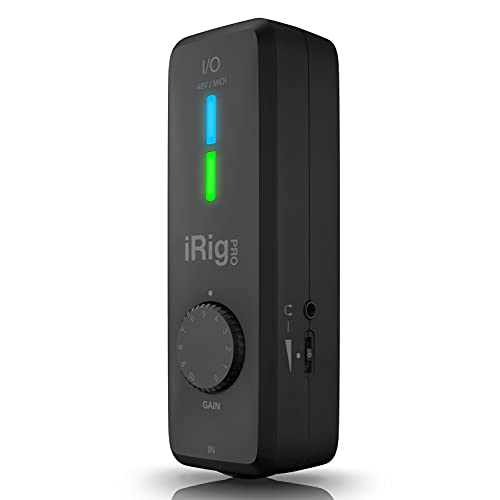
If you’re a mobile musician or audio professional seeking versatility, the IK Multimedia iRig Pro I/O audio interface stands out as an ideal choice. This compact device supports 24-bit, 96 kHz recording and connects seamlessly to your iPhone, iPad, Mac, or PC using USB-C, Lightning, and USB cables. You’ll appreciate its XLR and Hi-Z combo input for instruments and mics, plus +48v phantom power for condenser mics. With a direct headphone jack, you can monitor your sound in real-time, ensuring superior quality. It’s compatible with popular apps like Clubhouse and Zoom, delivering studio-quality audio wherever you go.
Best For: Mobile musicians and audio professionals seeking a versatile and high-quality audio interface for recording and performance across multiple devices.
Pros:
- High-quality 24-bit/96 kHz audio recording ensures professional sound.
- Compact and lightweight design makes it easy to transport for on-the-go use.
- Direct headphone monitoring allows for real-time sound checks without latency.
Cons:
- May require additional adapters for certain device compatibility.
- Limited power options, as it relies on device battery for operation.
- Some users may find the setup process slightly complex for first-time use.
PreSonus Quantum ES 2 USB-C Audio Interface with Studio One Pro Software

The PreSonus Quantum ES 2 USB-C Audio Interface stands out as an ideal choice for musicians and audio professionals seeking exceptional sound quality and low latency. With its two MAX-HD mic preamps offering +75 dB gain, you’ll experience impressive clarity and dynamics. The included Studio One Pro software enhances your creative workflow, while the custom low-latency driver guarantees prime audio performance. Weighing just 1.5 pounds and featuring a solid build, it’s perfect for mobile setups. Plus, the twist-to-lock power connection secures your setup. Overall, the Quantum ES 2 is a reliable option for achieving professional-level recordings.
Best For: The PreSonus Quantum ES 2 is best for musicians and audio professionals looking for high-quality sound and low-latency performance in a portable audio interface.
Pros:
- Exceptional sound quality with MAX-HD mic preamps and +75 dB gain for clarity and dynamics.
- Lightweight and sturdy design makes it ideal for mobile recording setups.
- Included Studio One Pro software enhances creative workflow and productivity.
Cons:
- Requires DAW for live monitoring, which may complicate setup for some users.
- Twist-to-lock power plug might be inconvenient for rack-mounted installations.
- Absence of hardware monitoring can be a drawback for certain recording situations.
Factors to Consider When Choosing a Mac Pro Audio Interface
When choosing a Mac Pro audio interface, you’ll want to take into account several key factors that can impact your sound quality and workflow. Think about audio quality standards, input and output options, and whether the interface is compatible with your software. Don’t forget to evaluate its build quality, durability, portability, and power source to guarantee it meets your needs.
Audio Quality Standards
Choosing the right Mac Pro audio interface hinges on understanding key audio quality standards that directly influence your recordings. Look for interfaces that support high-resolution recording standards like 24-bit/192kHz to guarantee clarity and professionalism. High-performance mic preamps are essential; they enhance audio quality by delivering cleaner, more dynamic sound capture, especially for vocals and instruments. Pay attention to the dynamic range—aim for at least 106 dB to capture subtle nuances and create lifelike recordings. Minimal latency during monitoring is vital; seek interfaces with latency under 10 ms for real-time feedback. Finally, don’t overlook the importance of high-quality AD-DA converters, as they directly affect the fidelity of your audio signal during capture and playback.
Input and Output Options
Understanding your input and output needs is vital for selecting the right Mac Pro audio interface. Start by considering how many inputs and outputs you’ll need based on the microphones, instruments, or MIDI devices you plan to connect simultaneously. Look for interfaces with combo XLR/line inputs to maximize versatility for both microphones and line-level devices. If you’re recording electric guitars or basses, check for dedicated instrument inputs that cater to specific impedance settings. Low-latency monitoring options, like direct monitoring through headphone outputs, are essential for real-time feedback during recordings. Finally, verify the interface offers balanced outputs to minimize noise and interference when connecting to studio monitors or other audio equipment.
Software Compatibility Requirements
Software compatibility is essential in ensuring your audio interface works seamlessly with your Mac Pro setup. First, check that the interface supports the latest macOS versions, as compatibility can change with updates. You’ll also want to confirm it includes drivers optimized for low-latency performance, critical for real-time recording and monitoring. Make sure the interface integrates smoothly with popular Digital Audio Workstations like Logic Pro, Ableton Live, or Pro Tools to avoid workflow disruptions. Additionally, look for bundled software or subscriptions that enhance your production capabilities, adding value to your investment. Finally, consider interfaces that support ASIO drivers for reliable performance and lower latency when using professional audio software. These factors are essential for achieving high-quality sound.
Build Quality and Durability
When considering a Mac Pro audio interface, build quality and durability are essential factors that can greatly affect your experience. A sturdy metal chassis is often preferable to plastic, as it withstands rough handling and travel better, reducing damage risks. You’ll want an interface that’s lightweight yet durable, especially if you transport it frequently. Look for features like robust knobs and connectors; these add to the overall durability, minimizing the chance of breakage or malfunction. User feedback consistently emphasizes the importance of a solid build, particularly for professionals who rely on their gear in various environments. A well-constructed audio interface guarantees consistent performance and longevity, making it a worthwhile investment for your audio needs.
Portability and Power Source
Portability and power source are crucial considerations for anyone looking to choose a Mac Pro audio interface. You’ll want a model that’s lightweight and compact, making it easy to transport for mobile recording sessions. Opt for USB-powered interfaces, as they eliminate the hassle of an external power supply, enhancing convenience on the go. When evaluating options, look for dimensions around 1.71 x 5.65 x 3.77 inches, which are much more travel-friendly than bulkier models. Verify compatibility with your Mac to avoid complicated setups. Additionally, consider design features like rugged build quality and physical knobs for quick adjustments. These aspects will greatly enhance your recording experience wherever you go.