If GPU thermals are your top priority, an open-frame design can be a smart alternative to a sealed tower. These cases keep airflow unobstructed, make component swaps easier, and can help high-wattage graphics cards run cooler under load.
Below, we focus on the best picks for builders who want better heat dissipation, flexible mounting options, and practical layouts for gaming rigs, test benches, and DIY setups.
Best 10 Open Air PC Cases for GPU Cooling Picks for 2026
Open-Frame Airflow Pick
Cooler Master MasterFrame 500 Mesh ARGB
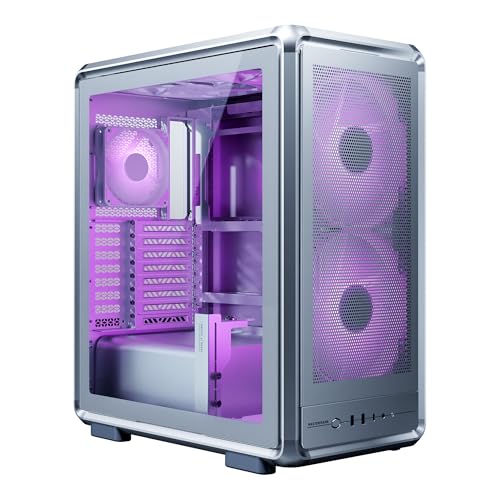
- Dual 200mm ARGB intake fans included
- Supports GPUs up to 390mm
- Open aluminum frame with up to 7 fans
Best For: Builders wanting strong airflow and flexible open-frame styling
Budget Test Bench Frame
TGDGAMER Open Chassis DIY Bench

- No limit on GPU length or cooler height
- Supports ATX, M-ATX, and ITX boards
- Open test-bench layout for easy access
Best For: DIY builders and testers who need maximum clearance
Mesh Mid-Tower Airflow Pick
PCCOOLER C3T700 Airflow Mid Tower

- Fits GPUs up to 420mm
- Mesh front with broad fan and radiator support
- No fans included, so airflow is customizable
Best For: Builders wanting a roomy airflow case for large graphics cards
Adjustable Open Frame Choice
PC Creative Assembly Frame Test Bench

- Supports EATX through ITX motherboards
- Open aluminum frame for strong heat dissipation
- Adjustable water-cooling placement for flexibility
Best For: Enthusiasts who want a configurable open frame with cooling flexibility
Open-Frame Flex Build

- Unlimited GPU length support
- Works with EATX, ATX, mATX, and ITX
- Supports air and water cooling
Best For: Builders with oversized GPUs and flexible platform needs
Budget Test Bench

- Open chassis for direct airflow
- Unlimited GPU length and width support
- Fits ATX, mATX, and ITX boards
Best For: Builders wanting an affordable open test bench
Stackable Workstation Bench

- Up to 8x 120mm fans supported
- Stackable horizontal design
- GPU clearance up to 310mm
Best For: Workstation and server rack-style builds
Budget Open-Frame ATX Pick
Open Air ATX Case for ATX, mATX, ITX

- Supports ATX, mATX, and ITX boards
- No GPU length limit listed in the notes
- Open-air design with one HDD/SSD slot
Best For: Budget builders who want simple airflow and broad motherboard compatibility
High-Capacity Stackable Workstation Frame
Open Air Test Bench for Large Builds

- Supports EATX through ITX motherboards
- Up to 8x 120mm fans and several radiator options
- Stackable design for workstation or server use
Best For: Power users who need high airflow and expansion for large builds
Open-Frame Airflow Pick – Cooler Master MasterFrame 500 Mesh ARGB
If you want open air pc cases for gpu cooling with a more polished, build-friendly layout, the Cooler Master MasterFrame 500 Mesh ARGB is built around high airflow and flexible hardware support. Its open-frame aluminum exo-structure and dual pre-installed 200mm front intake fans make it a strong option for keeping a large GPU supplied with fresh air.
Best For: Builders who want an open-frame case with strong out-of-box cooling and broad component support.
Pros:
- Two pre-installed 200mm ARGB PWM intake fans for strong front airflow
- Supports graphics cards up to 390mm and up to 7 fans
- Open-frame aluminum design with interchangeable panels for flexible builds
- Fits Mini-ITX through E-ATX motherboards and 360mm radiators
Cons:
- Open design is less enclosed than a traditional quiet-focused case
- Large size and 22-pound weight may be bulky for some setups
This is a compelling pick if you want airflow-first GPU cooling without giving up a more refined chassis style. The pre-installed 200mm fans and roomy interior give it a clear advantage for high-end cards and thermal-heavy builds.
Budget Test Bench Frame – TGDGAMER Open Chassis DIY Bench
For open air pc cases for gpu cooling in a test-bench style layout, this TGDGAMER open chassis is designed for maximum clearance and simple access. It supports ATX, M-ATX, and ITX boards, with no limit in GPU length and no limit in CPU cooler height, making it especially practical for frequent swaps or open-air experimentation.
Best For: DIY builders and testers who want maximum component clearance in an open chassis.
Pros:
- No limit on GPU length
- No limit on CPU cooler height
- Supports ATX, M-ATX, and ITX motherboards
- Open frame layout is easy to access for builds and testing
Cons:
- More of a test bench than a traditional finished-looking case
- Storage support is limited to 1 SSD and 1 HDD
If your priority is unrestricted hardware clearance and straightforward cooling access, this bench-style frame fits the job well. It is less about aesthetics and more about keeping a build open, reachable, and easy to configure.
Mesh Mid-Tower Airflow Pick – PCCOOLER C3T700 Airflow Mid Tower
If you are comparing open air pc cases for gpu cooling but still want a more conventional tower, the PCCOOLER C3T700 focuses on airflow-friendly design. Its ventilated mesh front, tempered glass side panel, and support for large front, top, and rear fan layouts make it a practical housing for high-end graphics cards.
Best For: Builders who want a roomy, airflow-oriented mid-tower for large GPUs and future upgrades.
Pros:
- Supports graphics cards up to 420mm
- Mesh front and fan-ready layout for strong cooling potential
- Radiator support up to 360mm front or top
- Tool-free side panel and neat cable-management features
Cons:
- No fans are included
- Not a true open-frame case, since it uses a closed mid-tower structure
This is a good pick if you want excellent GPU clearance and airflow without moving to a fully open chassis. It gives you plenty of room for cooling hardware, but you will need to add your own fans to take advantage of it.
Adjustable Open Frame Choice – PC Creative Assembly Frame Test Bench
Among open air pc cases for gpu cooling, this egowz aluminum frame stands out for its adjustable layout and broad motherboard support. It is built for EATX, ATX, Micro ATX, and ITX boards, and its open design is intended to improve heat dissipation while giving builders flexible placement for graphics and water-cooling parts.
Best For: Builders who want a configurable open frame with strong cooling flexibility and broad platform support.
Pros:
- Supports EATX, ATX, Micro ATX, and ITX motherboards
- Open aluminum structure is designed for excellent heat dissipation
- Adjustable water-cooling mounting positions add flexibility
- Supports up to two water-cooling installations
Cons:
- GPU installation may require optional accessories
- ITX and MATX builds can be limited if using an air-cooled CPU
This frame is best for enthusiasts who want to tune the layout around their cooling hardware. Its open structure and movable mounting points make it especially useful when card length, radiator placement, or custom fit are a concern.
Open-Frame Flex Build – DIY Open Frame PC Chassis
For open air pc cases for gpu cooling, this aluminum open-frame chassis is built around flexibility and airflow-friendly hardware support. It accepts ATX, mATX, ITX, and EATX motherboards, supports ATX, SFX, and 1U power supplies, and leaves graphics card length unrestricted for larger GPU builds.
Best For: Builders who want a highly adaptable open-frame case for oversized GPUs and mixed cooling setups.
Pros:
- Unlimited graphics card length support for high-end GPU installations
- Fits ITX, mATX, ATX, and EATX motherboards
- Compatible with both air and water cooling
- Aluminum open-frame design with Type-C support
Cons:
- Open-frame layout offers less dust protection than closed cases
- DIY chassis format may take more effort to assemble
This is a strong option if you want maximum hardware compatibility and easy access to components. Its unrestricted GPU space makes it especially practical for oversized graphics cards that can be hard to fit in conventional cases.
Budget Test Bench – AL01 Open Air PC Case
If you’re comparing open air pc cases for gpu cooling, this steel test bench focuses on straightforward airflow and broad motherboard support. It works with ATX, Micro ATX, and ITX boards, supports standard ATX power supplies, and leaves graphics card length and width unlimited based on the motherboard layout.
Best For: Budget-minded builders who want a simple open test bench with strong airflow access.
Pros:
- Open chassis design supports direct airflow around components
- GPU size is not limited by length or width, depending on motherboard fit
- Supports ATX, Micro ATX, and ITX motherboards
- Includes support for both air and water cooling
Cons:
- Steel construction is less premium than aluminum alternatives
- Desktop-style test bench layout is less enclosed and less protective
This model makes sense if you want a low-frills open bench for testing or a practical gaming build. The wide GPU allowance and open layout help airflow, though the simple frame keeps the focus on function over finish.
Stackable Workstation Bench – PS091 Open Frame Case
For open air pc cases for gpu cooling, this stackable techbench is aimed at builders who want airflow, hardware access, and rack-style flexibility. It supports EATX, ATX, Micro ATX, and ITX boards, allows up to 8x 120mm fans or multiple water-cooling radiator setups, and gives you GPU clearance up to 310mm with internal fans.
Best For: Workstation and server-style builds that need stackable open-frame cooling support.
Pros:
- Supports up to 8x 120mm fans for strong air cooling
- Can handle 360mm, 240mm, or 120mm water-cooling setups
- Stackable design is useful for racks and multi-system setups
- Supports EATX through ITX motherboards with solid hardware capacity
Cons:
- GPU clearance is limited to 310mm with internal fans
- Stackable bench format is more specialized than a standard case
This is the most workstation-focused option in the group, with cooling and expandability taking priority over compactness. If you need an open frame that can scale across multiple systems, its fan and radiator support stand out.
Budget Open-Frame ATX Pick – Open Air ATX Case for ATX, mATX, ITX
If you want open air pc cases for gpu cooling without paying for a complex enclosure, this ATX open-frame option keeps things simple. Its open design leaves the graphics card exposed to airflow, and the frame supports ATX, Micro ATX, and ITX boards with no graphics card length limit listed in the notes.
Best For: Budget-minded builders who want a straightforward open frame for easy GPU access and broad motherboard support.
Pros:
- Supports ATX, Micro ATX, and ITX motherboards.
- No graphics card length limit is listed, which helps with larger GPUs.
- Includes support for one HDD or SSD and a standard ATX power supply.
- Open-air layout is made for simple airflow and test-bench style access.
Cons:
- Only one internal drive bay is supported.
- Cooling is air-only, so it is not aimed at liquid-cooling builds.
- Build materials are basic 0.8mm SPCC rather than aluminum.
This is a practical pick if your priority is an open frame that keeps GPU access easy and stays compatible with common board sizes. It is best suited to builders who value simplicity over premium materials or advanced cooling layouts.
Flexible Cooling Test Bench – Aluminum Open Frame Case with GPU Clearance
Among open air pc cases for gpu cooling, this aluminum test bench stands out for its flexible layout and strong cooling support. It handles ATX, mATX, and ITX boards, supports horizontal or vertical GPU mounting, and can fit multiple radiator and fan sizes for a more customizable cooling setup.
Best For: Builders who want a highly adjustable open frame with room for large GPUs, radiators, and upgrade-friendly layouts.
Pros:
- Premium aluminum construction with a compact open-frame layout.
- Supports horizontal and vertical GPU installation.
- Accepts 120mm, 180mm, 240mm, or 280mm radiators plus 90mm to 140mm fans.
- No graphics card size limit is listed, and cooling placement can be adjusted.
Cons:
- Vertical GPU mounting needs an additional riser cable not included.
- Best cooling flexibility depends on how you arrange the hardware.
- Drive support is modest at 2.5-inch and 3.5-inch storage only.
This is a strong choice if you want a test-bench style frame that can be tuned around your GPU and cooler layout. The combination of aluminum construction and adjustable cooling positions makes it more versatile than a basic open rack.
High-Capacity Stackable Workstation Frame – Open Air Test Bench for Large Builds
If you need open air pc cases for gpu cooling in a larger workstation or server-style build, this stackable test bench is built for capacity. It supports EATX, ATX, Micro ATX, and ITX boards, allows up to 8x 120mm fans, and lists GPU support up to 335mm depending on fan placement.
Best For: Power users building a workstation or test bench that needs strong airflow, stackable expansion, and room for larger components.
Pros:
- Supports EATX, ATX, Micro ATX, and ITX motherboards up to 330 x 330mm.
- Can mount up to 8x 120mm fans or multiple water-cooling radiators.
- Stackable up to 10 units in horizontal mode for server-style setups.
- Lists GPU clearance up to 335mm with external fan mounting.
Cons:
- Large footprint compared with smaller open frames.
- GPU length is more limited when internal fan installation is used.
- Designed more for workspace performance than a clean closed-case look.
This frame is best if cooling capacity and expansion matter more than compact size. With its stackable layout, broad board support, and high fan count, it is well suited to demanding builds that need airflow around the GPU and CPU.
How We Picked the Best Open Air PC Cases for GPU Cooling
We focused on Open Air PC Cases for GPU Cooling that offer real airflow benefits, not just aesthetic appeal. Priority factors included graphics card clearance, motherboard compatibility, cooler and radiator support, frame rigidity, cable-routing practicality, and how well each design keeps hot air from recirculating around the GPU.
We also considered ease of building and maintenance, since open-frame layouts are often chosen for frequent upgrades, benchmarking, or troubleshooting.
Quick Comparison
In general, enclosed mesh towers are better if you want a quieter daily-use system with more dust control, while open-frame test benches are better if maximum accessibility and cooling visibility matter most. For the best GPU temperatures, look for a layout that leaves the card with open vertical space, supports strong case fans or liquid cooling, and avoids tight side panels near the heatsink.
Key Buying Factors for Open Air PC Cases for GPU Cooling
GPU Clearance and Layout
Check both card length and thickness support. Larger modern GPUs need enough side and top breathing room so the cooler can exhaust heat without obstruction.
Motherboard and Cooler Compatibility
Make sure the frame supports your board size, whether ATX, Micro-ATX, ITX, or larger layouts. If you plan to use a liquid cooler, confirm radiator mounting positions and size limits.
Material and Stability
Aluminum frames are often lighter and easier to move, while steel designs may feel sturdier. A rigid chassis is important for supporting heavy GPUs and keeping the system stable on a desk or bench.
Dust, Noise, and Environment
Open designs generally cool well, but they also expose components to dust and ambient noise. If your room is dusty or you want a quieter build, consider whether the cooling gain outweighs that trade-off.
Who Should Buy Which Open Air PC Cases for GPU Cooling?
Choose an open-frame or test bench if you benchmark often, swap hardware regularly, or want the most accessible setup for tuning GPU temperatures. Choose a mesh-heavy airflow case if you want better cooling than a sealed chassis but still need a more everyday-friendly build. For first-time builders, the safest choice is usually a frame with clear mounting points, broad motherboard support, and enough room for a large graphics card and front or top cooling hardware.
For most buyers, the best option is the one that balances GPU clearance, cooling flexibility, and the level of protection you want for daily use.