Open test bench cases for PC hardware are built for builders who want quick access, easy part swaps, and better airflow during testing. They’re especially useful for benchmarking, troubleshooting, and repeated upgrades.
Below, we focus on open-frame options that support common motherboard sizes, liquid cooling, and sturdy construction so you can choose a setup that fits your workflow.
Best 10 Open Test Bench Cases for PC Hardware Picks for 2026
Compact Open Bench

- Steel open rack for ATX, mATX, and ITX boards.
- 0.8mm SPCC build with black painted finish.
- Open layout helps with access and airflow.
Best For: Compact hardware testing and easy motherboard swaps
Flexible Full-Size Bench

- Supports EATX, ATX, MATX, and ITX boards.
- Works with ATX, SFX, and 1U power supplies.
- Open aluminum chassis supports air and water cooling.
Best For: Builders needing maximum compatibility across board and PSU sizes
Budget Open Stand

- Portable open rack for M-ATX and ITX boards.
- Can stand upright or lie flat on a bench.
- Supports 256mm GPUs and 360mm water cooling.
Best For: Portable M-ATX/ITX bench testing with simple access
Large E-ATX Bench
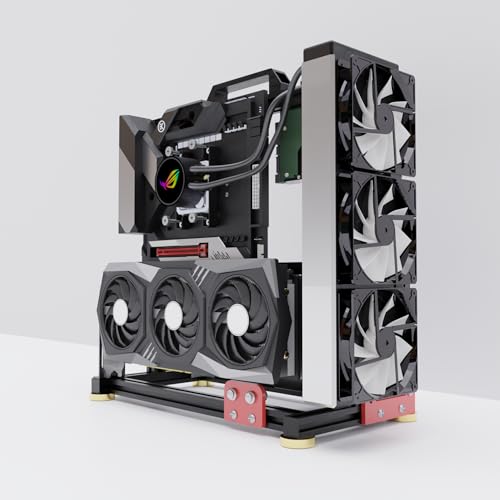
- EATX-focused open chassis with ATX/MATX/ITX support.
- Works with ATX, SFX, and 1U power supplies.
- Open aluminum frame supports air and water cooling.
Best For: Large-format test builds needing wide motherboard compatibility
Compact Open Air ATX Test Bench
Compact open-frame bench for ATX, mATX, and ITX testing

- Supports ATX, Micro ATX, and ITX boards
- No listed GPU length limit
- 0.8mm SPCC build with one drive bay
Best For: Compact hardware testing with easy access to standard desktop parts
Stackable Techbench Server Rack Frame
Stackable open bench with EATX support and big cooling capacity

- Supports EATX, ATX, mATX, and ITX boards
- Stacks up to 10 units horizontally
- Up to 8x 120mm fans or multiple radiator sizes
Best For: Stackable workstation or server-style testing with broad cooling flexibility
Aluminum DIY Open Frame Chassis
Flexible aluminum open frame for custom cooling builds

- Supports EATX, ATX, M-ATX, and ITX boards
- Works with ATX or SFX power supplies
- Adjustable water-cooling placement for build flexibility
Best For: DIY custom builds with flexible cooling and open-frame access
Wide-Compatibility Open Frame
egowz MATX Open Aluminum Assembly Bench

- Fits EATX, ATX, M-ATX, and ITX boards
- Supports ATX and SFX power supplies
- Designed for up to two water-cooling installs
Best For: Water-cooling builders and testers who need broad motherboard compatibility
Large-Board Test Rig
egowz EATX Open Aluminum Assembly Frame

- Supports EATX, ATX, Micro ATX, and ITX boards
- Built with a stable vertical aluminum structure
- Fits air or water cooling with two install positions
Best For: Users building around EATX boards or needing extra bench space
Compact Open Bench – DIY Pc Test Bench
If you want open test bench cases for pc hardware that keep swaps simple, this steel rack is built for ATX, Micro ATX, and ITX boards in a very compact footprint. The open-air layout makes it easy to access components, while the wide body design is aimed at better heat dissipation during testing or light daily use.
Best For: Builders who want a small, straightforward open bench for ATX, mATX, or ITX testing.
Pros:
- Supports ATX, Micro ATX, and ITX motherboards up to 305 x 245 mm.
- Open chassis design with wide body airflow for easier cooling access.
- Uses 0.8mm SPCC steel with a black sand-grain painted finish.
- Fits a standard ATX power supply and includes room for storage drives.
Cons:
- Listed support is for standard ATX PSU sizing, so fit is not as flexible as larger modular benches.
- The compact frame is less expandable than larger workstation-style open cases.
This is a practical pick if you want a simple, sturdy test bench for routine hardware changes and motherboard swaps. Its main strengths are broad board compatibility, open access, and a straightforward steel construction.
Flexible Full-Size Bench – DIY Aluminium Pc Open Case
Among open test bench cases for pc hardware, this aluminum chassis stands out for flexibility: it supports EATX, ATX, MATX, and ITX boards, plus ATX, SFX, and 1U power supplies. The open design is meant for DIY installs, and it also supports both air and water cooling, making it a strong option for builders who want a test bench that can adapt to different setups.
Best For: DIY builders and testers who want broad motherboard and power supply compatibility.
Pros:
- Supports EATX, ATX, MATX, and ITX motherboards.
- Compatible with ATX, SFX, and 1U power supplies.
- Handles both water and air cooling configurations.
- Unlimited graphics card length support adds flexibility for larger builds.
Cons:
- It is a full-size desktop-style open case, so it will take up more space than compact benches.
- Only two fans are listed in the supplied details.
If you need one bench for many different board sizes and cooling setups, this is the most adaptable option in the group. The aluminum build and open layout make it especially useful for frequent rebuilding and high-compatibility testing.
Budget Open Stand – Open Computer Case
This open-air stand is a practical choice if you are looking for open test bench cases for pc hardware and mainly work with M-ATX or ITX builds. It uses a 1mm steel sheet construction, supports front and rear ATX power supply installation, and can stand upright or lie flat for different benching setups.
Best For: M-ATX and ITX users who want a simple, portable open bench.
Pros:
- Open portable rack designed for M-ATX and ITX motherboards.
- Can stand or lie down, giving you setup flexibility on a workbench.
- Supports up to 256mm graphics cards and 360mm water cooling.
- Built from 1mm thick sheet steel with a standard stainless steel handle.
Cons:
- The notes warn that if your motherboard is ATX, some screw holes may not align.
- Board support is primarily positioned around M-ATX/ITX rather than full ATX use.
This is a good pick for testers who prioritize portability and quick access over maximum board size. Just be sure your build matches the stated M-ATX/ITX orientation before buying.
Large E-ATX Bench – DIY Aluminium Pc Open Case
If you need open test bench cases for pc hardware that can handle bigger layouts, this aluminum chassis is built around EATX support while also listing compatibility with ATX, MATX, and ITX boards. The open desktop format is meant for easy DIY installation, and the case is also specified for both air and water cooling setups.
Best For: Larger motherboard builds that need an open bench with broad compatibility.
Pros:
- Supports EATX, ATX, MATX, and ITX motherboards.
- Compatible with ATX, SFX, and 1U power supplies.
- Open aluminum design supports both air and water cooling.
- Unlimited graphics card support is useful for large or high-end builds.
Cons:
- The listed expansion slot count is only 2 in the supplied details.
- Only one internal bay is listed, so storage expansion appears limited.
This model is best when motherboard size and hardware flexibility matter more than storage expansion. For large-format test setups, it offers the kind of broad support that makes repeated hardware changes easier.
Compact Open Air ATX Test Bench – Compact open-frame bench for ATX, mATX, and ITX testing
If you want open test bench cases for pc hardware that keep things simple, this ATX open frame model is built for straightforward component access and quick swaps. It supports ATX, Micro ATX, and ITX boards, gives you room for standard ATX power supplies, and keeps the graphics card length unrestricted, which is useful for frequent hardware changes and testing.
Best For: Builders who want a compact open-frame bench for ATX, mATX, or ITX testing with easy GPU access.
Pros:
- Supports ATX, Micro ATX, and ITX motherboards up to 305 x 245 mm
- No listed limit on graphics card length, which helps with larger GPUs
- Fits a standard ATX PSU and one HDD/SSD
- Made from 0.8mm SPCC with a black sandblasted finish
Cons:
- Only one drive bay is included
- Open design offers less enclosure protection than a closed case
- Best suited to air-cooled testing rather than feature-heavy storage builds
This is a practical pick if you need a simple, durable bench for hardware testing and don’t need a large storage layout. Its compact size and wide motherboard support make it a good fit for frequent swap-outs and benchmark work.
Stackable Techbench Server Rack Frame – Stackable open bench with EATX support and big cooling capacity
Among open test bench cases for pc hardware, this stackable frame is aimed at heavier-duty test setups and small rack-style builds. It supports EATX, ATX, Micro ATX, and ITX boards, handles up to eight 120mm fans or multiple radiator sizes, and can be placed horizontally or vertically for flexible workstation layouts.
Best For: Builders who need a stackable test bench with broad motherboard support and strong cooling options.
Pros:
- Supports EATX, ATX, Micro ATX, and ITX motherboards up to 330 x 330 mm
- Stackable up to 10 units horizontally for rack-style setups
- Strong cooling support with up to 8x 120mm fans or multiple radiator options
- Includes PSU, spacer wrench, and screws for setup
Cons:
- Larger footprint than a compact test bench
- GPU clearance depends on whether internal or external fan mounting is used
- Designed more for workstations and server racks than portable use
This is the most flexible option in the group if you care about cooling, expandability, and stackable installation. It’s a strong fit for repetitive testing, multi-rig setups, or a bench that also has to function in a server-like environment.
Aluminum DIY Open Frame Chassis – Flexible aluminum open frame for custom cooling builds
If you’re comparing open test bench cases for pc hardware and want an aluminum frame with flexible layout options, this DIY chassis is built for that kind of hands-on build. It supports EATX, ATX, M-ATX, and ITX motherboards, works with ATX or SFX power supplies, and is designed to accommodate water-cooling setups and independent graphics card installation with optional accessories.
Best For: DIY builders who want an open aluminum frame with flexible cooling and motherboard support.
Pros:
- Supports EATX, ATX, M-ATX, and ITX motherboard formats
- Aluminum alloy construction with a stable vertical structure
- Supports water cooling and can mount up to two cooling devices
- Adjustable water-cooling placement helps accommodate longer graphics cards
Cons:
- ITX and M-ATX are not suitable for air-cooled CPU setups per the notes
- Vertical GPU installation requires additional extension cables
- Independent graphics card mounting needs optional accessories
This frame makes the most sense for builders who want to customize layout and cooling rather than rely on a fixed bench design. Its open aluminum structure and repositionable cooling mounts give it a lot of flexibility for experimental or water-cooled systems.
Flexible Aluminum Test Bench – RGEEK Aluminum Open Frame PC Test Bench
If you want open test bench cases for pc hardware that make building, swapping parts, and tuning airflow easier, this RGEEK aluminum frame is built for exactly that kind of hands-on setup. It supports ATX, micro ATX, and ITX boards, plus ATX, SFX, and SFX-L power supplies, with room for horizontal or vertical GPU mounting depending on how you want to configure the rest of the build.
Best For: DIY builders who want a flexible open-frame case with strong cooling support and a compact desktop footprint.
Pros:
- Aluminum open-frame construction for a sturdy DIY test bench layout
- Supports ATX, mATX, and ITX motherboards, plus multiple PSU formats
- Flexible cooling support for 120mm, 180mm, 240mm, and 280mm radiators
- Horizontal GPU installs can pair with two radiators at once
Cons:
- Vertical GPU mounting needs an extra riser cable that is not included
- No hard size limit on GPUs, but very long cards may require moving the radiator placement
- Open design offers less physical protection than a closed case
This is a strong pick if your priority is easy access and cooling flexibility rather than enclosure coverage. The compact footprint and adjustable mounting points make it especially appealing for custom builds and frequent hardware changes.
Wide-Compatibility Open Frame – egowz MATX Open Aluminum Assembly Bench
Among open test bench cases for pc hardware, this egowz frame stands out for compatibility and a stable vertical aluminum design. It supports EATX, ATX, M-ATX, and ITX motherboards, along with ATX or SFX power supplies, and it is set up for water-cooling builds with room for two cooling installations.
Best For: Builders who want a versatile open frame for motherboard testing, water cooling, and frequent component changes.
Pros:
- Supports EATX, ATX, M-ATX, and ITX motherboards
- Open aluminum frame is built for strong airflow and easy access
- Can support up to two water-cooling installations
- Horizontally mounted GPUs can work alongside dual cooling setups
Cons:
- Vertical GPU mounting requires additional extension cables
- Air-cooled CPU builds are not ideal with ITX and MATX frames because the cooler can block the graphics card
- Some graphics card support depends on optional accessories
This bench is best when you need broad motherboard support and expect to revisit your layout often. It is less suited to simple air-cooled small-form-factor setups, but it gives water-cooled DIY users a lot of room to experiment.
Large-Board Test Rig – egowz EATX Open Aluminum Assembly Frame
If your priority is a larger platform for open test bench cases for pc hardware, this EATX version of the egowz frame gives you the room to work with bigger boards and multiple components. It supports EATX, ATX, Micro ATX, and ITX motherboards, uses a stable vertical aluminum structure, and is designed to handle air or water cooling with space for two cooling setups.
Best For: Builders using larger motherboards who want a roomy open-frame test bench with flexible cooling options.
Pros:
- Supports EATX, ATX, Micro ATX, and ITX motherboards
- Open aluminum design promotes easy access and heat dissipation
- Supports both air and water cooling, with room for two installations
- Includes multiple USB ports and two internal bays
Cons:
- Vertical GPU use still requires additional extension cables
- Air-cooled ITX and MATX configurations may leave less room around the graphics card
- The open frame offers less protection than an enclosed tower case
This is the more spacious option in the lineup, especially if you are building around an EATX board or need extra flexibility for storage and cooling. It is a practical choice for test rigs, but the open design is still better suited to bench use than everyday transport.
How We Picked These Open Test Bench Cases for PC Hardware
We prioritized compatibility, frame rigidity, cooling support, and how practical each design is for real-world testing and assembly. The best Open Test Bench Cases for PC Hardware make it easy to mount parts, route cables, and swap components without fighting the chassis.
We also looked for clear support for ATX, Micro-ATX, Mini-ITX, and, where relevant, E-ATX layouts, plus room for SSDs, radiators, and taller hardware. Because these benches are often used repeatedly, build quality and stability matter as much as raw flexibility.
Quick Comparison
Choose a compact bench if you want a lighter footprint for bench testing and basic diagnostics. Step up to a larger open frame if you run bigger boards, custom cooling, or frequent component changes. If you work with multiple systems, a more spacious rack-style design can save time by reducing rebuilds between tests.
Key Buying Factors for Open Test Bench Cases for PC Hardware
Motherboard and Component Compatibility
Check supported form factors first. An open bench is only useful if it can safely fit your board, PSU, GPU length, storage drives, and cooler clearance. For mixed-use setups, wider support is usually the safest choice.
Cooling and Radiator Support
Open frames naturally help airflow, but not all are equally friendly to liquid cooling. If you plan on using a 240 mm radiator or larger cooling setup, verify mounting options before buying.
Material and Stability
Aluminum frames are popular because they’re light, durable, and easy to move. Steel or reinforced designs can offer extra stability for heavier hardware, which is worth considering if you swap parts often.
Ease of Assembly
Since Open Test Bench Cases for PC Hardware are designed for frequent access, look for a layout with simple mounting points, sensible spacing, and enough room around headers and power connectors. Faster access means less frustration during testing.
Who Should Buy Which Open Test Bench Cases for PC Hardware?
Choose a compact open test bench if you are a hobbyist, reviewer, or repair user who values speed and portability. Pick a full-size frame if you build high-end systems, use E-ATX boards, or want more room for cooling and expansion.
If your workflow includes repeated component swaps, troubleshooting, or performance validation, an open bench is a smart investment. If you want a clean, display-ready build, an open frame can also work well as a visible showcase for your hardware.