The best overhead camera rigs for remote work make it easier to share documents, demonstrate products, record hands-on tutorials, or create a more flexible video-call setup without constantly repositioning your camera.
We selected options ranging from compact clamp-on arms to tall, heavy-duty rigs, emphasizing stability, adjustability, compatibility, and practical desk use. The right choice depends on your camera weight, available workspace, and how often you need to switch between overhead and eye-level angles.
Best 10 Overhead Camera Rigs for Remote Work Picks for 2026
Best Heavy-Duty Desk Rig
NEEWER NK002 Overhead Camera Mount

- Supports up to 26.5lb/12kg
- Adjustable height and width
- Dual 360° ball heads
Best For: Sturdy remote-work desks needing flexible camera and accessory mounting
Best Full-Height Option
SmallRig CT200 Horizontal Overhead Tripod

- Reaches 72.8 inches high
- 180° tilt and 360° rotation
- Converts to a monopod
Best For: Portable overhead video calls, demonstrations, and camera work
Best Tabletop Platform
NEEWER ST100 Overhead Camera Rig

- Steel frame supports 10lb/4.5kg
- 14-position height adjustment per column
- 12 crossbar mounting points
Best For: Large desks used for stable top-down meetings and demonstrations
Best Compact Desk Arm
SmallRig DTCK001 Overhead Camera Mount

- Adjustable pole and extension arm
- Supports two devices up to 2kg
- 360° arm adjustment
Best For: Compact home offices using lightweight cameras, phones, lights, or microphones
Heavy-Duty Desk Studio

- 26.5-pound maximum load
- Telescoping height and width adjustment
- Phone holder and protective C-clamp included
Best For: Remote studios needing high capacity and expansive positioning
Compact Articulating Choice
DImotliyor 3-Section Desk Mount
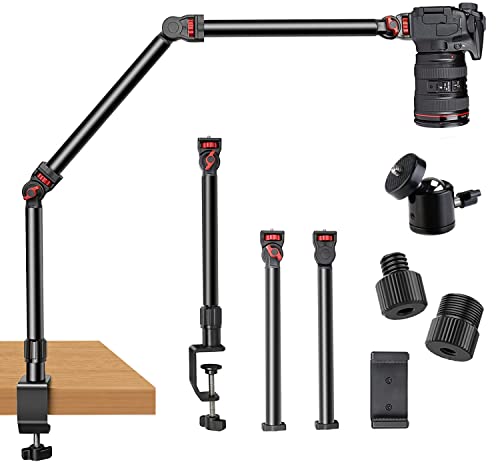
- Three detachable adjustable sections
- 360-degree base and ball head
- Up to 6-pound maximum load
Best For: Compact desks and lighter remote-work equipment
Secure Gear-Joint Support

- Locking three-joint articulated arm
- Supports up to 8.8 pounds vertically
- Detachable ball head and accessory threads
Best For: Stable remote presentations using heavier gear
Best Flexible Desk Mount
SMALLRIG 22-Inch Magic Arm Clamp

- 22-inch articulated arm for flexible positioning
- Clamp fits desks and round tubes
- Supports devices up to 600g/21oz
Best For: Remote workers needing a versatile mount for phones, webcams, and lights
Best Ring-Light Bundle
Pozliv Overhead Camera Mount with Ring Light
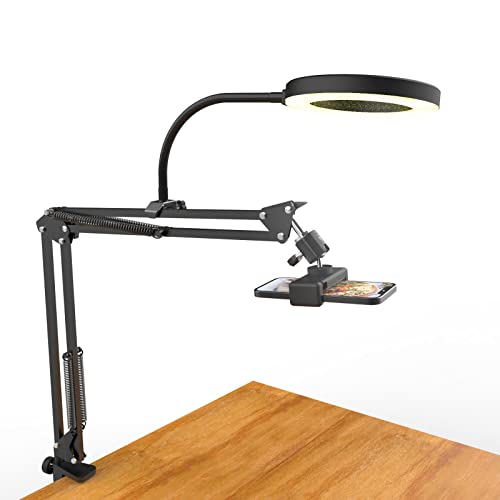
- Six-inch USB ring light with adjustable brightness
- Flexible arms support overhead and side angles
- Includes phone, webcam, and lightweight-device mounting options
Best For: Video calls and beginner creators who want integrated lighting
Best Heavy-Duty Option
UBeesize 360-Degree Overhead Camera Mount

- Supports up to 5.5 pounds of gear
- 15- to 35-inch adjustable height range
- Tool-free clamp fits tables up to 2.6 inches thick
Best For: Remote workers needing a sturdier mount for cameras and accessories
Best Heavy-Duty Desk Rig – NEEWER NK002 Overhead Camera Mount
If you need overhead camera rigs for remote work that can also handle lighting and accessories, the NEEWER NK002 is a versatile desktop option. Its clamp-based design saves space, while adjustable height, width, and dual ball heads make it practical for video calls, product demos, and top-down content.
Best For: Remote workers who want a sturdy, space-saving rig for cameras, phones, webcams, microphones, or lights.
Pros:
- Supports up to 26.5lb/12kg with a heavy-duty desktop C clamp.
- Adjusts from 27.2–48 inches high and 25.2–47.2 inches wide.
- Dual 360° ball heads provide flexible overhead viewing angles.
- Includes a phone holder and supports multiple 1/4-inch accessories.
Cons:
- Crossarms and several expansion accessories are sold separately.
- The dual ball head mount is limited to 3.3lb/1.5kg.
The NK002 is a strong choice when stability and expansion matter more than a minimal footprint. Its broad adjustment range suits varied desk setups, but users should account for the lower load rating of the included ball-head mount.
Best Full-Height Option – SmallRig CT200 Horizontal Overhead Tripod
The SmallRig CT200 stands out among overhead camera rigs for remote work when you need full-height positioning rather than a desk-only mount. Its horizontal center column supports overhead views, while the tripod can convert to a monopod for added flexibility around a home office or studio.
Best For: Remote workers and creators who need a portable, full-height rig for cameras, smartphones, and overhead demonstrations.
Pros:
- Horizontal center column tilts 180° and rotates 360°.
- Offers a working height range from 10.2 to 72.8 inches.
- Supports up to 33lb/15kg, with a 22lb/10kg tripod-head rating.
- Includes a counterweight bag, carrying bag, and smartphone holder.
Cons:
- Its 4.4lb/2kg weight and full tripod footprint may be more than a small desk requires.
- Maximum tripod height is listed as 72.8 inches, so it may not suit every seated setup without adjustment.
Choose the CT200 if portability, height, and shooting-angle range are priorities. The counterweight bag and adaptable feet add stability, while the monopod conversion makes it more versatile than a dedicated desktop arm.
Best Tabletop Platform – NEEWER ST100 Overhead Camera Rig
For remote workers who want overhead camera rigs for remote work with a stable tabletop platform, the NEEWER ST100 provides a structured alternative to a single arm. Its steel frame, spring-loaded height adjustment, and multiple mounting points support top-down calls, tutorials, drawing, cooking, and product presentations.
Best For: Large desks at least 39.4 inches wide that need a stable platform for top-down cameras and add-on accessories.
Pros:
- Steel construction supports up to 10lb/4.5kg.
- Height adjusts from 24 to 39 inches using spring-loaded columns.
- Crossbar includes 12 mounting points for accessories.
- T base and nonslip rubberized feet improve stability and help protect surfaces.
Cons:
- Requires a flat desk at least 39.4 inches/1 meter wide for tabletop use.
- Phone clamp, super clamps, backdrop, and other expansion accessories are not all included.
- Its 5.7kg weight makes it less convenient to move frequently.
The ST100 makes sense when you value a broad, stable overhead workspace over compact storage. It is especially useful for repeatable top-down setups, though its desk-size requirement and heavier frame limit portability.
Best Compact Desk Arm – SmallRig DTCK001 Overhead Camera Mount
The SmallRig DTCK001 is a compact choice among overhead camera rigs for remote work, combining a desk clamp, adjustable main pole, and extension arm. Its one-touch locking knob and movable arm make it easy to reposition a camera, phone, light, or microphone during video conferences and tabletop shooting.
Best For: Home-office users who want a flexible single-desk mount for one or two lightweight devices.
Pros:
- Main pole adjusts from 30 to 73cm, while the secondary arm extends from 30 to 50cm.
- Secondary arm offers 360° angle adjustment.
- Supports up to 2kg and can hold two devices simultaneously.
- Provides 1/4-20 and 3/8-16 mounting points plus a detachable ball head.
Cons:
- Base fits surfaces only 1–6cm/0.4–2.3 inches thick.
- Its 2kg capacity is lower than the heavier-duty rigs in this roundup.
- It is intended for indoor desktop use and is not water resistant.
The DTCK001 is a practical fit for compact workstations where quick repositioning matters. It offers useful compatibility and two-device support, but its 2kg limit makes it better suited to lightweight remote-work gear than larger camera combinations.
Heavy-Duty Desk Studio – EMART Adjustable Overhead Rig
For remote work setups that need more than a basic webcam angle, the EMART mount is a versatile choice among overhead camera rigs for remote work. Its telescoping frame offers broad height and width adjustment, while the heavy-duty construction supports cameras, webcams, phones, and additional studio accessories.
Best For: Remote educators, streamers, podcasters, and creators who need a stable top-down camera setup with room for extra gear.
Pros:
- Adjusts from 27.2 to 48 inches in height and 25.2 to 47.2 inches in width.
- Supports up to 26.5 pounds for cameras, lights, and other equipment.
- Includes a phone holder, dual 1/4-inch screws, and a 5/8-inch stud.
- C-clamp fits desks up to 3.5 inches thick and includes protective rubber pads.
Cons:
- The expanded frame takes up more space than a compact single-arm mount.
- Additional magic arms and tablet holders are sold separately.
- The listed folded length is 36 inches, so storage space is worth planning for.
The EMART stands out when stability, load capacity, and flexible positioning matter most. It is especially practical for a permanent or semi-permanent remote studio, though smaller desks may benefit from a more compact design.
Compact Articulating Choice – DImotliyor 3-Section Desk Mount
The DImotliyor mount is a flexible option for shoppers comparing overhead camera rigs for remote work. Its three detachable sections and rotating joints make it easier to position a webcam, phone, microphone, light, or lightweight camera without taking up much desk space.
Best For: Remote presenters, online instructors, and content creators who want a travel-friendly articulated mount for lighter equipment.
Pros:
- Three adjustable sections provide 180-degree rod movement and a 360-degree rotating base.
- Includes 1/4-inch, 3/8-inch, and 5/8-inch screw options plus a 360-degree ball head.
- Supports up to 4.5 pounds horizontally and a maximum of 6 pounds.
- Padded C-clamp helps protect the desk from scratches.
Cons:
- Its load rating is substantially lower than heavy-duty overhead rigs.
- The clamp extends up to 2.4 inches, which may not suit thicker desks.
- Flexible multi-joint positioning may require careful tightening for heavier devices.
This mount offers a good balance of portability and adjustability for compact workstations. It is best suited to phones, webcams, microphones, lights, and lighter cameras rather than a large camera-and-accessory setup.
Secure Gear-Joint Support – TARION TKA01-L Overhead Mount
The TARION TKA01-L is built for users who prioritize firm positioning when choosing overhead camera rigs for remote work. Its three locking gear joints, steel tubes, and dual-slot clamp are designed to keep cameras, lights, and projectors steady during extended presentations, demonstrations, and livestreams.
Best For: Remote educators, livestreamers, and solo creators using heavier cameras, zoom lenses, ring lights, or projectors.
Pros:
- Three toothed gear joints offer 180-degree tilt and 360-degree rotation with locking support.
- Supports up to 8.8 pounds vertically and 6.6 pounds horizontally.
- Steel tubes and a dual-slot clamp are designed for stable positioning.
- Detachable ball head and extra 1/4-inch and 3/8-inch threads expand mounting options.
Cons:
- The clamp opening is limited to 2.36 inches, restricting compatibility with some desks.
- Its mechanical design may be less convenient to reposition than a lighter articulating arm.
- The mount extends to 38 inches, which may be more than small workspaces need.
The TARION is a strong middle ground between compact desk mounts and larger studio frames. Its locking joints and steel construction make it a compelling choice when steady, repeatable overhead positioning is more important than minimal size.
Best Flexible Desk Mount – SMALLRIG 22-Inch Magic Arm Clamp
For remote workers comparing overhead camera rigs for remote work, the SMALLRIG 22-inch Magic Arm offers a compact, highly adjustable setup for a phone, webcam, light, or lightweight camera. Its clamp attaches to desks or round tubes, while the articulated arm helps position your device for overhead demonstrations, video calls, and content creation.
Best For: Remote workers and creators who want a flexible desk-mounted arm for phones, webcams, lights, or other devices weighing within its stated limit.
Pros:
- Long 22-inch arm with independently adjustable double-ball joints.
- Anti-deflection interface, silicone pads, and rubber rings support a secure, scratch-resistant grip.
- Clamp opens to 63.5mm and works on desktops or round tubes.
- Includes a phone holder and 1/4-inch to 3/8-inch adapter for broader compatibility.
Cons:
- Recommended load capacity is limited to 600g/21oz, so it is not intended for heavy camera setups.
- Heavier phones may require shortening the arm to reduce ball-head slippage.
This is a practical choice when adjustability and a relatively long reach matter more than supporting larger cameras. Keep the arm compact and stay within the stated load guidance for the most stable setup.
Best Ring-Light Bundle – Pozliv Overhead Camera Mount with Ring Light
The Pozliv combines an overhead arm, phone holder, tripod-style mounting, and a USB-powered ring light in one setup. Among overhead camera rigs for remote work, it suits users who want adjustable framing and built-in lighting for video meetings, tutorials, cooking demonstrations, or live streams.
Best For: Remote workers and beginner creators who need a lightweight phone or webcam mount with adjustable front lighting.
Pros:
- Six-inch ring light offers three lighting modes and ten brightness levels per mode.
- Flexible arm, ball head, and clamp support overhead and side-angle positioning.
- USB power works with a power bank, wall charger, or laptop.
- Includes an extra flexible clip arm for combining a phone, webcam, light, or lightweight camera.
Cons:
- Maximum stated load is 3 pounds, and the product is not intended for heavy-duty cameras or devices.
- The desk clamp fits surfaces up to 5.2cm, or about 2 inches, thick.
This bundle is appealing if lighting is just as important as camera positioning. Its multiple arms add versatility, while the lightweight load guidance makes it better suited to phones, webcams, compact cameras, and action cameras than larger equipment.
Best Heavy-Duty Option – UBeesize 360-Degree Overhead Camera Mount
For shoppers seeking overhead camera rigs for remote work that can support more substantial equipment, the UBeesize mount pairs an aluminum articulating arm with a 360-degree ball head and tabletop clamp. Its adjustable 15- to 35-inch height range makes it suitable for overhead shots, side angles, product work, and Zoom meetings in compact home studios.
Best For: Remote workers and creators who need a sturdier tabletop mount for cameras, smartphones, webcams, or ring lights.
Pros:
- Stated 5.5-pound capacity supports a broad range of cameras and accessories.
- 360-degree ball head and boom arm allow quick overhead and side-angle adjustments.
- Height adjusts from 15 to 35 inches for different desk layouts.
- Rubber-padded C-clamp fits tables up to 2.6 inches thick without drilling.
Cons:
- At 0.95kg, it is heavier than a basic phone-only desktop stand.
- Its larger capacity may be more setup than needed for users who only mount a phone.
This is the strongest-looking option in the group based on its stated capacity and aluminum construction. It makes sense for users who want room to grow beyond a phone, provided their desk can accommodate the clamp and extended arm.
How We Picked the Best Overhead Camera Rigs for Remote Work
We compared these 10 rigs by looking at the factors that matter most in a home office or creator workspace: mounting style, load capacity, arm reach, height adjustment, joint design, camera compatibility, and ease of repositioning. We also considered whether each system is better suited to a phone, webcam, compact camera, or DSLR.
Clamp-based mounts are useful when desk space is limited, while tripod-style systems can offer better stability and more placement freedom. Detachable arms, ball heads, and 360-degree adjustment can make a major difference when switching between document sharing, product demonstrations, and video recording.
Quick Comparison
| Best For | Look For | Recommended Style |
|---|---|---|
| Phones and lightweight webcams | Simple adjustment and low weight | Compact clamp or flexible arm |
| Documents and demonstrations | Long reach and secure overhead positioning | Articulating desk mount |
| DSLRs and heavier cameras | High load capacity and rigid support | Heavy-duty rig or tripod |
| Frequent angle changes | Ball heads, geared joints, or multiple pivot points | Adjustable articulated system |
Key Buying Factors for Overhead Camera Rigs for Remote Work
Camera Compatibility and Load Capacity
Check the mounting thread and maximum supported weight before buying. A phone holder or webcam arm may not safely support a DSLR, lens, or external accessories. Leave some capacity below the stated maximum to reduce sag and improve stability.
Desk Clamps, Tripods, and Available Space
Desk clamps save floor space but require a sturdy, accessible edge. Measure your desk thickness and check whether the clamp will interfere with drawers, cable channels, or monitor stands. A tripod is usually easier to place but needs more floor or tabletop space.
Reach, Height, and Adjustment
Measure the distance from the mounting point to the area you want to film. Longer arms provide more coverage but can flex or vibrate more easily. Look for locking joints, counterbalanced sections, or rigid horizontal bars if you plan to use a heavier camera overhead.
Stability and Cable Management
Overhead positioning magnifies small movements, especially during typing or demonstrations. Choose a rigid mount for live calls and secure loose cables along the arm so they do not pull the camera out of position.
Who Should Buy Which Overhead Camera Rigs for Remote Work?
Choose a compact clamp or phone-focused arm if you mainly use a smartphone or webcam and need an affordable, space-saving setup. These are convenient for occasional overhead notes, crafts, or product shots.
Choose an articulated desk mount if you regularly demonstrate documents, equipment, or hands-on work. Multiple adjustment points make it easier to switch between overhead and angled views.
Choose a heavy-duty rig or tripod if you use a DSLR, larger lens, or accessories such as a microphone and light. The added rigidity is worthwhile for recording and live work where camera movement is distracting.
Before ordering, confirm your camera’s weight, desk dimensions, desired shooting area, and whether you need a phone holder, ring light, or second mounting point. Those checks will narrow the list quickly and help you build a safer, more reliable overhead workspace.