Overhead camera rigs make it easier to capture steady, repeatable top-down footage without asking someone to hold a camera. The right setup can simplify product photography, recipe videos, drawing demonstrations, livestreams, and desk-based tutorials.
This roundup includes compact desk clamps, articulating arms, adjustable poles, and heavier modular platforms. Use the guide below to match each design to your camera, workspace, shooting angle, and load requirements.
Best 10 Overhead Camera Rigs Picks for 2026
Heavy-Duty Desk Rig
NEEWER NK002 Overhead Camera Mount

- Supports up to 26.5 pounds
- Adjustable height and width
- Dual 360-degree ball heads
Best For: Heavy-duty desktop overhead shooting and multi-device setups
Modular Desk Arm
SMALLRIG DTCK001 Overhead Camera Stand

- Adjustable height and extension arm
- Supports up to 2 kg
- Can hold two devices
Best For: Compact indoor streaming and tabletop shooting
Large-Setup Rail Rig
Glide Gear OH 75 Overhead Mount

- Six-foot overhead pole
- 15-pound payload capacity
- Includes clamps, posts, and camera sled
Best For: Large top-down scenes and on-location production
Triangular Stability Mount
SMALLRIG 4304 Overhead Desk Clamp

- Triangular reinforced structure
- Supports up to 3 kg
- Fits desks up to 7 cm thick
Best For: Stable tabletop filming with phones, cameras, or webcams
Most Versatile
Glide Gear OH 150 Overhead Rig

- Adjusts from 4 to 12 feet
- Supports up to 20 pounds at 4 feet
- Mounts to tripods and stand systems
Best For: Large, customizable overhead camera setups
Best Tabletop Platform
NEEWER ST100 Overhead Camera Rig

- Steel frame supports up to 10 pounds
- Height adjusts from 24 to 39 inches
- Crossbar includes 12 mounting points
Best For: Stable flat-lay and tabletop content creation
Best Compact Desk Mount
CACENCAN Articulating Overhead Arm

- Adjusts from 15 to 25 inches
- Supports up to 5 pounds
- Clamps to desks without drilling
Best For: Small desks and temporary overhead recording setups
Best Expandable Rig
JUSMO LS15 Pro Camera Desk Mount

- Supports up to 22 pounds
- Segmented poles adjust length and height
- Expandable for multiple devices
Best For: Multi-device desktop studios and overhead production
Best Flexible Articulating Arm
3-Section Detachable Overhead Camera Mount
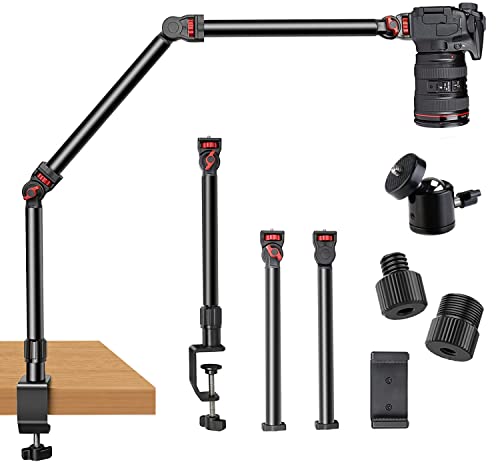
- Three adjustable detachable sections
- 360-degree base and ball head
- Supports up to 6 pounds
Best For: Flexible overhead shooting and lightweight creator setups
Best Telescoping Reach
Ailight Adjustable Overhead Camera Mount

- Vertical height adjusts to 33.45 inches
- Horizontal boom extends to 20 inches
- Includes padded C-clamp and ball heads
Best For: Adjustable streaming, webcam, and desk-light setups
Heavy-Duty Desk Rig – NEEWER NK002 Overhead Camera Mount
For creators who need sturdy overhead camera rigs in a limited workspace, the NEEWER NK002 combines two desktop C-clamp stands with an adjustable crossbar and dual ball-head mounting system. Its height and width adjustments make it practical for tabletop filming, unboxing, product photography, and live streaming.
Best For: Heavy-duty desktop overhead shooting with cameras, phones, webcams, lights, or microphones.
Pros:
- Supports up to 26.5 pounds with a secure, rubber-padded C-clamp design.
- Adjustable height from 27.2 to 48 inches and width from 25.2 to 47.2 inches.
- Dual ball heads provide flexible 360-degree positioning, with a phone holder included.
- Includes mounting options for cameras, phones, action cameras, and additional accessories.
Cons:
- Additional telescopic crossarms and other expansion accessories are sold separately.
- The maximum load for the included dual ball-head clamp is 3.3 pounds, lower than the stand’s overall capacity.
The NK002 is a strong choice when stability and expandability matter more than minimal size. Its broad adjustment range and heavy-duty support suit demanding desktop setups, while the included phone and camera mounting options make it versatile.
Modular Desk Arm – SMALLRIG DTCK001 Overhead Camera Stand
The SMALLRIG DTCK001 is one of the more compact overhead camera rigs for desk-based content creation. It offers tool-free height and angle adjustments, a detachable extension pole, and mounting points for cameras, phones, lights, and microphones.
Best For: Indoor streaming, video conferences, and tabletop shooting where quick adjustments and compact storage are important.
Pros:
- Main-pole height adjusts from 30 to 73 cm, while the secondary arm extends from 30 to 50 cm.
- 360-degree secondary-arm adjustment supports flexible overhead and angled views.
- Supports up to 2 kg and can accommodate two devices simultaneously.
- Offers 1/4-20 and 3/8-16 mounting options plus a detachable 360-degree ball head.
Cons:
- Its 2-kg load capacity is lower than heavier-duty desktop rigs.
- The base fits surfaces from 1 to 6 cm thick, limiting compatibility with thicker desks.
This SMALLRIG model emphasizes adjustability and convenient storage rather than maximum payload. It is a sensible fit for creators who regularly switch between cameras, phones, and accessories on a standard indoor desk.
Large-Setup Rail Rig – Glide Gear OH 75 Overhead Mount
The Glide Gear OH 75 takes a different approach to overhead camera rigs, using a six-foot aluminum pole supported by compatible C-stands. It is designed for top-down coverage of larger setups, including tables, drum sets, vehicles, food arrangements, and assembly projects.
Best For: Large overhead scenes and on-location production where a long camera rail is useful.
Pros:
- Six-foot pole provides broad overhead coverage for large subjects and setups.
- Supports up to 15 pounds while weighing 2.3 pounds.
- Includes two pole clamps, two baby pin posts, and a camera sled.
- Can accept rails or poles measuring 1 to 2 inches in diameter.
Cons:
- C-stands are required but not included.
- The long-pole design is less suited to small desktop workspaces.
- It is intended for camera mounting rather than a supplied multi-device desk setup.
The OH 75 is a strong option for expansive top-down shots, especially when you already own suitable C-stands. Its lightweight aluminum construction and customizable pole compatibility make it easier to adapt for larger or location-based productions.
Triangular Stability Mount – SMALLRIG 4304 Overhead Desk Clamp
The SMALLRIG 4304 uses a reinforced triangular structure to add stability to desktop overhead camera rigs. Its adjustable horizontal rod, auxiliary support arm, C-clamp, phone holder, and ball head make it suitable for product demos, food videos, beauty content, and other tabletop shooting.
Best For: Stable desk-mounted camera, phone, webcam, or light positioning on tables up to 7 cm thick.
Pros:
- Triangular support structure helps improve stability, with a load capacity of up to 3 kg.
- Horizontal rod adjusts from 42 to 68.5 cm for flexible framing.
- C-clamp fits desks up to 7 cm thick.
- Includes a 1/4-20 ball head and phone holder for multiple device types.
Cons:
- The 3-kg capacity is not intended for heavier camera-and-accessory combinations.
- It is designed for desktop use and may not suit large overhead scenes.
- Multiple locking knobs may require more setup adjustments than a simpler arm.
The 4304 stands out for its stability-focused triangular design. It is a practical choice for creators who want a relatively compact clamp mount with flexible angles and support for both phones and cameras.
Most Versatile – Glide Gear OH 150 Overhead Rig
If you need overhead camera rigs for larger setups, the Glide Gear OH 150 offers a modular platform that adjusts from 4 to 12 feet. It can mount to tripods, C-Stands, or Junior Stands and supports cameras, lights, microphones, and other accessories.
Best For: Photographers and videographers building adjustable overhead setups for product work, tutorials, or creative top-down perspectives.
Pros:
- Adjustable 4- to 12-foot length for flexible framing.
- Supports up to 20 pounds at a 4-foot setup, with capacity varying by length.
- Includes stand adapters, accessory spacers, a camera riser, and ball head.
- Modular click-in design simplifies setup, takedown, and storage.
Cons:
- Payload decreases to 10 pounds at the full 12-foot length.
- At 17.6 pounds and approximately 53 inches folded, it is less compact than desk mounts.
- Requires a compatible tripod, C-Stand, or Junior Stand.
The OH 150 is the strongest choice here for wide, customizable overhead coverage. Its changing load limits and substantial folded size are worth considering if portability or maximum reach is your priority.
Best Tabletop Platform – NEEWER ST100 Overhead Camera Rig
The NEEWER ST100 is one of the more structured overhead camera rigs for flat-lay work on a desk or floor. Its steel frame has adjustable side columns, a crossbar with 12 mounting points, and a load rating of up to 10 pounds.
Best For: Flat-lay photography, cooking demonstrations, drawing, crafts, unboxing videos, and tabletop lighting setups.
Pros:
- Height adjusts from 24 to 39 inches using spring-loaded positioning points.
- Steel construction supports up to 10 pounds.
- Crossbar provides 12 mounting points for accessories.
- T-base and nonslip rubberized feet improve stability and help protect surfaces.
Cons:
- Requires a desk at least 39.4 inches wide for tabletop placement.
- Super clamps, phone clamp, and backdrop are sold separately or not included.
- At 5.7 kg, it is heavier than a simple articulating desk arm.
The ST100 makes sense when you want a dedicated, stable platform rather than a single clamp-mounted arm. Its larger footprint is the trade-off for a steel frame, accessory expansion, and repeatable tabletop positioning.
Best Compact Desk Mount – CACENCAN Articulating Overhead Arm
For small workspaces, this CACENCAN mount is a compact option among overhead camera rigs. Its three-section articulating arm clamps to a desk, adjusts from 15 to 25 inches, and includes a phone holder, 1/4-inch screw, and 360-degree ball head.
Best For: Renters, home studios, and creators recording overhead product videos, cooking clips, video calls, or livestreams from a desk.
Pros:
- Compact articulating design fits small desks and home studios.
- Supports up to 5 pounds for phones, webcams, cameras, lights, or microphones.
- Rubber-padded C-clamp fits desks from 0.5 to 2.1 inches thick.
- No drilling is required, and the clamp is designed for quick setup.
Cons:
- Its 5-pound capacity is lower than the larger rig options.
- Height range is limited to 15 to 25 inches.
- Warranty coverage is listed as 180 days.
This mount is a practical choice when desk space and fast setup matter more than reach or heavy payload capacity. The C-clamp and articulating arm make it convenient for temporary recording stations.
Best Expandable Rig – JUSMO LS15 Pro Camera Desk Mount
For creators who need a versatile option among overhead camera rigs, the JUSMO LS15 Pro stands out with segmented aluminum poles, flexible height and length adjustment, and support for multiple devices. Its enlarged C-clamp fits desktops up to 3.54 inches wide, while the system can carry up to 22 pounds.
Best For: Desktop studios, recipe videos, crafts, painting demonstrations, stop-motion work, streaming, and multi-device setups.
Pros:
- High 22-pound maximum load capacity for cameras, lights, microphones, and other equipment.
- Segmented poles allow DIY adjustment of the rig’s length and height.
- Includes a super clamp and supports expansion with extra poles or compatible clamps.
- Anti-slip poles, locking screws, and engraved adjustment marks support stable positioning.
Cons:
- The larger, heavier 4 kg design may be less portable than simpler desk mounts.
- Additional poles and expansion clamps are purchased separately.
- The listed warranty is limited to three months.
The LS15 is the most expandable and load-capable choice in this group. It makes sense when you want a permanent or semi-permanent desktop rig that can grow with lights, microphones, and other accessories.
Best Flexible Articulating Arm – 3-Section Detachable Overhead Camera Mount
This 3-section desktop mount is a practical pick among overhead camera rigs for users who want broad angle adjustment without taking up much desk space. Its detachable aluminum sections, rotating base, 360-degree ball head, and adjustable joints make it suitable for cameras, phones, lights, and microphones.
Best For: YouTube videos, live streaming, online lessons, baking content, vlogging, and flexible overhead lighting.
Pros:
- Three detachable sections can be adjusted at multiple angles for flexible positioning.
- 360-degree rotating base and ball head help fine-tune the shooting angle.
- Includes phone holder and 1/4-inch, 3/8-inch, and 5/8-inch screw compatibility.
- Padded aluminum clamp helps protect the desk and fits surfaces up to 2.4 inches thick.
Cons:
- Horizontal load capacity is limited to 4.5 pounds, with a 6-pound maximum recommendation.
- Its lower capacity may not suit heavier DSLR and lighting combinations.
- The product listing provides limited warranty information.
This mount balances flexibility and portability well. Choose it when easy angle changes and a compact, detachable design matter more than carrying especially heavy equipment.
Best Telescoping Reach – Ailight Adjustable Overhead Camera Mount
The Ailight TS6101 offers adjustable reach for creators comparing overhead camera rigs with a more telescoping design. Its vertical stand adjusts from 15.75 to 33.45 inches, while the horizontal boom extends from 11.8 to 20 inches for positioning a camera, webcam, ring light, or other compatible accessory.
Best For: Video recording, live streaming, Zoom meetings, online teaching, interviews, makeup content, and adjustable desk lighting.
Pros:
- Three-section vertical pole adjusts from 15.75 to 33.45 inches.
- Two-section horizontal boom extends from 11.8 to 20 inches.
- Standard 1/4-inch screws and swiveling ball heads support cameras, phones, webcams, and LED lights.
- Rubber-padded C-clamp fits desks from 0.2 to 1.97 inches thick and helps prevent scratches.
Cons:
- The horizontal extension arm has a 2.2-pound load capacity.
- It may be less suitable for heavier camera-and-light combinations.
- The clamp accommodates a narrower desk-thickness range than some larger mounts.
The TS6101 is a strong fit when height and reach adjustability are priorities. Its relatively light 2.1-pound construction and one-year warranty also make it appealing for users who want a flexible, dedicated desk mount.
How We Picked These Overhead Camera Rigs
We selected these Overhead Camera Rigs to cover the main ways creators shoot from above: clamping directly to a desk, mounting a camera on an adjustable arm, or building a larger studio-style platform on a tripod or C-stand. We considered stated weight capacity, adjustment range, mounting compatibility, portability, and the practical needs of phone, webcam, mirrorless, and DSLR users.
Because desk shapes, camera weights, and accessories vary, treat manufacturer load ratings as limits rather than targets. A rig should remain stable with the camera, lens, adapter, quick-release plate, lights, and any other attached equipment.
Quick Comparison
| Rig type | Best for | Main advantage | Watch for |
|---|---|---|---|
| Desk clamp and articulating arm | Webcams, phones, and lightweight cameras | Compact and easy to reposition | Desk vibration and limited reach |
| Heavy-duty desk mount | DSLRs and larger lenses | More support and stability | Requires a strong, suitable desk |
| Adjustable pole rig | Recipe and product-video setups | Greater height and framing range | Needs adequate floor or stand space |
| Modular platform rig | Studio work and multiple accessories | High capacity and expansion potential | Less portable and more involved to set up |
Key Buying Factors for Overhead Camera Rigs
Camera and Accessory Capacity
Check the total supported weight, not just the camera body. A heavier DSLR lens or a side-mounted light can shift the center of gravity and increase strain on the arm or clamp.
Reach, Height, and Adjustment
Measure the distance from the mounting point to the center of your workspace. Articulating arms are convenient for small areas, while telescoping poles and modular platforms provide more height and coverage. Confirm that the rig can hold its position at the reach you need.
Mounting Compatibility
Look for the connection your equipment uses, such as a standard camera screw, ball head, phone holder, or webcam mount. Multiple adjustment points make it easier to keep the lens level and frame a clean, centered shot.
Desk Stability and Footprint
A C-clamp needs a solid, accessible edge and enough clearance to tighten securely. Avoid relying on a thin, flexible, or unusually shaped desk. For larger cameras or frequent movement, a tripod- or C-stand-mounted system may be safer.
Vibration and Workflow
Even a strong rig can transmit desk movement. Use a stable surface, tighten every joint, and avoid touching the desk during recording. Quick-release hardware can also make repeated setup and teardown faster.
Who Should Buy Which Overhead Camera Rigs?
Choose a compact clamp arm if you mainly use a phone, webcam, or lightweight camera and need an affordable setup for a desk. These models suit video calls, streaming, drawing, and occasional demonstrations.
Choose a reinforced desk mount if you use a DSLR or mirrorless camera and want a permanent top-down position near your workspace. Prioritize capacity, clamp strength, and reach over the smallest footprint.
Choose an adjustable pole rig if you record cooking, crafts, or product videos and need more height or a wider shooting area. These are useful when a short desk arm cannot clear the subject.
Choose a modular platform system if you run a dedicated studio, need to mount lights or other accessories, or want the most expansion room. It is the better fit for heavier equipment and repeatable professional setups, provided you have a suitable stand and enough space.