Professional overhead camera rigs make flat-lay photography, product demonstrations, tutorials, and livestreams easier to frame consistently. The right setup can also reduce desk clutter, camera shake, and repeated repositioning.
This roundup compares 10 options, from compact desk mounts to heavy-duty C-stand and modular systems. Consider your camera weight, available space, shooting angle, and need for portability before choosing.
Best 10 Professional Overhead Camera Rigs Picks for 2026
Versatile Height Champion
K&F CONCEPT 90-Inch Overhead Tripod

- 90-inch maximum height
- 22-pound load capacity
- Detachable monopod and 360° rotation
Best For: Portable overhead photography with extended reach
Studio Stability Pick
Kupo 40-Inch C-Stand Overhead Kit

- 40-inch C-stand with turtle base
- Steel baby boom included
- Supports overhead loads up to 22 pounds
Best For: Studio and location production workflows
High-Capacity Tripod
SmallRig CT200 Horizontal Overhead Rig

- 33-pound maximum tripod load
- 180° tilt and 360° rotation
- Counterweight bag and travel case included
Best For: Portable overhead work with heavier camera setups
Desktop Space Saver
NEEWER NK002 Overhead Camera Mount

- Desk clamp-based overhead design
- Adjustable 27.2–48-inch height
- Includes phone holder and dual ball heads
Best For: Tabletop content creation and livestreaming
Best Modular Rig

- 4- to 12-foot adjustable platform
- Up to 20-pound capacity at 4 feet
- Mounts to tripods, C-Stands, or Junior Stands
Best For: Flexible, higher-capacity overhead filming
Best Desk Clamp

- Clamps to surfaces up to 5.12 inches thick
- 34- to 53-inch adjustable reach
- Supports cameras and accessories up to 5 pounds
Best For: Tabletop studios and live streaming
Best Expandable Desk Rig

- Supports up to 10 kg or 22.05 pounds
- Segmented poles adjust length and height
- Expandable for cameras, lights, and microphones
Best For: Multi-device desktop studios and demonstrations
Flexible Desk Rig
3-Section Articulating Camera Mount
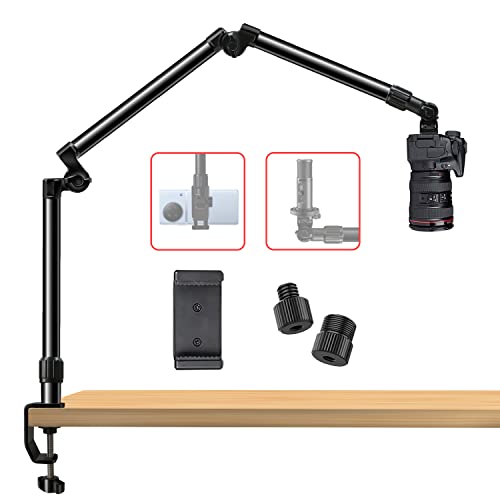
- 35.4-inch articulating arm folds to 13.8 inches
- 360-degree top and bottom rotation
- Supports cameras, phones, lights, and projectors
Best For: Flexible top-down shooting in compact workspaces
Gear-Locked Stability
TARION TKA01-L Overhead Camera Mount

- Three geared joints with 180-degree tilt and 360-degree rotation
- Supports 6.6 pounds in horizontal extension
- Detachable ball head and accessory mounting threads
Best For: Stable, repeatable angles for creator workflows
Heavy-Duty Studio Frame

- Height adjusts from 27.2 to 48 inches
- Width adjusts from 25.2 to 47.2 inches
- Supports up to 26.5 pounds with a 3.5-inch desk clamp
Best For: Wide, multi-device overhead studio setups
Versatile Height Champion – K&F CONCEPT 90-Inch Overhead Tripod
For photographers comparing professional overhead camera rigs, the K&F CONCEPT stands out with a 90-inch maximum height, a flexible horizontal setup, and a travel-friendly 4.5-pound aluminum build. Its gimbal-style head and adjustable legs make it useful for overhead compositions, panoramas, and changing shooting positions.
Best For: Photographers who want tall overhead reach with portable tripod flexibility.
Pros:
- Reaches up to 90 inches while folding to roughly 21 inches.
- Supports up to 22 pounds with its 28mm ball head.
- Offers 180-degree tilt, 360-degree rotation, and a detachable monopod.
Cons:
- It is not water resistant.
- Its aluminum tripod design may be less convenient for permanent studio installation than a dedicated C-stand rig.
The K&F CONCEPT is a strong all-purpose option when height, portability, and angle control matter more than a fixed studio footprint. The included bag and detachable monopod add useful flexibility for location work.
Studio Stability Pick – Kupo 40-Inch C-Stand Overhead Kit
The Kupo Overhead Shooting Kit 4 is a purpose-built choice among professional overhead camera rigs, pairing a 40-inch C-stand, turtle base, steel baby boom, mounting plate, and safety shot bag. It is designed for controlled studio and location workflows where secure load management is a priority.
Best For: Studio and production teams needing a dedicated, counterweighted overhead setup.
Pros:
- Includes a C-stand, turtle base, grip head, baby boom, mounting plate, and safety shot bag.
- Turtle base supports quick leg deployment and secure locking.
- Handles overhead camera loads up to 22 pounds with counterweight support.
Cons:
- At 38.7 pounds, it is substantially heavier than travel-oriented tripods.
- The listed folded length is 134 cm, so transport requires more planning.
This kit favors dependable production handling over portability. Its included boom and safety accessories make it a practical foundation for flat lays, overhead video, and studio setups that need repeatable positioning.
High-Capacity Tripod – SmallRig CT200 Horizontal Overhead Rig
The SmallRig CT200 offers a strong balance for buyers evaluating professional overhead camera rigs. Its lateral center column tilts 180 degrees and rotates 360 degrees, while the aluminum frame remains relatively light at about 4.4 pounds and supports up to 33 pounds overall.
Best For: Photographers who need high load capacity, broad angle adjustment, and travel-friendly operation.
Pros:
- Supports up to 33 pounds, with a 22-pound head load rating.
- Provides 180-degree tilt and 360-degree horizontal rotation.
- Includes a counterweight bag, carrying bag, smartphone holder, and reversible center column.
Cons:
- Its maximum tripod height is 72.8 inches, shorter than the 90-inch K&F model.
- The listed minimum height begins at 26 cm, which may limit some very-low setups.
With a 29mm leg diameter, angle-adjustment locks, accessory thread holes, and terrain-adaptable feet, the CT200 is a versatile choice for photographers who want a capable overhead platform without moving to a much heavier C-stand system.
Desktop Space Saver – NEEWER NK002 Overhead Camera Mount
For tabletop creators seeking professional overhead camera rigs without a full-size tripod footprint, the NEEWER NK002 uses two desktop stands, a crossbar, a super clamp, and dual ball heads. Height adjusts from 27.2 to 48 inches, while width adjusts from 25.2 to 47.2 inches for adaptable desk-based shooting.
Best For: Tabletop livestreaming, unboxing, still-life photography, and online meetings.
Pros:
- Clamps securely to desktops up to 2.6 inches wide with rubber pads.
- Offers adjustable height and width with marked tubes and twist locks.
- Includes a phone holder, dual ball-head clamp, mini ball head, and accessory mounting points.
Cons:
- The dual-ball-head camera mount is rated for only 3.3 pounds.
- Crossarms and additional accessories mentioned for expansion are sold separately.
The NK002 is best viewed as a compact desk-mounted system rather than a heavy camera stand. Its broad device compatibility and included phone hardware make it especially convenient for creators working in limited spaces.
Best Modular Rig – Glide Gear OH 150
For creators comparing professional overhead camera rigs, the Glide Gear OH 150 stands out as a modular platform with a 4- to 12-foot adjustable span. It can mount to a tripod, C-Stand, or Junior Stand and provides multiple mounting points for cameras, lights, and microphones.
Best For: Photographers and videographers who need adjustable reach and higher payload capacity for varied overhead setups.
Pros:
- Adjusts from 4 to 12 feet for flexible overhead framing.
- Supports up to 20 pounds at a 4-foot setup, with capacity varying by length.
- Includes stand adapters, accessory spacers, a camera riser, and ball head.
- Modular click-in design supports easier setup, takedown, and storage.
Cons:
- Its 17.6-pound weight and approximately 53-inch folded length may be substantial for transport.
- Maximum capacity decreases to 10 pounds at the full 12-foot extension.
The OH 150 is the most versatile option here for larger or more demanding overhead productions. Its reach and mounting flexibility are useful, but users should match the payload to the selected arm length and provide a suitable stand.
Best Desk Clamp – iBOLT Stream-Cast DSLR Mount
The iBOLT Stream-Cast is a practical choice among professional overhead camera rigs for tabletop studios, live streaming, and unboxing videos. Its C-clamp attaches to surfaces up to 5.12 inches thick, while the adjustable arm reaches from 34 to 53 inches overall.
Best For: Desk-based creators using a DSLR, smartphone, microphone, light, or mini projector weighing up to 5 pounds.
Pros:
- Heavy-duty clamp fits desks and other surfaces up to 5.12 inches thick.
- Adjustable length extends from 34 to 53 inches.
- Supports compatible equipment weighing up to 5 pounds.
- Includes a tablet holder compatible with 7- to 10-inch tablets.
Cons:
- The 5-pound capacity is lower than that of the larger modular rigs.
- Desk or tabletop installation limits placement compared with stand-mounted systems.
Choose the Stream-Cast when a compact, clamp-mounted workflow matters more than maximum payload. It offers useful reach and accessory compatibility for desktop production, provided your camera-and-lens combination stays within 5 pounds.
Best Expandable Desk Rig – JUSMO LS15 Pro Overhead Mount
The JUSMO LS15 Pro is one of the more expandable professional overhead camera rigs for desktop video, photography, streaming, and demonstrations. Its segmented aluminum-pole design supports adjustable height and length, while included clamps allow multiple devices to be added around the main setup.
Best For: Desktop creators who want to mount a camera alongside lights, microphones, phones, or other compatible equipment.
Pros:
- Rated for loads up to 10 kg, or 22.05 pounds.
- Segmented poles allow DIY adjustment of length and height.
- Includes a super clamp for expanding the setup with additional equipment.
- Large C-clamps fit desktops up to 90 mm, or 3.54 inches, wide.
Cons:
- Its 3-month warranty is shorter than the warranty noted for the iBOLT and Glide Gear options.
- Additional poles or clamps may be needed for more complex expansions.
- Desktop mounting restricts the rig to suitable table or desk surfaces.
The LS15 Pro is a strong fit for creators building a multi-device desktop studio. Its high stated capacity and expandable pole system offer plenty of flexibility, though the setup is best suited to users comfortable with DIY assembly and compatible accessories.
Flexible Desk Rig – 3-Section Articulating Camera Mount
For creators comparing professional overhead camera rigs, this DNSbabi stand offers a compact desk-mounted design with three articulating sections and 360-degree rotation at both the top and bottom. Its geared joints, padded clamp, and multiple mounting screws make it adaptable for cameras, phones, lights, and other equipment.
Best For: Top-down video, cooking demonstrations, livestreaming, online lessons, and vlogging where flexible positioning and foldable storage matter.
Pros:
- Three-section arm extends to 35.4 inches and folds to 13.8 inches for storage.
- 360-degree rotation at the top and bottom supports flexible shooting angles without requiring an additional rotating ball head.
- Gear-locked joints and a padded desk clamp provide a stable, surface-protective setup.
- Includes 1/4-inch, 3/8-inch, and 5/8-inch screws plus a spring-loaded phone holder.
Cons:
- The clamp accommodates desks up to 2.4 inches thick.
- The stated load capacity varies by position, with lower support for horizontal extension than the maximum listed capacity.
This is a versatile choice when you want an overhead rig that folds away and supports several device types. Its geared arm is especially useful for repeatable positioning, though setup weight and camera placement should be matched to the arm’s horizontal capacity.
Gear-Locked Stability – TARION TKA01-L Overhead Camera Mount
The TARION TKA01-L is a practical option among professional overhead camera rigs for users who prioritize locked positioning. Its three geared joints provide 180-degree tilt and 360-degree rotation, while the steel-tube construction and desk clamp are designed to keep cameras and other equipment steady during longer recording sessions.
Best For: Unboxing videos, cooking tutorials, document scans, stop-motion, macro photography, livestreaming, and remote teaching.
Pros:
- Three locking gear joints help maintain selected angles and resist unwanted drops.
- Steel tubes support up to 8.8 pounds vertically and 6.6 pounds in horizontal extension.
- Detachable ball head offers 1/4-inch and 3/8-inch mounting options.
- Dual-slot clamp opens to 2.36 inches and includes extra threads for microphones, monitors, or lights.
Cons:
- Its horizontal load rating is 6.6 pounds, so heavier setups require careful positioning.
- The desk clamp is limited to workspaces compatible with its 2.36-inch opening.
Choose this model if repeatable, mechanically locked positioning is more important than maximum reach. The 38-inch extension and accessory threads suit more involved creator setups, while the detachable ball head keeps mounting options flexible.
Heavy-Duty Studio Frame – EMART Telescopic Overhead Rig
For larger workspaces and more elaborate professional overhead camera rigs, the EMART overhead mount uses a telescopic frame rather than a simple single arm. Height adjusts from 27.2 to 48 inches and width from 25.2 to 47.2 inches, giving creators room to position cameras, phones, lights, and other compatible accessories around a desk.
Best For: Flat-lay photography, cooking demonstrations, unboxing videos, studio photography, podcasts, teaching, and top-down streaming.
Pros:
- Adjustable height and width provide a broad positioning range for larger shooting areas.
- Aluminum alloy construction supports up to 26.5 pounds.
- Includes a phone holder, dual 1/4-inch screws, and a 5/8-inch stud.
- C-clamp fits desks up to 3.5 inches thick and uses rubber pads to help prevent slipping and scratches.
Cons:
- The expanded frame takes more space than a compact articulating arm.
- Additional magic arms and tablet holders are compatible but sold separately.
- Its larger structure may require disassembly for storage.
This is the strongest fit for creators who need a wide, adjustable frame and substantial load capacity. It is less minimal than a folding arm, but the telescoping dimensions and accessory compatibility make it better suited to multi-device or studio-style arrangements.
How We Picked These Professional Overhead Camera Rigs
We focused on the factors that matter most in real overhead shooting: load capacity, mounting stability, reach, adjustment range, compatibility, and setup flexibility. The selection includes desk-mounted arms for creators with limited space, horizontal tripods for larger work areas, and C-stand or modular systems for demanding photography and video setups.
We also considered whether each design supports common camera and accessory connections, including 1/4-inch, 3/8-inch, and 5/8-inch hardware, as well as ball heads, clamps, phone holders, and lighting accessories. Always verify the manufacturer’s stated capacity with your complete camera-and-lens combination installed.
Quick Comparison
| Rig type | Best suited to | Main advantage | Watch for |
|---|---|---|---|
| Desk mount | Streaming, tutorials, and small workspaces | Compact and quick to install | Desk thickness, clamp stability, and limited reach |
| Horizontal tripod | Flat lays and larger tabletop scenes | Broad overhead coverage | Floor space and transport size |
| C-stand or boom kit | Studio photography and video | Strong support and accessory flexibility | Heavier setup and more involved balancing |
| Modular platform | Adjustable studio configurations | Variable height, width, and mounting options | Higher cost and setup complexity |
Key Buying Factors for Professional Overhead Camera Rigs
Load Capacity and Balance
Choose a rig rated comfortably above the combined weight of your camera, lens, adapter, monitor, and accessories. A higher stated capacity does not eliminate the need to balance the arm or tighten every joint securely.
Reach and Working Area
Measure the desk or tabletop before buying. Horizontal bars and long arms can cover larger scenes, but they need enough clearance behind or beside the shooting surface. Check whether the advertised length is usable reach or total frame length.
Stability and Mounting Surface
Desk clamps are convenient, but they depend on a rigid, suitably thick desk. A tripod or C-stand may be safer for heavier cameras and frequent repositioning. Look for wide bases, locking joints, counterweights, or steel construction when stability is a priority.
Adjustment and Compatibility
Ball heads allow fast framing, while geared or articulated joints can provide more controlled positioning. Confirm thread sizes and included adapters, especially if you plan to mount lights, microphones, phones, or action cameras alongside a DSLR or mirrorless body.
Who Should Buy Which Professional Overhead Camera Rigs?
Choose a desk-mounted model if you create tutorials, overhead livestreams, crafting videos, or product demonstrations from one workstation. These rigs are generally the easiest to store and install.
A horizontal tripod is better for photographers who need a broad, centered flat-lay area without attaching hardware to a desk. Choose a C-stand or modular overhead system for heavier equipment, frequent studio use, or setups that must support lights and other accessories.
For occasional use or smaller cameras, prioritize compact adjustment and simple setup. For professional production, prioritize capacity, locking mechanisms, footprint, and long-term serviceability over the lowest purchase price.