Professional wide-angle camera lenses can transform cramped scenes into clean, expansive images with better perspective control and more creative flexibility.
Below, we focus on lenses that balance sharpness, autofocus performance, build quality, and real-world usefulness for photographers and videographers.
Best 10 Professional Wide-Angle Camera Lenses Picks for 2026
Budget Ultra-Wide Zoom
Canon EF-S 10-18mm f/4.5-5.6 IS STM

- 10-18mm ultra-wide zoom for APS-C Canon bodies
- Optical image stabilization for steadier hand-held shots
- STM autofocus is suited to quieter video work
Best For: Affordable ultra-wide coverage for Canon APS-C landscapes and video
Pro Full-Frame Ultra-Wide
Nikon AF-S NIKKOR 14-24mm f/2.8G ED

- Constant f/2.8 aperture across 14-24mm
- Advanced optical build with ED, aspherical elements, and Nano Crystal Coat
- Made for Nikon F (FX) full-frame DSLR cameras
Best For: Serious Nikon full-frame shooters needing a fast ultra-wide zoom
Compact Full-Frame Prime

- Ultra-wide fixed 16mm prime for EOS R cameras
- Bright f/2.8 aperture in a very compact body
- Quiet STM autofocus is useful for video
Best For: Travel and video shooters who want a small full-frame ultra-wide prime
Premium L-Series Ultra-Wide

- Extreme 11mm start with a 126-degree angle of view
- Constant f/4 aperture and L-series optics
- Ring USM and full-time manual focus
Best For: Canon EF photographers needing a premium ultra-wide zoom
Ultra-Wide Zoom Pick
Sigma 10-20mm f/3.5 EX DC HSM for Nikon

- 10-20mm ultra-wide zoom for APS-C Nikon DSLRs
- Constant f/3.5 aperture and 102.4-degree view
- HSM autofocus with multi-layer coating
Best For: Nikon shooters needing a bright, flexible ultra-wide zoom
Manual-Focus Ultra Wide
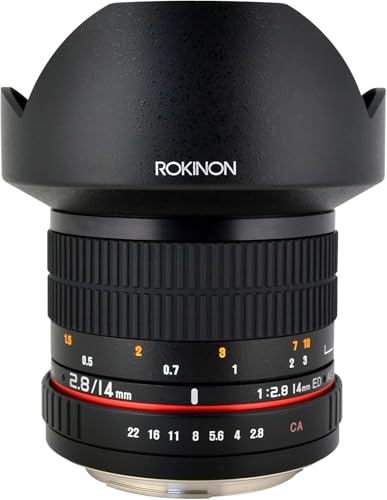
- 14mm ultra-wide prime with 115.7-degree view
- Fast f/2.8 aperture for low-light scenes
- Manual focus with distortion-reducing aspherical elements
Best For: Canon shooters wanting a fast, no-frills ultra-wide prime
Stabilized Wide Zoom

- 10-18mm wide zoom for Sony APS-C E-mount cameras
- Optical SteadyShot image stabilization
- Constant f/4 aperture and close focusing
Best For: Sony APS-C users who want a stabilized everyday wide zoom
Canon RF Ultra-Wide Zoom

- 10-20mm ultra-wide coverage for full-frame RF bodies
- Compact mirrorless-friendly design
- STM autofocus supports smooth, quiet video
Best For: Canon RF users needing a premium ultra-wide zoom for stills and video
Classic EF Ultra-Wide

- 17-40mm ultra-wide zoom for Canon EF DSLRs
- Constant f/4 aperture across the zoom range
- Lightweight 1.1-pound body with USM focusing
Best For: Canon EF DSLR owners wanting a proven ultra-wide zoom
Weather-Ready EF Ultra-Wide

- 17-40mm ultra-wide zoom for Canon EF SLRs
- Ring-type USM for fast, silent autofocus
- Weather-resistant build for outdoor use
Best For: Outdoor and event shooters using Canon EF SLR cameras
Budget Ultra-Wide Zoom – Canon EF-S 10-18mm f/4.5-5.6 IS STM
If you want professional wide-angle camera lenses without overspending, the Canon EF-S 10-18mm f/4.5-5.6 IS STM is a practical ultra-wide zoom for Canon EF-S shooters. Its 10-18mm range, optical image stabilization, and STM stepping motor make it especially useful for landscapes, interiors, and smoother video autofocus.
Best For: Canon APS-C users who need an affordable ultra-wide zoom for landscapes, interiors, and video.
Pros:
- Ultra-wide 10-18mm zoom gives a strong field of view for landscapes and tight indoor spaces.
- Optical image stabilization helps hand-held shooting stay steadier.
- STM stepping motor is designed for quieter autofocus during video recording.
- Compact zoom lens with a close focusing distance of 0.72 feet.
Cons:
- Maximum aperture narrows to f/4.5-5.6, so it is not a low-light powerhouse.
- Built for Canon EF-S/APS-C cameras, not full-frame bodies.
Overall, this is a smart entry-level ultra-wide option when you want useful perspective control, stabilization, and quiet autofocus in a lightweight package. It is less about speed and more about dependable wide-angle coverage for everyday shooting.
Pro Full-Frame Ultra-Wide – Nikon AF-S NIKKOR 14-24mm f/2.8G ED
For photographers shopping professional wide-angle camera lenses for Nikon full-frame DSLRs, the AF-S NIKKOR 14-24mm f/2.8G ED stands out as a fast ultra-wide zoom. Its constant f/2.8 aperture, 14-24mm range, and advanced optical construction are built for demanding landscape, architecture, and event work.
Best For: Nikon full-frame DSLR users who want a fast, high-end ultra-wide zoom for serious wide-angle shooting.
Pros:
- Constant f/2.8 aperture supports brighter framing and consistent exposure across the zoom range.
- 14-24mm range delivers an expansive 114°-84° angle of view.
- Complex optical design includes ED glass, aspherical lenses, and Nano Crystal Coat.
- Ultrasonic autofocus and inner focusing are suited to responsive operation.
Cons:
- Large and heavy at 970 g, so it is not the lightest travel option.
- Designed for Nikon F (FX) full-frame DSLR cameras, limiting compatibility.
This lens is aimed at users who prioritize image quality, speed, and a dramatic ultra-wide perspective over portability. If your work depends on a premium Nikon wide zoom, it is a serious tool rather than a casual one.
Compact Full-Frame Prime – Canon RF16mm F2.8 STM
If you prefer professional wide-angle camera lenses in a compact prime format, the Canon RF16mm F2.8 STM is an easy-to-carry ultra-wide option for EOS R series mirrorless cameras. It combines a fixed 16mm focal length with a bright f/2.8 aperture and a lightweight build, making it attractive for everyday wide-angle shooting and video.
Best For: EOS R mirrorless users who want a lightweight ultra-wide prime for travel, video, and general wide-angle use.
Pros:
- Fixed 16mm ultra-wide view is well suited to full-frame mirrorless shooting.
- Bright f/2.8 maximum aperture gives more flexibility than slower wide-angle options.
- Gear-type STM supports smooth, quiet continuous autofocus during video.
- Very lightweight and compact design makes it easy to carry.
Cons:
- Fixed focal length means no zoom flexibility.
- Minimum focusing distance of 5.11 inches may not replace a true close-up lens.
This is the kind of lens that rewards photographers who want a simple, small ultra-wide they can keep on the camera. It is not as versatile as a zoom, but its size and f/2.8 aperture make it a compelling everyday wide-angle choice.
Premium L-Series Ultra-Wide – Canon EF 11-24mm f/4L USM
The Canon EF 11-24mm f/4L USM is a premium choice for buyers comparing professional wide-angle camera lenses for Canon EF bodies. With an 11mm starting point, constant f/4 aperture, and advanced coatings and optics, it is built for photographers who want a very wide perspective with controlled performance.
Best For: Canon EF users who need an ultra-wide premium zoom for architecture, landscapes, and other demanding wide-angle work.
Pros:
- Starts at an extreme 11mm for a very broad 126-degree angle of view.
- Constant f/4 aperture provides consistent exposure throughout the zoom range.
- L-series construction includes Super UD and UD elements plus SWC and ASC coatings.
- Ring USM and full-time manual focus support responsive control.
Cons:
- At 1180 g, it is a substantial lens to carry.
- Designed for Canon EF cameras, so compatibility is limited to that mount.
This lens is best viewed as a specialized professional tool that prioritizes extreme width and optical refinement. If your work calls for dramatic wide framing and you can handle the size, it offers a very capable premium option.
Ultra-Wide Zoom Pick – Sigma 10-20mm f/3.5 EX DC HSM for Nikon
Sigma 10-20mm f/3.5 EX DC HSM ELD SLD Aspherical Super Wide Angle Lens for Nikon Digital SLR Cameras
Check Price On AmazonIf you want professional wide-angle camera lenses for Nikon DSLR shooting, this Sigma 10-20mm f/3.5 gives you a true ultra-wide view with a constant f/3.5 aperture. It is built for APS-C Nikon bodies and pairs a 10-20mm zoom range with multi-layer coating, strong peripheral brightness, and HSM autofocus for quiet, fast operation.
Best For: Nikon DSLR users who want a flexible ultra-wide zoom for landscapes, interiors, and travel work.
Pros:
- 10-20mm zoom range delivers a very wide 102.4-degree angle of view.
- Constant f/3.5 aperture keeps exposure consistent across the zoom range.
- Super multi-layer coating helps reduce flare and ghosting.
- HSM autofocus supports silent, high-speed operation.
Cons:
- Designed for Nikon DSLR cameras with an APS-C format lens design.
- Not water resistant.
This lens is a practical choice if you need an ultra-wide zoom that balances brightness, sharpness, and everyday usability. Its built-in motor support and included hood and case make it especially appealing for Nikon shooters building a dependable wide-angle kit.
Manual-Focus Ultra Wide – Rokinon 14mm F2.8 for Canon
Among professional wide-angle camera lenses for Canon EF users, this Rokinon 14mm f/2.8 stands out for its fixed ultra-wide perspective and fast aperture. The 14-element, 10-group optical design is aimed at sharp, detailed images across the frame, while the manual-focus setup gives you direct control for landscape, real estate, and astrophotography work.
Best For: Canon photographers who want a fast, manual ultra-wide lens for landscapes, real estate, and night scenes.
Pros:
- 14mm focal length provides a 115.7-degree angle of view.
- Fast f/2.8 aperture supports low-light shooting.
- 14 elements in 10 groups are designed for sharpness and clarity across the frame.
- Aspherical elements help minimize distortion and aberrations.
Cons:
- Manual focus only, so it is less convenient for fast-moving subjects.
- Fixed focal length offers no zoom flexibility.
- Large, heavy build may not suit all travel setups.
This is a strong option if you value optical reach and control over convenience. Its bright aperture, wide field of view, and durable build make it a focused tool for wide-angle work where composition and image quality matter most.
Stabilized Wide Zoom – Sony E 10-18mm F4 OSS
If you are comparing professional wide-angle camera lenses for Sony APS-C bodies, this E 10-18mm F4 OSS zoom is a versatile option with optical image stabilization built in. Its 10-18mm range covers a 109-degree to 76-degree angle of view, and the constant f/4 aperture plus 0.82-foot minimum focus distance make it useful for detailed wide scenes and closer compositions.
Best For: Sony E-mount APS-C photographers who want a stabilized wide-angle zoom for travel, interiors, and general-purpose shooting.
Pros:
- 10-18mm range provides a broad wide-angle zoom span.
- Optical SteadyShot helps stabilize handheld shots.
- Constant f/4 aperture keeps exposure consistent.
- Close 0.25 m minimum focus distance adds compositional flexibility.
Cons:
- APS-C lens with a 15-27mm full-frame equivalent field of view.
- Maximum aperture is f/4, which is slower than some wide-angle alternatives.
This lens is a balanced pick when you want wide coverage plus stabilization in one package. It is especially practical for shooters who need a reliable everyday wide zoom rather than an extreme ultra-wide or a fast prime.
Canon RF Ultra-Wide Zoom – RF 10-20mm f/4 L IS STM
For photographers and videographers looking for professional wide-angle camera lenses on Canon RF bodies, this RF 10-20mm option is built for extremely expansive perspectives in a compact mirrorless-friendly design. It delivers full-frame coverage from 10 to 20mm, combines advanced optical elements to help control ghosting, and adds STM focusing for smooth, quiet video work.
Best For: Full-frame Canon RF users who want an ultra-wide zoom for stills and video with quiet autofocus.
Pros:
- 10-20mm range gives very wide coverage for interiors, landscapes, and video framing.
- Compact and lightweight design is smaller than older DSLR ultra-wide lenses.
- Optical design includes super UD, UD, and aspherical elements plus SWC and ASC coatings.
- STM focus drive is well suited to smooth, quiet video autofocus.
Cons:
- Only works with Canon RF mount full-frame mirrorless cameras.
- Maximum aperture is f/4, so it is not a fast low-light zoom.
- Premium L-series design may be more lens than casual shooters need.
This is a strong pick if you need an ultra-wide zoom that stays portable without sacrificing Canon’s high-end optical and video-focused features. The 10-20mm range is the main attraction, especially for creators who want dramatic framing and dependable autofocus in a modern mirrorless package.
Classic EF Ultra-Wide – 17-40mm f/4L
If you’re comparing professional wide-angle camera lenses for a Canon EF DSLR setup, this 17-40mm f/4L remains a practical ultra-wide zoom with a proven range. It offers a constant f/4 aperture, inner focusing with USM, and a compact 1.1-pound build that makes it easy to carry for travel, landscapes, and general wide-angle shooting.
Best For: Canon EF DSLR shooters who want a reliable wide-angle zoom with a constant f/4 aperture.
Pros:
- 17-40mm range covers wide views through a short standard zoom reach.
- Constant f/4 aperture keeps exposure consistent across the zoom range.
- Inner focusing system with USM supports fast, quiet autofocus.
- Lightweight 1.1-pound build is convenient for handheld use and travel.
Cons:
- Made for Canon EF SLR cameras, not RF mirrorless bodies.
- No image stabilization is listed in the supplied details.
- Renewed listing and 90-day warranty may not suit buyers wanting new-stock coverage.
This lens is a straightforward choice when you want a familiar Canon ultra-wide zoom that balances portability, constant aperture performance, and reliable autofocus. It is less modern than the RF alternative, but the core formula still fits many practical wide-angle use cases.
Weather-Ready EF Ultra-Wide – 17-40mm f/4L USM
Canon EF 17-40mm f/4L USM Ultra Wide Angle Zoom Lens for Canon SLR Cameras (Renewed)
Check Price On AmazonFor buyers seeking professional wide-angle camera lenses with Canon EF compatibility, this 17-40mm f/4L USM version delivers a classic ultra-wide zoom range with strong optical support. It uses three aspherical elements and a super UD glass element, adds ring-type USM for fast and silent autofocus, and is described as weather-resistant for demanding outdoor work.
Best For: Canon SLR photographers who want an ultra-wide zoom for weddings, nature, and outdoor shooting.
Pros:
- 17-40mm focal range suits landscapes, weddings, and general ultra-wide use.
- Ring-type USM provides fast, quiet autofocus.
- Three aspherical elements and super UD glass help improve optical performance.
- Weather-resistant construction adds confidence for outdoor shooting.
Cons:
- Designed for Canon EF SLR cameras rather than mirrorless RF bodies.
- Maximum aperture is f/4, which is not especially bright.
- Renewed condition and 90-day limited warranty may not appeal to all buyers.
This version is the best fit if you prioritize dependable ultra-wide coverage and weather-ready handling over newer mirrorless features. It stays true to the classic Canon f/4L formula while adding autofocus speed and ruggedness that matter in real-world shooting.
How We Picked the Best Professional Wide-Angle Camera Lenses
We focused on Professional Wide-Angle Camera Lenses with strong optical performance, dependable autofocus or manual control, and practical focal lengths for landscape, interior, architecture, travel, and hybrid photo-video use. We also weighed lens mount compatibility, maximum aperture, stabilization, weight, and value across both native and third-party options.
Quick Comparison
There are two broad groups here: zooms for flexibility and primes for simplicity, speed, and lighter weight. Fast f/2.8 and f/4 zooms tend to suit working shooters who need range and consistency, while compact primes can be a smart choice for creators who value low weight and a wider field of view. Full-frame users should pay close attention to coverage, while APS-C shooters can often get equivalent framing from smaller, more affordable lenses.
Key Buying Factors for Professional Wide-Angle Camera Lenses
Focal Length and Coverage
For most buyers, the sweet spot is roughly 10mm to 20mm on APS-C and 14mm to 24mm on full frame. Wider is not always better; the right choice depends on whether you need dramatic perspective for interiors and real estate or a more natural look for landscapes and environmental work.
Aperture
Wide apertures help with low light and subject separation, but they can also increase size and cost. An f/2.8 lens is useful for event work and night scenes, while f/4 lenses often deliver an excellent balance of portability, price, and image quality.
Autofocus, Stabilization, and Handling
For video and run-and-gun shooting, quiet autofocus, optical stabilization, and smooth manual focusing matter a lot. If you shoot handheld often, stabilization can be more valuable than a slightly faster aperture. If you use a tripod, optical quality and edge-to-edge sharpness may matter more than IS or OSS.
Distortion and Edge Performance
Wide-angle lenses naturally show more distortion, especially at the edges. Look for strong correction if you shoot architecture or interiors, since straight lines and corner sharpness are often more important than center-only detail.
Who Should Buy Which Professional Wide-Angle Camera Lenses?
Choose a flexible zoom if you shoot travel, events, architecture, or video and need to react quickly. Pick a compact wide prime if you want the smallest kit, a simpler workflow, or a very wide perspective for creative framing. Full-frame users should prioritize lenses that clearly state full-frame coverage, while APS-C shooters can often save money without giving up useful width. For hybrid creators, Professional Wide-Angle Camera Lenses with quiet autofocus and stabilization are usually the best all-around choice.