When the power is out or help is hard to reach, a rugged phone can keep maps, contacts, and essential information close at hand. But a tough-looking case and a large battery do not guarantee that a phone will work on your carrier or meet your needs.
These 10 options range from compact backup handsets to large-battery models with built-in lights. Here is how to choose the right balance of runtime, portability, and practical emergency features.
Best 10 Rugged Smartphones for Emergency Use Picks for 2026
Best for Bright Task Lighting

- Dual 900/1,000-lumen camping lights
- 10,000mAh battery with 33W charging
- 5G and IP68/IP69K ratings
Best For: Night repairs and emergency task lighting
Best for Gloved Work

- Glove Mode for work or winter gloves
- 10,600mAh battery with reverse charging
- 256GB storage for maps and files
Best For: Cold-weather work and gloved navigation
Best for Quick Compass Checks

- Rear display shows compass and alerts
- 10,600mAh battery with reverse charging
- IP68/IP69K ratings; 4G connectivity
Best For: Glanceable navigation on outdoor trips
Best for Extended Power Outages

- 20,000mAh battery with reverse charging
- 348-lumen lantern with SOS mode
- Night vision and IP68/IP69K ratings
Best For: Outages and off-grid power reserves
Best Wet-Weather Controls

- Water-lock and glove modes
- 120-lumen flashlight
- 5,600mAh battery
Best For: Rainy outdoor work and emergency kits
Best Night-Vision Camera

- 24MP infrared night vision
- 6,320mAh battery
- Check limited carrier compatibility
Best For: Low-light documentation on a compatible network
Best Large Battery
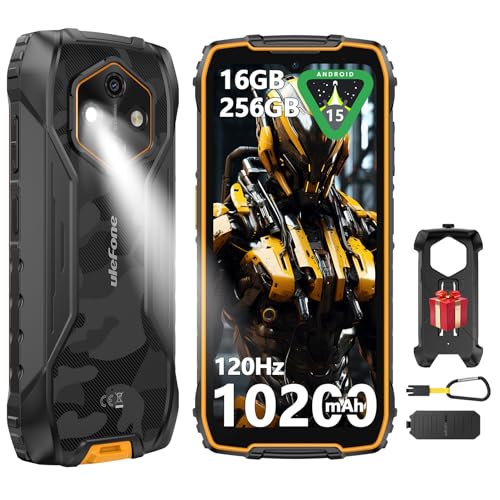
- 10,200mAh battery
- Water-lock mode and flashlight
- Protective case included
Best For: Longer trips away from charging
Long-Standby Pick

- 10,000mAh battery
- Advertised drop, water, and dust protection
- Dual SIM, GPS, and OTG
Best For: A long-lasting 4G backup phone for outdoor kits
Night-Inspection Pick

- 20MP infrared night-vision camera
- High-capacity battery; listed capacity varies
- Loudspeaker and dual 4G SIM
Best For: Dark-area inspections and noisy outdoor settings
Compact Flashlight Pick

- Compact 5.45-inch screen
- 110-lumen flashlight
- Water-lock mode and navigation tools
Best For: A smaller rugged phone with a practical flashlight
Best for Bright Task Lighting – OUKITEL WP58 Pro
Among rugged smartphones for emergency use, the OUKITEL WP58 Pro stands out for its two rear camping lights. Rated at 900 and 1,000 lumens, they have separate controls for brightness and color—useful when a power outage or roadside repair calls for more than a phone flashlight.
Best For: People who want strong built-in lighting for night repairs, camping, or emergency tasks.
Pros:
- Separately controlled dual camping lights for flexible illumination.
- 10,000mAh battery, 33W charging, and OTG reverse charging.
- 5G, IP68/IP69K ratings, and a night-vision camera.
Cons:
- Battery capacity is lower than the 20,000mAh option in this roundup.
- The supplied notes do not specify a dedicated SOS lighting mode.
The WP58 Pro makes the most sense when hands-on visibility is the priority; its battery and rugged ratings support that role without making lighting an afterthought.
Best for Gloved Work – OUKITEL G1
The OUKITEL G1 is a practical pick among rugged smartphones for emergency use when you need to check maps or messages without removing work or winter gloves. Its Glove Mode pairs with a 10,600mAh battery and IP68/IP69K ratings for demanding shifts and wet outdoor trips.
Best For: Outdoor workers and cold-weather travelers who need gloved touchscreen access and long battery life.
Pros:
- Glove Mode helps keep the touchscreen usable while wearing gloves.
- 10,600mAh battery supports OTG reverse charging.
- 256GB storage leaves room for offline maps and worksite photos.
Cons:
- The stated 24GB RAM includes 18GB of expansion RAM, not 24GB of physical RAM.
- The supplied notes identify T-Mobile compatibility but do not establish compatibility with every U.S. carrier.
Choose the G1 for usable, everyday preparedness rather than specialized emergency lighting. Check your carrier before relying on it as a primary phone.
Best for Quick Compass Checks – FOSSIBOT F101 Pro
The FOSSIBOT F101 Pro takes a different approach to rugged smartphones for emergency use: its 1.32-inch rear display shows compass readings, notifications, calls, and time without requiring the main screen for every quick check. A 10,600mAh battery and reverse charging add off-grid utility.
Best For: Hikers and outdoor workers who value a glanceable compass and long battery life.
Pros:
- Rear screen offers quick access to compass readings and alerts.
- 10,600mAh battery supports OTG reverse charging.
- IP68/IP69K ratings and MIL-STD-810G compliance are listed.
Cons:
- Uses 4G rather than 5G.
- Advertised 15GB RAM includes 7GB of expanded RAM; built-in storage is 128GB.
The rear display is useful for frequent status checks, but it does not replace checking your route and communication options before heading out.
Best for Extended Power Outages – Blackview ROCK 5
For shoppers comparing rugged smartphones for emergency use, the Blackview ROCK 5 offers the largest stated battery in this group at 20,000mAh. Its built-in 348-lumen lantern includes SOS and flashing modes, making it especially relevant for outages and nighttime signaling.
Best For: Extended power outages and off-grid trips where battery reserve and signaling matter most.
Pros:
- 20,000mAh battery with 33W charging and 5W reverse charging.
- Lantern has adjustable brightness, SOS, and flashing modes.
- 20MP night-vision camera plus IP68/IP69K and MIL-STD-810H ratings.
Cons:
- Listed as a 4G phone, not a 5G model.
- The advertised 48GB RAM includes 36GB of expansion; physical RAM is 12GB.
The ROCK 5 prioritizes power and built-in emergency lighting. Its 4G connectivity is the key trade-off to weigh against the higher-capacity battery.
Best Wet-Weather Controls – Ulefone RugKing 3 Pro
Among rugged smartphones for emergency use, the RugKing 3 Pro stands out for its water-lock mode, glove mode, and 120-lumen flashlight—useful features when conditions turn wet or dark.
Best For: A rain-ready phone for outdoor work or an emergency kit.
Pros:
- IP68/IP69K ratings and MIL-STD-810H certification.
- Water-lock mode helps prevent accidental touches in wet conditions; glove mode adds flexibility.
- 5,600mAh battery, four-system satellite navigation, and a 120-lumen flashlight.
Cons:
- Not compatible with AT&T or Cricket, according to the listing.
- Its 5,600mAh battery is smaller than the other two phones in this roundup.
The wet-weather controls make this a practical pick, but confirm carrier compatibility before relying on it as a backup phone.
Best Night-Vision Camera – Ulefone Armor X13
For shoppers comparing rugged smartphones for emergency use, the Armor X13 offers a 24MP infrared night-vision camera alongside a 6,320mAh battery. It suits people who may need to photograph a dark worksite or campsite.
Best For: Low-light documentation where T-Mobile service is available.
Pros:
- 24MP night-vision camera and 50MP main camera.
- 6,320mAh battery with reverse charging.
- IP68/IP69K ratings, MIL-STD-810H compliance, glove mode, and headset-free FM radio.
Cons:
- The listing says it is not compatible with AT&T, Cricket, Verizon, Sprint, or Boost Mobile.
- 64GB of built-in storage is the least of these three phones.
The night-vision camera is its clearest advantage, but the stated carrier restrictions make a network check essential.
Best Large Battery – Ulefone RugKing 4 Pro
The RugKing 4 Pro is the battery-focused choice among these rugged smartphones for emergency use. Its stated 10,200mAh capacity, built-in flashlight, and four-system satellite navigation suit longer stretches away from an outlet.
Best For: Extended outdoor trips where battery capacity is the priority.
Pros:
- 10,200mAh battery—the largest listed in this roundup.
- IP68/IP69K ratings, MIL-STD-810H certification, and water-lock mode.
- Includes a protective case with a rotating clip and carabiner.
Cons:
- Dock charging requires a separately sold dock.
- Not compatible with AT&T or Cricket, according to the listing.
Choose it for the extra stated battery capacity rather than the optional dock, and verify that your carrier supports it before heading out.
Long-Standby Pick – Blackview Fort 1
For shoppers comparing rugged smartphones for emergency use, the Blackview Fort 1 pairs a 10,000mAh battery with a reinforced design and GPS. Its 4G connectivity makes carrier compatibility especially important to check before relying on it as a backup phone.
Best For: Keeping a long-lasting backup phone for camping, outdoor work, or emergency kits.
Pros:
- 10,000mAh battery with a claimed 20 days of standby time.
- Advertised 2-meter drop resistance, 2-meter water resistance for 30 minutes, and dust protection.
- Dual SIM, GPS, and OTG support add useful backup-phone flexibility.
Cons:
- 4G-only; the listing says it is not compatible with AT&T, Cricket, or Verizon.
- The 6.56-inch display has a modest 720 × 1612 resolution.
The large battery is its clearest emergency-use advantage, but verify service with your carrier and test reception where you expect to use it.
Among rugged smartphones for emergency use, the DOOGEE Blade20 Pro stands out for its 20MP infrared night-vision camera, loudspeaker, and high-capacity battery. Those features could be useful for inspecting dark areas or hearing alerts in noisy surroundings.
Best For: Outdoor workers or campers who want night-vision imaging and a loud backup phone.
Pros:
- 20MP infrared night-vision camera alongside a 50MP main camera.
- Advertised 11,000mAh battery and OTG reverse charging for other gear.
- IP68/IP69K and MIL-STD-810H durability claims, plus dual 4G SIM support.
Cons:
- Limited to 4G cellular connectivity.
- The supplied specifications conflict on battery capacity, listing both 11,000mAh and 10,200mAh; confirm before buying.
Its night-vision camera gives it a specific role beyond routine backup calling. Check the final battery specification and carrier support before making it part of an emergency plan.
If a smaller device is easier to keep close, the Ulefone RugKing 2 Pro is a compact option among rugged smartphones for emergency use. Its 5.45-inch screen, 110-lumen flashlight, and multiple satellite-navigation systems suit a phone kept handy for outdoor tasks.
Best For: Carrying a compact rugged phone with a built-in flashlight and navigation tools.
Pros:
- 110-lumen flashlight and GPS, GLONASS, Beidou, and Galileo support.
- IP68/IP69K and MIL-STD-810H claims, plus a water-lock mode.
- Compact 5.45-inch Gorilla Glass screen, glove mode, and charging dock.
Cons:
- 4,500mAh battery is smaller than the batteries in the other phones here.
- 64GB built-in storage; the listing says it is not compatible with AT&T or Cricket.
This is the easier-to-carry choice when flashlight access matters more than maximum battery capacity. Confirm carrier compatibility before depending on it for emergency calls.
How We Picked the Best Rugged Smartphones for Emergency Use
We compared the listed specifications for the 10 selected phones, prioritizing battery capacity, built-in lighting, stated water and dust protection, connectivity, and ease of carrying. We also considered storage and features such as night-vision cameras where they may be useful. These are specification-based comparisons, not independent tests of runtime, reception, durability, or light output; verify the current listing before buying.
Quick Comparison: Rugged Smartphones for Emergency Use
Start with your likely scenario. The Blackview Rock 5 lists a 20,000mAh battery and a 348-lumen camping lantern, making it worth considering for prolonged outages if its size suits you. The DOOGEE Blade20 Pro, FOSSIBOT F101 Pro, and G1 list batteries of 10,600mAh or more for buyers prioritizing capacity. The WP58 Pro lists 5G and dual lights. At the smaller end, the Ulefone RugKing 2 Pro lists a 5.45-inch screen and 4,500mAh battery, a different trade-off for a grab-and-go kit.
Capacity is only a starting point: screen brightness, signal strength, temperature, and usage affect actual runtime. A larger battery can also mean more weight and longer charging times.
Key Buying Factors for Emergency Use
Check Connectivity Before Anything Else
An unlocked label does not confirm full compatibility with your carrier. Check the exact model’s supported bands, VoLTE support, and carrier approval—especially if you depend on calling or texting in an area with limited coverage. The listed Blackview 4G model mentions T-Mobile, but buyers should still confirm compatibility for their specific line and location. None of these phones should be assumed to provide satellite messaging unless the manufacturer explicitly confirms it.
Balance Battery Life, Charging, and Light
For extended outages, favor capacity you can comfortably carry and recharge. Check charger requirements and charging speed, and pack a charged power bank or other backup power source. A built-in lantern or dual lights can be convenient, but confirm their output and controls if lighting is central to your plan. Keep a separate flashlight as a backup.
Look Beyond Rugged Claims
Check the exact model’s published IP rating and the conditions behind it. Water resistance can diminish with wear or damaged port covers, and an IP rating is not a guarantee against impact damage. Consider grip, screen readability, glove usability, and whether the phone fits your emergency bag. Night-vision cameras may help inspect dark spaces, but they are not substitutes for adequate lighting or safe navigation.
Who Should Buy Which Rugged Smartphones for Emergency Use?
Choose a high-capacity model such as the Rock 5 if outage runtime and an integrated lantern outweigh pocketability. Consider the WP58 Pro if its listed 5G support and dual lights match your needs—but verify your carrier first. Look at the compact RugKing 2 Pro for a smaller backup handset, provided its battery capacity is sufficient for your plan. Other models in the lineup offer middle-ground choices; compare their exact weight, charging setup, and network support rather than buying on memory or camera numbers alone. Whichever rugged smartphone for emergency use you choose, download offline maps, save essential contacts, and test the complete kit before you need it.