If you tune CPUs, memory, or GPUs regularly, a purpose-built open frame can make the process faster, cleaner, and far less frustrating. The best test bench cases for overclocking give you easy access, strong airflow, and enough clearance for cooling hardware.
This roundup focuses on practical choices for builders who want quick component swaps, stable layouts, and better visibility during stress testing and benchmarking.
Best 10 Test Bench Cases for Overclocking Picks for 2026
Compact Open-Air ATX Test Bench
Compact Open-Air ATX Test Bench

- ATX, MATX, and ITX support
- No graphics card length limit
- 0.8mm SPCC steel frame
Best For: Simple open-frame testing with broad motherboard compatibility
Wide-Body E-ATX Overclocking Bench
Wide-Body E-ATX Overclocking Bench

- E-ATX through ITX support
- No GPU or cooler height limit
- 2 SSDs plus 2 HDDs
Best For: Large overclocking setups that need maximum clearance
Aluminum Open Frame Water-Cooling Bench
Aluminum Open Frame Water-Cooling Bench

- 8mm aluminum alloy build
- 120mm to 360mm water-cooling support
- Up to 4 drives
Best For: ATX overclocking rigs with custom water cooling
Versatile Mid-Tower DIY Test Bench
Versatile Mid-Tower DIY Test Bench

- ATX, MATX, and ITX support
- Air or water cooling with 8 fans
- 7 expansion slots and 2 USB ports
Best For: Lightweight, flexible benching for frequent component swaps
Open-Air Acrylic Pick
ATX Open Frame Test Bench for Overclocking

- 4mm transparent acrylic open frame
- ATX support with space for large GPUs
- Built for testing, overclocking, and gaming
Best For: ATX builders who want a lightweight open frame for frequent hardware changes
Aluminum DIY Pick
Modular Open Case for ATX, EATX, and More

- Supports EATX, ATX, MATX, and ITX boards
- Works with air or water cooling
- Compatible with ATX, SFX, and 1U PSUs
Best For: DIY builders who want one open chassis for many motherboard and cooling combinations
Wide-Body Gaming Pick
Open Test Bench for ATX, M-ATX, and ITX

- ATX, M-ATX, and ITX support
- No GPU length or CPU cooler height limit
- Wide-body frame improves heat dissipation
Best For: Gamers and overclockers who need roomy clearance for large components
Stackable Heavy-Duty Test Bench

- 1.5mm SPCC panels for added rigidity
- Stacks up to 10 units horizontally
- Supports large boards and strong cooling options
Best For: Builders who want a rigid, stackable open-frame bench
Flexible Aluminum OC Frame

- Aluminum alloy open frame with stable vertical design
- Adjustable support for up to two water-cooling units
- Works with EATX, ATX, M-ATX, and ITX boards
Best For: DIY builders who need an adjustable open frame
Tool-Free Budget Bench
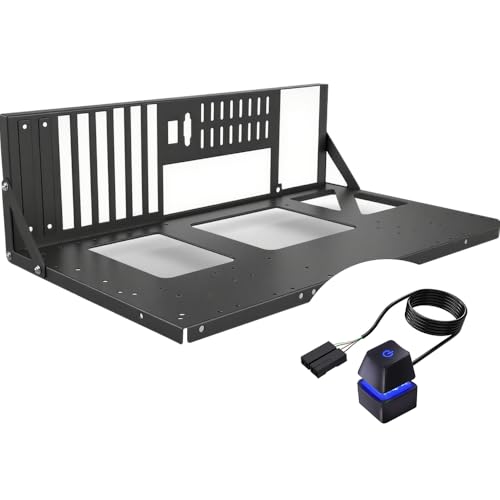
- Tool-free open-frame design for quick swaps
- Supports ATX, MATX, ITX, X79, and X99 builds
- Includes brackets for PSU, motherboard, and storage
Best For: Budget-minded builders who want quick access for testing and repeated hardware changes
Compact Open-Air ATX Test Bench – Compact Open-Air ATX Test Bench
If you’re shopping for test bench cases for overclocking, this open-air ATX frame is built for quick swaps and easy access during tuning sessions. It supports ATX, Micro ATX, and Mini ITX boards, leaves graphics card length unconstrained, and uses a simple open design that keeps hardware exposed for fast part changes.
Best For: Builders who want a straightforward open-frame bench for ATX, MATX, or ITX testing with no GPU length limits.
Pros:
- Supports ATX, Micro ATX, and ITX motherboards up to 305 x 245 mm
- No graphics card length restriction, which helps with oversized test GPUs
- Fits a standard ATX power supply and 1 HDD or SSD
- Made from 0.8mm SPCC steel with a black sandblasted finish
Cons:
- Open-air design offers less physical protection than a closed case
- Only one drive mount is listed
This is a practical, no-frills bench for frequent hardware changes and general overclocking work. Its simple layout and broad motherboard support make it easy to use as a test platform, especially if you want unrestricted GPU space.
Wide-Body E-ATX Overclocking Bench – Wide-Body E-ATX Overclocking Bench
For test bench cases for overclocking on larger platforms, this wide-body open chassis gives you room to work with E-ATX, ATX, M-ATX, and ITX builds. The design emphasizes airflow, with no limit on GPU length or CPU cooler height, making it a strong fit for frequent benchmark sessions and cooling experiments.
Best For: Users building a roomy open chassis for E-ATX systems, big coolers, and unrestricted graphics cards.
Pros:
- Supports E-ATX, ATX, M-ATX, and ITX motherboards
- No limit on GPU length or CPU cooler height
- Supports 2 SSDs and 2 HDDs
- Rear-mounted standard ATX power supply and high-airflow layout
Cons:
- Plastic enclosure material is less rigid than metal alternatives
- Only 2 expansion slots are listed
This bench makes sense if your priority is space and thermal freedom rather than compactness. The wide body and broad compatibility are especially useful when you’re swapping parts, testing coolers, or pushing larger boards.
Aluminum Open Frame Water-Cooling Bench – Aluminum Open Frame Water-Cooling Bench
If you’re comparing test bench cases for overclocking with custom cooling in mind, this aluminum open frame stands out for its water-cooling support. It fits standard ATX boards, accepts up to four drives, and is designed for repeated disassembly, which can be handy when you’re iterating on thermals and tuning.
Best For: Builders who want an aluminum bench with integrated water-cooling support for ATX test rigs.
Pros:
- Supports standard ATX motherboards and ATX power supplies
- Built from 8mm aerospace magnesium aluminum alloy
- Supports integrated water-cooling setups from 120mm to 360mm
- Can mount up to 4 hard drives or SSDs
Cons:
- Ships unassembled and requires setup from the buyer
- Only ATX is specified in the supplied notes
This is a strong pick for builders focused on cooling hardware rather than just barebones access. The aluminum construction, anti-slip pads, and wide water-cooling compatibility make it well suited to more involved test bench work.
Versatile Mid-Tower DIY Test Bench – Versatile Mid-Tower DIY Test Bench
This DIY open chassis is a flexible option if you want test bench cases for overclocking with broad motherboard support and easy hardware access. It supports ATX, Micro ATX, and ITX boards, uses a standard ATX power supply, and has an open-air layout that can simplify frequent swaps during benchmarking.
Best For: Users who want a lightweight, broad-compatibility test bench for everyday overclocking and part swapping.
Pros:
- Supports ATX, Micro ATX, and ITX motherboards up to 305 x 245 mm
- No graphics card length or width limit is listed
- Supports air or water cooling and up to 8 fans
- Includes 7 expansion slots and 2 USB ports
Cons:
- Only 2 internal drive bays are listed
- Open design provides minimal physical protection
This bench is aimed at practical testing rather than polished presentation. Its broad support, multiple fan capacity, and open layout make it a usable platform for repeated overclocking sessions and general DIY hardware work.
Open-Air Acrylic Pick – ATX Open Frame Test Bench for Overclocking
If you want a simple, open-air option for test bench cases for overclocking, this ATX acrylic frame keeps the focus on airflow and easy access. Its transparent 4mm acrylic design is aimed at builders who want to test components, swap parts, and monitor the system without fighting a closed enclosure.
Best For: ATX builders who want a lightweight open frame for testing, overclocking, or gaming setups.
Pros:
- Open-frame design supports better cooling, compatibility, and maintenance.
- Fits ATX motherboards and leaves room for larger graphics cards and big components.
- Heat circulation below the motherboard helps with high-performance testing.
- Transparent acrylic makes the internal build easy to see.
Cons:
- Requires patient assembly and following the instructions carefully.
- Acrylic panels may need regular cleaning to stay clear.
Overall, this is a straightforward pick for builders who want an affordable open test bench layout with good access and visibility. It’s best suited to ATX systems where cooling and quick hardware changes matter more than enclosure protection.
Aluminum DIY Pick – Modular Open Case for ATX, EATX, and More
For builders comparing test bench cases for overclocking, this aluminum open chassis stands out for its broad compatibility and flexible cooling support. It’s designed for DIY setups where you may move between ATX, EATX, MATX, and ITX hardware and want a frame that can handle water or air cooling.
Best For: DIY users who need a versatile open chassis for larger builds and mixed cooling setups.
Pros:
- Supports EATX, ATX, MATX, and ITX motherboards.
- Compatible with ATX, SFX, and 1U power supplies.
- Supports both water and air cooling for CPU setups.
- Aluminum construction gives it a sturdier, more substantial feel.
Cons:
- Heavier than the acrylic options at 2 kg.
- Case dimensions may be less convenient for compact workspaces.
In practice, this is the most flexible option in the group if you’re building bigger systems or experimenting with different hardware types. The unlimited GPU length claim and wide compatibility make it a practical test platform for performance-focused builds.
Wide-Body Gaming Pick – Open Test Bench for ATX, M-ATX, and ITX
This open chassis is a practical choice if you need test bench cases for overclocking with a wider layout and easy component access. It supports ATX, M-ATX, and ITX motherboards, and its wide-body design is aimed at improving heat dissipation for DIY gaming and test builds.
Best For: Gamers and tinkerers who want an open frame with broad motherboard support and plenty of component clearance.
Pros:
- Supports ATX, M-ATX, and ITX motherboards.
- No limit in GPU length and CPU cooler height.
- Wide open-frame layout is designed for better heat dissipation.
- Includes support for 1 SSD and 1 HDD, plus a standard ATX power supply.
Cons:
- Only 5 expansion slots, which is fewer than some larger frames.
- Limited internal drive support compared with more storage-focused cases.
For users focused on testing parts and keeping temperatures manageable, this model offers a strong balance of flexibility and airflow. It’s a sensible choice if you want a gaming-oriented open bench that still leaves room for oversized hardware.
Stackable Heavy-Duty Test Bench – JOYJOM Open Frame Rack
If you want a test bench case for overclocking that can double as a semi-permanent work platform, this open-air rack is built around size, rigidity, and broad motherboard support. The 1.5mm SPCC panels and stackable layout make it a practical choice for builders who swap parts often or run multiple systems nearby.
Best For: Builders who want a rigid, stackable open-frame bench for repeated tuning, testing, and workstation use.
Pros:
- Supports EATX, ATX, Micro ATX, and ITX motherboards up to 330 x 330 mm.
- Stackable up to 10 units horizontally for bench stations or server-style setups.
- Strong cooling support with space for up to 8 x 120 mm fans or multiple radiator sizes.
- Good component clearance, including up to 310 mm GPU length with internal fans.
Cons:
- Open-frame design offers less protection than a closed case.
- CPU cooler height is limited to 165 mm.
- Best suited to builders comfortable working in a fully exposed layout.
This is a solid bench-style chassis if your overclocking workflow depends on frequent access, strong airflow, and the ability to scale into a multi-rig setup. Its metal construction and modular cooling options make it especially useful for hands-on tuning sessions.
Flexible Aluminum OC Frame – egowz Open Chassis
This open-air frame is aimed at builders who want easy component access and flexible cooling layout for a test bench case for overclocking. Its aluminum alloy construction and adjustable water-cooling mounting make it convenient for experimenting with different hardware combinations.
Best For: DIY builders who need an adjustable open frame for frequent tuning and cooling experiments.
Pros:
- Supports EATX, ATX, M-ATX, and ITX motherboards.
- Open design and aluminum build are described as providing excellent heat dissipation.
- Supports up to two water-cooling installations with adjustable placement.
- Can work with ATX and SFX power supplies plus HDD and SSD storage.
Cons:
- Vertical graphics-card mounting may require extra extension cables.
- ITX and M-ATX use with air-cooled CPUs is limited by frame height, according to the notes.
- Graphics-card accessories are optional, so not every setup is fully ready out of the box.
For overclockers who value flexibility, this chassis stands out for its adjustable cooling positions and broad motherboard compatibility. It is more of a configurable build frame than a finished enclosure, which is exactly what many test-bench users want.
Tool-Free Budget Bench – Generic ATX Open Frame
For a straightforward test bench case for overclocking, this open-frame chassis focuses on easy access and broad compatibility rather than extras. The tool-free approach is handy if you plan to swap CPUs, memory, or cooling hardware often while dialing in stable settings.
Best For: Budget-minded builders who want quick access for testing and repeated hardware changes.
Pros:
- Supports ATX, MATX, ITX, and server-oriented X79/X99 builds.
- Open-air design improves access to parts and airflow during tuning sessions.
- Tool-free design makes installation and maintenance faster.
- Includes dedicated mounting brackets for motherboard, PSU, and storage devices.
Cons:
- Supported motherboard listing in the details is more limited than the broader compatibility notes.
- No warranty is listed in the supplied details.
- Open-frame construction provides minimal physical protection.
This is a practical pick if your priority is quick hardware access and broad DIY compatibility rather than premium materials or advanced modularity. It should suit users who want a simple bench for testing, tweaking, and server-style builds.
How We Picked the Best Test Bench Cases for Overclocking
For Test Bench Cases for Overclocking, the priority is not looks alone. We looked at motherboard support, structural stability, cooling clearance, ease of access, and whether the frame leaves room for repeated hardware changes. Open designs should make tuning simpler without creating unnecessary flex or awkward cable routing.
We also favored models that can handle common enthusiast setups, including ATX, Micro-ATX, and ITX, with some picks offering E-ATX compatibility or wider chassis layouts for larger builds.
Quick Comparison
Choose a compact open frame if you want a light, portable bench for everyday testing. Choose a wider chassis if you run larger boards, custom loops, or frequent thermal experiments. Aluminum frames usually offer better rigidity and a cleaner finish, while acrylic models can be easier to inspect visually. Server-style or rack-mount-inspired benches may appeal to users who want extra hardware flexibility.
Key Buying Factors for Test Bench Cases for Overclocking
Motherboard and Hardware Support
Confirm support for your board size first. ATX covers most enthusiast builds, but if you use E-ATX or plan to move parts between rigs, a wider frame saves time and avoids fit issues. Also check space for tall memory, large air coolers, radiator mounts, and long graphics cards.
Cooling and Layout
Overclocking creates heat, so open airflow matters. Look for frames with strong fan and radiator clearance, room for pumps or reservoirs if you use liquid cooling, and enough open area around the CPU socket to mount and remove coolers quickly.
Build Quality and Stability
A test bench should stay steady on the desk or work surface. Rigid metal frames often feel more secure during repeated swaps than very light designs. If the bench uses acrylic parts, check that mounting points and edges are well finished and that the structure does not wobble when fully assembled.
Access, Storage, and Cable Management
Frequent testing means frequent changes. Tool-free or highly accessible layouts are a plus, and some benches add space for SSDs, power supplies, or accessory mounting. You do not need hidden cable channels, but you do want enough routing space to keep the setup neat and safe during bench sessions.
Who Should Buy Which Test Bench Cases for Overclocking?
Choose a compact ATX or multi-form-factor bench if you want a flexible all-rounder for BIOS tuning, stress tests, and routine benchmarking. Choose a wider E-ATX-ready frame if you run bigger boards or custom cooling. Pick aluminum if rigidity and durability matter most, or acrylic if you want easy component visibility and a lighter build. If you swap hardware constantly, prioritize the simplest frame with the fewest obstacles between you and the motherboard.