Test bench PC cases with power button make it much easier to build, troubleshoot, and swap hardware without constantly opening a traditional tower. For benchmarking, repair work, and prototype setups, an open frame can save time and reduce hassle.
Below, we focus on practical picks that balance accessibility, cooling clearance, motherboard support, and everyday usability so you can choose the right bench for your build style.
Best 10 Test Bench PC Cases with Power Button Picks for 2026
Open-Air DIY Test Platform
ATX/M-ATX/ITX Open Chassis Rack

- Supports ATX, Micro ATX, and ITX boards
- Open steel frame favors airflow and easy access
- Standard ATX PSU support with bottom mount
Best For: DIY builders and test-bench setups
External Power Switch

- Adds boot and restart control plus status indicators
- 1.6 m cable helps with hard-to-reach setups
- Useful for bare-board and DIY water-cooled builds
Best For: Users needing an external replacement power button
High-Airflow E-ATX Bench

- Supports E-ATX, ATX, M-ATX, and ITX boards
- No GPU length or CPU cooler height limit listed
- Open chassis design prioritizes airflow
Best For: Large builds and open-air hardware testing
Compact Open Frame Rack

- Supports ATX, Micro ATX, and ITX boards
- GPU length and width are not limited
- 0.8 mm SPCC steel with black finish
Best For: Compact open-rack testing and frequent hardware swaps
Wide-Body Open Frame Test Bench
TGDGAMER Open Chassis DIY Gaming PC Test Bench

- Supports ATX, M-ATX, and ITX boards
- No GPU length or cooler-height limit
- Fits standard ATX power supplies
Best For: DIY builders who need an open-frame test bench with broad compatibility
Stackable Server-Style Bench

- Includes a power button
- Stackable design for up to 10 units
- Supports multiple board sizes and cooling setups
Best For: Users who want a stackable open-air bench for testing and workstation use
Aluminum DIY Open Case
DALAIBUKESI Aluminium Pc Open Case

- Supports EATX, ATX, M-ATX, and ITX boards
- Works with ATX, SFX, and 1U PSUs
- Supports both air and water cooling
Best For: DIY builders who want an open aluminum case with broad compatibility
ATX-Friendly Open Frame
PC Test Bench PC Case for ATX, MATX, ITX
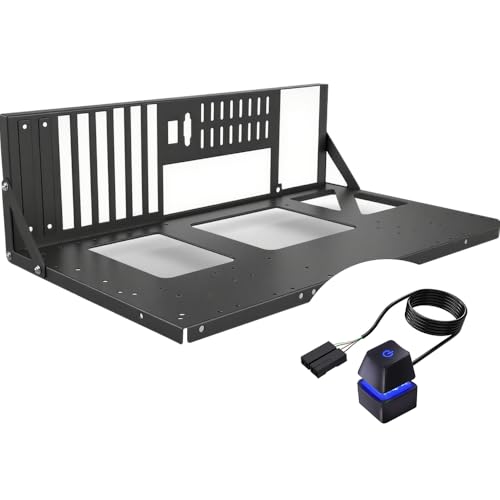
- Supports ATX, MATX, ITX, and server-style boards
- Open-air layout gives easy access and better airflow
- Tool-free design with mounting brackets for core parts
Best For: Versatile open-air testing and DIY builds
Budget Desktop Frame
DIY Computer Case Open Chassis for ATX and ITX

- Supports ATX, Micro-ATX, and ITX motherboards
- Includes switch, GPU holders, screws, pillars, and tools
- Compatible with ATX and SFX power supplies
Best For: Easy-assembly bench builds and budget testing
Open-Air DIY Test Platform – ATX/M-ATX/ITX Open Chassis Rack
If you want test bench pc cases with power button, this open chassis rack is more of a bare-metal DIY platform than a finished enclosure. It supports ATX, Micro ATX, and ITX boards, uses a standard ATX power supply, and keeps components exposed for easy access and strong airflow during builds, upgrades, and troubleshooting.
Best For: DIY builders, repair work, and open-air bench testing on ATX, M-ATX, or ITX systems.
Pros:
- Supports ATX, Micro ATX, and ITX motherboards up to 305 x 245 mm
- Standard ATX PSU support with a bottom-mount layout
- Open-air steel design helps with heat dissipation and easy part access
- Includes space for 3.5-inch drives and multiple expansion slots
Cons:
- No built-in power button is listed in the supplied notes
- Open frame design offers little protection from dust or physical contact
- Best suited to bench use, not a closed, finished PC build
For builders who need frequent access to hardware, this rack keeps the focus on compatibility and cooling rather than polish. It is a practical choice when the main goal is testing and assembling parts quickly on an open platform.
External Power Switch – Desktop PC Case Power Button
For test bench pc cases with power button, this external switch is a simple add-on that lets you move power and reset control to a more convenient spot. It is designed for bare-board machines, DIY water-cooled setups, and cases where the front-panel button is broken or hard to reach.
Best For: Bench testers, DIY builders, and anyone needing an external replacement power switch.
Pros:
- Includes a boot button, restart button, power indicator, and hard disk indicator
- 1.6 m cable gives flexibility for hard-to-reach chassis or open setups
- Useful when the case panel button is damaged or inconvenient to access
- Panel-mount design with a simple plug-in connection
Cons:
- It is an accessory, not a full PC case or bench frame
- Acrylic build is practical, but not a rugged metal enclosure
- Only useful if you need external switch control
This is the right kind of accessory when the case itself does not provide the button placement you want. It adds convenient front-panel-style control without changing the rest of your test bench setup.
High-Airflow E-ATX Bench – Wide Open Chassis Test Rack
If you are comparing test bench pc cases with power button, note that this open chassis is built for airflow and component clearance, but the supplied details do not list a power button. It supports E-ATX, ATX, M-ATX, and ITX motherboards, along with a standard ATX power supply, making it a flexible bench-style platform for large builds and hardware testing.
Best For: Builders who need an open, high-airflow bench for large motherboards and oversized components.
Pros:
- Supports E-ATX, ATX, M-ATX, and ITX motherboards
- No limit listed for GPU length or CPU cooler height
- Standard ATX power supply support
- Open chassis design emphasizes airflow and easy access
Cons:
- No power button is mentioned in the supplied notes
- Only 2 expansion slots are listed in the details
- Plastic enclosure material may feel less premium than metal alternatives
This model makes sense when compatibility and clearance matter more than enclosure features. It is a straightforward open bench for large test builds, but buyers should plan for separate power-control needs if required.
Compact Open Frame Rack – ATX/MATX/ITX Test Bench
This open frame is aimed at builders who want test bench pc cases with power button flexibility, but the supplied notes do not mention a built-in power switch. It supports ATX, Micro ATX, and ITX motherboards, takes a standard ATX power supply, and keeps the graphics card and cooling space unrestricted for fast part swaps and open-air testing.
Best For: DIY users who want a compact open rack for bench testing and frequent hardware changes.
Pros:
- Supports ATX, Micro ATX, and ITX motherboards up to 305 x 245 mm
- Graphics card length and width are not limited
- Standard ATX PSU support and space for one HDD/SSD
- 0.8 mm SPCC steel with black sandblasted finish
Cons:
- No power button is listed in the product notes
- Only one drive bay is specified
- Open-air design offers little protection from dust and handling
For a straightforward bench rack, this model focuses on compatibility and easy access rather than extras. It is a sensible pick for repeated test builds, though buyers needing integrated front-panel control will need another solution.
Wide-Body Open Frame Test Bench – TGDGAMER Open Chassis DIY Gaming PC Test Bench
If you want a practical option for test bench pc cases with power button, this TGDGAMER open chassis keeps the focus on compatibility and easy access. It supports ATX, M-ATX, and ITX motherboards, uses a standard ATX power supply, and leaves plenty of room for large GPUs and tall air coolers, which makes it a straightforward choice for DIY builds and hardware testing.
Best For: DIY builders who want an open-frame test bench with broad motherboard support and simple everyday access.
Pros:
- Supports ATX, M-ATX, and ITX motherboards
- No GPU length limit and no CPU cooler height limit
- Fits a standard ATX power supply
- Includes support for 1 SSD and 1 HDD
Cons:
- Open chassis design offers less protection than a closed case
- Only two storage drive positions are listed
This is a good pick if your priority is build flexibility over enclosure protection. The wide-body layout and open-frame cooling approach make it well suited for frequent part swaps, test builds, and systems that need room for oversized components.
Stackable Server-Style Bench – JOYJOM Open Air PC Test Bench
For buyers comparing test bench pc cases with power button, this JOYJOM open-air chassis stands out for stackability and hardware support. It handles EATX, ATX, Micro ATX, and ITX motherboards, includes a power button, and offers flexible cooling and drive support, making it a strong fit for benches, workstations, or server-rack-style setups.
Best For: Users who want a stackable test bench with a power button and broad cooling options.
Pros:
- Includes a power button in the package
- Supports EATX, ATX, Micro ATX, and ITX motherboards
- Stackable up to 10 units horizontally
- Supports up to 8x 120mm fans or multiple radiator sizes
Cons:
- GPU clearance is limited to 310mm with internal fans
- Maximum CPU cooler height is 165mm
This bench is especially useful if you need a modular setup for repeated testing or multiple systems. The included power button, rigid metal build, and strong storage support make it practical for hands-on work where convenience matters.
Aluminum DIY Open Case – DALAIBUKESI Aluminium Pc Open Case
If you need test bench pc cases with power button options in a flexible open-frame format, this aluminum DALAIBUKESI chassis is built for broad component support. It works with EATX, ATX, M-ATX, and ITX motherboards, supports ATX, SFX, and 1U power supplies, and allows both air and water cooling for builders who want a versatile test platform.
Best For: DIY builders and workstation users who want an aluminum open case with wide hardware compatibility.
Pros:
- Supports EATX, ATX, M-ATX, and ITX motherboards
- Compatible with ATX, SFX, and 1U power supplies
- Supports both air and water cooling
- No graphics card length limit listed
Cons:
- No power button is mentioned in the supplied details
- Only two fans are listed
This chassis is a strong pick when you want maximum install flexibility and an aluminum build. The open design and broad PSU support make it useful for custom projects, but it is less convenient if you specifically need a built-in power button.
ATX-Friendly Open Frame – PC Test Bench PC Case for ATX, MATX, ITX
If you’re comparing test bench pc cases with power button access in mind, this open-frame option is built for quick hardware swaps and broad motherboard support. It suits builders who want a simple, tool-free test bench layout for ATX, MATX, and ITX systems, plus easy access during troubleshooting or frequent upgrades.
Best For: Builders who want a versatile open-air test bench for ATX, MATX, ITX, or server-style projects.
Pros:
- Supports ATX, MATX, ITX, and server motherboard use cases
- Open-air design improves access and airflow for cooling
- Tool-free setup makes installation and maintenance quicker
- Includes mounting brackets for motherboard, power supply, and storage
Cons:
- Open frame design offers less protection than a closed case
- No included details about built-in fans or lighting
- Best suited to benching and display rather than quiet enclosed builds
This is a practical pick if your priority is compatibility and easy access over enclosure features. The compact steel-and-aluminum build keeps the layout simple while still covering a wide range of DIY test bench setups.
Budget Desktop Frame – DIY Computer Case Open Chassis for ATX and ITX
DIY Computer Case PC Frame Desktop Open Chassis Case PC Test Bench Support Motherboards MATX and ATX
Check Price On AmazonFor shoppers looking at test bench pc cases with power button support and a straightforward desktop footprint, this open chassis focuses on assembly convenience. It supports ATX, Micro-ATX, and ITX boards, and the included accessories make it easier to get a bench-style build up and running without hunting for extra parts.
Best For: Builders who want an easy-assembly open chassis for gaming, testing, or mining-style setups.
Pros:
- Supports ATX, Micro-ATX, and ITX motherboards
- Includes accessories such as power bracket, switch, GPU holders, screws, pillars, and tools
- Open chassis design promotes strong airflow and heat dissipation
- Compatible with both ATX and SFX power supplies
Cons:
- Metal frame is more functional than finished-looking
- Only two internal bays are listed
- Open design leaves components exposed to dust and handling
This model stands out for convenience more than extras. If you want a simple test bench layout with broad compatibility and the included parts to assemble it quickly, it covers the basics well.
Modular Aluminum Bench – Open Frame PC Test Bench with Liquid Cooling Support
This is one of the more flexible test bench pc cases with power button-friendly DIY layouts, especially if you want room for cooling and GPU experimentation. The aluminum open-frame chassis supports ATX, mATX, and ITX motherboards, plus multiple PSU and radiator configurations, so it works well for builders who like to reconfigure their setup.
Best For: DIY builders who want a modular open-frame bench with strong cooling and hardware flexibility.
Pros:
- Premium aluminum open-frame construction
- Supports ATX, mATX, ITX boards and ATX, SFX, SFX-L power supplies
- Handles horizontal or vertical GPU mounting
- Supports multiple fan and radiator sizes, including up to 280mm cooling
Cons:
- Vertical GPU setup requires an additional riser cable
- Large customization range may be more than simple users need
- No size limit is listed for graphics cards, but fit may still depend on layout choices
If you want a bench platform that can grow with your parts list, this one is the most adaptable of the group. Its modular design and broad cooling support make it a strong fit for testing, tuning, and showcase builds.
How We Picked the Best Test Bench PC Cases with Power Button
We prioritized open-frame designs that are easy to access, compatible with common motherboard sizes, and practical for frequent component changes. For Test Bench PC Cases with Power Button, the power control itself matters too, so we looked for setups that make booting, rebooting, and troubleshooting simpler during hands-on work.
We also considered cooling space, storage mounting options, material quality, and how well each design supports quick part swaps. Since these cases are often used for testing rather than permanent desk display, usability and stability mattered more than aesthetics.
Quick Comparison
In general, aluminum benches tend to feel more rigid and premium, while steel-frame and mixed-material options may offer better value. Larger open chassis designs are usually better for E-ATX or custom cooling, while compact models are a smarter choice for ATX, Micro-ATX, and ITX users who want a smaller footprint.
If you need an external on/off switch, confirm whether it is built into the frame or handled by a separate desktop power button accessory. That detail can make a big difference for workbench convenience.
Key Buying Factors for Test Bench PC Cases with Power Button
Motherboard and PSU Compatibility
Check support for ATX, Micro-ATX, ITX, or E-ATX before buying. Some benches also handle larger server-oriented boards, but mounting layout and PSU placement can vary a lot between models.
Cooling and Hardware Clearance
Open benches usually offer strong airflow, but you still need enough room for tall air coolers, large GPUs, radiator mounts, and cable routing. If you plan to use water cooling, verify radiator support and tubing space.
Build Quality and Stability
A test bench should stay stable on a desk or work surface. Aluminum can be lighter and easier to move, while heavier constructions may feel sturdier during repeated hardware changes.
Power Button Convenience
For frequent testing, a reliable power switch is more than a small bonus. It helps when you are flashing BIOS, diagnosing POST issues, or cycling parts on and off repeatedly.
Who Should Buy Which Test Bench PC Cases with Power Button?
Choose a compact open-frame bench if you want a flexible workstation for standard desktop testing and occasional upgrades. Go larger if you run E-ATX boards, multiple drives, or custom cooling.
If your priority is bench testing and fast daily access, a model with an integrated or easy-to-reach power button is the most practical choice. If you already have a chassis but just need easier startup control, an external desktop power switch may be enough on its own.