When you’re looking to enhance your workspace with seamless connectivity, docking stations featuring DisplayLink technology can be a game changer. These devices not only support multiple monitor setups but also come packed with various ports for all your needs. From dual 4K displays to versatile power delivery options, the choices can be overwhelming. Let’s explore the top ten docking stations that could transform your productivity and simplify your setup.
WAVLINK USB C Dual Monitor Docking Station

If you’re a multitasker looking to elevate your productivity, the WAVLINK USB C Dual Monitor Docking Station is the perfect choice. This 13-in-1 powerhouse supports dual 5K or 4K displays through DisplayLink technology, making it ideal for M1/M2/M3/M4 Mac and Windows laptops. With 13 ports, including USB 3.0 and Gigabit Ethernet, you’ll stay organized and connected. Plus, the 100W Power Delivery keeps your laptop charged during intense tasks. Compatible with various operating systems, it guarantees you won’t miss a beat. With a 1-year warranty and lifetime technical support, you’ve got peace of mind while enhancing your workflow.
Best For: Multitaskers seeking to enhance their productivity with dual high-resolution displays on Mac and Windows laptops.
Pros:
- Supports dual 5K/4K displays for superior multitasking capabilities.
- Includes 13 ports for versatile connectivity options, including Gigabit Ethernet.
- Provides 100W Power Delivery to keep laptops charged during demanding tasks.
Cons:
- Requires installation of DisplayLink driver for proper functionality.
- Incompatible with Unix systems, Linux, iOS, and iPad.
- May not deliver full performance with certain older laptop models.
WAVLINK USB C Docking Station for Dual Monitor Setup

For professionals and creatives who rely on a dual monitor setup, the WAVLINK USB C Docking Station stands out with its impressive triple 4K video output capabilities. This 13-in-1 dock offers two 4K HDMI and one 8K DisplayPort, ensuring you have flexibility for multiple displays. It’s compatible with various operating systems, including Windows, macOS, and Linux. Plus, with 1000Mbps Ethernet and USB-C transfer speeds up to 10Gb/s, you’ll enjoy seamless connectivity. Weighing just 100 grams, it’s portable, and the 130W power adapter provides up to 100W charging for your laptop. Experience enhanced productivity with this powerful docking station.
Best For: Professionals and creatives who require a versatile dual monitor setup for enhanced productivity.
Pros:
- Supports triple 4K video output with multiple display options.
- High-speed connectivity with USB-C transfer speeds up to 10Gb/s and 1000Mbps Ethernet.
- Lightweight and portable design, making it easy to transport.
Cons:
- macOS users can only connect one external monitor due to system limitations.
- Some Windows laptops may have GPU limitations that restrict the number of displays.
- The 130W power adapter may be excessive for users with lower power requirements.
ACASIS USB C to Dual HDMI DisplayLink Adapter

The ACASIS USB C to Dual HDMI DisplayLink Adapter is the ideal solution for professionals who need to boost their productivity with dual 4K monitors. It connects two monitors at up to 60Hz through a single USB-C or USB-A port, making multitasking a breeze. Compatible with Mac M1/M2/M3/M4/M5/Neo and Windows PCs, it’s perfect for office work or coding, though not suitable for gaming. The adapter features a 100W USB-C PD port for fast charging, ensuring your devices stay powered. Lightweight and compact, it’s easy to take anywhere, backed by a one-year warranty and Amazon’s 30-Day Return Guarantee.
Best For: Professionals and multitaskers who require dual 4K monitors for enhanced productivity in office work or coding.
Pros:
- Supports dual 4K displays at 60Hz for smooth performance.
- Compact and lightweight design makes it portable and easy to carry.
- 100W USB-C PD port allows for fast charging of laptops while in use.
Cons:
- Not suitable for gaming or HDCP content.
- Limited to a single USB-C/USB-A port for dual monitor connection.
- May require DisplayLink drivers for full functionality.
Plugable USB C Triple Display Docking Station

Designed for professionals who rely on multitasking, the Plugable USB C Triple Display Docking Station stands out with its ability to support up to three HDMI monitors, making it an ideal choice for enhancing productivity. With 100W Power Delivery, it guarantees your devices stay charged while you work. You’ll enjoy six USB 5Gbps ports for all your peripherals, and its compatibility with Windows, macOS, and ChromeOS means you can use it across various systems seamlessly. Weighing just 332 grams, it’s easy to transport, making it perfect for hybrid teams or anyone needing flexible, powerful connectivity on the go.
Best For: Professionals who need to enhance productivity through multitasking with multiple displays and seamless connectivity across different operating systems.
Pros:
- Supports up to three HDMI monitors, allowing for extensive multitasking capabilities.
- 100W Power Delivery ensures devices remain charged while in use.
- Lightweight design (332 grams) makes it highly portable for on-the-go use.
Cons:
- Limited to HDMI display outputs, which may not suit all users’ needs.
- Integrated DisplayLink technology could require additional drivers or software updates.
- Compatibility may vary with certain devices, particularly with older models.
Anker Prime Docking Station (DL7400) – 14-Port Triple Display
If you’re a multitasker who relies on multiple displays for productivity, the Anker Prime Docking Station (DL7400) is an excellent choice. With 14 ports, it supports triple displays, including one 8K monitor, making multitasking seamless. You’ll enjoy powerful connectivity with a 140W USB-C upstream port and two additional USB-C ports for high-speed charging. Plus, its built-in fan and ActiveShield 3.0 guarantee stability. Just remember, you’ll need the latest DisplayLink driver for peak performance. The included cable and 24-month warranty offer peace of mind, though be aware that DRM-protected streaming may require some adjustments in your browser settings.
Best For: The Anker Prime Docking Station (DL7400) is best for multitaskers who need to connect multiple displays for enhanced productivity.
Pros:
- Supports triple external monitors, including one in stunning 8K resolution.
- Equipped with multiple high-speed USB-C ports for charging and data transfer.
- Built-in fan and ActiveShield 3.0 ensure optimal cooling and performance stability.
Cons:
- Requires the latest DisplayLink driver for full functionality.
- DRM-protected streaming may require adjustments in browser settings to avoid black screens.
- Front USB-C ports do not support media display, limiting their functionality for certain devices.
Plugable USB-C Triple Monitor Docking Station (UD-ULTCDL)
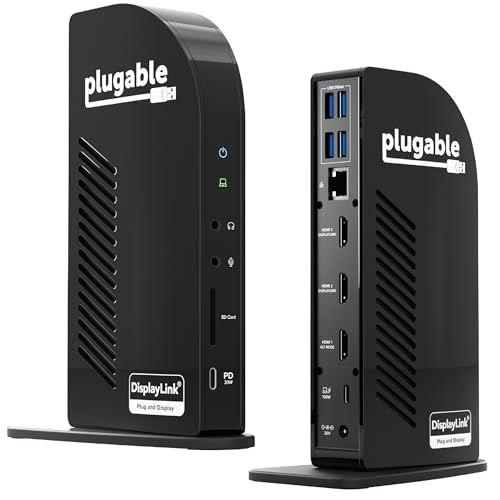
For professionals who juggle multiple tasks and need a seamless multi-monitor experience, the Plugable USB-C Triple Monitor Docking Station (UD-ULTCDL) stands out with its impressive ability to support three displays simultaneously. With 100W charging for laptops and 20W for devices, it’s perfect for your complete desk setup. Connect up to three HDMI displays, with the primary monitor reaching 4K at 30Hz and secondary monitors at 1920×1200. Featuring 13 ports, including USB-A, USB-C, and Gigabit Ethernet, it offers extensive connectivity options. Compatible with various systems, you’ll need to install DisplayLink Manager for seamless operation on macOS.
Best For: Professionals and multitaskers who require a seamless multi-monitor setup for enhanced productivity.
Pros:
- Supports up to three HDMI displays, providing a versatile multi-monitor experience.
- Delivers 100W charging for laptops, ensuring your device stays powered during use.
- Features a wide range of connectivity options with 13 total ports including USB-A, USB-C, and Gigabit Ethernet.
Cons:
- Requires installation of DisplayLink Manager on macOS to enable multiple displays, which may be an extra step for users.
- Limited to a maximum of 4K 30Hz on the primary display, which may not meet the needs of users requiring higher refresh rates.
- Heavier than some portable docking solutions, making it less ideal for travel.
CENMATE USB A/C 3.0 to 4xHDMI Adapter Docking Station

The CENMATE USB A/C 3.0 to 4xHDMI Adapter Docking Station stands out for users who need to connect multiple displays to their devices. With its 5-in-1 design, you can easily support four monitors—two at 4K30Hz and two at 1080P60Hz. It’s compatible with various systems, including Mac OS and Windows. You’ll enjoy speedy data transfer rates of up to 5 Gbps, making large file transfers a breeze. Installation requires a driver, and MacBook users must authorize screen recording. Plus, you get friendly tech support and a one-year warranty for peace of mind.
Best For: Users who need to connect multiple monitors to their devices for enhanced productivity and multitasking.
Pros:
- Supports four monitors with high display resolutions (4K30Hz x2 + 1080P60Hz x2).
- Fast data transfer rates of up to 5 Gbps, significantly improving file transfer times.
- Compatible with a wide range of operating systems, including Mac OS and Windows.
Cons:
- Requires a driver for installation, which may complicate the setup process for some users.
- HDCP content is not supported, limiting streaming options on services like Netflix or Hulu.
- ChromeOS, Linux, and Unix are not supported, restricting compatibility for users of these systems.
Plugable Dual 1080p HDMI Universal Docking Station (UD-3900Z)

With its ability to support dual HDMI displays at 1920×1200 resolution from a single USB connection, the Plugable Dual 1080p HDMI Universal Docking Station (UD-3900Z) is perfect for professionals who need to enhance their productivity. It features ten ports, including two USB 3.1, Gigabit Ethernet, and a 3.5mm audio jack, ensuring you’ve got all the connections you need. Compatible with various systems like M1 to M5 MacBooks and Windows 10+, it’s ideal for mixed-device environments. Plus, you’ll enjoy North American-based technical support and a two-year warranty for added peace of mind.
Best For: Professionals seeking to enhance productivity with dual monitor support and multiple connectivity options in mixed-device environments.
Pros:
- Dual HDMI display support at 1920×1200 resolution for improved multitasking.
- Wide compatibility with various operating systems and laptop brands.
- Backed by North American-based technical support and a two-year warranty.
Cons:
- Does not support HDCP, limiting its use for certain media playback.
- Not recommended for gaming or full-screen video playback due to performance limitations.
- DisplayPort monitors are not supported, which may restrict setup options.
WAVLINK DisplayLink Docking Station for Triple Monitor 4K

Looking to enhance your productivity? The WAVLINK DisplayLink Docking Station is your answer. With support for triple monitors at 4K@60Hz, you’ll enjoy stunning visuals. Its powerful 160W adapter charges laptops via USB-C, delivering up to 100W while powering your peripherals. You’ll appreciate the six USB Gen2 ports and 1Gbps Ethernet for fast data transfer. This station is optimized for the latest MacBook Neo, allowing seamless dual 4K monitor extension. Compatible with various operating systems, it’s designed to boost your workflow. Just make sure your laptop has the right type-C port for video output.
Best For: Professionals and creatives looking to enhance their productivity with multiple high-resolution displays.
Pros:
- Supports triple monitors at 4K@60Hz for exceptional visual clarity.
- Powerful 160W power adapter provides ample charging capabilities for laptops and peripherals.
- Optimized for the latest MacBook Neo, enabling seamless dual 4K monitor extension.
Cons:
- Requires laptops to have USB 3.1 full-function type-C or Thunderbolt 3/4 ports for compatibility.
- Not compatible with Unix systems, Linux, or iPad OS, limiting use with certain devices.
- HDMI (Alt Mode) port functionality depends on the laptop’s type-C port supporting video output.
Anker 10-in-1 USB C Docking Station
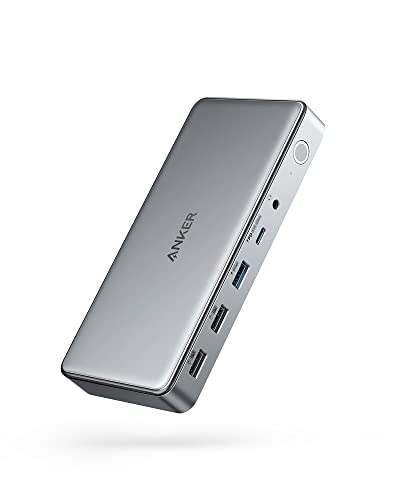
If you’re a professional requiring extensive connectivity options, the Anker 10-in-1 USB C Docking Station is an excellent choice. With DisplayLink technology, it expands your single USB-C port into two HDMI ports, a DisplayPort, and multiple USB-A and USB-C connections. You can enjoy triple display support with up to 4K resolution on the main screen. Plus, it provides 100W charging for your laptop and 30W for your phone. File transfers reach speeds of 5 Gbps. The docking station includes an 180W power adapter and comes with an 18-month warranty, making it a reliable investment for any workspace.
Best For: Professionals requiring extensive connectivity options and multi-display setups.
Pros:
- Versatile connectivity: Expands a single USB-C port into multiple HDMI, DisplayPort, and USB connections.
- High-resolution support: Allows triple display setups with up to 4K resolution on the main display.
- Fast charging capabilities: Provides up to 100W charging for laptops and 30W for phones, ensuring devices stay powered.
Cons:
- Limited to USB-C devices: Only compatible with laptops that have a USB-C port, excluding older models.
- DisplayLink dependency: Requires DisplayLink drivers for optimal performance, which may complicate setup.
- Size and portability: Slightly bulkier than other docking options, making it less ideal for travel.
Factors to Consider When Choosing Docking Stations With DisplayLink
When you’re choosing a docking station with DisplayLink technology, you need to take into account several key factors. Think about compatibility with your devices, the number of display outputs you require, and the power delivery capability. Additionally, look at the variety of ports and data transfer speeds to guarantee you get the best setup for your needs.
Compatibility With Devices
Choosing a docking station with DisplayLink technology requires careful consideration of compatibility with your devices. First, confirm it works with your operating system, as some models only support specific versions of Windows or macOS. Next, check if it connects to your device type, like USB-C or Thunderbolt, since compatibility can vary based on port type. Don’t forget to look for any driver requirements, as many stations need specific software to enable multi-monitor support. Think about how many external displays you plan to connect, since different docks support varying configurations. Finally, verify that the docking station provides adequate power delivery, typically between 60W and 100W, to charge your laptop while in use.
Number of Display Outputs
While considering a docking station with DisplayLink technology, the number of display outputs is an essential factor that can greatly impact your productivity. More outputs mean you can connect multiple monitors simultaneously, which is vital for multitasking. Some docking stations support dual monitor setups with resolutions up to 4K@60Hz, while others can even handle triple monitor configurations, giving you a broader workspace. The types of outputs, like HDMI and DisplayPort, also affect compatibility with different monitors. DisplayLink technology allows you to utilize multiple displays even if your system has limited native support. Just make sure the docking station’s specs match your devices’ capabilities, especially regarding supported resolutions and refresh rates for each output.
Power Delivery Capability
Power delivery capability is essential for guaranteeing your devices stay charged, especially during intensive tasks like video editing or running multiple applications. When choosing a docking station, look for one that provides up to 100W for laptops and less for peripherals. Higher wattage guarantees your laptop remains charged during demanding tasks, allowing you to focus on your work without worrying about battery life. Check the power delivery ratings, as they directly impact charging speed and device performance. Some docking stations can distribute power across multiple ports, letting you charge several devices simultaneously. Always verify compatibility with your device’s power requirements to avoid undercharging or risking damage from an overloaded docking station.
Port Variety and Types
A diverse selection of ports can greatly enhance your experience with a docking station featuring DisplayLink technology. When choosing one, consider the number and types of ports available. Look for a mix of USB-A and USB-C ports to accommodate various devices; USB 3.0 and 3.2 ports provide significant data transfer capabilities. Multiple video outputs, like HDMI and DisplayPort, are vital for supporting different monitor setups, especially if you need dual or triple displays. Don’t forget audio ports, such as a 3.5mm audio jack, for easy headphone or speaker connections. Finally, an Ethernet port guarantees stable internet access, which is essential for professional environments. Prioritize port variety to maximize your connectivity and functionality.
Data Transfer Speeds
When selecting a docking station with DisplayLink technology, data transfer speeds are a critical factor to take into account. You’ll find that USB-A ports typically offer speeds up to 480Mbps, while USB-C ports can reach impressive rates of 10Gbps. Consider the maximum speeds of the ports; USB 3.0 supports up to 5Gbps, and USB 3.2 can push that to 10Gbps. The number of USB ports also matters, as multi-port options allow you to connect multiple devices simultaneously, enhancing overall efficiency. If you’re into high-speed tasks like video editing or large file transfers, look for docking stations that can handle high data rates. Additionally, some models feature Gigabit Ethernet for stable internet access at 1000Mbps.
Size and Portability
Data transfer speeds are important, but size and portability can greatly influence your overall experience with docking stations equipped with DisplayLink technology. If you travel frequently, opt for compact models, which can be as small as 7L x 3.5W x 0.65H inches and weigh between 100 to 400 grams. These lightweight units easily fit in your laptop bag. Many feature a sleek aluminum design that’s not only stylish but also easy to carry. While considering size, think about the number and type of ports you need; compact options may prioritize essentials, while larger ones offer more connectivity. Keep in mind that built-in cooling systems can add weight, impacting portability during prolonged use.
Installation and Setup Ease
How easy is it to set up a docking station with DisplayLink technology? Generally, it’s a straightforward process. You’ll need to install specific DisplayLink drivers, which you can easily download and follow prompts on both Windows and macOS systems. Once that’s done, you might need to tweak your display settings to arrange monitors and resolutions to your liking. However, make sure your laptop has the necessary USB-C or Thunderbolt ports that support video output; otherwise, you could run into compatibility issues. Most docking stations come with clear instructional manuals that guide you through installation and address common troubleshooting. With the right steps, you’ll be connected and productive in no time!
Warranty and Support Options
Setting up your docking station with DisplayLink technology is just the beginning; choosing the right one also means considering warranty and support options. Look for a warranty period of at least one year, but some models may offer up to two years for added peace of mind. A clear and accessible customer support system is essential; it’ll enhance your experience when troubleshooting or setting up. Additionally, a return policy of 30 days or more allows you to test the docking station and return it if it doesn’t meet your needs. Some manufacturers even offer lifetime technical support, providing valuable resources for long-term usage. Finally, check customer reviews to gauge the reliability of warranty claims and support responsiveness.