Digitizing a box of prints is one thing; preserving slides and negatives calls for a scanner with film support and a workflow you can live with. These five Epson flatbeds span higher-end film-focused options and older models worth considering if you find them in good condition.
The right choice depends less on the biggest dpi number than on what you scan most, the condition of your originals, and whether the scanner works with your computer.
Best 5 Flatbed Scanners for Photos and Slides Picks for 2026
Pro-Grade Detail
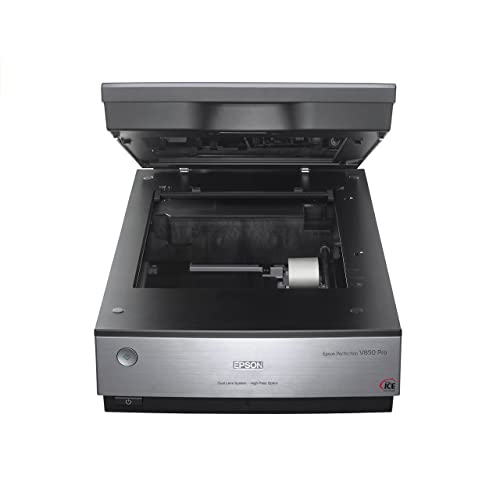
- 6400 dpi resolution
- 4.0 Dmax tonal range
- Dual-lens system
Best For: Detail-focused photo and slide projects
Tonal-Range Pick

- 6400 dpi resolution
- 4.0 Dmax tonal range
- Scans photos and slides
Best For: Photos and slides with subtle shadow detail
Format-Flexible Pick

- Print, slide, and negative support
- Medium-format film up to 6 x 22 cm
- No-warm-up LED scanning
Best For: Mixed print and film archives
Best for Multiple Film Formats
Epson Perfection 4990 Photo Scanner

- Adapters for slides through 4-by-5 film
- 4,800 x 9,600 dpi stated resolution
- Digital ICE and Easy Photo Fix
Best For: Mixed print and film collections
Best for Easy Photo Restoration
Epson Perfection V550 Photo Scanner

- 6,400 dpi optical resolution
- Built-in 35 mm film scanning
- Digital ICE and automatic photo cropping
Best For: Photo prints and 35 mm film
Pro-Grade Detail – Epson Perfection V850 Pro
Among flatbed scanners for photos and slides, the Epson Perfection V850 Pro is a choice for buyers prioritizing fine detail and tonal range. Its stated 6400 dpi resolution, 4.0 Dmax, and dual-lens system are aimed at detailed scans with smooth gradations and shadow detail.
Best For: Photo and slide scanning projects where detail and subtle tones matter most.
Pros:
- 6400 dpi resolution for detailed scans.
- 4.0 Dmax supports smooth gradations and fine shadow detail.
- Dual-lens system selects a lens for the scan.
Cons:
- At 20.9 pounds, it is relatively heavy to move.
- The listed operating-system support names older Windows and Mac OS X versions; verify compatibility with your computer.
The V850 Pro makes the most sense when scan quality takes priority over a lightweight setup. Check current computer compatibility before committing.
The Epson Perfection V800 Photo is one of the flatbed scanners for photos and slides to consider if preserving subtle tones is a priority. It pairs stated 6400 dpi resolution with 4.0 Dmax and a dual-lens system, and its listed media include both photos and slides.
Best For: Buyers scanning photos and slides who want fine shadow detail and smooth tonal gradations.
Pros:
- 6400 dpi resolution for detailed scans.
- 4.0 Dmax is specified for smooth gradations and fine shadow detail.
- Dual-lens system selects between two lenses.
Cons:
- At 20.9 pounds, it is not a lightweight option.
- The listed operating systems are older Windows and Mac OS X releases; check compatibility before buying.
Choose the V800 when resolution and tonal range are central to your project, but confirm that its software will work with your current setup.
For buyers comparing flatbed scanners for photos and slides, the Epson Perfection V600 Photo stands out for its stated film-format support. Its built-in transparency unit accepts four mounted 35mm slides or 12 negatives, while included holders support medium-format film up to 6 x 22 cm.
Best For: Digitizing a mix of prints, mounted slides, negatives, and medium-format film.
Pros:
- Scans photos and documents up to 8.5 x 11.7 inches alongside supported film formats.
- 6400 x 9600 dpi maximum resolution supports enlargements up to 17 x 22 inches.
- ReadyScan LED requires no warm-up; four customizable buttons simplify common tasks.
- Included software offers DIGITAL ICE dust and scratch removal and Easy Photo Fix restoration.
Cons:
- The transparency unit holds only four mounted 35mm slides or 12 negatives at a time.
- It uses a wired USB 2.0 connection.
The V600 is a practical match for a varied home archive, especially if you want one scanner for prints and several film formats. Its holder capacity is worth considering for large slide collections.
Best for Multiple Film Formats – Epson Perfection 4990 Photo Scanner
Among flatbed scanners for photos and slides, the Epson Perfection 4990 stands out for its adapters for slides, film strips, medium-format film, and 4-by-5 film. Its stated 4,800 x 9,600 dpi resolution and 4.0 Dmax make it a versatile choice for scanning a mixed photo and film collection.
Best For: People digitizing prints alongside several film formats, including medium-format and 4-by-5 film.
Pros:
- Adapters accommodate slides, film strips, medium-format film, and 4-by-5 film.
- Offers 48-bit color and 16-bit grayscale scanning.
- Includes Digital ICE and Epson Easy Photo Fix, plus USB 2.0 and FireWire interfaces.
Cons:
- At 19.6 pounds, it is relatively heavy to move or store.
- The supplied system requirements list Windows 7; confirm compatibility with your current computer before buying.
The broad film-format support is the main reason to choose this model. Check that its connections and software fit your setup before committing to an older scanner.
Best for Easy Photo Restoration – Epson Perfection V550 Photo Scanner
If you are comparing flatbed scanners for photos and slides, the Epson Perfection V550 offers a practical mix of 6,400 dpi optical resolution, a built-in transparency unit for 35 mm film, and tools for restoring older images. ReadyScan LED technology also eliminates warmup time.
Best For: Scanning photo prints and 35 mm slides or negatives with built-in restoration features.
Pros:
- Scans 35 mm slides, negatives, and film using its built-in transparency unit.
- Digital ICE reduces the appearance of dust and scratches on film; Easy Photo Fix helps restore faded photos.
- Can detect and save multiple photos as separate files, and includes OCR software for documents.
Cons:
- The supplied notes specify 35 mm film support, not medium-format or 4-by-5 film support.
- Uses Hi-Speed USB 2.0 rather than a newer USB connection.
The V550 is a strong fit when convenient print and 35 mm film scanning matters more than support for larger film formats. Its automatic photo cropping is especially useful for processing several prints at once.
How We Picked the Best Flatbed Scanners for Photos and Slides
We focused on five Epson flatbeds suited to scanning reflective photos and, with the appropriate holders, transparent film. The shortlist includes different price and age brackets rather than five interchangeable current models. We weighed film-format support, practical image quality, dust-removal options, workflow, and the risks of buying an older scanner. Listed specifications are a starting point; they do not guarantee the same detail from every original.
Quick Comparison
The V850 Pro is the premium pick for frequent film scanning, especially if you want its dual-lens design and bundled film-scanning accessories. The V800 offers a similar high-end direction if you find a complete unit at a worthwhile price. The V600 is a more accessible choice for mixed prints and common film formats. The V550 can suit occasional scanning when its price and included holders make sense. Treat the 4990 as a used-market option: condition, accessories, and software compatibility matter more than its original position in the lineup.
Key Buying Factors for Flatbed Scanners for Photos and Slides
Match the Scanner to Your Originals
Any of these flatbeds can handle prints, but slides and negatives require a functioning transparency light source and the correct film holders. Before buying, confirm support for your exact film format and check whether the holder is included. Medium-format film and mounted 35mm slides have different mounting needs; improvised placement can make alignment and focus less consistent.
Look Beyond the Dpi Claim
A higher advertised optical resolution does not automatically produce a sharper scan. Film sharpness, holder height, focus, and the scanner’s effective detail all matter. For small prints destined for sharing or modest reprints, a sensible scan setting saves time and storage. For slides or negatives you may enlarge, scan at a resolution that retains useful detail, then judge a test image at full size before committing to an entire archive.
Plan for Dust, Color, and Time
Clean the glass and originals gently before scanning. Infrared-based dust correction, where supported, can reduce cleanup on many color-film scans, but it is not a universal fix for every film type or damaged original. Allow time for cropping, color adjustment, file naming, and backups; these steps often take longer than the scan itself.
Check the Full Setup Before You Buy
With an older or secondhand scanner, verify the power supply, USB connection, transparency unit, holders, and glass condition. Confirm that compatible drivers and scanning software are available for your operating system. If possible, request sample scans of both a print and a slide or negative.
Who Should Buy Which Flatbed Scanners for Photos and Slides?
Choose the V850 Pro if you scan film regularly and value a more capable, accessory-rich workflow. Consider the V800 when you want a high-end alternative and can verify its condition and contents. Pick the V600 for a balanced prints-and-film setup; consider the V550 for lighter use if it costs meaningfully less. Buy a 4990 only when you are comfortable checking an older scanner and its software support. For any of these Flatbed Scanners for Photos and Slides, the best deal is the one that handles your actual film, includes the needed parts, and works reliably with your computer.