Cat 8 Ethernet Cable review is most useful if you want a long, tidy, high-spec cable for gaming, streaming, or network runs.
This Cat 8 Ethernet Cable 50FT looks built for people who care more about reliable wired connectivity than flashy extras.
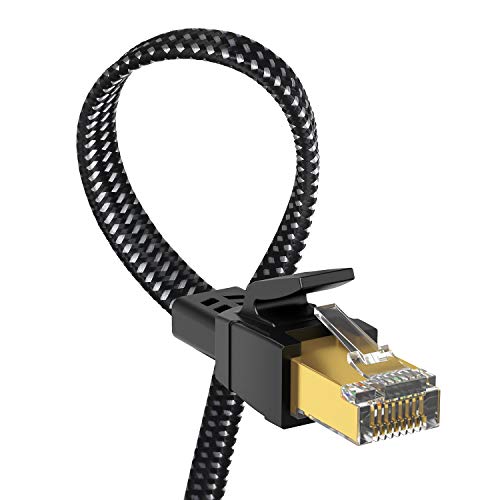
Cat 8 Ethernet Cable Review Summary
If you need a long indoor Ethernet cable that emphasizes speed, shielding, and easy routing, this Cat 8 Ethernet Cable is a strong fit.
It is aimed at buyers who want a flat cable that can be hidden along walls or edges, while still claiming Cat 8-level bandwidth and broad compatibility with common home and office gear.
The appeal is straightforward: high-speed positioning, shielded construction, and a flexible flat form factor.
That combination makes sense for gaming PCs, routers, modems, consoles, printers, and network storage devices where the main goal is stable wired connectivity over a long run.
Review Scorecard
| Category | Score | Why it scores here |
|---|---|---|
| Speed potential | 9/10 | Listing claims up to 40 Gbps and 2000 MHz, which is aggressive for a consumer cable. |
| Interference resistance | 8/10 | S/FTP shielding and foil twisted pairs are specifically positioned to reduce crosstalk and noise. |
| Install flexibility | 9/10 | The flat design is ideal for hiding the cable along walls, corners, and edges. |
| Device compatibility | 9/10 | Marketed for Cat5 through Cat6A environments and many common home devices. |
| Durability | 8/10 | Double braided nylon and a bend rating of at least 10,000 bends point to rugged everyday use. |
| Value for long runs | 8/10 | The feature set is strong if you actually need a 50ft shielded cable. |
| Versatility | 8/10 | Works across gaming, streaming, routers, printers, TVs, and storage gear. |
The short verdict: buy it if you want a long, neat, shielded Ethernet cable and you value practical installation more than premium branding. It is less compelling if you only need a short desk cable or if your setup does not benefit from Cat 8-level positioning.
Key Features and Specifications of Cat 8 Ethernet Cable
This model is a 50-foot flat Cat 8 Ethernet cable with a braided exterior and shielded internal construction.
The listing describes it as an indoor RJ45 LAN patch cord designed for gaming PCs, modems, routers, consoles, televisions, printers, and network storage equipment.
Here are the core facts from the listing:
| Spec | Detail |
|---|---|
| Length | 50 ft |
| Category | Cat 8 |
| Claimed speed | Up to 40 Gbps |
| Claimed bandwidth | Up to 2000 MHz |
| Shielding | S/FTP with 4 shielded foiled twisted pairs |
| Connector type | RJ45 with 24K gold-plated contacts |
| Cable shape | Flat |
| Outer jacket | Double braided nylon |
| Compatibility | Cat5, Cat5e, Cat6, Cat6A and many Ethernet devices |
| Intended use | Indoor networking, gaming, streaming, home and office installs |
The most important part of the spec sheet is the shielding and form factor.
Cat 8 branding gets attention, but for many buyers the practical upside is that this cable is flat, flexible, and easier to route than a round cable in the same length class.
The gold-plated RJ45 connectors are another useful detail, though they should be read as a durability and contact-quality feature rather than a magic performance upgrade.
In a cable like this, the build and shielding matter more than marketing language.
Pros and Cons of Cat 8 Ethernet Cable
Pros
- Long 50ft reach for rooms where the router and device are far apart.
- Flat profile makes it easier to tuck under edges, run along baseboards, or keep out of the way.
- S/FTP shielding is a real advantage for busy network environments with more interference.
- Broad compatibility means it can slot into many existing home setups.
- Braided construction suggests better everyday toughness and less tangling.
- Flexible routing is useful if you do not want a stiff cable fighting your layout.
Cons
- The Cat 8 label may be more than many households actually need.
- A 50ft run is overkill for users sitting right next to a router or switch.
- Flat cables can be convenient, but some buyers still prefer round cables for certain cable-management styles.
- The product is strong on listed specs, but the page gives little detail beyond the basics, so the buying decision rests mostly on trust in the build claims.
The balance is clear: the strengths are practical, not decorative.
This is a utility cable for people who want a neater long run and a sturdier-feeling product rather than a bare-minimum patch cord.
Who Should Buy Cat 8 Ethernet Cable?
This cable makes the most sense for buyers who need to connect devices across a room or around furniture and want the cable to stay unobtrusive.
It is also a sensible choice for gamers, streamers, and home-network users who prefer wired stability over Wi-Fi for consoles, PCs, or media devices.
It should also appeal to people building a cleaner setup.
The flat profile is a genuine advantage if you want the cable to follow a wall, slide behind a desk, or run around corners without creating a bulky visual line.
Good buyers include:
- Gamers using a PC, PlayStation, Xbox, or Switch over Ethernet
- Home users connecting routers, modems, and smart TVs
- Anyone running a long cable to a printer or network-attached storage device
- Buyers who want a flexible indoor cable that is easier to hide
Skip it if:
- You only need a very short patch cable
- Your network hardware is already close together
- You do not care about shielding or cable concealment
- You want the simplest, cheapest basic Ethernet lead rather than a higher-spec build
In plain terms, this is for people who need a long, disciplined cable run.
If that sounds like your setup, the product is aligned with the job.
Cable Design and Real-World Use of Cat 8 Ethernet Cable
Flat Shape for Cleaner Routing
The flat design is one of the most useful features here.
A flat cable is easier to lay along trim, slide behind furniture, and keep visually controlled in a room where a round cable would be harder to hide.
For many home users, that matters more than raw category labeling.
Shielding for Busy Environments
The listing emphasizes 4 shielded foiled twisted pairs and S/FTP construction.
That matters most when the cable has to coexist with other electronics, power cords, or dense equipment.
It is the kind of feature that supports stability rather than chasing flashy benchmark talk.
Durability for Repeated Adjustments
The braided nylon exterior and bend rating of at least 10,000 bends point toward a cable designed to tolerate movement and rerouting.
That is useful if you are likely to reposition the cable during setup changes or want something that feels less disposable.
Device Versatility Across a House
Compatibility with Cat5, Cat5e, Cat6, and Cat6A devices means the cable is not locked into a narrow use case.
It can serve as a general-purpose replacement or upgrade cable across entertainment gear, office equipment, and home networking hardware.
Alternatives to Cat 8 Ethernet Cable
If you want a different route, the main alternatives are usually about cable style, length, or brand reputation rather than radically different functionality.
- Jadaol Cat 6 Flat Ethernet Cable
- Cable Matters Cat 6 Ethernet Cable
- Amazon Basics Ethernet Cable
- UGREEN Cat 8 Ethernet Cable
- Vandesail Cat 8 Ethernet Cable
The most sensible comparison is usually between this cable and a well-reviewed Cat 6 or Cat 6A flat cable.
If you do not need the shielding claims or the Cat 8 positioning, a simpler alternative may be enough.
If you do want a long shielded flat cable, then this model stays competitive on design.
Is Cat 8 Ethernet Cable Worth It?
Yes, if you need a 50ft flat Ethernet cable with shielding and a durable braided build. That is the real value here, and it is enough to justify the product for gaming setups, home networking runs, and clean install projects.
If your network needs are modest, a shorter or lower-category cable may be the smarter buy.
But for buyers who specifically want a long indoor cable that is easier to hide and built with more protection in mind, this Cat 8 Ethernet Cable is worth considering.