Budget OLED gaming monitors deliver the contrast, response time, and motion clarity that make fast-paced games feel dramatically better. In 2026, even more 27-inch QHD models are bringing premium OLED performance to a wider range of players.
This roundup focuses on the best-value options for gamers who want deep blacks, vivid color, and high refresh rates without overspending. Whether you play competitive shooters or cinematic single-player titles, there’s a strong fit here.
Best 10 Budget OLED Gaming Monitors Picks for 2026
Budget OLED Pick
AOC 27" QHD 240Hz QD-OLED Gaming Monitor

- 27-inch QHD QD-OLED panel
- 240Hz refresh rate, 0.03ms response time
- HDR400 True Black and Adaptive-Sync
Best For: Fast 1440p gaming with strong OLED contrast
Premium Speed Runner
MSI MAG 271QP 27" 280Hz QD-OLED Gaming Monitor

- 280Hz QD-OLED panel with 0.03ms response
- 99% DCI-P3 and Delta E ≤2 accuracy
- HDMI 2.1, DP 1.4a, and USB-C connectivity
Best For: Competitive gaming with premium OLED speed
Balanced 240Hz Choice
MSI MAG 274QP 27" 240Hz QD-OLED Gaming Monitor

- 27-inch WQHD QD-OLED panel
- 240Hz refresh and 0.03ms response
- OLED Care 2.0 with HDMI 2.1 support
Best For: Balanced 1440p OLED gaming and console use
Premium Speed OLED
LG 27GX704A-B 27-inch QHD 240Hz OLED

- 240Hz QHD OLED with 0.03ms response time
- Up to 1300 nits peak brightness and True Black 400
- HDMI 2.1, DisplayPort, G-SYNC Compatible, FreeSync Premium Pro
Best For: Fast 27-inch OLED gaming with strong HDR and console support
Color-Accurate Competitive Pick
MSI MAG 272QP QD-OLED X24 27-Inch 240Hz

- QD-OLED panel with 10-bit color and 99% DCI-P3
- 240Hz refresh, 0.03ms response, ClearMR 13000
- OLED Care 2.0 plus Smart Crosshair and console modes
Best For: Color-focused players who want fast QHD OLED gaming
Value-Oriented OLED Choice
Z-Edge X27 27-inch QHD 240Hz OLED

- 240Hz OLED with 0.03ms GTG response
- QHD 1440p panel with true blacks and 1500000:1 contrast
- PIP/PBP plus height, swivel, and portrait adjustments
Best For: Budget buyers who want core OLED gaming performance and flexibility
Budget Sweet Spot
GIGABYTE GO27Q24G 27" W-OLED 240Hz QHD Gaming Monitor
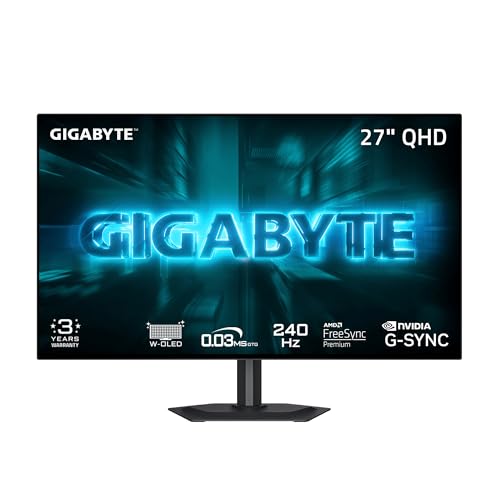
- MLA+ WOLED panel with up to 1300 nits peak brightness
- 240Hz refresh rate and 0.03ms response time
- AI-based OLED Care plus RealBlack Glossy coating
Best For: Fast shooters and buyers wanting a bright, high-refresh OLED
Balanced Performer
MSI MAG 271QPX QD-OLED E2 27-inch 2K Gaming Monitor

- QD-OLED panel with strong contrast and high picture quality
- 240Hz refresh rate and 0.03ms response time
- Fanless design with OLED Care 2.0 and custom heatsink
Best For: Competitive gamers who want silent, fanless QD-OLED performance
All-Around Pick
ViewSonic VX2738-2K-OLED 27 Inch QHD OLED Gaming Monitor

- QD-OLED panel with infinite contrast and 10-bit color
- 240Hz refresh rate and 0.03ms response time
- G-Sync, FreeSync Premium, and adjustable ergonomics
Best For: PC and console players who want one flexible OLED display
Budget OLED Pick – AOC 27" QHD 240Hz QD-OLED Gaming Monitor
If you want budget OLED gaming monitors with a strong mix of speed and image quality, the AOC Q27GAZD is an easy place to start. Its 27-inch QHD panel, 240Hz refresh rate, and 0.03ms response time are aimed at fluid PC gaming, while QD-OLED tech brings vivid color and deep contrast for single-player and competitive use alike.
Best For: Gamers who want a fast 1440p QD-OLED display with strong color and no-frills gaming performance.
Pros:
- 240Hz refresh rate and 0.03ms response time for smooth, responsive gameplay
- QD-OLED panel with 147.6% sRGB and 110.2% DCI-P3 coverage
- HDR400 True Black for deeper blacks and brighter highlights
- Adaptive-Sync support to help reduce tearing and stutter
Cons:
- No mention of USB-C, so connectivity may be more basic than some rivals
- HDR is limited to DisplayHDR 400 True Black rather than higher-tier certification
Overall, this AOC model focuses on the essentials: speed, contrast, and rich QD-OLED color. For shoppers comparing budget OLED gaming monitors, it stands out as a straightforward 1440p option that prioritizes gaming performance over extra features.
Premium Speed Runner – MSI MAG 271QP 27" 280Hz QD-OLED Gaming Monitor
The MSI MAG 271QP QD-OLED X28 is built for buyers looking at budget OLED gaming monitors but still wanting premium-speed performance. It pairs a 27-inch WQHD Quantum Dot OLED panel with a 280Hz refresh rate and 0.03ms response time, making it a strong fit for fast competitive play while still delivering the deep blacks and rich color OLED is known for.
Best For: Competitive gamers who want a 280Hz QD-OLED panel with solid console and PC connectivity.
Pros:
- 280Hz refresh rate with 0.03ms response time for very fast motion handling
- Quantum Dot OLED panel with 99% DCI-P3 coverage and Delta E ≤2 color accuracy
- DisplayHDR True Black 400 plus up to 1000 nits peak brightness
- HDMI 2.1, DP 1.4a, and USB-C with 15W power delivery
Cons:
- USB-C power delivery is limited to 15W
- Glossy screen finish may not suit every room setup
This MSI model pushes harder on speed and feature depth than many entry-level OLED options. If your priority is a fast, color-accurate 1440p display with useful gaming and connectivity extras, it is one of the more capable picks in this roundup.
Glare-Free Value OLED – Samsung 27" Odyssey OLED G5 QD-OLED
For shoppers comparing budget OLED gaming monitors, the Samsung Odyssey OLED G5 offers a practical blend of picture quality and comfort features. Its 27-inch QHD QD-OLED panel delivers strong color and brightness, while the matte Glare Free finish, OLED Safeguard, and Pantone Validated color support make it a flexible pick for mixed gaming and desktop use.
Best For: Players who want a glare-free QD-OLED monitor with burn-in protection and easy everyday use.
Pros:
- QD-OLED QHD panel with strong color accuracy and brightness
- Glare Free matte screen helps reduce reflections
- OLED Safeguard with Thermal Modulation System for burn-in prevention
- 180Hz refresh rate, 0.03ms response time, and G-Sync/FreeSync support
Cons:
- 180Hz is lower than the faster 240Hz and 280Hz rivals here
- Peak brightness is listed at 280 cd/㎡, which may trail some alternatives
This Samsung model leans into usability as much as gaming performance. If you want an OLED display that should feel easier to live with day to day, the anti-glare screen and safeguard features make it a smart, balanced choice.
Balanced 240Hz Choice – MSI MAG 274QP 27" 240Hz QD-OLED Gaming Monitor
The MSI MAG 274QP QD-OLED X24 fits well among budget OLED gaming monitors if you want a balanced spec sheet without chasing the absolute highest refresh rate. It uses a 27-inch WQHD Quantum Dot OLED panel, pairs that with 240Hz and 0.03ms response, and adds Adaptive-Sync plus HDMI 2.1 for straightforward gaming setup across PC and console use.
Best For: Gamers who want a 240Hz QD-OLED monitor with strong color, console support, and a practical feature set.
Pros:
- 240Hz refresh rate and 0.03ms response time for fast gameplay
- Quantum Dot OLED panel with 99% DCI-P3 and Delta E ≤2 accuracy
- Adaptive-Sync plus HDMI 2.1 and DP 1.4a connectivity
- OLED Care 2.0 and graphenе heatsink for durability-focused design
Cons:
- Peak brightness is listed at up to 400 nits, lower than some higher-end QD-OLED models
- Features are solid but less flashy than the X28 model’s 280Hz spec
In practical terms, this MSI monitor offers the core OLED gaming benefits without leaning too far into premium extras. It should appeal to buyers who want a dependable 1440p OLED screen that balances speed, connectivity, and burn-in protection.
Premium Speed OLED – LG 27GX704A-B 27-inch QHD 240Hz OLED
If you’re shopping for budget OLED gaming monitors but still want top-tier motion handling, the LG 27GX704A-B makes a strong case with a 27-inch QHD OLED panel, 240Hz refresh rate, and 0.03ms response time. It pairs next-gen console and PC connectivity with G-Sync Compatible and FreeSync Premium Pro support, so it fits well in a fast, no-nonsense gaming setup.
Best For: Players who want a fast 27-inch OLED with strong brightness, console-friendly ports, and flexible ergonomics.
Pros:
- 240Hz refresh rate and 0.03ms response time for very smooth, low-latency gameplay
- OLED panel with 275 nits standard brightness and up to 1300 nits peak brightness
- VESA DisplayHDR True Black 400 and 98.5% DCI-P3 coverage for deep blacks and vivid color
- Dual HDMI 2.1 plus DisplayPort 1.4 and USB ports for PC and console use
Cons:
- Glossy finish may be less ideal in bright rooms with uncontrolled lighting
- No built-in speakers are listed in the supplied details
- OLED care features need to be managed for long-term image retention protection
The LG stands out for buyers who want a premium-feeling OLED gaming monitor without sacrificing speed or connectivity. If your priority is responsive play with bright HDR punch and adjustable ergonomics, it covers the essentials well.
Color-Accurate Competitive Pick – MSI MAG 272QP QD-OLED X24 27-Inch 240Hz
Among budget OLED gaming monitors, the MSI MAG 272QP QD-OLED X24 is aimed at players who want strong contrast, sharp motion, and better color precision in a 27-inch WQHD package. Its QD-OLED panel, 240Hz refresh rate, and 0.03ms response time make it a practical option for fast gaming while the 10-bit color and 99% DCI-P3 coverage help it handle rich visuals well.
Best For: Gamers who care about color accuracy, fast response, and OLED care features in a mid-size 1440p display.
Pros:
- QD-OLED panel with 10-bit color and 99% DCI-P3 coverage
- 240Hz refresh rate, 0.03ms response time, and ClearMR 13000 rating
- Graphene heatsink design is fanless for panel durability
- OLED Care 2.0, Smart Crosshair, and console modes add useful gaming tools
Cons:
- Peak brightness is listed at up to 400 nits, which is lower than some premium OLED rivals
- Only tilt/height adjustment is specified in the supplied notes, so stand flexibility is not the most extensive
- Connectivity is solid but limited to DisplayPort 1.4a and HDMI 2.1 CEC ports
This MSI model is a balanced pick if you want OLED gaming speed without giving up color quality. It looks especially appealing for players who want built-in protection features and a clean 27-inch form factor.
Value-Oriented OLED Choice – Z-Edge X27 27-inch QHD 240Hz OLED
The Z-Edge X27 fits the budget OLED gaming monitors search well if you want a straightforward 27-inch QHD OLED without a long feature list. It delivers the core essentials for gaming—240Hz refresh, 0.03ms GTG response, true blacks, and strong contrast—while adding a few practical extras like PIP/PBP and visibility tools for darker scenes.
Best For: Budget-minded gamers who want a fast 1440p OLED with useful visibility and multitasking features.
Pros:
- 240Hz refresh rate and 0.03ms GTG response for smooth motion
- QHD 2560×1440 OLED panel with 1500000:1 contrast and true black performance
- PIP/PBP support for multi-source setups
- Ergonomic stand with height, swivel, and portrait rotation adjustments
Cons:
- Matte finish may not deliver the same glossy pop some OLED buyers prefer
- Brightness is listed at 400 cd, which may be modest versus higher-end OLED options
- The brand and feature set are less established than some mainstream gaming monitor competitors
The Z-Edge X27 focuses on the fundamentals, which is exactly what some buyers want from an affordable OLED gaming monitor. If you value speed, contrast, and a flexible stand over premium extras, it is easy to consider.
Budget Sweet Spot – GIGABYTE GO27Q24G 27" W-OLED 240Hz QHD Gaming Monitor
If you want budget OLED gaming monitors that still feel premium in fast-paced games, the GIGABYTE GO27Q24G is built around speed and contrast. Its 27-inch WOLED panel with MLA+ aims for brighter HDR highlights, while the 240Hz refresh rate and 0.03ms response time keep motion crisp for competitive play.
Best For: Fast shooters, esports players, and anyone who wants a bright, high-refresh OLED without overcomplicating the setup.
Pros:
- MLA+ WOLED panel with up to 1300 nits peak brightness for more vivid HDR punch
- 240Hz refresh rate and 0.03ms GtG response time for very fluid motion
- RealBlack Glossy coating helps preserve dark detail in brighter rooms
- AI-based OLED Care adds built-in burn-in protection with minimal interference
Cons:
- Best brightness numbers are peak-based, not typical sustained output
- OLED care features may add setup choices for users who want the simplest possible monitor
The GO27Q24G stands out if you want a sharper, faster OLED gaming monitor with modern protection features and a cleaner borderless design. It looks especially compelling for buyers comparing affordable OLED options that still prioritize speed and HDR impact.
Balanced Performer – MSI MAG 271QPX QD-OLED E2 27-inch 2K Gaming Monitor
For shoppers comparing budget OLED gaming monitors, the MSI MAG 271QPX QD-OLED E2 offers the core gaming specs most people actually want: 240Hz, 0.03ms response, and strong OLED contrast. Its QD-OLED panel is aimed at excellent picture quality, while the fanless cooling design and OLED Care 2.0 focus on long-term practicality.
Best For: Competitive gamers who want a QD-OLED picture with silent, fanless operation and broad gaming compatibility.
Pros:
- QD-OLED panel delivers strong contrast and high picture quality
- 240Hz refresh rate paired with 0.03ms GtG response for fast gameplay
- OLED Care 2.0 is designed to reduce the chances of panel aging
- Graphene film and customized heatsink enable fanless, silent heat dispersion
Cons:
- Matte screen finish may not appeal to buyers who prefer a glossier OLED look
- Only one HDMI port is listed, which may matter for multi-device setups
This MSI model is a practical pick if you want the familiar strengths of QD-OLED without extra noise from an active cooling fan. It fits neatly into a roundup of affordable OLED gaming monitors for players who value speed, contrast, and a low-maintenance design.
All-Around Pick – ViewSonic VX2738-2K-OLED 27 Inch QHD OLED Gaming Monitor
If you want budget OLED gaming monitors with strong everyday flexibility, the ViewSonic VX2738-2K-OLED is an easy model to compare. It combines a 27-inch QD-OLED panel, 240Hz refresh, and 0.03ms response time with broad device support, making it a straightforward choice for mixed PC and console use.
Best For: Players who want one OLED monitor for PC gaming, consoles, and general use.
Pros:
- QD-OLED panel delivers infinite contrast, deep blacks, and vibrant 10-bit color
- 240Hz refresh rate and 0.03ms GtG response for smooth, blur-free motion
- Supports NVIDIA G-Sync and AMD FreeSync Premium for tear-free gaming
- Fully adjustable stand with tilt, swivel, pivot, and height adjustments
Cons:
- No peak brightness figure is listed in the supplied notes
- Connectivity is limited to HDMI and DisplayPort inputs in the provided details
The VX2738-2K-OLED is a sensible option when you want the core advantages of OLED plus ergonomic flexibility and wide compatibility. For a roundup focused on affordable OLED gaming monitors, it covers a lot of bases without leaning too hard into one specialty.
How We Picked the Best Budget OLED Gaming Monitors
For Budget OLED Gaming Monitors, we prioritized real gaming value over flashy specs alone. The best picks combine 240Hz-class performance, low response times, strong HDR behavior, and practical connectivity such as HDMI 2.1, DisplayPort, and adaptive sync support. We also looked for models that make sense for most buyers: 27-inch QHD panels, competitive pricing for OLED, and enough flexibility for both PC and console gaming.
Quick Comparison
Most of these displays share a similar sweet spot: 27-inch size, 2560 x 1440 resolution, and refresh rates from 240Hz to 280Hz. If you want the fastest option, look at the 280Hz class. If you want the safest all-around value, 240Hz QD-OLED and W-OLED models usually hit the best balance of price, motion performance, and image quality.
Key Buying Factors for Budget OLED Gaming Monitors
Refresh Rate and Response Time
For competitive play, 240Hz is the baseline to target, while 280Hz can offer a small edge if your system can actually push the frames. OLED response times are already excellent, so motion clarity comes more from refresh rate and overall tuning than raw panel speed.
Panel Type and Image Preference
QD-OLED often delivers especially strong color volume and perceived vibrancy, while W-OLED can be a great choice for buyers who want a more traditional OLED look. Both are excellent for gaming, so your preference may come down to brightness behavior, text clarity, and pricing.
HDR, Brightness, and Connectivity
Look for DisplayHDR True Black certification or a similarly strong HDR implementation if you want better highlight impact in supported games. For console users, HDMI 2.1 is important, while PC gamers should confirm DisplayPort version, adaptive sync compatibility, and the number of USB or video inputs they need.
Burn-In Protection and Long-Term Use
OLED care features matter, especially if you use your monitor for work as well as gaming. Automatic pixel refresh, logo dimming, screen shifting, and warranty coverage can help make an OLED purchase feel safer over time.
Who Should Buy Which Budget OLED Gaming Monitors?
Choose a 280Hz model if you play competitive shooters and want every possible responsiveness advantage. Pick a well-priced 240Hz QD-OLED if you want the best all-around mix of value and image quality. If you game on both PC and console, prioritize HDMI 2.1 and adaptive sync support. And if your budget is tighter, the most affordable 240Hz options still deliver the core OLED advantages that make these displays worth considering.