The best compact hard drive docking stations make it easier to access, clone, back up, and reuse bare SATA drives without installing them inside a computer. They are especially useful for upgrading storage, recovering files, or switching between multiple drives.
This roundup compares 10 options across USB 3.0 and USB-C connectivity, single- and dual-bay designs, cloning features, and support for 2.5-inch and 3.5-inch HDDs and SSDs.
Best 10 Compact Hard Drive Docking Stations Picks for 2026
Dual-Bay Cloning Pick
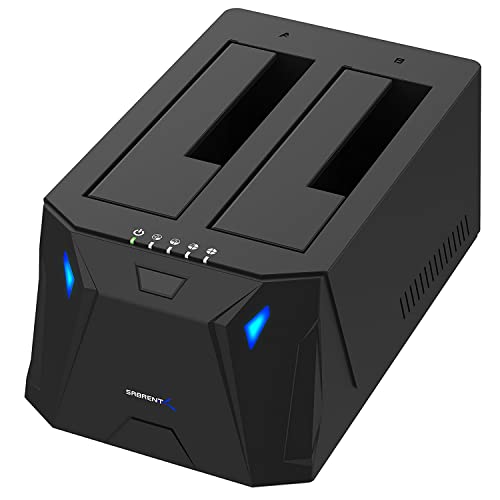
- Dual bays for 2.5-inch and 3.5-inch SATA drives
- Offline cloning without a computer
- USB 3.0 speeds up to 5Gbps
Best For: Standalone cloning and two-drive access
High-Capacity Lay-Flat Pick
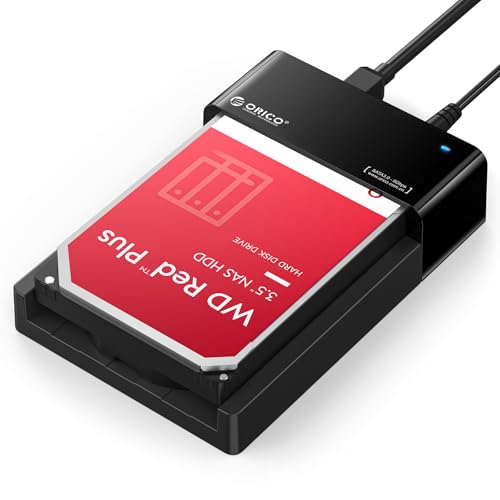
- Supports a single drive up to 24TB
- USB 3.0 with UASP up to 5Gbps
- Lay-flat design encourages natural cooling
Best For: High-capacity single-drive access
USB-C Cloning Pick

- Two bays for separate drive access
- Offline 1-to-1 cloning up to 60MBps
- USB-C connectivity with USB 3.0 speeds
Best For: USB-C users cloning and transferring between SATA drives
Versatile Single-Bay Pick

- Supports SATA drives up to 22TB
- UASP and USB 3.0 up to 5Gbps
- Compatible with computers and several consumer devices
Best For: Flexible single-drive access across multiple platforms
Simple SATA Access
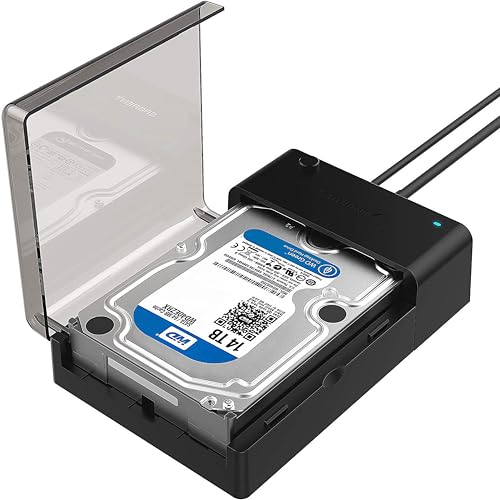
- Single-bay access for 2.5- and 3.5-inch SATA drives
- Tool-free, hot-swap design with USB 3.0
- 12V adapter included for 3.5-inch drives
Best For: Straightforward access to one bare SATA HDD or SSD
Clone and Connect

- Dual bays support up to 44TB total
- Offline cloning without a computer
- UASP, TRIM, and USB 3.0 support
Best For: Two-drive transfers and offline disk duplication
Everyday Drive Swaps
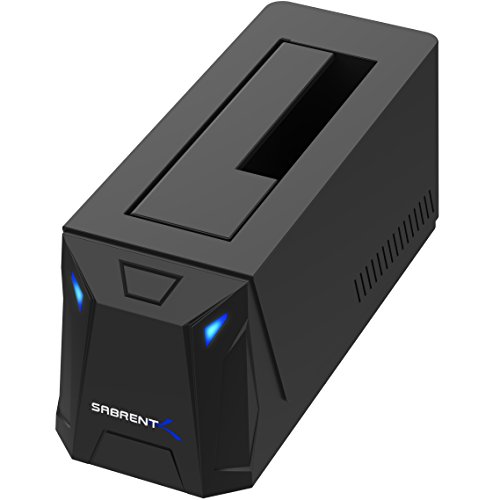
- Supports 2.5- and 3.5-inch SATA drives
- USB 3.0 with UASP and hot-swapping
- Auto-sleeps after 30 minutes of inactivity
Best For: Routine backups and transfers with bare SATA drives
Most Versatile
ICY BOX M.2 and SATA Drive Dock

- Reads 3.5-inch, 2.5-inch, and M.2 drives
- USB 3.2 Gen 2 speeds up to 10Gbps
- Includes USB-C and USB-A connectivity
Best For: Mixed-drive users needing one flexible dock
Best SATA Pick

- Supports 2.5-inch and 3.5-inch SATA drives
- Up to 10Gbps and 20TB-plus capacity support
- Includes USB-A and USB-C cables
Best For: High-capacity SATA backups and drive swapping
Best for Cloning

- Holds two 2.5-inch or 3.5-inch SATA drives
- Performs offline cloning without a computer
- USB 3.0 transfers up to 5Gbps
Best For: Two-drive access and offline SATA cloning
Dual-Bay Cloning Pick – Sabrent USB 3.0 Dock
For users comparing compact hard drive docking stations, the SABRENT EC-HD2B combines two SATA bays with offline cloning and USB 3.0 connectivity. It accepts both 2.5-inch and 3.5-inch SATA HDDs or SSDs, making it useful for drive access, backups, and upgrades without installing drives inside a computer.
Best For: Users who want a dual-bay SATA dock with standalone drive cloning.
Pros:
- Supports 2.5-inch and 3.5-inch SATA hard drives and SSDs.
- Holds two drives and supports capacities up to 10TB per drive.
- Offers offline cloning at up to 60Mbps without requiring a computer.
- Plug-and-play USB 3.0 connectivity reaches up to 5Gbps.
Cons:
- Designed for SATA drives, so other drive interfaces are not covered.
- Offline cloning is limited to the stated 60Mbps speed.
The EC-HD2B is a practical choice when two-bay access and simple offline duplication matter more than a minimal single-drive footprint. Its included power supply and USB 3.0 cable make it ready for straightforward desktop use.
High-Capacity Lay-Flat Pick – Orico UASP Dock
The ORICO lay-flat model is one of the compact hard drive docking stations suited to high-capacity single-drive access. Its USB 3.0 interface with UASP supports up to 5Gbps, while the open, flat design helps promote natural convection cooling during extended data tasks.
Best For: Users who need a single-drive dock supporting large-capacity 2.5-inch or 3.5-inch SATA storage.
Pros:
- Supports one 2.5-inch or 3.5-inch SATA I/II/III HDD or SSD up to 24TB.
- UASP-enabled USB 3.0 connectivity supports transfer speeds up to 5Gbps.
- Tool-free, hot-swappable design simplifies drive changes.
- Compatible with Windows, Linux, and Mac OS systems without additional drivers.
Cons:
- Only one drive can be installed at a time.
- It does not provide the dual-bay cloning function found on some docks.
Choose this ORICO dock when capacity, easy swapping, and a low-profile lay-flat design are priorities. The included 12V adapter and USB 3.0 cable also support a ready-to-use setup.
USB-C Cloning Pick – Sabrent Dual-Bay USB-C Dock
The SABRENT EC-CH2B stands out among compact hard drive docking stations for its USB-C host connection and two-bay workflow. It can mount two SATA drives separately for computer-based file transfers or clone one drive to another offline with the press of a button.
Best For: USB-C computer users who need dual-drive access and offline 1-to-1 cloning.
Pros:
- Supports bare 2.5-inch and 3.5-inch SATA HDDs and SSDs.
- Clones offline without a computer at up to 60MBps.
- Both bays can be read and written as separate drives over USB.
- Tool-free, hot-swappable design includes an access LED for each bay.
Cons:
- Requires a computer with USB-C or a separate USB-C-to-USB-A cable.
- Does not support IDE/PATA, M.2, NVMe, or Molex-equipped drives.
- The target drive must be the same size as or larger than the source for cloning.
This dock is a strong fit for migration and backup workflows built around USB-C systems. Confirm your computer’s port and the drive interface before ordering, since compatibility is limited to SATA storage.
Versatile Single-Bay Pick – Orico SATA Dock
The ORICO DD18 is a flexible option among compact hard drive docking stations, supporting 2.5-inch and 3.5-inch SATA drives through USB 3.0. UASP support, hot-swapping, broad operating-system compatibility, and connections for devices such as PCs, smart TVs, routers, and PS4 systems make it useful beyond a single desktop setup.
Best For: Users wanting a versatile single-bay SATA dock for computers and compatible consumer devices.
Pros:
- Supports 2.5-inch and 3.5-inch SATA I/II/III HDDs and SSDs up to 22TB.
- UASP-enabled USB 3.0 supports transfer speeds up to 5Gbps.
- Works with Windows, Mac, Linux, iPad OS devices with Thunderbolt, and Raspberry Pi.
- Includes hot-swap support, LED indicators, and automatic sleep after 10 minutes of inactivity.
Cons:
- Supports one drive at a time.
- Does not support IDE or SAS drives.
- New or unallocated drives must be initialized and formatted before recognition by a PC.
The DD18 balances capacity, compatibility, and simple tool-free operation. It is particularly appealing if the same dock may be used with several supported platforms, though users should verify SATA compatibility and prepare blank drives through disk management.
Simple SATA Access – Compact Single-Bay Dock
For straightforward access to a bare drive, this compact hard drive docking station supports one 2.5-inch or 3.5-inch SATA HDD or SSD through USB 3.0. Its tool-free, lay-flat design makes it convenient for backups, drive swaps, and troubleshooting, provided your computer has a USB-A port.
Best For: Users who need a simple single-drive dock for standard SATA drives.
Pros:
- Supports 2.5-inch and 3.5-inch SATA I/II/III HDDs and SSDs.
- Tool-free insertion, hot-swapping, and plug-and-play support for Windows, macOS, and Linux.
- Includes the 12V power adapter required for 3.5-inch drives.
- UASP support can help compatible systems make better use of USB 3.0.
Cons:
- Supports SATA drives only—not IDE/PATA, M.2, SAS, or USB-enclosed drives.
- Uses a USB Type-A host cable; a USB-C adapter is needed for USB-C-only computers.
- Does not pass S.M.A.R.T. diagnostics through the USB bridge.
This SABRENT dock keeps the setup small and uncomplicated, but its single-bay design and SATA-only compatibility make it best suited to routine drive access rather than cloning or multi-drive workflows.
Clone and Connect – ORICO Dual-Bay Dock
This ORICO dual-bay model adds offline cloning to the usual file-transfer duties, making it one of the more versatile compact hard drive docking stations for two bare SATA drives. It supports 2.5-inch and 3.5-inch HDDs or SSDs and includes a dedicated 12V/3A power supply.
Best For: Users who need dual-drive access and computer-free disk cloning.
Pros:
- Supports two 2.5-inch or 3.5-inch SATA drives, with capacity support up to 44TB total.
- Offline clone function works without connecting the dock to a computer.
- UASP and TRIM support with USB 3.0 connectivity.
- Works with Windows, Mac, Linux, iPadOS, Android, smart TVs, routers, and PS4 according to the supplied specifications.
Cons:
- The target disk must be larger than the source disk for offline cloning.
- Uses USB-A connectivity, which may require an adapter for USB-C-only computers.
- The dock does not power on without a hard drive inserted.
Choose this ORICO when cloning and two-drive flexibility matter more than the smallest possible footprint. Its independent power supply and status indicators are useful for sustained transfers, while the tool-free bays simplify swapping.
Everyday Drive Swaps – SABRENT Auto-Sleep Dock
This SABRENT model is a practical compact hard drive docking station for routine access to 2.5-inch and 3.5-inch SATA drives. It includes an AC adapter, supports USB 3.0 with UASP, and adds automatic sleep after 30 minutes of inactivity to reduce unnecessary operation.
Best For: Home and office users who regularly connect bare SATA drives for backups or transfers.
Pros:
- Accepts standard 2.5-inch and 3.5-inch SATA HDDs and SSDs.
- Includes the required AC adapter and USB 3.0 cable.
- Supports UASP, hot-swapping, and backward compatibility with USB 2.0 and 1.1.
- Auto-sleep after 30 minutes of idle time and separate power and transfer LEDs.
Cons:
- SATA only; it does not support SAS or M.2 NVMe drives.
- New or blank drives must be initialized and formatted in Disk Management or Disk Utility.
- The supplied AC adapter is required for operation, so it needs access to a wall outlet.
With clear activity indicators and automatic sleep, this dock is a sensible everyday choice for drive access. Remember that hot-swapping should be done only when the drive is not being accessed.
Most Versatile – ICY BOX M.2 and SATA Drive Dock
For shoppers comparing compact hard drive docking stations, the ICY BOX stands out as a flexible single-bay reader for 3.5-inch HDDs, 2.5-inch SSDs, and M.2 NVMe or SATA SSDs. Its USB 3.2 Gen 2 connection supports transfers up to 10Gbps, while the open, tool-free design makes drive changes quick.
Best For: Users who need one compact dock for several drive types and operating systems.
Pros:
- Supports 3.5-inch HDDs, 2.5-inch drives, and M.2 NVMe/SATA SSDs.
- Up to 10Gbps transfer speeds through USB 3.2 Gen 2.
- Includes a USB-C-to-C/A cable for modern and traditional ports.
- Works with Windows, macOS, Linux, and Android without drivers.
Cons:
- Its single bay handles only one drive at a time.
- It requires a 12V DC power supply.
The ICY BOX is the strongest all-around option here if you regularly work with both legacy SATA drives and newer M.2 storage. Its broad compatibility and fast interface add convenience, though a dual-bay dock may be better for simultaneous drives.
Best SATA Pick – SABRENT USB-C SATA Dock
The SABRENT DS-UC1B is a practical choice among compact hard drive docking stations if your storage is primarily SATA-based. It accepts 2.5- and 3.5-inch HDDs or SSDs, supports up to 20TB drives, and uses USB 3.2 Gen 2 for transfer rates up to 10Gbps.
Best For: Users who want a fast, tool-free dock for high-capacity 2.5- or 3.5-inch SATA drives.
Pros:
- Supports 2.5-inch and 3.5-inch SATA HDDs and SSDs.
- Handles drives rated at 20TB and larger.
- Includes both USB-A and USB-C-to-C cables.
- Tool-free, hot-swappable design with a retractable dust cover.
Cons:
- It does not support M.2 drives.
- Only one drive can be connected at a time.
Choose the SABRENT when reliable SATA support and easy swapping matter more than broad format coverage. Its high-capacity support and included cables make it a well-equipped single-drive solution for backups and transfers.
Best for Cloning – FIDECO Dual-Bay SATA Dock
The FIDECO dual-bay dock offers a different advantage from many compact hard drive docking stations: it can hold two 2.5- or 3.5-inch SATA drives and clone one drive to another without a computer. Its USB 3.0 connection reaches up to 5Gbps for ordinary file transfers.
Best For: Users who need two-drive access or convenient offline SATA drive cloning.
Pros:
- Dual bays accept two 2.5-inch or 3.5-inch SATA HDDs or SSDs.
- Supports offline cloning without a connected computer.
- Plug-and-play operation with Windows, macOS, and Linux.
- Supports transfer speeds up to 5Gbps over USB 3.0.
Cons:
- It supports SATA drives only, not M.2 storage.
- Its USB 3.0 speed is lower than the 10Gbps docks listed here.
- New drives may need initialization before the computer recognizes them.
The FIDECO is the most useful option when drive cloning or simultaneous two-drive access is a priority. It trades newer USB speeds and M.2 support for a straightforward dual-bay layout and computer-free cloning feature.
How We Picked the Best Compact Hard Drive Docking Stations
We focused on docks that balance compact designs with practical storage support. The selected models cover common SATA drive formats, including 2.5-inch laptop drives and 3.5-inch desktop drives, while also including options for USB-C systems, dual-drive workflows, offline cloning, and M.2 NVMe storage.
We also considered connection speed, bay layout, ease of swapping drives, compatibility, and the type of user each dock best serves. A dock is most useful when its interface and features match your computer, drive collection, and backup routine.
Quick Comparison
| Feature | What to look for | Best suited to |
|---|---|---|
| Drive capacity | 2.5-inch, 3.5-inch, or both | Matching your existing drives |
| Bay count | Single or dual bay | Individual access or drive-to-drive work |
| Connection | USB 3.0 or USB-C | Matching your computer and desired speed |
| Cloning | Offline cloning support | Drive upgrades and direct duplication |
| Protocol support | UASP or 10Gbps USB | Faster compatible transfers |
Key Buying Factors for Compact Hard Drive Docking Stations
Drive Size and Interface
Check whether the dock supports both 2.5-inch and 3.5-inch SATA drives. Most SATA docks do not support IDE, SAS, or PCIe drives unless those formats are specifically listed. If you use M.2 SSDs, confirm whether the dock accepts SATA M.2, NVMe M.2, or both.
USB Speed and Compatibility
USB 3.0 is adequate for many hard drives, while USB 3.2 Gen 2 or 10Gbps USB-C can reduce transfer times with faster SSDs. A USB-C dock may still work with an adapter, but a direct connection is generally simpler and more reliable. UASP support can improve performance when the computer and operating system support it.
Single Bay, Dual Bay, or Cloning
Single-bay docks are smaller and suit occasional drive access. Dual-bay models are more convenient when comparing drives, copying data, or keeping two disks connected. Offline cloning is valuable for upgrading a boot drive, but verify that the destination drive is at least as large as the source and understand that cloning may overwrite existing data.
Power and Everyday Usability
3.5-inch desktop drives usually require an external power adapter, so review the included power supply and cable length. Look for stable drive slots, clear status indicators, accessible eject controls, and a footprint that fits your desk or travel setup.
Who Should Buy Which Compact Hard Drive Docking Stations?
Choose a compact single-bay dock if you mainly access one bare drive at a time and want the smallest setup. A dual-bay dock is better for frequent backups, drive comparisons, or moving data between two SATA drives. Choose a cloning model for straightforward drive upgrades without relying entirely on computer software.
USB-C models are the natural choice for newer laptops and desktops, while USB 3.0 options remain practical for broad compatibility. If your workflow includes both traditional SATA drives and M.2 SSDs, select a hybrid dock only after confirming the exact M.2 protocol and supported drive types.