A compact diagnostic scanner can turn a warning light into useful information without taking up much room in your glove box, toolbox, or roadside kit.
We compare 10 space-saving car diagnostic scanners across wired and Bluetooth designs, focusing on practical features such as code reading, live data, battery testing, readiness checks, and ease of use.
Best 10 Space-Saving Car Diagnostic Scanners Picks for 2026
Compact Code Reader

- Reads and clears engine codes
- Compact, lightweight design
- Supports major OBDII protocols
Best For: Portable emission-system checks for compatible OBDII vehicles
Simple Color-Screen Scanner
- Plug-and-play OBDII operation
- Color display with DTC lookup
- Includes I/M readiness testing
Best For: DIYers seeking accessible check-engine diagnostics
Two-in-One Space Saver

- Engine scanner and battery tester
- Tests cranking and charging systems
- Compact with live-data functions
Best For: DIYers consolidating engine and battery testing in one tool
Entry-Level DIY Scanner
- Plug-and-play code reading
- Built-in database with 3,000+ codes
- Includes live data and I/M readiness
Best For: Portable basic diagnostics for compatible OBDII vehicles
Best Bluetooth Pick

- Compact wireless OBD-II scanner for iOS and Android
- Reads codes, live data, freeze frames, and readiness status
- Requires a compatible third-party app
Best For: Drivers wanting smartphone-based check-engine diagnostics
Best Standalone Value
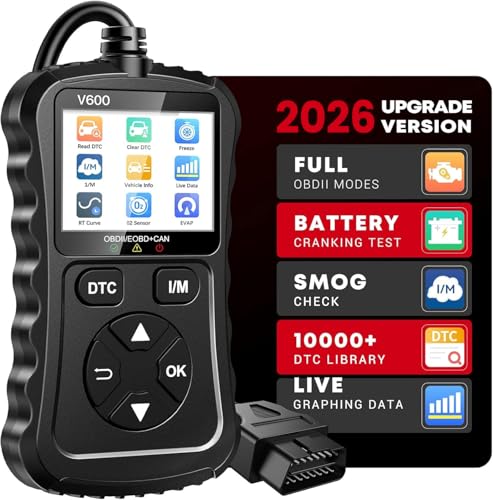
- Standalone color-screen scanner with plug-and-play operation
- Adds voltage testing, live graphs, and readiness checks
- Compact housing and flexible cable simplify storage
Best For: Beginners who prefer a wired reader without a phone app
Best for Live Data

- Compact standalone reader with a 2.8-inch color screen
- Graphs live engine data and supports EVAP and O2 tests
- Includes readiness shortcuts and lifetime free updates
Best For: DIYers diagnosing engine and emissions issues
Best Connected Option

- Compact sensor stays hidden under the dash
- Wireless iPhone and Android diagnostics
- Tracks multiple vehicles and maintenance reminders
Best For: Drivers who prefer app-based, always-ready diagnostics
Best Screen-Based Choice
ANCEL AD410 Enhanced OBD2 Scanner

- Dedicated 2.4-inch color display
- Includes 42,000+ code definitions
- Supports live data and emissions readiness checks
Best For: DIY users wanting no-app engine diagnostics
Compact Code Reader – ANCEL AD310 Classic
For straightforward space-saving car diagnostic scanners, the ANCEL AD310 keeps the focus on essential engine-code checks. Its compact, lightweight body, clear screen, and built-in vehicle power make it practical for a glove box, backpack, or home garage.
Best For: Drivers and DIYers who need a portable reader for emission-related engine codes on compatible OBDII vehicles.
Pros:
- Reads and clears engine trouble codes, with live data, freeze-frame, and I/M readiness functions.
- Supports major OBDII protocols and many 1996-or-newer compatible vehicles.
- Compact 12-ounce design with a sturdy 2.5-foot cable and no battery or charger requirement.
Cons:
- Limited to emission-related engine diagnostics.
- Does not diagnose ABS, SRS, transmission, or OBDI systems.
The AD310 is a sensible, compact choice when you want quick check-engine-light information without carrying a larger professional scanner. Confirm vehicle compatibility before purchase.
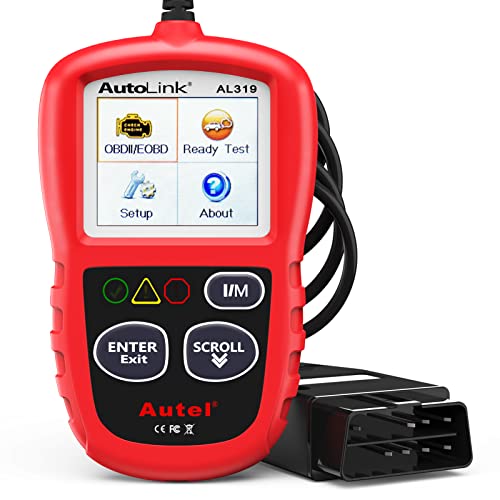
Simple Color-Screen Scanner – Autel AL319
The Autel AL319 is a compact option among space-saving car diagnostic scanners, combining plug-and-play operation with a color display and one-click I/M readiness testing. It is designed for quick check-engine-light troubleshooting without batteries or a complicated setup.
Best For: DIY vehicle owners who want an easy-to-read scanner for basic OBDII engine diagnostics and emissions readiness checks.
Pros:
- Reads and clears codes, displays live data and freeze frame, and provides DTC lookup.
- Features a 2.4-inch TFT color screen, built-in speaker, and LED indicators.
- Supports seven languages, post-1996 OBDII vehicles, lifetime free updates, and a 12-month warranty.
Cons:
- Functions are centered on OBDII diagnostics rather than broader system scanning.
- Compatibility still depends on the vehicle’s supported OBDII protocol.
With its small footprint and straightforward interface, the AL319 suits owners who want fast access to common check-engine information while keeping storage space to a minimum.
Two-in-One Space Saver – ANCEL AD410 PRO
The ANCEL AD410 PRO stands out among space-saving car diagnostic scanners by combining engine diagnostics with 12V battery testing in one compact tool. That all-in-one design can reduce the need to store separate equipment for battery, starting, charging, and check-engine checks.
Best For: DIYers who want one portable tool for compatible OBDII engine diagnostics plus battery, cranking, and charging-system tests.
Pros:
- Combines OBDII code scanning with battery health, cranking, and charging-system testing.
- Offers live data, waveform graphs, freeze frame, I/M readiness, and a database of more than 42,000 SAE codes.
- Has a compact glove-box-friendly design, 2.4-inch screen, 10-language support, and lifetime updates.
Cons:
- Does not support ABS, SRS, transmission systems, or EVs.
- Requires the included battery clamp cable for battery-system testing.
If storage efficiency matters, the AD410 PRO delivers more coverage than a basic code reader without requiring a separate battery tester. Verify that your vehicle meets its stated OBDII compatibility requirements.
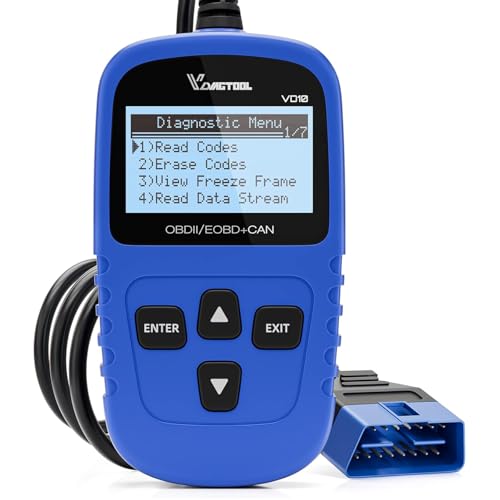
Entry-Level DIY Scanner – VDIAGTOOL VD10
The VDIAGTOOL VD10 offers a compact approach to everyday OBDII troubleshooting. Its plug-and-play design provides code reading, code clearing, live data, freeze frame, and I/M readiness checks without needing batteries or a separate charger.
Best For: Car owners and hobbyists who want a straightforward portable scanner for compatible 12V OBDII cars, SUVs, and light trucks.
Pros:
- Reads and clears generic, pending, and manufacturer-specific codes with built-in DTC definitions.
- Displays live sensor data, freeze frame information, I/M readiness, and vehicle identification details.
- Supports all listed OBDII protocols and uses a plug-and-play, adjustable-contrast display.
Cons:
- Designed for OBDII diagnostics rather than advanced vehicle systems.
- Its stated compatibility varies by region and model year, so vehicle fit should be checked.
The VD10 is a practical space-saving choice for basic engine fault checks and inspection preparation. Its built-in code database can also reduce the need to search for common code definitions separately.
Best Bluetooth Pick – Veepeak OBDCheck BLE
The Veepeak OBDCheck BLE is a compact option for drivers seeking space-saving car diagnostic scanners that work with a smartphone. Its Bluetooth LE connection supports iOS and Android devices, while compatible third-party apps provide standard OBD-II code reading and live data.
Best For: Smartphone users who want a small wireless scanner for check-engine diagnostics.
Pros:
- Compact 1.61-by-1.97-by-0.87-inch design with a mini carrying case
- Reads and clears check-engine codes, freeze-frame data, I/M readiness, and live sensor data
- Works with many compatible apps, including Car Scanner ELM OBD2, Torque, and OBD Fusion
Cons:
- Requires a compatible third-party app, and some features may cost extra
- Does not support special functions such as ABS bleeding, oil resets, injector coding, or relearns
- Bluetooth connection must be initiated within the app rather than the phone’s Bluetooth menu
This is a convenient glove-box solution for basic OBD-II troubleshooting, but buyers should verify both vehicle and app compatibility before ordering.
Best Standalone Value – Compact OBD2 Code Reader
This compact wired reader is a practical choice among space-saving car diagnostic scanners for users who prefer a built-in screen over a phone app. It provides plug-and-play OBD-II diagnostics, a voltage test, and a flexible cable for convenient storage and use.
Best For: Beginners and DIYers who want an affordable standalone reader with voltage monitoring.
Pros:
- Compact, lightweight housing with a bright color screen and flexible cable
- Reads and clears engine codes, displays live data and graphs, and checks freeze-frame and I/M readiness information
- Built-in voltage test, power indicator, shortcut keys, and support for 10 languages
Cons:
- Cannot detect trucks or motorcycles according to the supplied notes
- Japanese vehicles made before 2005 may not have supported OBD diagnostic capability
- Backed by a 90-day warranty, which is shorter than some competing options
Its dedicated display and straightforward controls make it easy to keep in a vehicle or toolbox, provided your car meets the stated compatibility requirements.
Best for Live Data – FOXWELL NT301 OBD2 Scanner
The FOXWELL NT301 combines a compact wired format with more detailed emissions and engine information, making it one of the more capable space-saving car diagnostic scanners for DIY use. Its color display, live-data graphs, and dedicated readiness controls help organize basic troubleshooting.
Best For: DIYers who want live sensor graphs and emissions-related OBD-II tests in a standalone tool.
Pros:
- Reads and clears engine codes with plug-and-play operation and no subscription
- Graphs live data such as oxygen sensors, fuel trims, coolant temperature, and RPM
- Includes I/M readiness shortcuts, LED status indicators, EVAP checking, and O2 sensor testing
- Offers lifetime free updates and a bright 2.8-inch color screen
Cons:
- Focused on OBD-II diagnostics rather than broad manufacturer-specific systems
- Compatibility and functionality vary by vehicle year, make, model, and VIN
- Requires a wired connection to the vehicle’s diagnostic port
The NT301 is a strong fit when live-data visibility and inspection readiness matter more than wireless convenience, while its compact screen keeps the setup manageable.
Best Connected Option – FIXD Bluetooth OBD2 Scanner
For drivers seeking space-saving car diagnostic scanners, the FIXD Bluetooth OBD2 Scanner offers a compact, hidden-under-the-dash design with wireless phone access. It can identify more than 39,000 issues, explain codes in the app, and support scans across multiple vehicles.
Best For: Drivers who want app-based diagnostics, maintenance reminders, and a scanner that can remain installed in the vehicle.
Pros:
- Compact 1.5-by-0.5-by-1.75-inch sensor can stay hidden under the dash
- Works with iPhone and Android through Bluetooth
- Supports unlimited scans and more than 39,000 issue explanations
- Lets users manage multiple vehicles in one app
Cons:
- Requires a compatible smartphone and app
- Advanced features may require the optional premium upgrade
- Features vary by vehicle make and model
FIXD is a strong space-conscious choice when you prefer wireless access and ongoing vehicle tracking rather than a handheld screen. Its always-installed format is particularly convenient for households with multiple cars.
Best Screen-Based Choice – ANCEL AD410 Enhanced OBD2 Scanner
The ANCEL AD410 is a practical pick among space-saving car diagnostic scanners for users who want a dedicated handheld unit without carrying a phone or charger. Its 2.4-inch color display provides code definitions and live vehicle data directly from the OBD2 port.
Best For: DIY drivers who want broad engine and emissions diagnostics in a self-contained, no-app scanner.
Pros:
- Requires no battery, charger, Bluetooth, or phone app
- Supports live data, freeze frame, I/M readiness, O2, and EVAP tests
- Includes more than 42,000 built-in DTC lookups
- Offers multilingual menus and free software updates
Cons:
- Reads engine and emissions-related codes only
- Does not support ABS, SRS, transmission, bidirectional control, or service resets
- Compatibility should be checked for the specific vehicle
The AD410 balances a relatively compact handheld format with useful on-screen diagnostics. It is a good fit for garage or glove-box storage, though its capabilities are focused on engine and emissions systems.
Best Portable Value – OBDEXPERT V519 OBD2 Scanner
The OBDEXPERT V519 combines a compact handheld body with plug-and-play operation, making it a convenient option among space-saving car diagnostic scanners. It reads and clears engine codes, displays live data, checks battery voltage, and stores 35,901 built-in code definitions.
Best For: Beginners and DIY owners who want a portable scanner for routine checks, road trips, and emergency diagnostics.
Pros:
- Compact, lightweight design is easy to store and carry
- Needs no batteries, app, or Bluetooth pairing
- Provides live data, I/M readiness, VIN, battery voltage, and onboard tests
- Supports 10 languages and includes a one-year warranty
Cons:
- Its 6.3-inch listed length may require more storage room than the smallest sensors
- Designed for OBD2 engine diagnostics rather than advanced system controls
- Vehicle compatibility depends on having a standard 16-pin OBD2 port
With a built-in display and broad basic diagnostic functions, the V519 is easy to keep in a glove box or emergency kit. It offers useful coverage without the setup involved with wireless scanners.
How We Picked These Space-Saving Car Diagnostic Scanners
We selected scanners that combine a small footprint with useful everyday diagnostic functions. The lineup includes simple plug-and-play code readers, more capable wired tools with live data, and Bluetooth models that work through a phone app. We considered compatibility with standard OBD2 vehicles, code-reading and clearing functions, display or app usability, portability, and whether each tool adds helpful capabilities such as battery-voltage checks, EVAP-related testing, freeze-frame data, or I/M readiness.
These scanners are intended primarily for diagnosing common check-engine-light issues. They do not replace professional equipment for manufacturer-specific systems such as airbags, ABS, transmission modules, or advanced bidirectional testing unless explicitly stated by the manufacturer.
Quick Comparison
| Type | Best For | Main Advantage | Potential Limitation |
|---|---|---|---|
| Basic wired reader | Occasional code checks | Simple setup and no charging | Fewer advanced functions |
| Enhanced wired scanner | DIY troubleshooting | Live data, readiness, and freeze-frame information | Requires access to the vehicle port |
| Bluetooth scanner | Phone-based monitoring | Compact storage and app features | Requires a compatible app and phone |
| Scanner with battery testing | Starting and charging concerns | Combines two useful checks in one tool | Battery analysis may be limited compared with dedicated testers |
Key Buying Factors for Space-Saving Car Diagnostic Scanners
Vehicle Compatibility
Confirm that the scanner supports your vehicle’s model year and OBD2 protocol. Most gasoline vehicles sold in the United States from 1996 onward use OBD2, while diesel, hybrid, imported, and newer vehicles may require additional compatibility checks.
Functions You Actually Need
For occasional warning-light checks, reading and clearing diagnostic trouble codes may be enough. Live data helps track sensor readings while the engine runs, whereas freeze-frame data records conditions present when a fault occurred. I/M readiness is useful before emissions testing. A battery-voltage function can also help identify basic electrical concerns, but it is not always a full replacement for a dedicated battery analyzer.
Wired Versus Bluetooth Design
Wired scanners are ready to use without pairing, subscriptions, or a separate device. Bluetooth models are often the smallest option and can provide charts, saved results, and app-based guidance, but their experience depends on phone compatibility, software quality, and permissions.
Portability and Operation
Look for a short cable or compact plug-in body, a readable screen, clearly labeled buttons, and durable strain relief. If the scanner will stay in the car, consider whether it can be stored safely without interfering with pedals or driver controls.
Who Should Buy Which Space-Saving Car Diagnostic Scanners?
Choose a basic wired reader if you want an inexpensive tool for checking a check-engine light and clearing codes after repairs. Select an enhanced wired model if you want live data, readiness information, or freeze-frame details without relying on a smartphone. A Bluetooth scanner is best for drivers who prefer app-based results, long-term monitoring, and the smallest storage footprint. If you are troubleshooting no-start concerns or weak electrical systems, a model with voltage or battery-testing features is the more versatile choice.
Before clearing any code, record the code number and related data. Clearing the warning light does not fix the underlying problem and may reset emissions monitors, so complete repairs and drive-cycle checks before an inspection.