Faulty cables can waste rehearsal time, interrupt live shows, and create confusing studio problems. The best budget audio cable testers make it easier to identify broken conductors, shorts, miswiring, and connector issues before they become bigger headaches.
This roundup compares 10 affordable options, from compact audio-focused testers to broader kits that also handle Ethernet, coaxial, speaker, lighting, and other cable types.
Best 10 Budget Audio Cable Testers Picks for 2026
Best All-Around Budget Pick
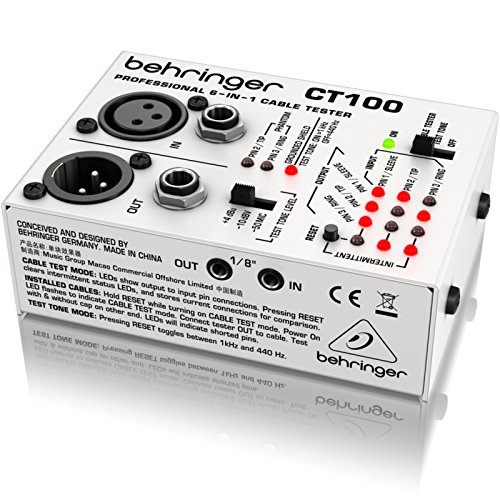
- Tests cables, installed cables, and test tones
- Handles XLR, TRS, RCA, MIDI, and more
- Detects continuity, intermittent contacts, and shielding issues
Best For: General audio-cable troubleshooting across varied connector types
Best for Wire Tracing

- Traces non-active low-voltage wires under 60 volts
- Includes alligator clips and an RJ45 test cable
- Adds wire mapping, volume control, headphones, and a work light
Best For: Low-voltage cable tracing and wire identification
Best for Connector Variety
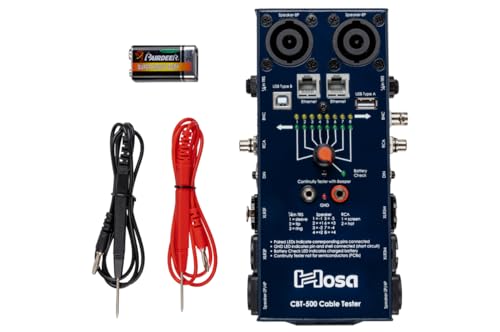
- Supports XLR, BNC, Ethernet, and SpeakON
- Uses battery-powered ohmmeter testing
- Includes a limited lifetime warranty
Best For: Testing mixed professional audio and signal cables
Best for Speaker and Stage Cables

- Tests multiple audio, SpeakON, network, and DMX connectors
- Supports 2-, 4-, and 8-pole SpeakON connections
- Provides ohmmeter and continuity testing
Best For: Live-sound and stage setups with diverse connectors
Multi-Cable Workbench Pick
MFL. 15-Plug Audio Cable Tester

- Tests a broad selection of audio connectors
- LED indicators show conductor continuity
- Rugged casing with a 10-way switch
Best For: Mixed recording and live-performance cable setups
Rugged Pro-Style Pick
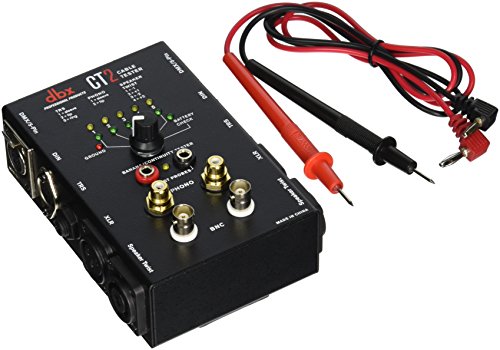
- Six-position selector with pin LEDs
- Adds audible continuity feedback
- Rugged construction with XLR and speaker connections
Best For: Routine XLR, speaker, and general continuity testing
Compact Value Pick
MFL. 13-Plug Audio Cable Tester

- Tests up to 13 cables
- LED indicators reveal continuity issues
- Compact metal body with an eight-way switch
Best For: Home studios and small audio setups
Detachable Audio Testing Value
15-in-1 Detachable Cable Checker

- Covers a wide range of audio and data connectors
- Splits into sender and receiver units
- LEDs show conductor connection status
Best For: Multi-format audio and installed-cable testing
Pro Audio & Lighting Choice
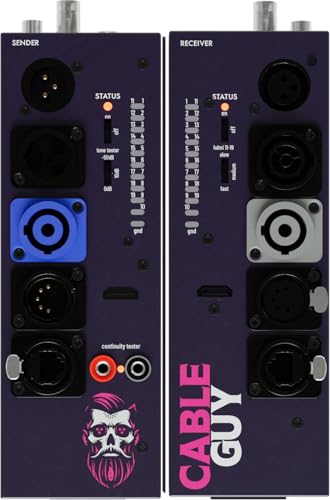
- Tests XLR, HDMI, RJ45, TRS, RCA, BNC, and powerCON
- LEDs provide quick continuity feedback
- Two-piece design supports through-wall testing
Best For: Professional audio, lighting, and installation work
Best All-Around Budget Pick – Behringer CT100
The Behringer CT100 is a practical choice for shoppers comparing budget audio cable testers. Its microprocessor-controlled design supports cable tests, installed-cable tests, and a test-tone mode, while the LED display keeps operation straightforward.
Best For: Home studios, musicians, and audio setups using a broad mix of common connector types.
Pros:
- Supports XLR, TRS, RCA, MIDI, and other standard connectors.
- Offers continuity checks and intermittent-contact detection.
- Includes phantom-power and ground-shield checks.
- Compact, battery-powered design with an intuitive LED display.
Cons:
- The supplied notes do not specify battery life or included battery type.
- Warranty details require referring to the manufacturer’s warranty information.
With its wide connector coverage and multiple testing modes, the CT100 is a versatile budget audio cable tester for general-purpose troubleshooting.
Best for Wire Tracing – Klein Tools VDV500-705
The Klein Tools VDV500-705 is a tone generator and probe kit suited to budget audio cable testers shoppers who also need broader low-voltage wire tracing. It is designed for non-active wires under 60 volts and includes accessories for unterminated and RJ45 connections.
Best For: Tracing and mapping speaker, telephone, Ethernet, coax, and other low-voltage wiring.
Pros:
- Combines a tone generator with a wire-tracing probe.
- Includes alligator clips and an RJ45-to-RJ45 test cable.
- Supports pin-to-pin wire mapping.
- Features adjustable volume, a headphone jack, and a probe work light.
Cons:
- It is intended for low-voltage wiring and has a maximum operating voltage of 60 volts.
- Its focus is wire tracing and mapping rather than a dedicated multi-connector audio tester.
This kit makes the most sense when cable identification is as important as continuity checking, particularly in installations with mixed low-voltage wiring.
Best for Connector Variety – Hosa CBT-500
The Hosa CBT-500 is a battery-powered audio cable tester for buyers who need support for several cable formats. The supplied specifications identify compatibility with XLR, 75-ohm BNC, Ethernet, and SpeakON connections, making it useful for varied audio and signal setups.
Best For: Users testing a selection of professional audio, network, and signal cables from one tester.
Pros:
- Supports XLR, 75-ohm BNC, Ethernet, and SpeakON cables.
- Uses ohmmeter-style testing.
- Battery-powered for portable use.
- Includes a limited lifetime warranty.
Cons:
- The supplied notes provide limited information about testing modes and display features.
- At 2 pounds, it is heavier than some compact cable-testers.
The CBT-500 is worth considering when connector coverage matters more than a long list of advanced testing functions, though buyers may want to confirm compatibility with their exact cables.
Best for Speaker and Stage Cables – Elite Core OSP CT-04C
The Elite Core OSP CT-04C is a broad-coverage continuity tester for shoppers seeking budget audio cable testers for speaker and stage connections. It supports common audio plugs along with SpeakON, network, and DMX connections.
Best For: Live-sound users and speaker-cable setups involving SpeakON, XLR, TRS, MIDI, and related connectors.
Pros:
- Tests 1/4-inch TRS, male and female XLR, RCA, MIDI, and DIN connections.
- Supports 2-, 4-, and 8-pole SpeakON connectors.
- Also covers 1/8-inch mini stereo, RJ45 CAT5e, and 3- or 5-pin DMX.
- Provides ohmmeter or continuity testing.
Cons:
- Its 1.8-pound weight and listed dimensions make it less compact than pocket-sized testers.
- The supplied notes do not identify advanced diagnostic modes or display details.
For stage rigs with speaker and lighting-related connectors, the CT-04C offers especially wide coverage and a useful continuity-testing focus.
Multi-Cable Workbench Pick – MFL. 15-Plug Audio Cable Tester
For shoppers comparing budget audio cable testers, the MFL. 15-Plug model is a practical choice when you need broad connector coverage and quick continuity checks. Its LED indicators, 10-way switch, and rugged metal casing are suited to troubleshooting cables in recording or live-performance setups.
Best For: Users who need an affordable, versatile tester for checking several audio cable types and up to 13 cables at the same time.
Pros:
- Supports a wide range of connections, including TRS, XLR, RCA, DIN, and Speakon.
- LED indicators help confirm individual conductor connections.
- Compact metal casing is designed for durability.
- 10-way switch helps select the connection being tested.
Cons:
- Requires a 9-volt battery, which is not included.
- At 1.5 pounds, it may be heavier than simpler handheld testers.
Its extensive connector support makes this a strong value for mixed audio setups. Choose it if maximum testing flexibility matters more than having the smallest possible tester.
Rugged Pro-Style Pick – dbx CT-2 Cable Tester
Among budget audio cable testers, the dbx CT-2 stands out for its sturdy construction and straightforward connection testing. It combines a six-position rotary selector with LED indicators, a beeper-equipped banana connector tester, and dedicated XLR and speaker twist connections.
Best For: Musicians, technicians, and audio users who want a durable tester with visual and audible continuity indications.
Pros:
- Six-position selector provides individual LED indications for up to five pins.
- Built-in battery-life check helps monitor the tester’s power source.
- Beeper and LED indicator support continuity testing through the banana connector.
- Includes XLR and speaker twist connectors for pin-to-pin testing.
Cons:
- Uses a battery and does not list a battery as included in the supplied details.
- Its listed connector set may be less broad than the multi-plug MFL. models.
The CT-2 is a sensible option when ruggedness and clear testing feedback are priorities. Its dedicated connectors make it especially useful for common XLR and speaker-cable checks.
Compact Value Pick – MFL. 13-Plug Audio Cable Tester
The MFL. 13-Plug model is a useful budget audio cable tester for checking continuity across common audio connections without a complicated setup. It offers LED indicators, an eight-way switch, and a compact metal enclosure while supporting up to 13 cables at the same time.
Best For: Home studios and small audio setups that need broad cable testing in a straightforward, durable format.
Pros:
- All-in-one design supports testing up to 13 cables.
- LED indicators help identify conductor connection problems.
- Strong, compact metal casing is suited to repeated use.
- Eight-way switch helps select the connection to test.
Cons:
- Requires a 9-volt battery, which is not included.
- The eight-way switch offers fewer selections than the related 15-plug model.
This tester balances connector coverage, simple operation, and durability. It is a good fit when you want a versatile cable checker but do not need the additional switch positions of the larger MFL. model.
Versatile Coax & Ethernet Pick – Portable BNC/RJ45 Cable Tester
For shoppers comparing budget audio cable testers, this compact coax and Ethernet checker is a practical option for quick continuity troubleshooting. It supports BNC, F-style coax, and RJ45 connectors, making it useful across audio, video, network, and security setups.
Best For: Portable field testing of coaxial and RJ45 cables.
Pros:
- Supports BNC, F-style coax, and RJ45 connectors.
- Designed to identify signal and connectivity issues quickly.
- Compact, portable construction for on-site testing.
- Requires no external power source.
Cons:
- Its supported connector range is narrower than that of multi-format audio testers.
- Uses ohmmeter-style continuity measurement rather than advanced signal analysis.
This is a straightforward choice when your main needs are coax or RJ45 continuity checks. Its simple, portable design keeps troubleshooting convenient without adding extra features you may not need.
Detachable Audio Testing Value – 15-in-1 Detachable Cable Checker
This detachable 15-in-1 model stands out among budget audio cable testers for its broad connector coverage and split sender-and-receiver design. It can check long or preinstalled cables while LED indicators help identify conductor connection problems.
Best For: Audio setups that require testing multiple connector types and installed cable runs.
Pros:
- Supports RJ45, RJ11, HDMI, Speakon, XLR, RCA, BNC, DIN, TRS, DMX, and Banana connections.
- Separates into sender and receiver units for long or installed cables.
- Ten-way switch helps select the connection being tested.
- Rugged metal casing is designed for repeated use.
Cons:
- Battery is required but not included.
- At 1.14 kg, it is less lightweight than a basic single-format tester.
Choose this tester when flexibility matters more than minimal size. Its extensive connector support and detachable construction make it particularly useful for diagnosing cables already routed through an audio or installation environment.
Pro Audio & Lighting Choice – Multi-Function Cable Tester
For budget audio cable testers used in professional-style rigs, this multi-function model combines broad cable support with a durable steel housing. Its LED indicators provide quick continuity feedback, and the two-piece design supports through-wall testing.
Best For: Audio, lighting, networking, and permanent installations using several industry-standard cable types.
Pros:
- Tests 3-pin and 5-pin XLR, HDMI, RJ45/EtherCON, powerCON, powerCON TRUE1, TRS, RCA, and BNC cables.
- Matching LED indicators provide fast continuity feedback.
- Separate sender and receiver units enable through-wall testing.
- Steel housing is built for heavy-use professional environments.
Cons:
- Requires two 9V batteries, which are not included.
- Its broad feature set may be unnecessary for users testing only one cable format.
This is a strong fit for technicians who work across audio and lighting systems and need one tester for multiple cable families. The rugged enclosure and separated units add practical value for installation work, while the LED display keeps checks quick.
How We Picked the Best Budget Audio Cable Testers
We focused on practical value for musicians, recording engineers, live-sound crews, installers, and technicians who need dependable fault checks without buying high-end diagnostic equipment. Our comparison considers connector coverage, continuity and wiring tests, cable tracing features, switch and indicator layout, portability, construction, and ease of use.
Because “audio cable tester” can mean anything from a simple XLR checker to a multi-format cable diagnostic tool, we included both dedicated audio models and versatile testers that support common stage and installation connections.
Quick Comparison
| Best For | Look For |
|---|---|
| Basic audio troubleshooting | XLR, TRS, TS, RCA, and speaker-cable compatibility |
| Mixed studio and stage setups | Multiple connector types and clear LED indicators |
| Ethernet, coax, or data work | RJ45, BNC, F-type, telephone, or network testing |
| Cable tracing | Tone generation, probe support, or line-finder functionality |
| Frequent professional use | Strong housing, secure switches, and replaceable batteries |
Key Buying Factors for Budget Audio Cable Testers
Connector Coverage
Start with the plugs and sockets you actually use. XLR support is essential for microphone and balanced signal cables, while 1/4-inch, RCA, speakON, DIN, HDMI, RJ45, BNC, and power connectors may matter in larger or more varied systems. More connector types add flexibility, but they can also make a tester larger and more expensive.
Test Functions and Indicators
At minimum, look for continuity testing and a readable indicator system that identifies open, shorted, reversed, or crossed conductors. A stepped switch or automatic scan can speed up checks, while a detachable remote end is useful for long cables and installed runs.
Tracing and Troubleshooting Range
A continuity tester confirms whether conductors connect correctly. A tone generator and probe can help locate an unknown cable in a bundle or wall, making that feature especially valuable for installers and venues. Choose a tracer only if you regularly need to identify cables, since it may add cost and complexity.
Portability and Durability
Compact testers are convenient for gig bags and tool cases, but a sturdy enclosure and protected controls matter when the unit travels frequently. Check battery type, indicator brightness, switch quality, and whether the tester can handle the cable lengths and connectors used in your workflow.
Who Should Buy Which Budget Audio Cable Testers?
Choose a simple audio tester if you mainly maintain microphone, instrument, patch, and speaker cables. It will be faster to learn and easier to carry than a broad diagnostic kit. A multi-format tester is the better choice for mobile production teams, studios, schools, and venues managing several cable standards.
Installers and technicians should prioritize models with tone generation, remote testing, or support for Ethernet and coaxial connections. For professional crews, paying slightly more for wider connector coverage and a tougher design can reduce replacement costs and save time. Whatever you choose, keep a known-good cable nearby so you can confirm the tester itself is operating correctly before diagnosing a critical signal path.