Reliable audio distribution matters when reporters, cameras, and production teams all need clean feeds from the same source. The best high-performance audio press boxes help reduce signal conflicts while keeping event setups organized and predictable.
This roundup compares 10 options spanning passive press boxes, stereo DI units, stage boxes, and compact isolators, so you can match channel count, connectivity, and portability to your workflow.
Best 10 High-Performance Audio Press Boxes Picks for 2026
High-Capacity Press Box

- One input feeds 12 microphone outputs
- Transformer-isolated outputs help reduce noise
- 20 Hz–20 kHz range with 150-ohm impedance
Best For: Large press events requiring many isolated microphone feeds
Multi-Output Event Box

- 12+2 mult-box configuration
- Metal body for professional setups
- XLR connector compatibility
Best For: Large press events needing a robust multi-output box
Compact Eight-Output Press Box

- One XLR input with eight isolated outputs
- Compact 8 x 4 x 8-inch design
- Weighs 3.5 pounds
Best For: Smaller press events and portable eight-channel setups
Two-Channel Isolation Option

- Passive two-channel stereo DI
- Isolation transformer and ground lift
- Includes a 15 dB pad
Best For: Two-channel isolated routing and signal-level management
Press Distribution Specialist
Whirlwind PB24 Passive Press Box
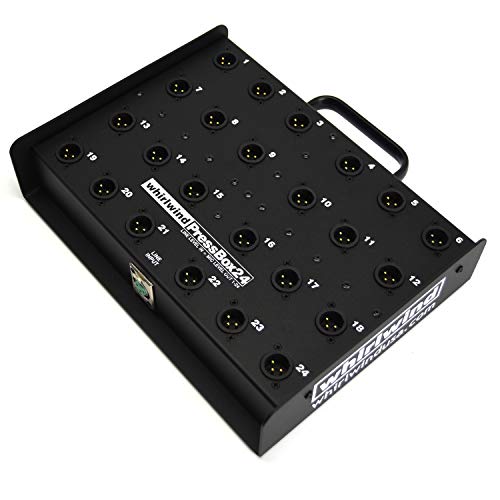
- One line input to 24 microphone outputs
- Passive design for simple operation
- Designed for press-conference distribution
Best For: Media events needing many microphone feeds
Digital Stage Connectivity
Behringer S32 32-Channel Stage Box

- 32 programmable Midas-designed mic preamps
- 16 servo-balanced XLR outputs
- AES50, AES/EBU, and Ultranet connections
Best For: Large digital live-production systems
Stereo Signal Cleanup
Mackie MDB-2P Passive Stereo DI Box

- Dual 1/4-inch inputs for stereo sources
- Ground lift helps reduce hum and buzz
- 15 dB pads handle hot signals
Best For: Keyboards, DJ rigs, and backing-track sources
Practical Hum Control
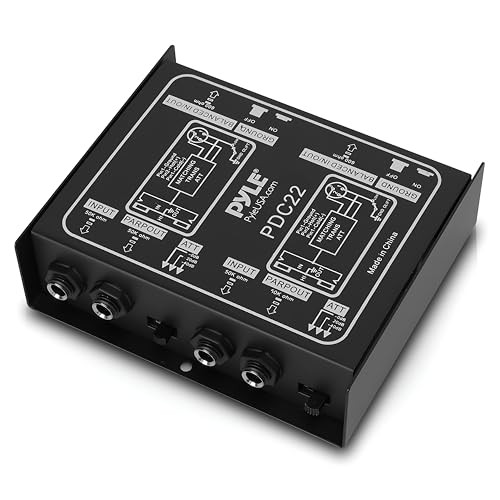
- Two-channel passive DI with 1/4-inch connectivity
- Helps reduce buzz and ground-related hum
- Steel chassis for live and recording use
Best For: Musicians connecting instruments and unbalanced sources to PA or recording mixers
Tour-Ready Stereo Performance
Radial Engineering ProD2 Bundle

- Stereo passive DI designed especially for keyboards
- Custom transformers and 20 Hz–18 kHz response
- Rack-mountable steel build with pad and ground lift
Best For: Touring musicians and engineers using keyboards, DJ gear, or stereo instruments
Simple Two-Channel Isolation
GINTOOYUN PRO X2 Audio Isolator

- Two-channel balanced/unbalanced signal isolation
- Helps reduce ground-loop and external line noise
- Supports 6.5 mm and XLR connections
Best For: Streaming, broadcasting, and mixing-console setups needing plug-and-play isolation
High-Capacity Press Box – Whirlwind PB12
Whirlwind PB12 1 Line in to 12 Mic Out Passive Press Box, 150 Ohms Output Impedance
Check Price On AmazonThe Whirlwind PB12 is a practical choice for high-performance audio press boxes when one line-level feed must serve many microphones. Its passive design provides 12 XLR microphone outputs, with transformer isolation on every channel to help limit crosstalk, ground noise, and interference.
Best For: Press events, media rooms, and speech or video-conference setups needing 12 isolated microphone feeds from one input.
Pros:
- Distributes one line input to 12 microphone outputs.
- Individual transformers isolate each output.
- Offers a 20 Hz–20 kHz frequency range and 150-ohm output impedance.
- Uses XLR connectors and requires no separately noted external power source.
Cons:
- At 6.1 pounds, it is less portable than smaller press boxes.
- Its 11.9 x 11 x 2-inch footprint may require dedicated bag or case space.
Choose the PB12 when channel count and output isolation matter more than minimizing size. It is especially well suited to larger press feeds where multiple isolated microphone connections are needed.
Multi-Output Event Box – Whirlwind PRESSMITE
The Whirlwind PRESSMITE is designed for demanding press-distribution duties where a rugged multi-output box is more important than a compact footprint. Its 12+2 mult-box configuration and metal construction make it a strong candidate among high-performance audio press boxes for organized event setups.
Best For: Professional press events and installations that need a 12+2 mult-box in a metal enclosure with XLR connectivity.
Pros:
- Provides a 12+2 mult-box configuration.
- Metal body supports a durable, professional setup.
- Uses XLR connectors for compatible audio connections.
Cons:
- Its 14.4 x 14.3 x 8.8-inch dimensions make it relatively bulky.
- The supplied information lists no warranty.
- Specific isolation and frequency details are not provided.
The PRESSMITE makes sense when you need its expanded 12+2 format and metal construction. Confirm the exact connector layout and system requirements before purchase, since the supplied specifications do not detail its isolation or audio-performance characteristics.
Compact Eight-Output Press Box – PB-8 Press Box
The PB-8 is a straightforward option for high-performance audio press boxes when an eight-output format is sufficient. It accepts an XLR female input and provides one XLR male, isolated output per channel in a compact 8 x 4 x 8-inch enclosure.
Best For: Smaller press conferences and field audio setups needing eight isolated XLR outputs in a manageable enclosure.
Pros:
- Provides eight output channels from one XLR female input.
- Each channel has an isolated XLR male output.
- Compact dimensions and a 3.5-pound weight support easier transport.
- Made in the United States according to the supplied product notes.
Cons:
- Eight outputs may be limiting for larger media pools.
- The supplied notes do not specify frequency response or impedance.
The PB-8 is a sensible middle ground for teams that need isolated press feeds without the size of a higher-channel-count unit. Its clearly defined XLR input and outputs also make system compatibility easy to evaluate.
Two-Channel Isolation Option – Radial ProD2 Stereo DI
The Radial ProD2 is a passive stereo direct box rather than a conventional multi-output press box, but it can fit specialized high-performance audio press boxes workflows that require two-channel signal conversion and isolation. Its isolation transformer, ground-lift switch, and 15 dB pad support flexible signal handling.
Best For: Two-channel stereo routing where passive operation, transformer isolation, ground lift, and signal attenuation are useful.
Pros:
- Provides two-channel passive stereo DI operation.
- Includes an isolation transformer for signal separation.
- Ground-lift switch can help manage grounding issues.
- 15 dB pad supports higher-level input sources.
Cons:
- It is a two-channel direct box, not a 8-, 12-, or 14-output press box.
- Its connectivity is limited to 1/4-inch and XLR connectors.
- The supplied notes do not specify a frequency range or output count beyond two channels.
The ProD2 is best treated as a complementary signal-management tool rather than a full press distribution box. Choose it when two-channel isolation and level control are the priority, not when multiple reporter microphone outputs are required.
Press Distribution Specialist – Whirlwind PB24 Passive Press Box
For events that need to distribute one source to many media microphones, the Whirlwind PB24 is a straightforward choice among high-performance audio press boxes. Its passive design accepts one line input and provides 24 microphone outputs, making it suited to organized press-conference setups.
Best For: Press conferences, media events, and installations requiring one line feed for up to 24 microphone outputs.
Pros:
- Provides 24 microphone outputs from one line input.
- Passive operation keeps the design simple.
- Purpose-built for press-distribution applications.
Cons:
- Offers one line input rather than multiple source inputs.
- At 9.77 pounds, it is less convenient for lightweight mobile rigs.
The PB24 is the most directly focused option here for traditional press-box distribution. Choose it when output quantity and simple signal sharing matter more than digital networking or stereo instrument connectivity.
Digital Stage Connectivity – Behringer S32 32-Channel Stage Box
The Behringer S32 is a digital stage box rather than a conventional passive press distributor, but its extensive I/O makes it relevant for high-performance audio press boxes in larger production systems. It combines 32 Midas-designed programmable mic preamps with network and output connections for complex stage-to-PA workflows.
Best For: Larger live-production systems needing 32 microphone preamps, AES50 networking, and flexible analog or digital outputs.
Pros:
- Includes 32 Midas-designed, fully programmable microphone preamps.
- Provides 16 servo-balanced XLR outputs.
- Supports AES50, AES/EBU, and Ultranet connectivity.
- Designed for low-jitter, low-latency digital networking through SuperMAC technology.
Cons:
- Its digital stage-box format may be more capability than a simple press event requires.
- Requires compatible system components to take full advantage of its networking features.
The S32 stands out when a press or production setup is part of a broader digital audio system. Its 32 preamps and varied connections provide substantial expansion, though smaller events may not need this level of infrastructure.
Stereo Signal Cleanup – Mackie MDB-2P Passive Stereo DI Box
The Mackie MDB-2P is a compact stereo passive DI box for feeding keyboards, DJ controllers, and backing-track rigs into balanced audio systems. While it is not a multi-output press distributor, its ground lift and 15 dB pads can help prepare clean signals within high-performance audio press boxes and event rigs.
Best For: Stereo keyboards, DJ rigs, and other line-level sources that need hum reduction and balanced XLR connectivity.
Pros:
- Accepts dual 1/4-inch high-impedance inputs for stereo sources.
- Ground lift helps address ground-loop buzz.
- 15 dB pads accommodate hot signals without distortion.
- Passive operation requires no power.
Cons:
- It has two channels rather than the many microphone outputs expected from a traditional press box.
- Its primary role is signal balancing and cleanup, not press-feed distribution.
The MDB-2P is best treated as a supporting utility for an audio event system. Its stereo inputs, noise-control features, and rugged steel case make it useful when a source needs clean, balanced delivery before reaching the rest of the setup.
Practical Hum Control – PYLE-PRO PDC22 Passive DI Box
For musicians and small recording setups seeking high-performance audio press boxes, the PYLE-PRO PDC22 is a practical two-channel passive DI option. It connects instruments and other unbalanced sources to balanced or unbalanced XLR equipment while helping reduce buzz and hum.
Best For: Connecting guitars, basses, keyboards, submixers, and consumer audio sources to PA or recording mixers.
Pros:
- Supports 1/4-inch device connections and XLR integration.
- Ground-lift and impedance-transformer functions help address hum and unwanted noise.
- Steel chassis and two-channel design suit regular live or recording use.
Cons:
- Passive design may be less suitable when an active DI’s gain or power features are needed.
- The supplied notes do not specify detailed frequency-response or maximum-level ratings.
The PDC22 emphasizes flexible connectivity, noise reduction, and durable construction. It is a sensible choice when you need straightforward signal conversion rather than a feature-heavy studio interface.
Tour-Ready Stereo Performance – Radial Engineering ProD2 Bundle
The Radial Engineering ProD2 Bundle is built for high-performance audio press boxes and stereo DI applications where clean handling and rugged integration matter. Its passive design uses custom Radial transformers, a -15 dB pad, and a ground-lift switch, while the bundle adds a 10-foot XLR cable.
Best For: Keyboards, digital pianos, DJ setups, drum machines, acoustic guitar, and touring rigs needing stereo DI connectivity.
Pros:
- Handles high signal levels and massive transients without distortion, according to the supplied product notes.
- Custom transformers provide a stated 20 Hz–18 kHz frequency response.
- Rack-mountable 14-gauge steel enclosure, ground lift, and -15 dB pad support touring use.
- Bundle includes a 10-foot Pig Hog XLR cable and polishing cloth.
Cons:
- Its 2.67-pound package weight and rack-oriented construction may be more than needed for casual setups.
- As a passive DI, it does not provide the active gain features some sources may require.
The ProD2 stands out when stereo operation, dependable transient handling, and road-ready construction are priorities. The included cable also makes this bundle convenient for building or refreshing a performance setup.
Simple Two-Channel Isolation – GINTOOYUN PRO X2 Audio Isolator
The GINTOOYUN PRO X2 offers a straightforward approach to high-performance audio press boxes for mixing consoles, live broadcasts, and streaming systems. Its two-channel isolation design supports balanced and unbalanced conversion while helping separate ground-loop interference and external line noise.
Best For: Live streaming, broadcast, mixing-console, and audio-system setups needing two-channel isolation and XLR connectivity.
Pros:
- Provides two-channel physical input-output isolation.
- Supports 6.5 mm and XLR Canon input and output connections, as described in the notes.
- Designed to reduce ground-circuit noise, external interference, and voltage-difference issues.
- Plug-and-play setup is accessible to nonprofessional users.
Cons:
- The supplied notes do not list included accessories or detailed electrical specifications.
- Its focus is isolation and conversion rather than instrument-specific features.
The PRO X2 is best viewed as a practical signal-isolation tool for reducing noise between connected audio devices. Its metal construction and simple connection process make it appealing for flexible broadcast and live-audio setups.
How We Picked These High-Performance Audio Press Boxes
We selected products based on the needs of live press conferences, broadcast work, interviews, houses of worship, and event production. Key considerations included input and output capacity, passive signal handling, connector layout, impedance suitability, isolation features, ground-lift options, build quality, and portability. Because these products serve different roles, the list includes dedicated press boxes alongside DI and stage-box solutions that may fit smaller or more specialized setups.
Before buying, confirm whether you need multiple microphone-level outputs, stereo distribution, instrument compatibility, or a larger stagebox connection. A DI box can solve signal-balancing and ground-loop problems, but it is not always a substitute for a dedicated press feed distributor.
Quick Comparison
- Best for many press outputs: Whirlwind models with 12- or 24-output configurations.
- Best for compact stereo distribution: Radial ProD2 and Mackie MDB-2P.
- Best for larger stage systems: Behringer S32 32-channel stage box.
- Best for basic, budget-conscious isolation: PYLE-PRO and GINTOOYUN passive units.
- Best for flexible small press setups: Whirlwind PRESSMITE and the PB-8.
Key Buying Factors for High-Performance Audio Press Boxes
Output Count and Signal Type
Choose the number of outputs based on your maximum expected users, not only today’s setup. A 12- or 24-output press box provides room for multiple reporters and cameras, while an eight-output model may be easier to carry for smaller events. Verify whether the outputs are intended for microphone-level feeds or line-level distribution.
Passive Versus Active Design
Passive boxes generally need no power and are simple to deploy. They can be dependable for straightforward splits, but source level and impedance matching still matter. Active stage boxes and powered systems may provide greater routing capacity and integration with digital consoles, though they add setup requirements.
Isolation, Grounding, and Noise Control
Transformer isolation and ground-lift controls can help prevent hum caused by interconnected equipment. These features are especially useful when cameras, mixers, laptops, and venue systems share power. They cannot correct every gain-staging or cabling issue, so use balanced connections and appropriate cable lengths whenever possible.
Construction and Portability
For frequent field work, prioritize sturdy metal enclosures, clearly labeled connectors, strain relief, and a layout that can be checked quickly under pressure. Larger units may offer more outputs but require more case space and transport planning.
Who Should Buy Which High-Performance Audio Press Boxes?
Choose a high-output Whirlwind press box when several media outlets need simultaneous microphone feeds. Pick the PB-8 or PRESSMITE for smaller press conferences and mobile production kits. Radial or Mackie stereo DI boxes suit musicians, playback systems, and compact balanced-feed applications. The Behringer S32 is better suited to a compatible stagebox and digital-console workflow. Budget isolators from PYLE-PRO or GINTOOYUN can work for simple stereo connections, but buyers with demanding broadcast or touring requirements should prioritize stronger construction, verified specifications, and professional support.