Reliable audio distribution matters when one source must reach multiple cameras, recorders, mixers, or broadcast systems without introducing noise or ground-loop problems.
We selected 10 audio press boxes and related DI-style solutions spanning high-output passive press boxes, compact distribution units, stereo interfaces, and flexible stage-ready designs.
Best 10 Audio Press Boxes Picks for 2026
Best Multi-Channel Pick

- One input feeds 12 mic outputs
- Transformer-isolated outputs
- 20 Hz–20 kHz frequency range
Best For: Press events needing many isolated feeds
Best 8-Channel Distribution Option
MDS-108 Media Distribution Box

- Eight-channel distribution
- Functions as a signal processor
- Made in the United States
Best For: Fixed or production setups needing eight channels
Best High-Output Splitter

- 14 passive line-level outputs
- Trim pots for adjustment
- XLR through and daisy chaining
Best For: Large line-level distribution systems
Best Compact 8-Output Press Box

- One input and eight outputs
- Isolated XLR outputs
- 3.5-pound design
Best For: Smaller events needing eight isolated feeds
Compact Stereo Hum Control
Mackie MDB-2P Passive Stereo DI Box

- Dual 1/4-inch inputs for stereo sources
- Ground lift and 15 dB pads
- Passive, power-free steel construction
Best For: Stereo keyboards, DJ rigs, and backing-track sources
High-Output Media Routing
Whirlwind 1-In to 24-Out Passive Press Box
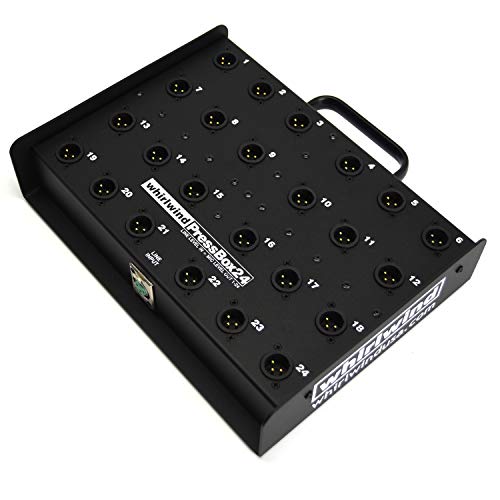
- One line input
- Twenty-four microphone outputs
- Passive design for press distribution
Best For: Press conferences and media events with many microphone feeds
Flexible Active Signal Interface

- Dual stereo or mixed-mono inputs
- XLR and 1/4-inch thru outputs
- USB-C or 9V battery power options
Best For: Live sound and recording with instruments or unbalanced sources
Simple Stage Solution
Monoprice Sound Block Passive Direct Box

- Heavy-duty 14-gauge steel construction
- Bidirectional impedance matching
- Ground lift and attenuator included
Best For: Single-channel stage and recording setups
Flexible Stereo Power
Bolanle J22 Active Stereo DI Box

- 48V, 9V, and 5V USB power options
- Dual-channel stereo signal routing
- Ground lift and polarity reversal controls
Best For: Stereo keyboards and mobile live setups
Passive Stereo Control
Samson MD2 Pro Stereo Direct Box

- No batteries or phantom power required
- Transformer-based stereo signal conversion
- Per-output pads, ground lift, and thru outputs
Best For: Stereo instruments and parallel live or studio routing
Best Multi-Channel Pick – Whirlwind PB12
Whirlwind PB12 1 Line in to 12 Mic Out Passive Press Box, 150 Ohms Output Impedance
Check Price On AmazonThe Whirlwind PB12 is a practical choice for audio press boxes when one incoming line needs to feed several microphones or recording destinations. Its 12 transformer-isolated XLR outputs are designed to help reduce crosstalk, ground noise, and interference between channels.
Best For: Press events, speech, and video-conference setups needing 12 isolated outputs from one input.
Pros:
- Provides one line input to 12 mic outputs.
- Each output has its own transformer for isolation.
- Offers a 20 Hz–20 kHz frequency range.
- Uses standard XLR connectivity.
Cons:
- Its 6.1-pound weight may be more than needed for small setups.
- It is a passive unit rather than a powered signal processor.
Choose the PB12 when output count and isolation are priorities. Its 12-channel layout makes it especially useful for distributing a single source to many press or recording feeds.
Best 8-Channel Distribution Option – MDS-108 Media Distribution Box
The MDS-108 is an 8-channel media distribution box for buyers comparing audio press boxes and signal-processing equipment. Its straightforward configuration is aimed at distributing media signals across eight channels in a substantial rack-style enclosure.
Best For: Installations or production setups that need an 8-channel media distribution box.
Pros:
- Provides eight distribution channels.
- Designed as a media distribution box and signal processor.
- Made in the United States.
Cons:
- The supplied notes do not specify connector types or output isolation.
- Its listed dimensions may be relatively large for portable use.
The MDS-108 is worth considering when eight-channel distribution is the main requirement. Confirm the connector layout and compatibility with the rest of your system before purchase.
Best High-Output Splitter – Radial Exo-Pod Line Splitter
The Radial Exo-Pod is a useful alternative for audio press boxes when the goal is to split one line-level source across many destinations. This passive splitter provides 14 outputs, trim pots, XLR through connections, and daisy-chaining capability.
Best For: Line-level distribution systems requiring up to 14 outputs and level adjustment.
Pros:
- Offers 14 passive line-level outputs.
- Includes trim pots for output adjustment.
- Supports XLR through connections and daisy chaining.
- Uses a stainless-steel housing.
Cons:
- It is designed for line-level splitting rather than mic-output distribution.
- Passive operation may not suit systems requiring powered processing.
The Exo-Pod stands out for output count and routing flexibility. Select it over a conventional press box when your workflow centers on line-level distribution and adjustable feeds.
Best Compact 8-Output Press Box – PB-8 8-Output Press Box
The PB-8 is a compact option for audio press boxes when eight isolated feeds are sufficient. It uses an XLR female input and eight XLR male outputs, with one isolated output per channel for straightforward press-distribution wiring.
Best For: Smaller press events and recording setups needing eight isolated XLR outputs.
Pros:
- Provides one input and eight outputs.
- Uses an XLR female input and XLR male outputs.
- Includes isolated outputs, one per channel.
- Weighs 3.5 pounds.
Cons:
- Offers fewer outputs than 12-channel models.
- The supplied notes do not specify frequency range or impedance.
For a smaller distribution rig, the PB-8 keeps the channel count focused while retaining isolated XLR outputs. It is a sensible fit when eight destinations cover the event’s needs.
Compact Stereo Hum Control – Mackie MDB-2P Passive Stereo DI Box
For audio press boxes and live signal-routing setups that need a dependable stereo interface, the Mackie MDB-2P provides two high-impedance 1/4-inch inputs for keyboards, DJ controllers, and backing-track rigs. Its passive design requires no power, while ground lift and 15 dB pads help manage buzz and hot signals before they reach the mixer.
Best For: Stereo keyboards, DJ rigs, and backing-track setups needing passive DI conversion and hum control.
Pros:
- Dual 1/4-inch high-impedance inputs support stereo sources.
- Ground lift helps address ground-loop buzz.
- 15 dB pads accommodate hot signals with less risk of distortion.
- Passive operation needs no power and the steel case is roadworthy.
Cons:
- It is designed for stereo DI duties rather than a dedicated multi-output press box.
- Its passive design may be less suitable when an active DI is specifically required.
The MDB-2P is a practical choice when your priority is clean stereo signal handling, straightforward hum reduction, and a power-free setup. It is especially well matched to instruments and DJ playback sources.
High-Output Media Routing – Whirlwind 1-In to 24-Out Passive Press Box
For audio press boxes where one source must feed many microphones or recording inputs, the Whirlwind 1 Line In to 24 Mic Out Passive Press Box is built around a high-capacity distribution format. Its passive configuration is suited to press and media applications that require multiple mic-level outputs from a single line input.
Best For: Press conferences, media events, and broadcast setups requiring one line input to feed up to 24 microphone outputs.
Pros:
- Provides a single line input for centralized signal distribution.
- Offers 24 microphone outputs for multiple recording or reporting positions.
- Passive press-box design is purpose-built for media signal sharing.
Cons:
- The supplied notes do not specify additional controls, output isolation, or connector details.
- Its large output count may be unnecessary for smaller events.
This Whirlwind unit is the most directly purpose-built option here for traditional press-box work. Choose it when broad microphone distribution matters more than stereo instrument DI features.
Flexible Active Signal Interface – Dual-Input Active Direct Box
For audio press boxes and live recording chains that also need instrument-friendly routing, this active direct box combines dual high-impedance 1/4-inch inputs with stereo XLR outputs and 1/4-inch thru outputs. It supports guitar, bass, keyboards, submixers, and other unbalanced sources, with ground lift for reducing hum.
Best For: Live sound and recording setups that need active DI conversion, stereo routing, and flexible power options.
Pros:
- Dual inputs can handle stereo audio or a mixed mono source.
- Provides both stereo XLR outputs and stereo 1/4-inch thru outputs.
- Ground lift supports cleaner connections from unbalanced sources.
- Can use USB-C charging or a 9V GF22 battery, which is not included.
Cons:
- It requires power for active operation.
- The 9V battery is not included.
- At 2.01 pounds, it is heavier than the Mackie passive DI listed here.
This unit offers more routing flexibility than a basic passive DI, especially when thru outputs and active operation are useful. It is a versatile choice for musicians and small production setups, though it is not a 24-output press box.
Simple Stage Solution – Monoprice Sound Block Passive Direct Box
Monoprice Sound Block Passive Direct Box - With Ground Lift and Attenuator - Stage Right Series
Check Price On AmazonThe Monoprice Sound Block is a straightforward option for audio press boxes and stage signal routing. Its passive design provides bidirectional impedance matching, while the ground lift and attenuator help adapt connections in practical live or recording setups.
Best For: Musicians, small production setups, and users who need a compact single-channel passive direct box for microphones, mixers, or audio interfaces.
Pros:
- Heavy-duty 14-gauge steel construction.
- Bidirectional impedance matching.
- Ground lift and attenuator controls.
- Uses XLR connectivity and requires no software-specific setup.
Cons:
- Only one channel.
- Passive design may be less suitable when active DI features are needed.
The Sound Block keeps the feature set focused and durable. Choose it when you want a basic, single-channel DI solution rather than stereo operation or multiple power options.
Flexible Stereo Power – Bolanle J22 Active Stereo DI Box
The Bolanle J22 is a versatile choice for audio press boxes when stereo routing and flexible power are priorities. Its dual-channel design supports stereo instruments, while 48V phantom power, a 9V battery option, and 5V USB power accommodate different stage and studio environments.
Best For: Keyboard players, synth users, and performers who need dual-channel stereo DI routing with multiple power options.
Pros:
- Three power options: 48V phantom, 9V battery, or 5V USB.
- Dual channels preserve stereo separation.
- Ground lift and 180-degree polarity reversal support signal troubleshooting.
- Metal housing and compact dimensions suit mobile setups.
Cons:
- Batteries are not included.
- Heavier and larger than a basic single-channel DI box.
The J22 stands out for flexibility: it can run in setups with or without phantom power and handles two signals at once. It is a strong fit for stereo performers who value backup power choices.
Passive Stereo Control – Samson MD2 Pro Stereo Direct Box
The Samson MD2 Pro is a practical stereo option for audio press boxes and live or studio signal routing. It converts two unbalanced 1/4-inch sources into balanced mic-level XLR outputs, while its passive transformer-based design avoids the need for batteries or phantom power.
Best For: Stereo instrument or line-level sources that need balanced XLR connections, ground-lift control, attenuation, and pass-through outputs.
Pros:
- Passive operation requires no external power.
- STLX transformer and Mu-Metal shielding support low-distortion signal handling.
- Ground lift and -15dB/-30dB pads are provided for each output.
- Thru outputs can feed pedals or amplifiers.
Cons:
- Designed around two 1/4-inch inputs rather than XLR inputs.
- Does not offer active DI power options.
The MD2 Pro is well suited to stereo rigs that need clean balanced outputs and parallel routing. Its passive, power-free operation is especially convenient for setups where simplicity matters.
How We Picked These Audio Press Boxes
We focused on signal-routing products that can support media feeds, live production, recording, or stage use. The selection includes dedicated press boxes with multiple microphone-level outputs as well as passive and active DI boxes that can solve similar distribution, isolation, and connection problems in smaller systems.
Key considerations included input and output count, passive or active operation, transformer isolation, impedance compatibility, connector flexibility, power requirements, ground-lift options, shielding, and portability. Because these products serve different jobs, the best choice depends on whether you need many isolated microphone feeds or a compact interface for one or two sources.
Quick Comparison
| Need | Best fit | What to prioritize |
|---|---|---|
| Large press conference | 12- or 24-output press box | Output count, isolation, rugged construction |
| Small media setup | 8-output press box | Simple routing and microphone-level compatibility |
| Stereo source distribution | Dual-channel DI or stereo box | Dual inputs, ground lift, transformer isolation |
| Instrument or line-level source | Passive or active DI box | Input impedance, attenuation, and power options |
Key Buying Factors for Audio Press Boxes
Output Count and Signal Type
Choose the number of outputs based on the maximum number of recorders, cameras, reporters, or mixers you expect to connect. Dedicated press boxes generally provide multiple balanced microphone-level outputs, while DI boxes usually offer only one or two outputs and may be better suited to instruments or line-level sources.
Passive Versus Active Design
Passive units typically need no batteries or phantom power and can be dependable for straightforward distribution. Active designs may offer more flexibility, higher input impedance, or better performance with particular sources, but they require a suitable power source and add another setup consideration.
Isolation, Ground Lift, and Noise Control
Transformer isolation helps reduce hum and ground-loop noise between connected devices. A ground-lift switch can be useful when integrating cameras, mixers, computers, and powered equipment, although it should be used thoughtfully and never as a substitute for safe electrical practices.
Connectors and Impedance
Verify the input and output connectors before buying. Also check whether the unit is designed for microphone-level, line-level, instrument-level, or high-impedance signals. A mismatch can cause weak output, clipping, excessive noise, or an unbalanced workflow.
Who Should Buy Which Audio Press Boxes?
Event producers and press-conference teams: choose a dedicated 12- or 24-output press box when many media outlets need simultaneous feeds.
Small venues and independent crews: an eight-output model can provide practical distribution without the size and cost of a larger unit.
Musicians and mobile recording users: a passive or active DI box is usually the better fit for guitars, basses, keyboards, stereo playback devices, and compact recording rigs.
Users troubleshooting hum: prioritize transformer isolation and a ground-lift feature, then confirm that the box supports your source level and connector type.