A compact ultrawide monitor can give editors more room for timelines, tools, previews, and reference windows without requiring a dual-monitor setup. The best options balance usable resolution, color coverage, connectivity, refresh rate, and desk-friendly dimensions.
We selected 10 models ranging from affordable 34-inch WQHD displays to high-resolution 5K options, with choices for color-focused editing, hybrid work, gaming, and laptop-based studios.
Best 10 Compact Ultrawide Editing Monitors Picks for 2026
Best High-Resolution Pick

- 5120 x 2160 resolution with a 120Hz refresh rate
- Factory-calibrated color with Delta-E below 2
- USB-C provides up to 65W laptop power delivery
Best For: Detail-focused photo, video, and design editing
Best Balanced Work Monitor

- 3440 x 1440 curved screen for multitasking
- Up to 99% sRGB coverage with HDR10
- USB-C offers up to 65W power delivery
Best For: Home-office editing and flexible multitasking
Best Smart Display

- 3440 x 1440 curved screen with 100Hz refresh
- Built-in webOS streaming and LG Channels
- AirPlay 2, HomeKit, and screen-sharing support
Best For: Light editing, remote work, and streaming
Best Large-Screen Performance Pick

- 40-inch 3440 x 1440 ultrawide workspace
- 144Hz refresh rate with 1ms response time
- 95% DCI-P3, 500 nits, and HDR400 support
Best For: Spacious editing, gaming, and motion-focused workflows
Balanced Workspace Pick

- 3440 × 1440 Ultra-WQHD workspace
- HDR10 and automatic eye-care features
- PIP/PBP for multiple sources
Best For: High-resolution editing and multitasking
Comfort-Focused Productivity Pick
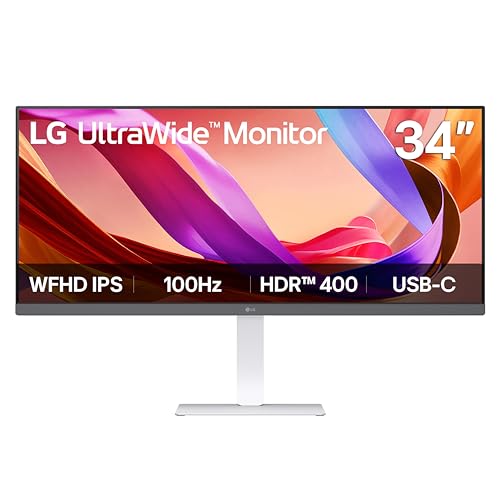
- IPS 21:9 workspace with 99% sRGB
- USB-C, DisplayPort, and HDMI connectivity
- Adjustable stand and built-in speakers
Best For: Laptop-based editing and everyday creative work
High-Refresh Editing Pick

- 3440 × 1440 curved WQHD display
- Up to 165Hz with 1ms MPRT
- 99% sRGB and FreeSync Premium
Best For: Editing plus gaming and smooth-motion content
Best All-in-One Setup
LG 34-inch UltraWide IPS Monitor

- 3440×1440 IPS panel with 21:9 workspace
- USB-C with up to 96W laptop charging
- 100Hz refresh, HDR10, and up to 99% sRGB
Best For: Editors and multitaskers seeking a clean USB-C workstation
Best Contrast-Focused Value

- 3440×1440 VA panel with 3500:1 contrast
- 120Hz refresh with Adaptive-Sync
- VESA support and eye-comfort features
Best For: Editors balancing darker image content with smooth everyday performance
Best for Fast Creative Workflows
INNOCN 34C1R 34-inch Ultrawide Monitor

- 3440×1440 IPS with 100% sRGB and HDR400
- 180Hz refresh, 1ms MPRT, and G-SYNC compatibility
- PIP/PBP plus height-adjustable ergonomic stand
Best For: Video editors who also game or use multiple source devices
Best High-Resolution Pick – INNOCN 34-inch 5K Ultrawide
For editors seeking compact ultrawide editing monitors with maximum workspace clarity, the INNOCN 34C1U stands out with a 5120 x 2160 resolution, 120Hz refresh rate, and wide color coverage. Its USB-C connection with 65W power delivery can also simplify a laptop-based desk.
Best For: Photo, video, and design professionals who prioritize sharp detail, accurate color, and one-cable laptop connectivity.
Pros:
- Exceptional 5K ultrawide resolution for detailed editing and multitasking.
- Factory-calibrated color with reported Delta-E below 2, 135% sRGB, and 106% DCI-P3 coverage.
- USB-C connectivity with 65W power delivery, plus HDMI 2.1, DisplayPort, and USB ports.
- Height, swivel, and tilt adjustment with VESA mounting support.
Cons:
- Its 34-inch panel and stand make it a substantial desk setup despite the ultrawide format.
- VA technology may be less suitable than IPS for buyers who specifically prefer IPS viewing characteristics.
The 34C1U is the strongest resolution-focused option here. It costs more in desk and system demands than a standard WQHD display, but its dense canvas and broad connectivity are well matched to serious editing workflows.
Best Balanced Work Monitor – LG 34-inch UltraWide WQHD
The LG 34WR55QK-B is a practical choice among compact ultrawide editing monitors when you want a manageable 34-inch workspace without moving to 5K. Its 3440 x 1440 resolution, curved VA panel, USB-C, and workspace controls support everyday editing and multitasking.
Best For: Home offices and general photo or multimedia work that benefit from split-screen multitasking and laptop connectivity.
Pros:
- 34-inch 21:9 WQHD screen provides room for multiple windows.
- Up to 99% sRGB coverage and HDR10 support enhance everyday image presentation.
- USB-C supports up to 65W power delivery, with HDMI, DisplayPort, USB, and headphone connections.
- OnScreen Control includes screen splitting and Picture-by-Picture support.
Cons:
- Its 100Hz refresh rate and 5ms response time are less performance-oriented than faster models.
- WQHD resolution provides less editing detail than the 5K INNOCN option.
This LG offers a sensible middle ground: a useful ultrawide canvas, ergonomic adjustment, and versatile connections without emphasizing extreme resolution. It is particularly appealing for mixed office, editing, and multimedia use.
Best Smart Display – LG 34-inch Smart UltraWide
The LG 34SR60QC-W adds built-in entertainment and smart features to the compact ultrawide editing monitors category. Its 34-inch 3440 x 1440 curved display supports multitasking, while webOS, streaming apps, AirPlay 2, and screen sharing let it function independently of a traditional computer.
Best For: Users who want one ultrawide display for light editing, remote-work tasks, streaming, and wireless device sharing.
Pros:
- 21:9 QHD curved display offers a broad workspace for side-by-side tasks.
- Built-in webOS provides access to streaming services and LG Channels.
- AirPlay 2, HomeKit compatibility, screen sharing, and cloud-service access expand its standalone functionality.
- 99% sRGB coverage, HDR10, 100Hz refresh rate, and built-in speaker support everyday multimedia use.
Cons:
- Connectivity is centered on HDMI and USB, without the USB-C laptop power delivery listed for the other LG model.
- Its smart features are more useful for mixed media use than demanding professional editing.
The 34SR60QC-W is the most flexible entertainment-focused option in this group. Choose it when built-in streaming and wireless sharing matter as much as the ultrawide editing workspace.
Best Large-Screen Performance Pick – INNOCN 40-inch WQHD 144Hz
Although larger than the other choices, the INNOCN 40C1R remains worth considering alongside compact ultrawide editing monitors if you want more physical workspace. Its 40-inch 3440 x 1440 panel combines 144Hz refresh, 500-nit brightness, HDR400, and 95% DCI-P3 coverage for editing, gaming, and media work.
Best For: Editors who want a spacious ultrawide canvas with strong motion performance and USB-C device compatibility.
Pros:
- 40-inch 21:9 display provides 18% more viewable area than a 34-inch gaming monitor, according to the supplied specifications.
- 144Hz refresh rate over DisplayPort, 1ms response time, FreeSync Premium, and HDR400 suit motion-heavy work and gaming.
- 500-nit brightness and 95% DCI-P3 coverage support vivid HDR-oriented viewing.
- Includes USB-C, DisplayPort, two HDMI ports, PBP/PIP, and height adjustment.
Cons:
- The 40-inch size is less compact and requires more desk space than the 34-inch alternatives.
- Its 3440 x 1440 resolution is less dense than the 5K INNOCN display at a larger physical size.
The 40C1R is best understood as a spacious performance ultrawide rather than a compact choice. It makes sense for buyers who value screen area, smooth motion, and strong brightness more than pixel density or a small footprint.
Balanced Workspace Pick – Samsung ViewFinity S50GC
The Samsung ViewFinity S50GC is a practical choice for compact ultrawide editing monitors when you want detailed 21:9 workspace without setting up two displays. Its 34-inch Ultra-WQHD resolution supports multitasking, while HDR10, eye-care features, and flexible picture-in-picture modes suit editing and general desktop work.
Best For: Editors and multitaskers who want high-resolution workspace, useful input flexibility, and comfortable all-day viewing.
Pros:
- 3440 × 1440 Ultra-WQHD resolution provides a spacious, detailed editing canvas.
- HDR10 supports over 1 billion colors for richer highlights and shadows.
- PIP and PBP allow multiple sources to be viewed simultaneously.
- Ambient brightness adjustment, Eye Saver Mode, and Flicker Free technology support extended use.
Cons:
- Its listed 72% color gamut may be less suitable for demanding color-critical work than wider-gamut displays.
- The 5ms response time and 100Hz refresh rate prioritize general productivity over high-speed gaming.
For editing workflows that benefit from sharp resolution and side-by-side content, this Samsung offers a well-rounded feature set in a relatively streamlined 34-inch format.
Comfort-Focused Productivity Pick – LG 34U530A-W UltraWide
The LG 34U530A-W is a useful option among compact ultrawide editing monitors for creators who value straightforward connectivity and an adjustable setup. Its 34-inch IPS panel offers a wide 21:9 workspace, USB-C display and data support, HDR400, and a stand with height, tilt, and swivel adjustments.
Best For: Laptop-based editors and office creators who want USB-C connectivity, IPS viewing angles, and built-in audio.
Pros:
- 21:9 IPS display provides broad horizontal space for multiple editing panels.
- USB-C supports display output and data transfer through a single cable.
- VESA DisplayHDR 400 and up to 99% sRGB coverage support vibrant everyday visuals.
- Height, tilt, and swivel adjustments make positioning easier, while built-in speakers reduce desk clutter.
Cons:
- 2560 × 1080 resolution provides less vertical detail than 1440p ultrawide models.
- The 1000:1 contrast ratio is more modest than the contrast specification listed for the Samsung model.
This LG emphasizes convenience and ergonomic flexibility. It is especially appealing for laptop workflows where one-cable USB-C connectivity and a tidy desk matter as much as resolution.
High-Refresh Editing Pick – Sceptre C345B-QUT168
The Sceptre C345B-QUT168 combines a detailed 34-inch curved panel with a high refresh rate, making it a strong performance-oriented option among compact ultrawide editing monitors. Its 3440 × 1440 resolution, 99% sRGB coverage, FreeSync Premium, and 1ms MPRT response target creators who also want smooth motion for gaming and video playback.
Best For: Editors who want a high-resolution ultrawide with smooth motion, curved immersion, and gaming-friendly performance.
Pros:
- 3440 × 1440 WQHD resolution delivers a detailed, spacious workspace.
- Up to 165Hz refresh rate and 1ms MPRT support smooth, responsive motion.
- 99% sRGB coverage is suited to general creative and multimedia work.
- Two DisplayPort inputs, two HDMI ports, built-in speakers, and a blue-light filter add practical flexibility.
Cons:
- The 280 cd/m² brightness is more limited for very bright environments or demanding HDR work.
- The curved VA design may not suit users who prefer a flat panel for precise layout work.
- The supplied details list tilt adjustment but not height or swivel adjustment.
Choose this Sceptre when smooth motion and gaming capability are important alongside editing space. Its 99% sRGB specification and WQHD resolution keep it capable for general creative use, while the curved design adds immersion.
Best All-in-One Setup – LG 34-inch UltraWide IPS Monitor
For compact ultrawide editing monitors, the LG 34U650A-B combines a spacious 34-inch 21:9 workspace with WQHD resolution, USB-C connectivity, and a comfort-focused curved IPS panel. Its 3440×1440 canvas is well suited to editing timelines, side-by-side applications, and general creative work without adding a second display.
Best For: Editors and multitaskers who want USB-C laptop charging, built-in audio, and a comfortable single-monitor workspace.
Pros:
- 3440×1440 IPS display with a 3800R curve and wide 21:9 workspace
- USB-C supports display, data, and up to 96W laptop charging
- Up to 99% sRGB coverage, HDR10, and 100Hz refresh rate
- Adjustable stand, built-in speakers, Reader Mode, and screen-layout software
Cons:
- 300-nit brightness and 1000:1 contrast are more suited to everyday editing than demanding HDR work
- The 5ms response time and 100Hz refresh rate are not as performance-focused as gaming-oriented alternatives
The LG is a practical choice when desk simplicity matters. USB-C connectivity and the adjustable stand make it easy to build a clean editing station, while the IPS panel and 21:9 layout provide useful room for creative applications.
Best Contrast-Focused Value – MSI PRO MP341CQ E12
Among compact ultrawide editing monitors, the MSI PRO MP341CQ E12 emphasizes a large 3440×1440 workspace, strong VA-panel contrast, and smooth 120Hz motion. It is a sensible option for editors who also want comfortable long-session viewing and occasional gaming or media use.
Best For: Productivity users who want deeper blacks, a high-refresh ultrawide panel, and flexible mounting options.
Pros:
- 34-inch 3440×1440 VA display with a 21:9 editing workspace
- High 3500:1 contrast ratio for deeper blacks and strong image separation
- 120Hz refresh rate with Adaptive-Sync and G-Sync compatibility
- Flicker-Free, Low Blue Light, VESA mounting, and a three-year warranty
Cons:
- 250-nit brightness is relatively modest for bright rooms or demanding HDR viewing
- VA technology may be less color-consistent across viewing angles than an IPS alternative
- Its stand is tilt-adjustable rather than fully height-adjustable
The MSI offers a balanced editing and entertainment profile. Its contrast advantage can help darker content look more distinct, while UWQHD resolution and 120Hz provide a smooth, spacious desktop for timelines, documents, and media.
Best for Fast Creative Workflows – INNOCN 34C1R 34-inch Ultrawide Monitor
The INNOCN 34C1R is one of the more performance-oriented compact ultrawide editing monitors, pairing a 34-inch 3440×1440 IPS panel with 180Hz refresh and HDR400 support. Its wide canvas suits video timelines and side-by-side tools, while PIP/PBP adds flexibility for multiple source devices.
Best For: Video editors and hybrid creator-gamers who want accurate sRGB coverage, fast motion, and an ergonomic stand.
Pros:
- 3440×1440 IPS display with 100% sRGB coverage and HDR400
- 180Hz refresh rate, 1ms MPRT, Adaptive-Sync, and G-SYNC compatibility
- PIP/PBP supports simultaneous viewing from two connected devices
- 130mm height adjustment, tilt and swivel customization, and dual HDMI inputs
Cons:
- 1000:1 contrast is lower than the MSI’s listed VA-panel contrast
- The one-year manufacturer warranty is shorter than the MSI’s three-year warranty
- Its feature set may be more than needed for editing-only setups
The 34C1R stands out for users who move between editing, gaming, and multiple devices. Its IPS panel, 100% sRGB coverage, adjustable stand, and PIP/PBP functionality make it flexible, though its strongest advantages are speed and versatility rather than maximum contrast.
How We Picked the Best Compact Ultrawide Editing Monitors
We focused on displays that provide a wide 21:9 workspace while remaining practical for compact editing desks. Selection criteria included resolution, panel technology, stated color coverage, HDR support, refresh rate, connectivity, ergonomic flexibility, and overall suitability for video, photo, and general creative work. We also considered whether each monitor offers useful extras such as USB-C, built-in speakers, picture-by-picture modes, adaptive sync, or smart-TV functionality.
Specifications can vary by input, operating system, and picture mode. For color-critical production, treat manufacturer claims as a starting point and plan to calibrate the display with a suitable colorimeter.
Quick Comparison
| Priority | Look for | Best suited to |
|---|---|---|
| Maximum workspace detail | 5K2K resolution | High-resolution video and photo editing |
| Balanced editing value | 34-inch WQHD IPS or VA | General creative work and multitasking |
| Motion and gaming | 120Hz or higher | Editors who also play games |
| Laptop-friendly setup | USB-C video and charging | MacBook and USB-C laptop users |
| Streaming and office use | Smart features or built-in speakers | Mixed work and entertainment |
Key Buying Factors for Compact Ultrawide Editing Monitors
Resolution and Workspace
WQHD at 3440×1440 is the practical baseline for a 34-inch ultrawide. It gives editing timelines and side-by-side windows useful room without demanding an especially powerful graphics card. A 5K2K display offers substantially sharper text and more vertical workspace, but it costs more and places heavier demands on the computer and connection.
Panel, Color, and HDR
IPS panels commonly offer strong viewing angles and consistent color across the screen, while VA models can provide deeper contrast. Check the stated sRGB or DCI-P3 coverage, then confirm whether the monitor supports the color workflow used by your applications. HDR labels alone do not guarantee studio-grade HDR performance; peak brightness, local dimming, and calibration matter too.
Connectivity and Ergonomics
USB-C can simplify a laptop desk by carrying video, data, and sometimes power. Verify the monitor’s charging wattage before relying on it as a one-cable dock. DisplayPort is useful for high refresh rates, while HDMI remains convenient for secondary devices. Height adjustment, VESA compatibility, tilt, and a suitable stand are especially important on compact desks.
Refresh Rate and Response
Editors can work comfortably at 60Hz, but 100Hz to 180Hz makes scrolling, playback, and everyday navigation feel smoother. Prioritize resolution and color consistency first unless gaming or fast-motion review is also a major part of your workflow.
Who Should Buy Which Compact Ultrawide Editing Monitors?
Choose a 5K2K model if fine text, detailed footage, and maximum timeline space matter most. Pick a 34-inch WQHD IPS display for a balanced creative workstation with broad viewing angles. VA WQHD monitors are attractive when contrast and value take priority. Models with USB-C are the most convenient match for MacBook and modern laptop users, while high-refresh options suit editors who also game. If the monitor will serve as an entertainment hub, smart features and built-in speakers may justify choosing them over a more focused professional display.