Electronic percussion controllers can turn a simple pad setup into a versatile performance and production tool. Whether you want realistic finger drumming, live triggering, or a compact studio workflow, the right model depends on how you play.
This 2026 roundup highlights ten strong options across stage-ready multipads, MIDI pad controllers, and hybrid percussion tools, so you can choose with confidence.
Best 10 Electronic Percussion Controllers Picks for 2026
Expressive Performance Pick
Alesis Strike Multipad Electric Drum Pad

- 9 velocity-sensitive RGB pads for pads, loops, and melodies
- Built-in looper records pad performance or external audio
- 32GB storage with 6GB+ of included content and effects control
Best For: Live performers and producers who want a versatile pad-based instrument
Compact Production Controller
Native Instruments Maschine Mikro Mk3 Drum Controller

- 16 pads support drum, melody, chord, and step sequencing
- Integrates with major DAWs as a plug-in or standalone software setup
- USB-powered compact design with 1.6 GB factory selection
Best For: Portable beatmakers working mainly inside software and DAWs
Hand Percussion Performance Choice
Roland HPD-20 Digital Hand Percussion Instrument

- 13 ultra-sensitive silicone pads for expressive hand playing
- 850 built-in sounds plus SuperNATURAL editing and effects
- Imports up to 500 WAV samples via USB flash memory
Best For: Hand percussionists and performers who want a deep expressive pad instrument
Sound Library Value Pick

- 1,061 drum, percussion, and effect sounds
- 216 keyboard sounds plus mute/layer and sequencer functions
- 64MB flash-ROM supports user samples
Best For: Players who want a broad preset library and simple sample support
Portable Performance Pad
PD705 Percussion Sample Multipad

- 9 dual-zone velocity-sensitive pads
- 592 sounds with 30 preset kits
- Recording, effects, and sample loading support
Best For: Drummers and producers needing a portable, expandable performance pad
Compact Starter Module
KTMP1 Electronic Drum and Percussion Pad

- Four velocity-sensitive pads
- 50 built-in drum and percussion sounds
- USB/MIDI plus trigger inputs
Best For: Budget-minded players wanting a simple compact percussion pad module
Feature-Rich Sample Pad
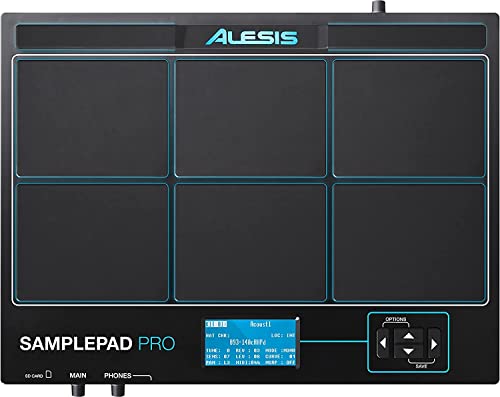
- 8 illuminated velocity-sensitive pads
- 200+ built-in sounds and 10 kits
- SD card support and extra trigger inputs
Best For: Performers needing an expandable pad with custom sample loading
Editor’s Pick

- 16 RGB velocity- and pressure-sensitive MPC pads
- 64 assignable pad banks and 36 assignable controls
- MPC note repeat, swing, full level, and tap tempo
Best For: Portable beat makers who want expressive MPC-style pad control
Most Versatile

- 9 dual-zone velocity-sensitive pads
- 592+ sounds, 30 kits, and custom kit storage
- MIDI I/O, USB MIDI, AUX, looper, and trigger inputs
Best For: Players who want onboard sounds plus broad connectivity
Best Value
Akai MPD218 16-Pad MIDI Controller

- 16 velocity-sensitive MPC pads with three banks
- 48 assignable pads and 18 assignable knobs
- Includes Ableton Live Lite, Drum Synth 500, and MPC Beats
Best For: Users who want a compact, software-ready pad controller
Expressive Performance Pick – Alesis Strike Multipad Electric Drum Pad
If you want electronic percussion controllers that can handle finger drumming, sample triggering, looping, and sample import in one unit, the Alesis Strike Multipad is built for that workflow. Its 9 velocity-sensitive RGB pads, onboard looper, and large color display make it practical for both live performance and fast sound editing.
Best For: Players who want a feature-rich pad controller for expressive live performance and sample-based production.
Pros:
- 9 velocity-sensitive RGB pads support one-shots, melodic parts, and loops.
- Built-in looper can record pad performance or external audio input.
- 32GB of storage includes over 6GB of sounds, loops, drums, percussion, and melodic instruments.
- USB loading, 5 built-in effects processors, and two A-LINK knobs add hands-on control.
Cons:
- May be more controller than you need if you only want basic pad triggering.
- Feature set is geared toward performance and production, so setup can feel involved.
The Strike Multipad stands out as a highly capable all-in-one pad instrument for users who want more than simple drumming pads. If your buying decision centers on versatility and performance tools, it is an easy one to compare near the top of the list.
Compact Production Controller – Native Instruments Maschine Mikro Mk3 Drum Controller
For buyers comparing electronic percussion controllers that lean into software-based production, the Maschine Mikro Mk3 offers a compact, tactile format with deep DAW integration. Its 16 pads support drum, melody, chord, and step-sequencing workflows, making it useful for building beats in a small footprint.
Best For: Producers who want a portable pad controller for software-driven beat making in major DAWs.
Pros:
- 16 pads support drum, Keyboard, Chord, and Step modes.
- Works as a VST, Audio Unit, or AAX plug-in in major DAWs.
- Includes 1.6 GB of factory sounds, kits, patterns, and songs.
- Compact USB-powered design is easy to fit into a small studio setup.
Cons:
- Requires compatible software and system requirements to get full use.
- Smaller hardware format may not suit players who want larger pads or more standalone features.
The Maschine Mikro Mk3 is a strong fit if your priority is tight software integration rather than a standalone percussion box. It is especially compelling for creators who want a portable controller that can cover several beat-making modes from one surface.
Hand Percussion Performance Choice – Roland HPD-20 Digital Hand Percussion Instrument
The Roland HPD-20 is aimed at musicians who want electronic percussion controllers with a hand-played feel and a broad sound set. With 13 silicone pads, 850 ready-to-play sounds, and USB import for custom WAV files, it suits live players and studio users who need expressive percussion options.
Best For: Hand percussion players and electronic performers who want an expressive pad instrument with a large built-in sound library.
Pros:
- 13 silicone pads offer ultra-sensitive velocity response for expressive playing.
- 850 built-in sounds cover percussion, melodic instruments, drums, and electronica tones.
- Import up to 500 WAV sounds via USB flash memory and assign them to pads.
- Includes SuperNATURAL sound engine with multi-effects, ambience, and EQ.
Cons:
- Not as compact as some smaller pad controllers.
- Designed around hand percussion performance, so it may be more specialized than general drum pads.
If you want a more performance-oriented hand percussion instrument than a simple trigger pad, the HPD-20 offers a deep sound library and detailed control. Its strength is expressive playing, especially when you want built-in sounds plus the option to load your own samples.
Sound Library Value Pick – Yamaha DTX Multi Pad Drum Pad
The Yamaha DTX Multi Pad is a straightforward option for shoppers who want electronic percussion controllers with a large sound library and practical sampling features. With more than a thousand drum, percussion, and effect sounds, plus keyboard sounds and user sample memory, it covers a wide range of triggering needs.
Best For: Players who want a versatile pad with lots of preset sounds, loops, and sample storage.
Pros:
- Includes 1,061 drum, percussion, and effect sounds.
- Also provides 216 keyboard sounds for broader musical use.
- Features mute/layer functions plus sequencer and preset loops.
- 64MB flash-ROM supports user samples.
Cons:
- Notes do not list as many performance details as some newer pad controllers.
- Storage is limited compared with higher-capacity sample-focused units.
The DTX Multi Pad is a practical pick if sound variety matters more than elaborate hardware features. It gives you a broad preset palette and user sample support, which makes it useful as an adaptable pad controller for different playing styles.
Portable Performance Pad – PD705 Percussion Sample Multipad
If you want electronic percussion controllers that can move easily between rehearsal, studio, and the stage, the PD705 is built for that kind of flexibility. It combines 9 dual-zone velocity-sensitive pads with a wide sound library, onboard recording, and multiple input options so you can use it as a compact performance hub or a MIDI controller in a larger setup.
Best For: Drummers and producers who want a portable multipad for live playing, looping, and sample expansion.
Pros:
- 9 dual-zone velocity-sensitive pads for expressive playing
- 592 sounds, 30 preset kits, plus 20 user kits
- Recording function for creating and playing back loops
- MIDI In/Out, USB-B, and audio outputs for flexible hookup
Cons:
- Uses an external amplifier for performance use
- Listed as a 6.6-pound unit, so it is portable but not ultralight
The PD705 stands out if you want a controller that can serve both as a percussion pad and a sample-based performance tool. Its expansion inputs, onboard effects, and sample-loading support make it especially useful for players who want more than a basic practice pad.
Compact Starter Module – KTMP1 Electronic Drum and Percussion Pad
The KTMP1 is a practical pick for buyers comparing electronic percussion controllers on a budget. It keeps the layout simple with four velocity-sensitive pads, a compact footprint, and USB/MIDI connectivity, making it a straightforward option for basic drum parts, practice, or trigger-based setups.
Best For: Players who want an affordable, compact percussion pad module with essential connectivity.
Pros:
- Compact and affordable design
- Four velocity-sensitive pads for responsive playing
- 50 drum and percussion sounds built in
- USB/MIDI connectivity plus hi-hat and bass drum trigger inputs
Cons:
- Only four pads, so it is less expansive than larger multipads
- Sound library is modest compared with higher-end options
The KTMP1 is best viewed as a simple, no-frills entry point rather than a feature-heavy performance centerpiece. For players who mainly need a compact electronic percussion controller with basic expansion options, it delivers the essentials without adding complexity.
Feature-Rich Sample Pad – Alesis SamplePad Pro
Among electronic percussion controllers, the SamplePad Pro is the most expansion-friendly option in this group. It gives you 8 isolated rubber pads with LED illumination, built-in sounds and kits, plus extra pad and pedal inputs, so it works well as a live performance pad or a sample-based centerpiece for a drum rig.
Best For: Performers who want a highly expandable pad with built-in sounds and sample-loading support.
Pros:
- 8 isolated rubber pads with blue LED illumination
- 2 additional pad inputs plus kick and hi-hat pedal inputs
- 200+ built-in drum, cymbal, and percussion sounds
- SD card support for loading and saving custom sounds and kits
Cons:
- SD card is not included
- May be more than needed if you only want a basic practice pad
The SamplePad Pro is a strong choice if you want a pad controller that can grow with your setup. With its inputs, sound capacity, and computer connectivity, it suits players who want both performance control and room for custom sample work.
Editor’s Pick – Akai MPD226 16-Pad Controller
If you’re comparing electronic percussion controllers for beat-making, the Akai MPD226 stands out as a compact USB MIDI pad controller built around classic MPC performance features. Its 16 RGB velocity- and pressure-sensitive pads, 64 assignable pad locations, and 36 assignable controls make it a flexible option for producers who want hands-on triggering and tweakable control in the studio or on the go.
Best For: Producers and beat makers who want a portable pad controller with deep assignable control and MPC-style performance tools.
Pros:
- 16 RGB MPC pads that are velocity- and pressure-sensitive
- 64 assignable pad banks plus 36 assignable controls for flexible mapping
- Includes MPC note repeat, MPC swing, 16 level, full level, and tap tempo
- USB connectivity and support for PC, Mac, and iOS devices
Cons:
- Focused on pad control rather than full drum-kit style playing
- No built-in sounds or standalone drum engine listed
The MPD226 is a strong fit if you want expressive pads and production controls in a lightweight controller. It leans toward performance and DAW integration, so it makes the most sense for users who value mapping flexibility and classic MPC workflow.
Most Versatile – LEKATO PD705 Drum Sample Pad
Among electronic percussion controllers, the LEKATO PD705 is aimed at players who want a more drum-set-like pad layout with built-in sounds and expansion options. It offers 9 dual-zone velocity-sensitive pads, 592+ sounds, 30 drum kits, MIDI I/O, USB MIDI, AUX, looper functions, and trigger inputs, making it useful for practice, triggering backing tracks, and integrating with a broader setup.
Best For: Drummers and performers who want a feature-rich sample pad with onboard sounds and lots of connection options.
Pros:
- 9 dual-zone velocity-sensitive pads for a drum-set style layout
- 592+ sounds and 30 drum kits with custom kit storage
- MIDI I/O, USB MIDI, AUX, looper, and trigger inputs for flexible use
- Supports backing track triggering and sample importing with WaveManager software
Cons:
- Heavier than a simple pad controller at 3.17 kg
- More complex than basic pad controllers if you only need simple MIDI triggering
The PD705 makes sense if you want one unit that can cover practice, sample triggering, and MIDI integration. Its onboard sound library and expandability give it a broader role than a typical pad controller, especially for users building a more complete percussion rig.
Best Value – Akai MPD218 16-Pad MIDI Controller
If you want a straightforward option in electronic percussion controllers, the Akai MPD218 focuses on the essentials: 16 thick MPC pads, USB power, and a compact footprint. It expands to 48 assignable pads through three banks and adds 18 assignable potentiometers, plus note repeat and full level controls, giving beat makers and producers a practical way to play drums, samples, and effects.
Best For: Beat makers, producers, and DJs who want a portable MIDI pad controller with strong hands-on control.
Pros:
- 16 velocity-sensitive MPC drum pads with three pad banks
- 48 assignable pads and 18 assignable knobs for flexible control
- Note repeat and full level controls support expressive performance
- Includes Ableton Live Lite, Drum Synth 500, and MPC Beats software
Cons:
- No standalone sounds or internal drum engine listed
- Smaller feature set than the MPD226 for dedicated control depth
The MPD218 is a sensible pick if you want Akai pad feel without moving up to a more control-heavy unit. It is compact, software-friendly, and well suited to users who mainly need responsive pads for DAW work and sample triggering.
How We Picked the Best Electronic Percussion Controllers
We focused on Electronic Percussion Controllers that offer a useful mix of pad feel, trigger response, sound flexibility, connectivity, and real-world usability. Priority went to models that suit drummers, beatmakers, and live performers, rather than niche gear with limited everyday value.
Quick Comparison
In broad terms, multipads are best for players who want onboard sounds, sample triggering, and hands-on performance control. MIDI pad controllers are a better fit for producers working inside a DAW and virtual instruments. Some options sit between those categories, giving you both standalone triggering and studio integration.
Key Buying Factors for Electronic Percussion Controllers
Pad Feel and Sensitivity
Look for velocity-sensitive pads with consistent triggering and enough dynamic range for soft taps and hard accents. Better pad response matters most if you play finger-drumming patterns or expressive fills.
Sound Engine and Sample Management
If you want standalone use, check how easily the unit loads, edits, and organizes samples. More memory, better layering, and clear pad assignment tools make a big difference for live sets.
Connectivity
USB, MIDI out, and audio outputs determine how easily the controller fits into a studio or stage rig. For laptop-based producers, USB MIDI is often enough. For gigging players, physical outputs and reliable external sync can matter more.
Workflow and Controls
Assignable knobs, faders, banks, and transport controls can speed up programming and performance. Simple layouts are helpful if you want quick access; deeper control is better if you build custom kits and sequences.
Portability and Power
Consider whether the unit will live on a desk, mount in a live rig, or travel in a backpack. Smaller controllers are easier to carry, while larger multipads often provide more direct control and better stage usability.
Who Should Buy Which Electronic Percussion Controllers?
Choose a multipad if you want one of the most flexible Electronic Percussion Controllers for triggering samples, backing tracks, or built-in sounds on stage. Choose a pad controller if your main goal is creating beats in software and controlling a DAW efficiently.
Drummers who want a practice or performance companion should prioritize expressive pads, dependable triggering, and standalone sound options. Producers should lean toward models with strong MIDI integration, while live performers should look for hardware that is fast to set up and easy to navigate under pressure.