If you’re looking to enhance your mining or gaming setup, choosing the right PCIe Gen5 risers for your GPUs is essential. These high-performance cables can greatly improve data throughput and overall system efficiency. With various options available, from vertical mounts to different lengths, it’s important to know what to look for. Let’s explore the top contenders that could elevate your setup to the next level.
LINKUP PCIe 5.0 Riser Cable for Vertical GPU Mount

If you’re looking to enhance your gaming setup with a vertical GPU mount, the LINKUP PCIe 5.0 Riser Cable is an excellent choice. This cable, measuring 24cm, supports standard layouts across various cases, including SFF/ITX and open benches. It’s fully backward-compatible with PCIe 4.0 and works seamlessly with next-gen GPUs like the RTX 5090. With its premium shielding, it delivers impressive performance of 128GB/s while minimizing crosstalk. Plus, the vertical mount promotes better cooling and a sleek look. Installation is straightforward, and you’ll enjoy responsive customer support and a reliable warranty for peace of mind.
Best For: Gamers and PC builders looking to enhance their setup with a high-performance vertical GPU mount.
Pros:
- Fully backward-compatible with PCIe 4.0 and compatible with next-gen GPUs like RTX 5090.
- Delivers full 128GB/s performance with premium shielding to minimize crosstalk and EMI.
- Vertical mounting improves cooling efficiency and aesthetic appeal in various case layouts.
Cons:
- May require precise measurements and additional support brackets for optimal installation.
- Not suitable for standard horizontal GPU setups, limiting versatility in some builds.
- Contacting support for guidance on tight fits may be necessary, adding potential installation complexity.
PCIe 5.0 Riser Cable for GPUs
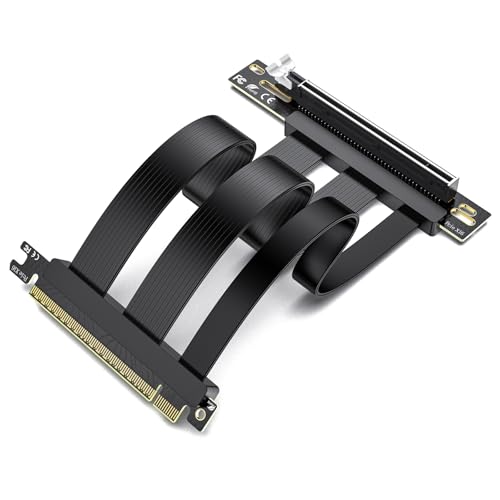
For gamers and content creators seeking unparalleled performance, the PCIe 5.0 Riser Cable for GPUs stands out as an essential upgrade. Designed for high-bandwidth Gen5 signal integrity, it’s compatible with top models like the RTX5090(ti) and RX7900. Its 90-degree right angle allows for vertical GPU mounting, optimizing your setup. With lossless performance and robust EMI shielding, you’ll experience stability during intense workloads. The flexible PVC sheath guarantees easy installation without creasing, while the gold-plated connectors maintain fast transmission rates. This high-quality riser cable delivers 78W power, preventing crashes and guaranteeing your system runs smoothly under pressure.
Best For: Gamers and content creators looking for high-bandwidth performance and stability in their GPU setups.
Pros:
- Lossless PCIe 5.0 performance ensures reliability during demanding tasks.
- Flexible PVC outer sheath allows for easy installation and cable management.
- Gold-plated connectors enhance transmission rates and signal stability.
Cons:
- May not be compatible with older GPU models.
- The 90-degree angle design might limit installation options in certain cases.
- Higher price point compared to standard riser cables.
PCIe 5.0 X16 Riser Cable for GPU Extension (15cm)

The PCIe 5.0 X16 Riser Cable for GPU Extension (15cm) is an excellent choice for gamers and professionals looking to enhance their setup without compromising compatibility. This cable supports Nvidia, AMD, Intel, and various GPUs, guaranteeing seamless integration with your system. Its dual reverse and straight design allows flexibility, making it ideal for compact ITX A4 cases. Built with 3M low-loss Twinax ribbon cable and aluminum shielding, it guarantees durability and minimal signal loss. Just remember to check the installation hole size, as the female end protection cover may conflict with some fans. Enjoy enhanced performance without the hassle!
Best For: Gamers and professionals seeking a high-performance GPU extension cable that offers compatibility with various graphics cards and compact ITX cases.
Pros:
- Excellent compatibility with Nvidia, AMD, Intel, and other gaming and professional GPUs.
- Durable construction with 3M low-loss Twinax ribbon cable and aluminum shielding for minimal signal loss.
- Flexible dual reverse and straight design suitable for compact ITX A4 cases.
Cons:
- Female end protection cover may be larger than other PCIe cables, potentially causing conflicts with fans.
- Limited length of 15cm may not suit all setups or configurations.
- Installation requires checking hole size and position for compatibility with specific PC cases.
EZDIY-FAB PCIe 5.0 X16 Riser Cable for RTX and RX GPUs

Designed specifically for high-performance RTX 50/40 and RX 9000/7000 GPUs, the EZDIY-FAB PCIe 5.0 X16 Riser Cable stands out with its impressive 128GB/s bandwidth. It offers optimized data transfer rates, delivering 64GB/s unidirectional and 128GB/s bidirectional performance. The 6-layer PCB design minimizes crosstalk and EMI, reducing data errors that can lead to crashes. You’ll appreciate the ultra-flex TPE jacket, which easily bends without kinking, perfect for tight ITX builds. With reinforced metal slots and precision copper contacts, you can trust stable connections, available in 200mm and 300mm lengths for versatile vertical GPU setups.
Best For: Gamers and PC builders seeking high-performance, reliable GPU connections in compact setups.
Pros:
- Optimized 128GB/s bidirectional bandwidth for maximum data transfer rates.
- Durable 6-layer PCB design minimizes crosstalk and EMI, ensuring stable performance.
- Ultra-flex TPE jacket allows for easy bending in tight spaces without kinking.
Cons:
- Limited to specific GPU models (RTX 50/40 and RX 9000/7000), potentially excluding other brands.
- May require additional space for installation in very compact builds.
- Higher price point compared to standard riser cables without PCIe 5.0 support.
EZDIY-FAB PCIe 5.0 X16 Riser Cable for RTX and RX GPUs

If you’re aiming to elevate your gaming or workstation setup with the latest GPUs, the EZDIY-FAB PCIe 5.0 X16 Riser Cable is an excellent choice. This riser cable supports RTX 50-series and RX 9000 GPUs, delivering up to 64 GB/s unidirectional and 128 GB/s bidirectional bandwidth. Its 6-layer PCB and individually wrapped high-speed lanes minimize crosstalk, ensuring stable performance. With ultra-flex TPE construction, you can easily bend the cable for compact ITX builds. Available in 200mm and 300mm lengths, it offers connector options for versatile installation, enhancing both aesthetics and functionality in your setup.
Best For: Users looking to enhance their gaming or workstation setups with high-performance GPUs while maintaining a clean and efficient design.
Pros:
- Supports the latest RTX 50-series and RX 9000 GPUs with high bandwidth capabilities.
- Features a durable design with reinforced metal slots and precision copper contacts for stable connections.
- Flexible cable construction allows for easy installation in compact spaces, accommodating various setups.
Cons:
- May be overkill for users with older GPUs that do not require PCIe 5.0 speeds.
- Limited length options (200mm and 300mm) may not suit all build requirements.
- Vertical GPU mounting may require additional case modifications for optimal aesthetics.
PCIe X16 GEN5 Right Angle Riser Cable with GPU Vertical Mount Bracket

For gamers and professionals looking to enhance their GPU setup, the PCIe X16 GEN5 Right Angle Riser Cable with GPU Vertical Mount Bracket stands out with its excellent compatibility across multiple generations, including PCIe 4.0 and 5.0. This 20CM riser supports Nvidia, AMD, and Intel GPUs, ensuring no need to lower generation speed in your BIOS. Featuring a low loss Twinax ribbon cable and an aluminum shielded design, it provides reliability and flexibility. With a strong L-shaped steel bracket, it securely holds large GPUs like the RTX4090 and RX7900XT, making it an ideal choice for any advanced gaming or mining rig.
Best For: Gamers and professionals seeking a reliable and flexible GPU mounting solution for advanced gaming or mining rigs.
Pros:
- Excellent compatibility with multiple generations of GPUs, including Nvidia, AMD, and Intel.
- Low loss Twinax ribbon cable ensures high performance and reliability during data transmission.
- Strong L-shaped steel bracket provides secure support for large GPUs, enhancing stability in vertical setups.
Cons:
- Requires at least 6 slots space for vertical mounting, which may limit options for some PC cases.
- Users may need to modify cases with ribs to ensure proper cable access, potentially complicating installation.
- Recommended for water-cooled systems, which may not appeal to users with air-cooled setups.
JMT 180 Degree Graphics Card Extension Cable (50CM)

The JMT 180 Degree Graphics Card Extension Cable (50CM) stands out for gamers and content creators seeking flexible GPU placement without sacrificing performance. With a bidirectional bandwidth of 64GB/S and backward compatibility with PCIe 4.0 and 3.0, this cable is perfect for various cards, including GPUs and sound capture devices. Its 12mm diameter and high-quality materials, like Teflon insulation and gold-plated connectors, guarantee reliability. Installation is simple, allowing you to replace direct motherboard connections with ease. Plus, rigorous quality assurance processes assure you’ll get a product that meets your high-performance needs for gaming or mining setups.
Best For: Gamers and content creators seeking flexible GPU placement without compromising performance.
Pros:
- High bidirectional bandwidth of 64GB/S ensures optimal performance for various applications.
- Backward compatibility with PCIe 4.0 and 3.0 allows for versatile use with older hardware.
- Quality materials such as gold-plated connectors and Teflon insulation guarantee durability and reliability.
Cons:
- Not compatible with server motherboards using PRSNT signals, limiting its use in certain systems.
- Installation might require additional space and consideration for cable management.
- 50CM length may not be suitable for all setups, depending on the case configuration.
PCIE 5.0 Riser Cables for RTX5090 RX9070 GPU

Designed specifically for gamers and content creators using the latest RTX 50-series and RX 9000 GPUs, PCIe 5.0 riser cables deliver exceptional performance and reliability. With a bandwidth of up to 63.02 GB/s in an x16 configuration, these risers double the speed of PCIe 4.0. The 29 AWG wires and 6-layer board structure optimize power supply and heat dissipation. Plus, the EMI Shielding Armor enhances signal stability, minimizing annoying black screens. You’ll appreciate the curved layout that improves pin durability and the expanded contact area for better connection quality. Enjoy maximum durability and efficient transmission with these top-tier riser cables.
Best For: Gamers and content creators seeking high-performance connectivity for RTX 50-series and RX 9000 GPUs.
Pros:
- Exceptional bandwidth of up to 63.02 GB/s, doubling PCIe 4.0 speeds.
- Enhanced signal stability and reduced black screen issues due to EMI Shielding Armor.
- Optimized construction with 29 AWG wires and a 6-layer board for improved power supply and heat dissipation.
Cons:
- May be overkill for users with older GPU models or less demanding applications.
- Higher cost compared to standard riser cables.
- Installation can be tricky for novice builders due to cable rigidity.
SSUPD PCIe 5.0 x16 Riser Cable (200 mm)

SSUPD’s PCIe 5.0 x16 Riser Cable (200 mm) stands out with its impressive transmission speed of 32 GT/s, making it an ideal choice for gamers and professionals seeking to maximize GPU performance. With a bandwidth of 64 GB/s, it supports both NVIDIA RTX 5090/5080 and AMD Radeon RX 9070 XT(X) models, ensuring compatibility across generations. Its precision-folded architecture maintains signal integrity, while the ultra-flexible design simplifies installation, fitting perfectly in tight spaces. Plus, it neatly routes behind motherboards, balancing aesthetics and functionality for any chassis. Whether you’re upgrading or building, this riser cable is a reliable choice.
Best For: Gamers and professionals looking to enhance GPU performance with reliable and high-speed connectivity.
Pros:
- High Transmission Speed: Achieves up to 32 GT/s, ensuring optimal performance for demanding applications.
- Excellent Compatibility: Works seamlessly with both NVIDIA and AMD graphics cards, supporting backward compatibility with Gen4 devices.
- Flexible Design: The ultra-flexible flat cable allows for easy installation in tight spaces, making it perfect for mini-ITX builds.
Cons:
- Length Limitation: At 200 mm, it may not suit all setups, especially larger cases requiring longer cables.
- Potential Cost: Higher performance may come at a premium price compared to standard riser cables.
- Installation Complexity: Some users may find installation challenging without proper cable management experience.
PCIe X16 GEN5 Riser Cable with Vertical Mount Bracket for RTX5090
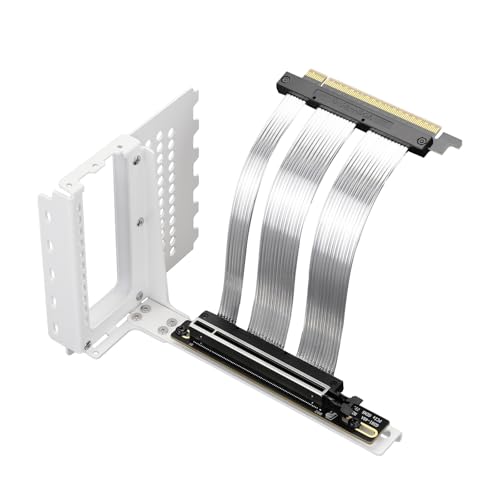
If you’re looking to future-proof your GPU setup, the PCIe X16 GEN5 Riser Cable with Vertical Mount Bracket for the RTX 5090 is an excellent choice. This 1.2-meter cable guarantees peak GEN5 data transmission and works seamlessly with Nvidia, AMD, and Intel GPUs without needing BIOS adjustments. Its durable construction features a low loss Twinax ribbon cable and an L-shaped steel bracket for enhanced support, accommodating hefty GPUs like the RTX 4090. Just make sure you’ve got at least six slots for installation. For best performance, consider pairing it with a water-cooled radiator to avoid air-cooling conflicts.
Best For: Gamers and PC builders looking to upgrade to PCIe 5.0 technology while ensuring compatibility with a range of GPUs.
Pros:
- Supports multiple GPU brands without BIOS adjustments, making installation hassle-free.
- Durable construction with low-loss Twinax ribbon cable and robust L-shaped steel bracket for added support.
- Future-proof design compatible with upcoming GPU models like the RTX 5090.
Cons:
- Requires a minimum of six slots for installation, which may limit compatibility with some cases.
- Recommended use with water-cooling systems, potentially increasing overall setup complexity.
- Customer rating of 3.5 out of 5 stars suggests mixed user experiences.
Factors to Consider When Choosing PCIe Gen5 Risers for GPUs
When you’re picking PCIe Gen5 risers for your GPU, several factors come into play. You’ll want to guarantee compatibility with your GPU model, look at bandwidth performance, and consider cable length. Don’t forget to assess shielding for signal integrity and how easy it is to install.
Compatibility With GPU Models
Choosing the right PCIe Gen5 riser for your GPU isn’t just about performance; compatibility with your specific model, like the RTX 5090 or RX 9000 series, plays a significant role. First, make sure the riser cable matches your GPU’s requirements, as this optimizes performance. Look for backward compatibility with earlier PCIe generations, such as 4.0 or 3.0, to seamlessly integrate older hardware. Full x16 bandwidth support is essential for high-end GPUs that demand higher throughput. Additionally, confirm the connector type and orientation—vertical or right-angle—to fit your case layout. Finally, verify the cable length so it fits your setup without excessive bending, which can compromise signal integrity. This way, you’ll achieve the best results for your mining and gaming endeavors.
Bandwidth and Performance Metrics
While selecting PCIe Gen5 risers, understanding bandwidth and performance metrics is essential for maximizing your GPU’s potential. These risers deliver up to 128 GB/s bidirectional bandwidth, doubling PCIe 4.0 speeds and enhancing data transfer rates for high-performance GPUs. You’ll find that bandwidth performance can vary based on the configuration, with x16 connections providing the highest data throughput. Additionally, the use of low-loss materials and advanced shielding techniques minimizes electromagnetic interference (EMI), ensuring stability during intensive workloads. Multi-layer PCB designs enhance signal integrity, reducing crosstalk and maintaining stable connections even under heavy loads. Plus, their backward compatibility allows for versatile integration into existing systems while maximizing future upgrade potential. Choose wisely to release your GPU’s full capabilities!
Cable Length and Flexibility
Selecting the right cable length and flexibility for your PCIe Gen5 risers can greatly impact your GPU setup. Riser cables typically range from 15cm to 1.2 meters, so measure the distance from your motherboard slot to the GPU PCB to guarantee a proper fit. Flexibility is also key; look for designs with ultra-flex TPE jackets or PVC sheaths that allow for sharp bends without kinks. This adaptability is vital for fitting into compact cases or tight spaces. Additionally, precision-folded architecture helps maintain signal integrity by avoiding stress points. A well-chosen riser can enhance your cable management system, improving airflow and aesthetics in your build while ensuring peak performance.
Shielding and Signal Integrity
When it comes to PCIe Gen5 risers, understanding shielding and signal integrity is essential for achieving peak GPU performance. High-quality risers minimize electromagnetic interference (EMI) and crosstalk, ensuring stable signal integrity during demanding tasks. Look for risers with multilayer shielding and advanced designs, like full-lane shielding, which enhance data transfer rates and prevent issues such as black screens or crashes. Using low-loss materials, like 3M Twinax ribbon cable, helps maintain signal quality over longer distances. Proper impedance tuning in PCIe cables preserves clean eye margins, reducing data errors and boosting system reliability. A well-designed riser cable should deliver full bandwidth capabilities, such as 128GB/s bidirectional, to leverage the performance of next-gen GPUs without any signal degradation.
Installation Ease and Requirements
Choosing the right PCIe Gen5 riser for your GPU involves several critical factors to guarantee a smooth installation. First, measure the distance from the motherboard slot to the GPU PCB to verify the cable length is appropriate. Make sure connectors are fully seated and latched; loose connections can lead to performance issues or crashes. Consider space requirements, as some risers need a minimum of six PCIe slots for vertical mounts. Be mindful of potential conflicts with other components like fans or radiators, and think about using a water-cooled system to manage heat. Finally, always follow the installation instructions included with the riser cable, especially in tight ITX cases where space is at a premium.
Aesthetic Considerations and Design
After ensuring a smooth installation, the next step is to contemplate how your PCIe Gen5 risers contribute to the overall aesthetic of your build. Vertical GPU mounting not only showcases your graphics card but also enhances airflow, creating a clean, gallery-style look. Look for riser cables that offer flexible, foldable designs for efficient cable management, keeping your setup tidy. Premium shielding materials minimize electromagnetic interference, helping your rig look organized by reducing clutter. Consider cable colors and styles that complement your build’s theme, adding a personalized touch. Finally, choose risers with reinforced connectors and high-quality materials for a sleek, professional appearance while ensuring reliability in performance.
Durability and Build Quality
Durability is a essential factor in selecting PCIe Gen5 risers for your GPU setup. Look for riser cables made from high-quality materials, like 6-layer PCBs and low-loss Twinax ribbon cables, to guarantee peak signal integrity. EMI shielding is significant; it minimizes interference, preventing black screens and data loss during demanding tasks. A robust outer sheath, like ultra-flex TPE or PVC, enhances durability and allows for sharp bends without kinking. Make certain the connectors have gold plating to boost conductivity and reduce unstable connections. Don’t overlook the cable’s retention force and pin durability; these features guarantee a secure fit under heavy GPU loads, keeping your setup reliable and performing at its best.
Price and Value Comparison
When evaluating PCIe Gen5 risers for GPUs, price and value are critical factors that can greatly influence your decision. Prices typically range from $20 to over $50, depending on features like shielding quality and length. Higher-priced options often offer advanced EMI shielding and premium materials, enhancing signal integrity during demanding tasks. You should assess the value by considering bandwidth capabilities; Gen5 risers support up to 128GB/s, doubling the speed of PCIe 4.0. Don’t overlook warranty and customer support, as some risers come with direct exchange guarantees. Finally, think about long-term benefits such as improved thermal management and aesthetics, which can justify a higher upfront cost and enhance your overall setup.